


 SHARE:
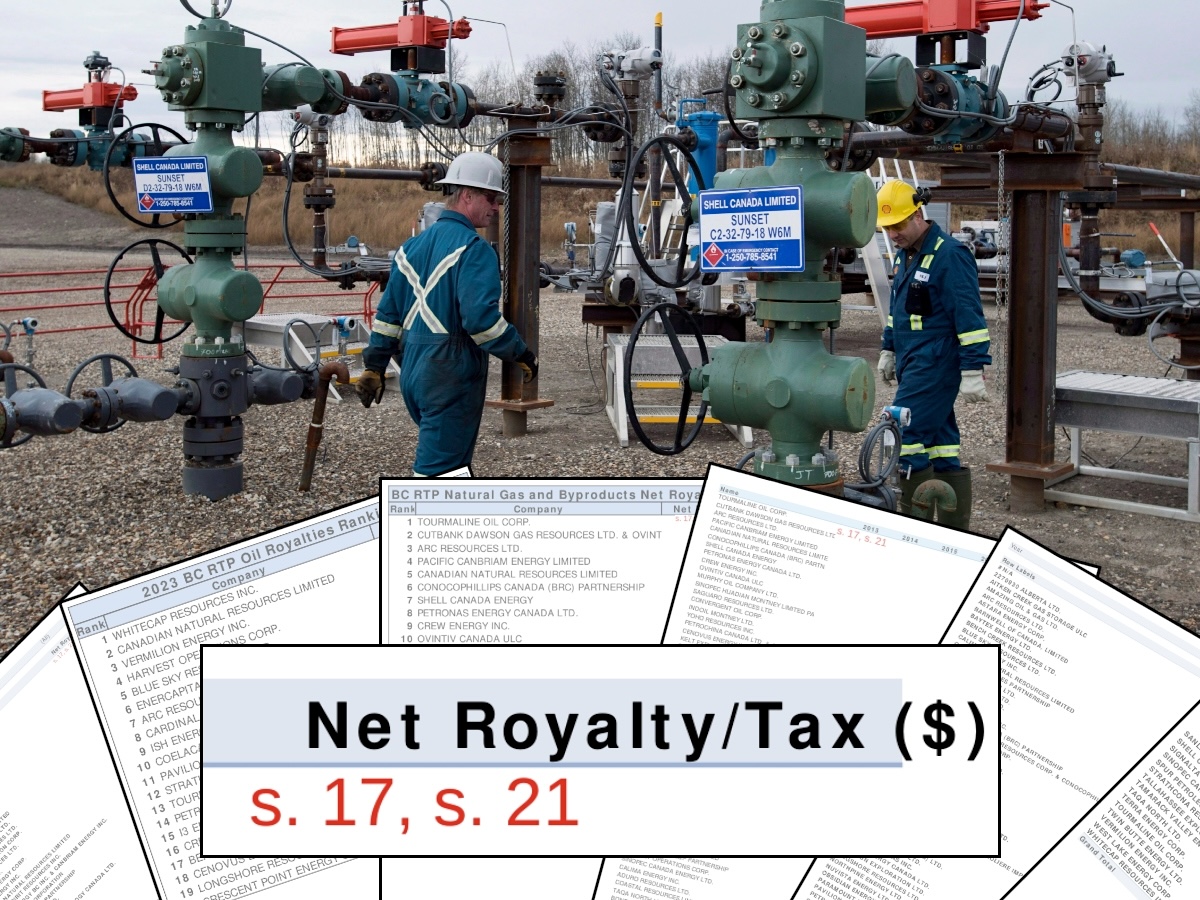
The provincial government has decided that British Columbians are not entitled to know how much fossil fuel companies pay in royalties for the publicly owned oil and gas they extract from the ground.
The province had previously released the information in response to two formal freedom of information requests. But less than a year after making those disclosures, the NDP government changed the law so that company-specific royalty payments would be shielded from public view.
The province says it made the change to “improve confidentiality” for Shell, ARC, Petronas, Ovintiv and a handful of other companies operating in B.C.’s fossil-fuel-rich Peace River region.
Those companies have dramatically increased drilling of methane gas and condensate in recent years, with much of the gas destined for a massive liquefaction and export facility in Kitimat and much of the condensate heading to Alberta, where the province’s heavy oil producers use it to dilute their product and pipe it to refineries in the southern United States or to the Port of Vancouver for loading onto ocean tankers.
But as drilling has ramped up, royalty revenues have plummeted by hundreds of millions of dollars, leading to questions about whether the public is getting a fair return for its resources. It was also recently revealed that the government badly overestimated the royalty revenues the public will receive from the oil and gas industry, leading to further criticism of Premier David Eby and the NDP.
The Tyee became aware of the new restrictions on royalty disclosures after filing a freedom of information request late last year asking for a 10-year breakdown of royalty payments by companies producing methane gas and light oils.
When the reply eventually came back, 30 pages of a 50-page response were largely blank, with long lists of dollar figures redacted and only company names remaining. The other 20 pages were a smattering of government emails in which royalties were mentioned or select slides from Ministry of Energy PowerPoint presentations showing the production figures of select companies and aggregate “taxes” paid.
Rob Botterell, the Green Party MLA for Saanich North and the Islands, was the lead person tasked with drafting B.C.’s freedom of information legislation in the early 1990s. In a conversation with The Tyee, he called the government’s response disturbing.
Botterell noted that British Columbians can access a government database that discloses the stumpage fees individual logging companies pay for the trees they cut down on public lands. But no similar data exists for oil and gas companies.
“I’m scratching my head trying to think of what the public policy reason is that on the one hand you would disclose stumpage and on the other hand you would not disclose information about royalties,” Botterell said.
By picking and choosing what information it chooses to release and what information it does not, Botterell said, the government fuels public distrust.
“When you don’t have a good reason, can’t explain why you’re not releasing it, of course that reduces trust in government,” Botterell said. “The assumption of lots of folks is... you must be hiding something.”
The province had previously released the information. In 2022, the Ministry of Finance provided three years of data to the Canadian Centre for Policy Alternatives, or CCPA, listing individual fossil fuel companies and what each company paid in royalties.
The release capped a lengthy dispute during which provincial finance officials initially refused to divulge the numbers. In an attempt to compel their release, the CCPA formally appealed to the Office of the Information and Privacy Commissioner. The government finally released the figures in May 2022, nearly three years after the appeal was filed and just before a hearing was to commence in which the government would have had to argue its reasons for withholding the documents.
The government subsequently released another two years of data but insisted before its release that the CCPA file another freedom of information request. The CCPA did so only after receiving assurance that the Finance Ministry would not delay the information’s disclosure. It took just one month for the government to provide the second batch of numbers.
But less than a year later, the government introduced amendments to legislation that allowed governments to avoid releasing such information in the future.
In March 2023, then-finance minister Katrine Conroy rose in the legislature to introduce second reading of the Budget Measures Implementation Act, Bill 10.
Included in Bill 10 was language to amend “numerous tax and revenue statutes to improve confidentiality,” including company-specific information on royalty payments.
In an email, a Finance Ministry spokesperson wrote that the “confidentiality provisions were originally introduced in 2018 and later updated in 2023 as part of broader efforts to harmonize confidentiality protections across B.C.'s tax and revenue statutes.”
The spokesperson added that this included changes to the Petroleum and Natural Gas Act that now “prohibits the disclosure of specific tax and royalty information.”
Asked why logging stumpage fees remain a matter of public record, but not the royalties that oil and gas companies pay, the spokesperson wrote:
“Different resource sectors operate under different legislative and administrative frameworks. The disclosure requirements that apply to forestry... are separate from the confidentiality provisions that govern tax and revenue information under the Petroleum and Natural Gas Act.”
In a followup email, the Finance Ministry said the province is also moving to a new method of calculating royalty rates, one that looks at “actual producer costs” before setting what fees individual companies will pay. “This information is particularly commercially sensitive,” the ministry said. “Releasing it could reveal business information that could provide competitors with an advantage.”
Botterell said he found the chain of events that began with the government reluctantly releasing information, only to then rewrite the disclosure rules, to be “unbelievable.”
He said one of the driving forces behind the original freedom of information legislation was the idea that once government decides to release certain information, that information should be disclosed as a matter of course.
“The access to information process itself is time-consuming and costly,” Botterell noted. “Why wouldn’t you, having released the information once and seen that there is a lot of interest in it, just make it available routinely?”
Botterell said the decision to deny the release of royalty figures is part of a suite of disturbing changes that are all aligning to clamp down on public access to information.
Those changes include the government’s decision in 2022 to charge $10 fees for each information request they file; a decision this spring to allow public bodies to avoid responding to information requests if they declare doing so would “unreasonably interfere” with their operations; and the decision last month to deny all members of the public, save government employees, access to the government directory, which lists the names, job titles, phone numbers and email addresses of civil servants.
All of the changes point to “a government determined not to release information,” Botterell said. ![[Tyee]](/design-article.thetyee.ca/ui/img/yellowblob.png)
Read more: Energy, BC Politics








Tyee Commenting Guidelines
Please note that email notifications for replies are not currently working due to a software issue which may be resolved in a future update.
Comments that violate guidelines risk being deleted, and violations may result in a temporary or permanent user ban. Maintain the spirit of good conversation to stay in the discussion and be patient with moderators. Comments are reviewed regularly but not in real time.
Do:
Do not: