


 SHARE:
[Editor’s note: This story includes a photo of a fish in distress that may be unsettling to some.]
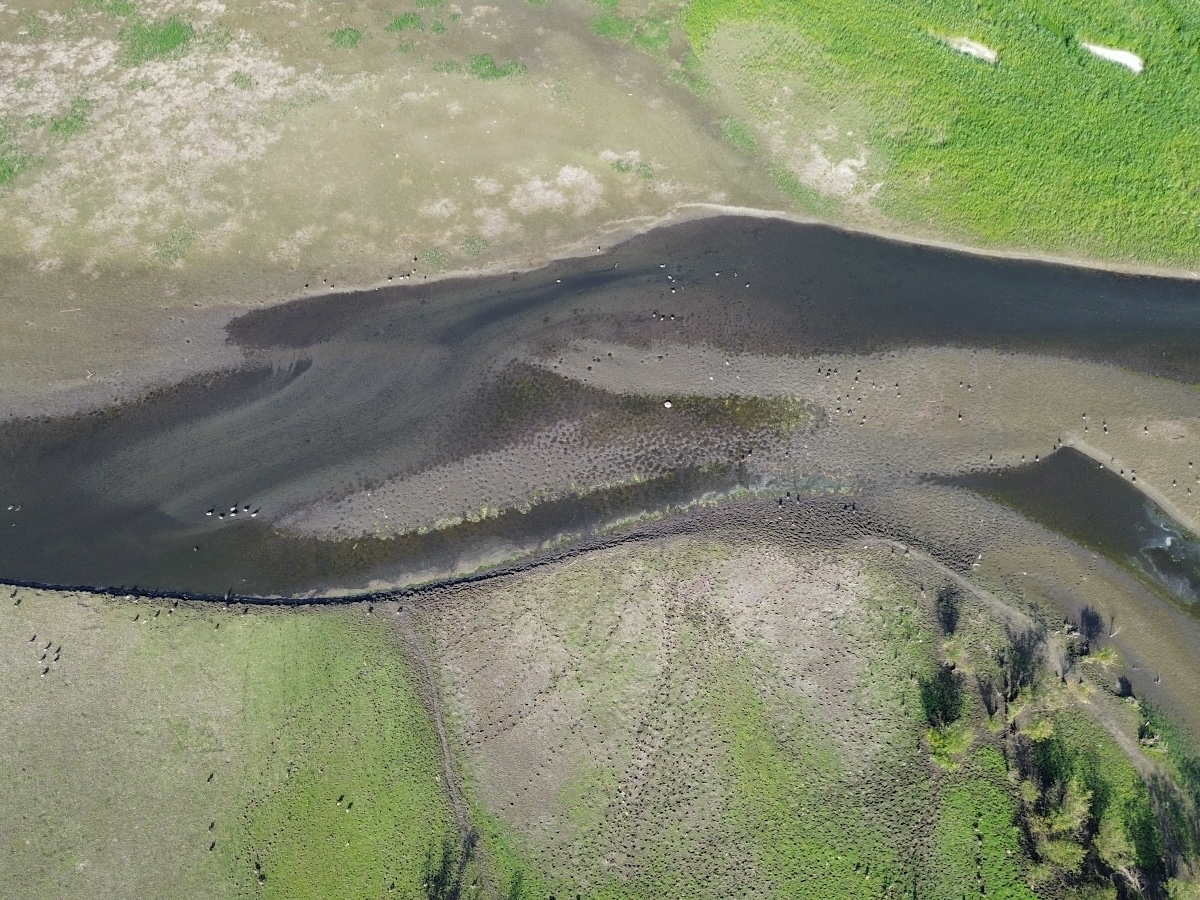
In the Shuswap, chinook salmon circle a small pool, preparing for the next leg of their journey up the Salmon River to spawn.
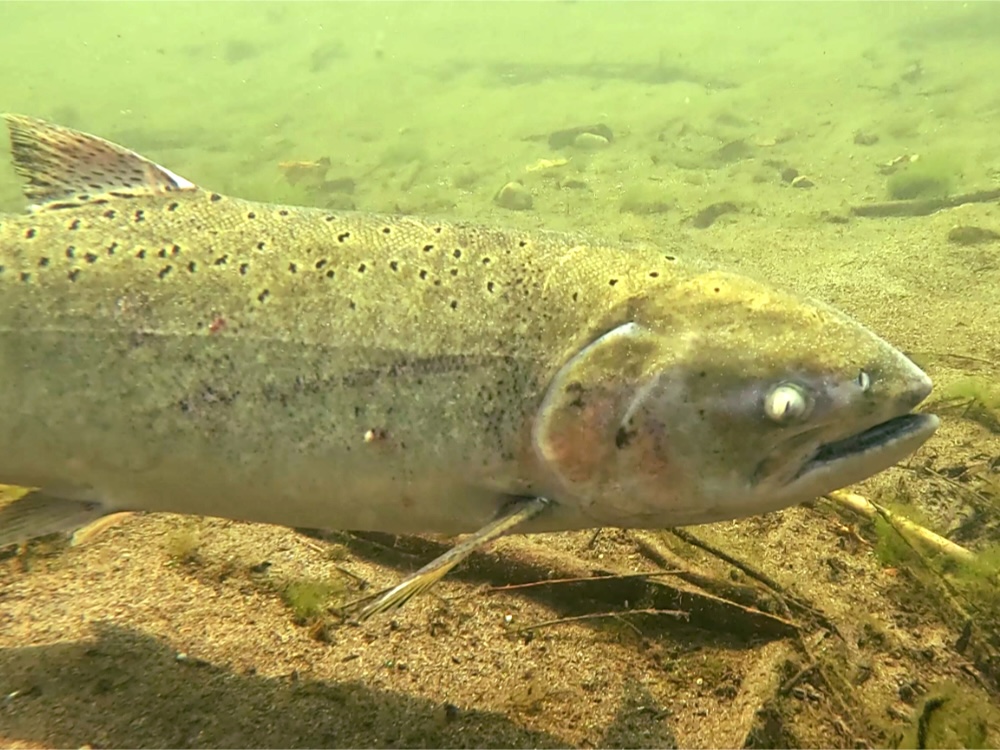
But this year, something is different: the salmon’s eyes have gone cloudy; some have fallen out entirely. The river they depend on has caused them to go blind.
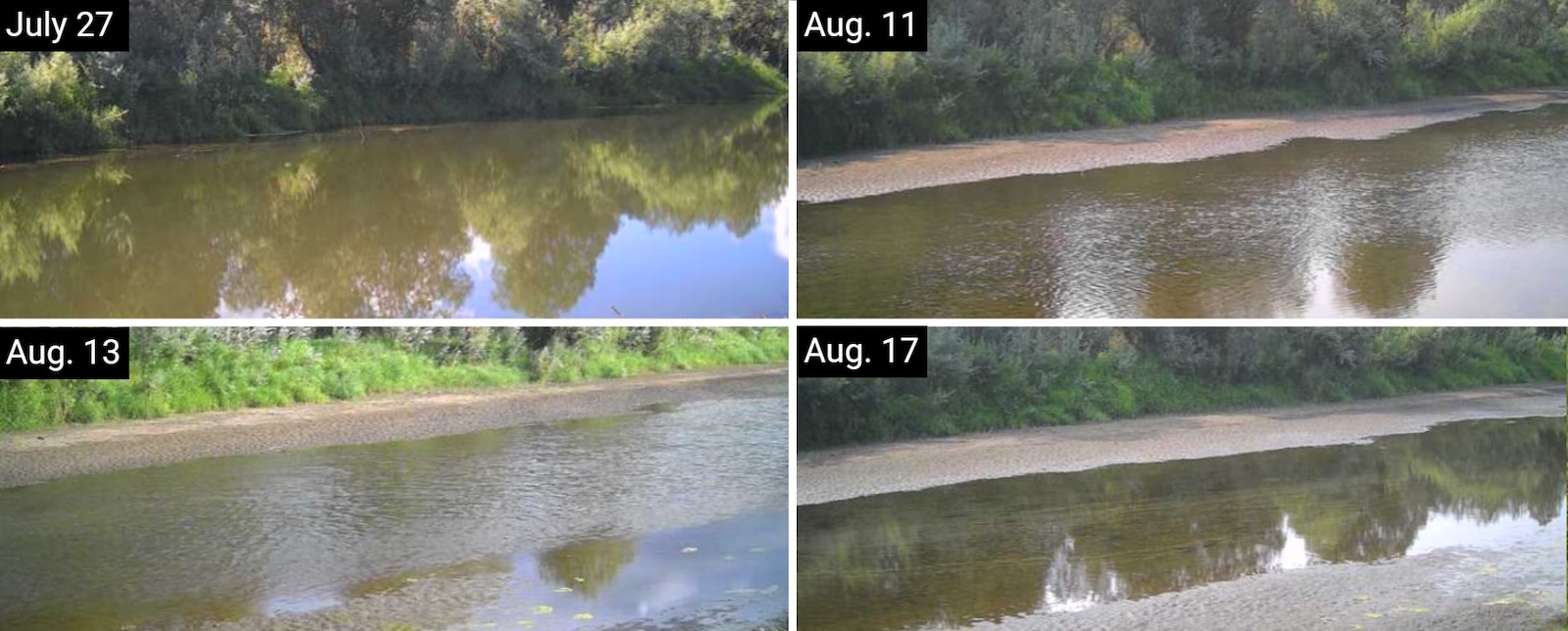
For salmon, living conditions in the river are among the worst they’ve ever been. What was once a wide, cool waterway is now a thin, warm channel. Water can become a death trap, causing the fish to suffocate and sometimes lose vision. Blinded salmon are unlikely to live long enough to spawn.
In July, the province issued a protection order to limit irrigation throughout the region in the hope of reducing the destruction now underway. The order was rescinded less than two weeks later, with officials citing the interests of industrial water users intent on irrigating their crops as wildfires loomed. The order was then reissued on Aug. 19, after hundreds of chinook had arrived in the watershed.
Whether this year’s returning salmon will survive remains unclear.
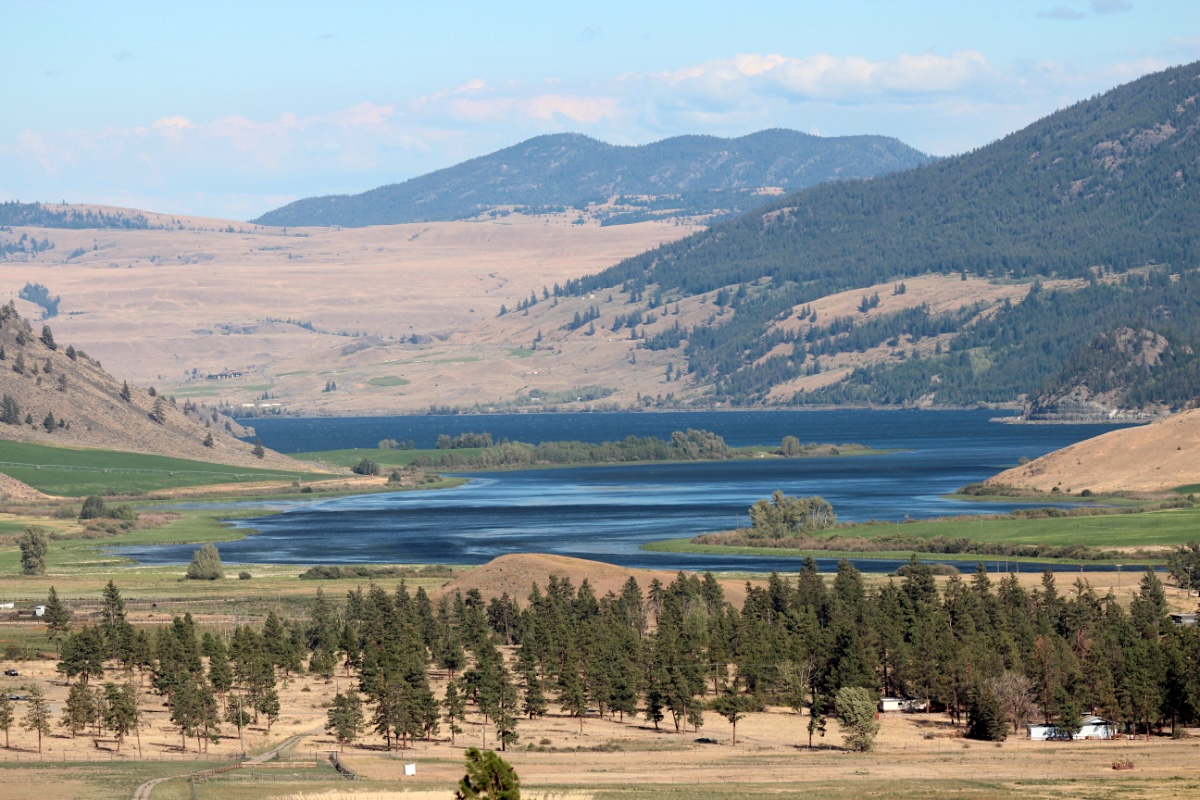
Winding its way from the plateaus west of Okanagan Lake northeast to Shuswap Lake, the Salmon River is surrounded by intensive water users, including large ranches and farms. In recent years historically low levels of snowpack and precipitation have compounded those pressures, leading to unprecedented levels of water scarcity.
Orders restricting access to the Salmon River’s water have become an almost yearly occurrence as the region faces consecutive years of extreme drought. But this year’s first order came with an ominous distinction: stream flows were far lower than in any year previous, and the order came weeks earlier into the dry season.
Encoded in B.C.’s system of water laws, an emergency order is meant to be a last-ditch lever that authorities can pull when fish survival is at imminent risk. But in several watersheds they are now being used on a regular basis as the province faces ongoing drought.
Rosie Simms, director of place-based projects at the POLIS Water Sustainability Project at the University of Victoria, said the repeated use of orders is a sign that things need to change.
“We can’t be trying to fix drought in an emergency,” Simms told The Tyee. She recently co-authored a report that documented patterns of prolonged drought across the province and called for a preventive approach to managing water in an era of increasing water scarcity.
“There’s a whole suite of things that would set us British Columbian communities up to be in a much better place to weather droughts and actually live well in drier conditions,” she said.
In an email, a spokesperson for the Ministry of Water, Land and Resource Stewardship wrote that “government has made preparing for drought conditions and responding to water scarcity a top priority, to safeguard the well-being of communities, businesses, ecosystems and wildlife.” They added that “the province is also working with partners on long-term, proactive solutions to improve water security in drought-prone watersheds.”
The water crisis in the southern Interior was anticipated long before the chinook began their journey upstream. In May, the Syilx Okanagan Nation Alliance declared a “watershed emergency” across rivers throughout the region, including the Salmon and Bessette watersheds.
The alliance of six Okanagan First Nations called for actions such as mandatory reductions in water use to protect fish flows and a co-governance forum between the Syilx and the province to address water scarcity.
“Water is life, and the health of our watersheds can no longer be treated as secondary to development and short-term interests,” Westbank First Nation Chief Robert Louie said in a press release at the time.
The abundance myth
With vast hydro power reservoirs across the province and nicknames like the “Wet Coast,” B.C.’s brand is often linked to images of water abundance.
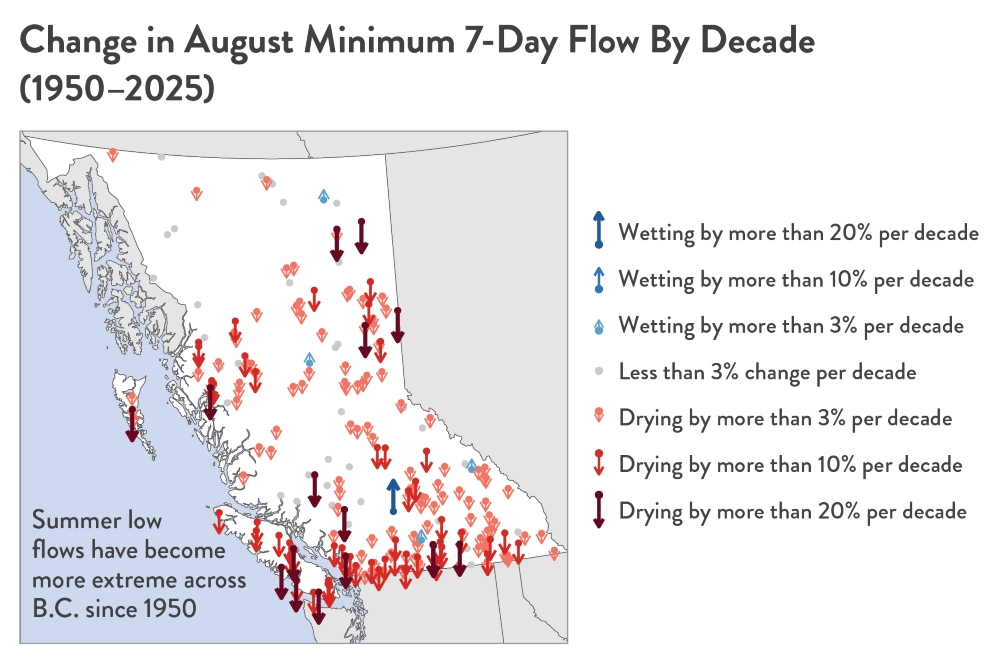
But in many regions, drought conditions are becoming a new norm.
The provincial government defines drought as a “naturally occurring period of abnormally dry conditions” that may lead to situations where there’s not enough water to meet human and ecological needs — a state it describes as “water scarcity.”
In their study, Simms and her colleagues reported that over the last decade, at least one watershed in the province has reached extreme drought levels every year.
In 2023, 85 per cent of B.C.’s water basins were afflicted by the most severe drought levels. Their report points to modelling predicting more 2023-like years as the climate warms.
Drought’s footprint is also growing across the province, reaching places that haven’t experienced it before. When drought arrives, it now tends to start earlier and last longer.
Excessively dry conditions in some parts of the province continue into December, upping the risk of run-on droughts, where one year’s deficit becomes the next year’s baseline.
“We've been tracking drought in the Okanagan for the last four years, and each year they get potentially consecutively worse,” Nelson Jatel, water stewardship director for the Okanagan Basin Water Board, told The Tyee.
The Okanagan has historically counted on snowmelt to fill the mountaintop reservoirs that supply its communities, farms and fish with water throughout the dry summer.
“If you don’t have the snow in the winter months, the reservoirs don’t fill, or they only partially fill,” Jatel said.
Low snowpack levels are often exacerbated by hotter springs and summers that melt snow faster and earlier than before and leave the ground drier than in places where the melt is slower and more measured.
Glaciers provide cold water to many B.C. watersheds, but they too are losing their charge: a recent study found that between 2021 and 2024, glaciers in Western Canada, the United States and Switzerland had shrunk at six times the rate of the previous decade. As the climate warms, the decline will only accelerate.
Simms said the government’s drought response hasn’t adjusted to the new reality.
"We have this water management regime in B.C. that was built for a different climate," she said. “We're still acting like we’re not actually in an era of limits where drought is just a temporary summer problem.”
B.C.’s continued reliance on emergency orders to respond to drought is a symptom of that problem, Simms said. Though she sees emergency orders as an important tool, she said they’re not equipped to address a systemic problem known by climate science to be getting worse.
“They’re not getting at the underlying problems of overallocation or degraded watersheds.”
BC Wildlife Federation executive director Jesse Zeman described the underlying problems as an issue of supply and demand. To avoid emergency response, people can try to reduce water use (demand), and they can work to increase the amount of water available to the ecosystem (supply).
Zeman and POLIS’s reports argue the province has fallen behind on both counts.
Shaping water demand
At the provincial level, water management in B.C. is akin to an open spigot — the province doesn’t limit water use proactively. Instead, it curtails use only in some extreme drought conditions, such as those found in the Salmon and Bessette watersheds this year.
Local governments sometimes pick up the slack, issuing restrictions according to drought levels. But their powers are limited: they can target the withdrawals only within their boundaries and on their water systems. That tends to leave out major water users like some farms, ranches and industrial sites such as mines and gas wells.
The problem isn’t a lack of legal teeth, Simms said. In 2016, B.C. introduced the Water Sustainability Act, which provides many of the powers and tools required to proactively shape how water is used before it reaches emergency levels. But Simms said many of the act’s abilities remain untried.
Among the gaps is a lack of information about what healthy water levels look like for each watershed. Without regionally tailored data and regulations requiring the government to take action accordingly, efforts to respond can appear haphazard, as when the protection order in the Salmon River was issued for lower water levels than in previous years.
Other examples abound. The province has powers to designate streams as “sensitive,” which requires officials to monitor and allocate water differently to prevent crisis points.
But B.C. has still not created regulations to determine which streams qualify. Similarly, the province has powers to assign local watershed authorities, including First Nations and local government representatives, to monitor and regulate watersheds and enforce protections. Although involving local and traditional knowledge and decision-makers in watershed management is generally considered a best practice, that tool also remains mostly untested.
Compounding the challenges is a dearth of information about how much water the province has, and where it exists.
Only a small fraction of B.C.’s aquifers are monitored regularly, leaving the province with a patchy sense of the groundwater available for the coming year.
In an email to The Tyee, a spokesperson for the Ministry of Water, Land and Resource Stewardship said the province monitors 180 aquifers regularly through 240 observation wells. There are nearly 1,300 aquifers across the province.
The POLIS report also noted that although the government now requires large commercial groundwater users to apply for licences, it doesn’t consistently track how much water they actually use. Domestic groundwater use remains unregulated, and many municipalities don’t track usage at the household level.
“We’re not even doing the basics here,” Simms said.
The report provides international examples where proactive water management is well underway. In Spain, for example, regional water authorities comprising water users and government bodies have powers to permit water access, plan for droughts and enforce rules.
Those authorities determine the water levels required in each water basin and identify thresholds that would trigger an already identified set of preventive actions.
‘Systematically underfunding their water management responsibilities’
Efforts to prevent drought can also work to boost the amount of water ecosystems can hold and maintain in the hottest, driest months.
“In degraded watersheds, including areas that have been potentially heavily logged, our landscape has lost the ability to hold and slow the flow of water,” said Meghan Rooney, science and communications manager with Watershed Watch Salmon Society.
Options to restore these ecosystems abound and depend on the local environment. In general, they involve slowing the rate at which rain, snow or ice proceeds on its course to the ocean. That can include removing flow barriers and planting native species in wetlands, reintroducing beavers and their natural water storage systems to streams, or introducing human-made logjams to slow water flow in rivers or streams.
“If you do enough small systems, then the big system feels it,” Zeman said.
Watershed restoration work is underway in many parts of the province, but ongoing funding is required, said Oliver Brandes, POLIS co-director and co-author of the report. He said watershed-related programs have seen their funding reduced by about 80 per cent in the last three years.
“The problem is they're systematically underfunding their water management responsibilities,” he told The Tyee.
Brandes pointed to B.C.’s low water rental fees as a missed opportunity to collect funds for water management in the province. Industrial water users pay $2.25 per million litres of water — one of the lowest rates in the country.
Efforts to prevent land degradation in the first place are also critical, says POLIS, including shaping forestry and land-use practices.
In places like the Salmon River where problems are acute and ongoing, one-off efforts to control water demand or supply won’t cut it, said Deana Machin, a strategic adviser with POLIS, a delegate with the First Nations Water Caucus and a member of the Syilx (Okanagan) Nation.
“You have to think at a watershed scale, and you have to do the work at a watershed scale,” Machin said.
The province has a legal tool to do just that. Water sustainability plans are special processes intended to address water issues at a regional scale, and they have the legal teeth to make changes to land-use or forestry policy and to proactively restrict water and reallocate water licences if water demand is deemed too high.
So far two plans have been initiated, but none are complete.
Critically, said Machin, the plans are developed by communities that rely on the region’s water, meaning they can provide a forum to navigate the tough decisions ahead.
“How are we going to work together as a community to address this situation, so that everybody can have what they need?” she said.
“It’s a very political conversation, but what’s the alternative? There’s no more water.”
Conflict on the Salmon River
This year’s back-and-forth protection orders on the Salmon River may foreshadow how acrimonious the clash of competing needs could become without better systems in place.
The protection orders don’t preclude any user from water access if wildfire risk is imminent, but Kevin Boon, general manager of the BC Cattlemen’s Association, and others called for the order to be rescinded to undertake preventive watering.
Boon cited the potential for wildfires to harm salmon and damage the rivers and tributaries upon which they rely, but said some members also used the order to irrigate their crops. He also said that if it comes to it, the volume of food that ranchers produce should take precedence over the relatively smaller number of fish.
Their advocacy was successful, and the province rescinded the order while fires burned in the general area. Water levels on the Salmon River dropped.
Zeman worries that the decision to rescind the order despite risks to salmon created a dangerous precedent.
“When we have drought, we’re going to face trade-offs,” he said. “If we go out and nuke the fish population every time we have drought, we're not going to have fish.”
Boon said that when the order was rescinded, his association committed to call on its members to use about 20 per cent of their water licences. But without metering technology or an established enforcement system, this was a challenge.
“Have you ever tried to herd cats?” he said.
“I'm not going to lie, it created hard feelings within a community,” Boon continued. “Whenever you ask somebody to do something, they always figure that the next guy is going to get a one-up on them somewhere along the line.”
Besides better monitoring systems, Boon wants to see more preventive work to keep the situation from happening again.
“What we have to do is make it so that there's no need to shut it down,” he said.
For Boon, that means investing in efforts to hold water back in reservoirs or in the ground. The Ministry of Water, Land and Resource Stewardship says it has invested more than $100 million since 2023 in such efforts and is currently investing more. But if prolonged drought intensifies, that investment could face diminishing returns.
Zeman and Machin say that in water-scarce regions such as the Salmon River, efforts to avoid crisis situations like this year’s will need to look at boosting water supply, but also regulating demand.
“Individual people and communities as a whole really need to look at how they're using the water,” Machin said. “Are they using the water in the most respectful way, the most responsible way, the most efficient way?”
But that kind of introspection and negotiation can’t happen in the midst of water emergencies, Zeman said.
“When we’re in the crisis, we're not solving anything.” ![[Tyee]](/design-article.thetyee.ca/ui/img/yellowblob.png)
Read more: Environment










Tyee Commenting Guidelines
Please note that email notifications for replies are not currently working due to a software issue which may be resolved in a future update.
Comments that violate guidelines risk being deleted, and violations may result in a temporary or permanent user ban. Maintain the spirit of good conversation to stay in the discussion and be patient with moderators. Comments are reviewed regularly but not in real time.
Do:
Do not: