
 SHARE:
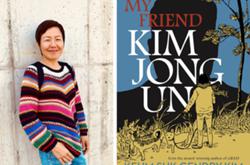
My Friend Kim Jong Un
Keum Suk Gendry-Kim
Drawn & Quarterly (2026)
[Content note: The graphic novel excerpts in this piece contain explicit discussions of sexual harassment involving women.]
No one is born wanting to be a dictator. Well, hardly anyone.
Kim Jong Un, the current leader of North Korea, inherited a mantle of total power and control from his father, Kim Jong Il, the former supreme leader of the country.
But long before he became one of the most feared men on the planet, Kim Jong Un was a kid, a teenager and a college student.
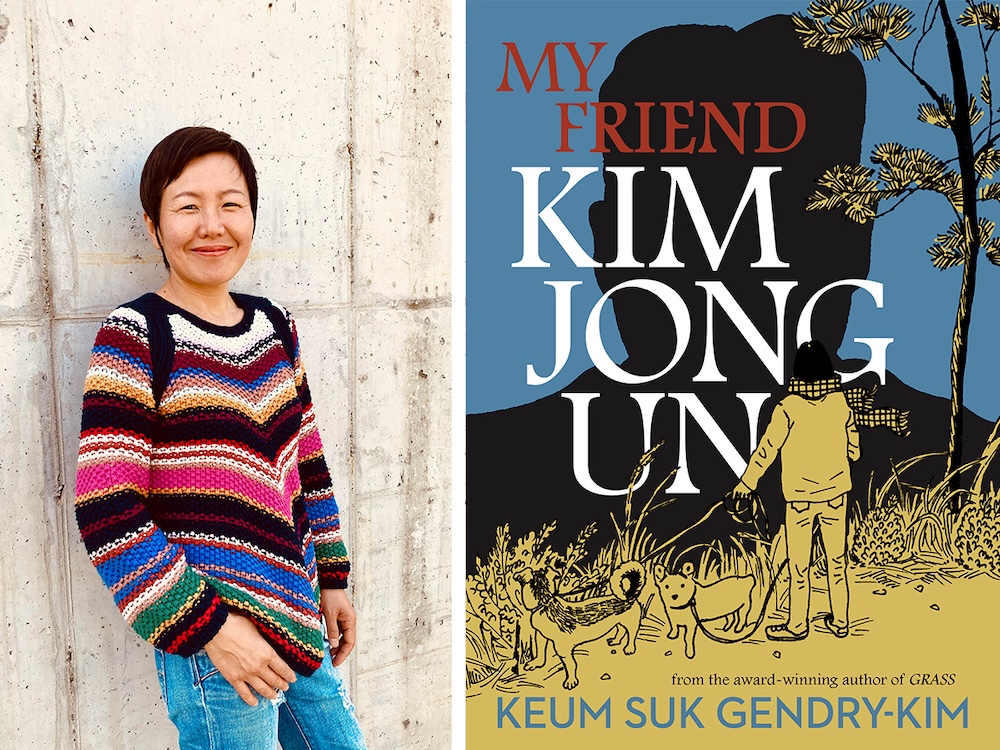
Graphic novelist Keum Suk Gendry-Kim sets out to better understand the leader of North Korea, as well as the historical and ongoing state of cultural and political division under his rule, in her new book My Friend Kim Jong Un, out Oct. 26 through Drawn & Quarterly.
Gendry-Kim takes a decidedly personal approach beginning with her own experience of being aurally bombarded by the military posturing between North and South Korea as the rattling reports of gunfire and sirens invade her home studio.
“Whenever there’s a South Korea-U.S. joint drill, North Korea responds immediately. Then South Korea answers back,” she writes. “Seventy years since the Korean War armistice and the cycle goes on and on.”
The past is extremely present in the small community, as the opening salvo of the story makes plain.
Gendry-Kim was born in Goheung County in South Korea’s South Jeolla Province. Her award-winning work has been internationally acclaimed and translated into multiple languages.
The first South Korean cartoonist to be named a Chevalier dans L’Ordre des Arts et des Lettres by the French government, she now lives with her partner Loïc Gendry and their dogs Carrot and Potato on Ganghwa Island, an hour away from Seoul.
The threat of war and nuclear threat hang heavy over the small community.
But as a conversation with an elderly neighbour reveals, the island’s residents are oddly resigned to the tension.
The author and her French husband do their best to maintain some semblance of normalcy, whether that means walking their dogs or making dinner while the roar of heavy artillery fills the air.
It’s not just the noise, but the atmosphere of fear and uncertainty that drives her to investigate the figure at the centre of it all.
Even before wars of the 20th century severed the nation in two, the Korean people had suffered considerably. In her previous book The Waiting, Gendry-Kim delved into the experiences of families searching for their missing loved ones across the border between North and South Korea.
Grass explored the struggles of sex workers in wartime society, and The Naked Tree looked at how the country’s violent past informed the most personal and intimate relationships.
My Friend Kim Jong Un is more than a deep dive into the history of one man. Although that itself is fascinating enough, it also parallels the author’s own life as she begins her research, interviewing a broad array of people who offer their own interpretations of the supreme leader.
Even as Gendry-Kim uncovers details about Kim Jong Un’s childhood, education and family life, the figure at the centre of the story remains something of a cipher. It is the people who knew him as a younger person who come more clearly into focus, whether that’s former South Korean president Moon Jae-in or one of Kim’s old schoolmates.
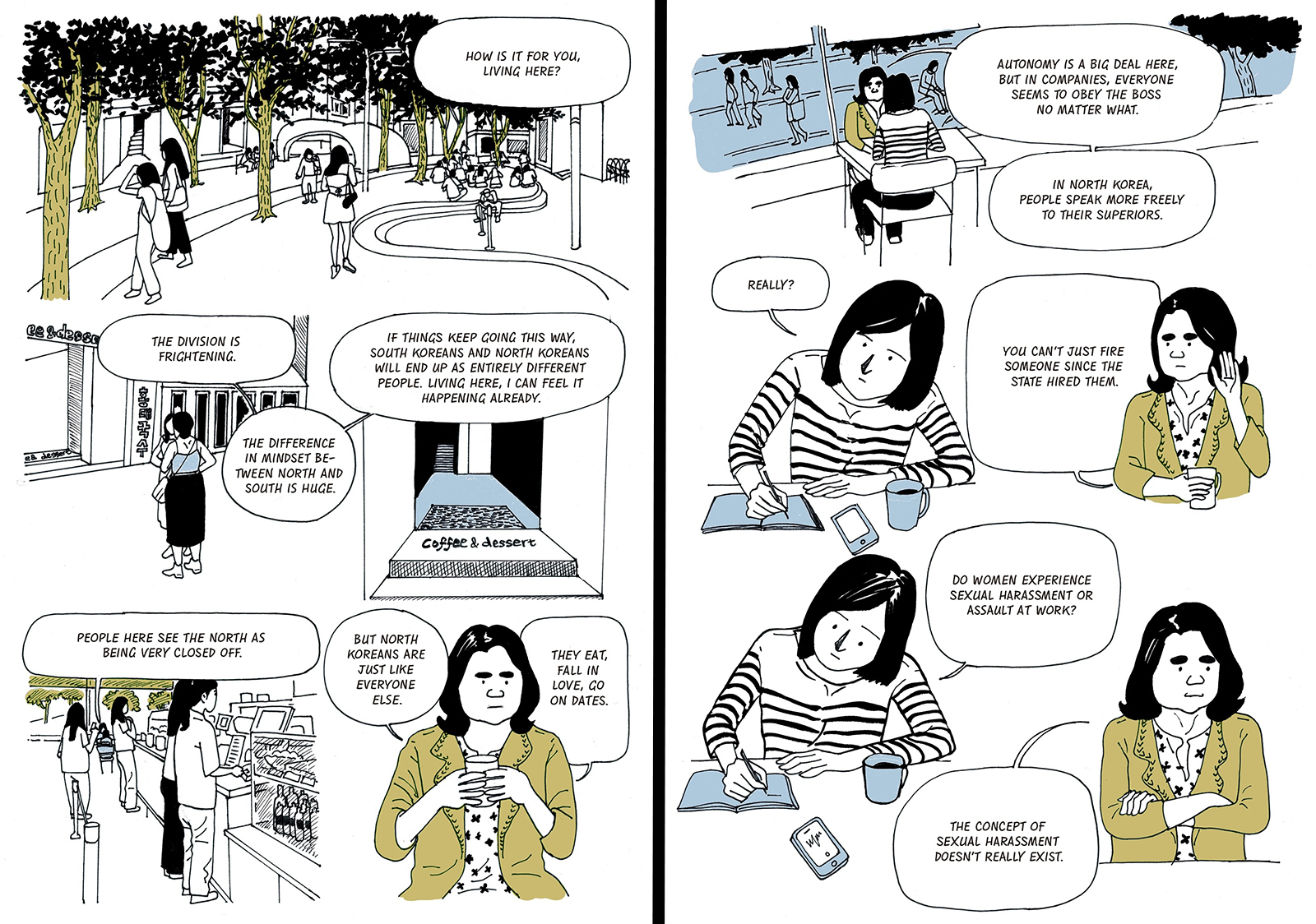
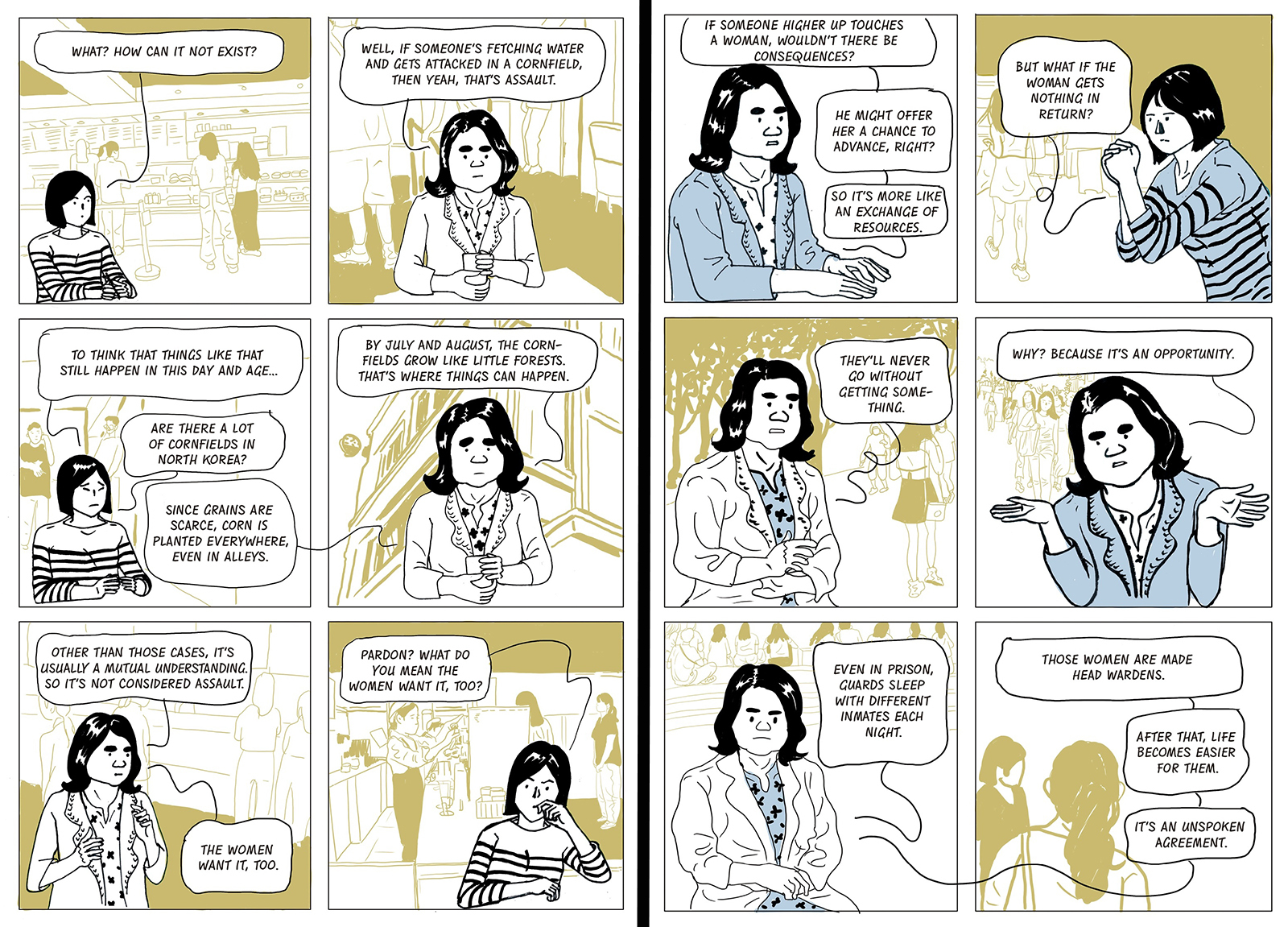
One of the most compelling chapters in the book, excerpted here, is a conversation with a defector who explains the brutal realities of life in North Korea.
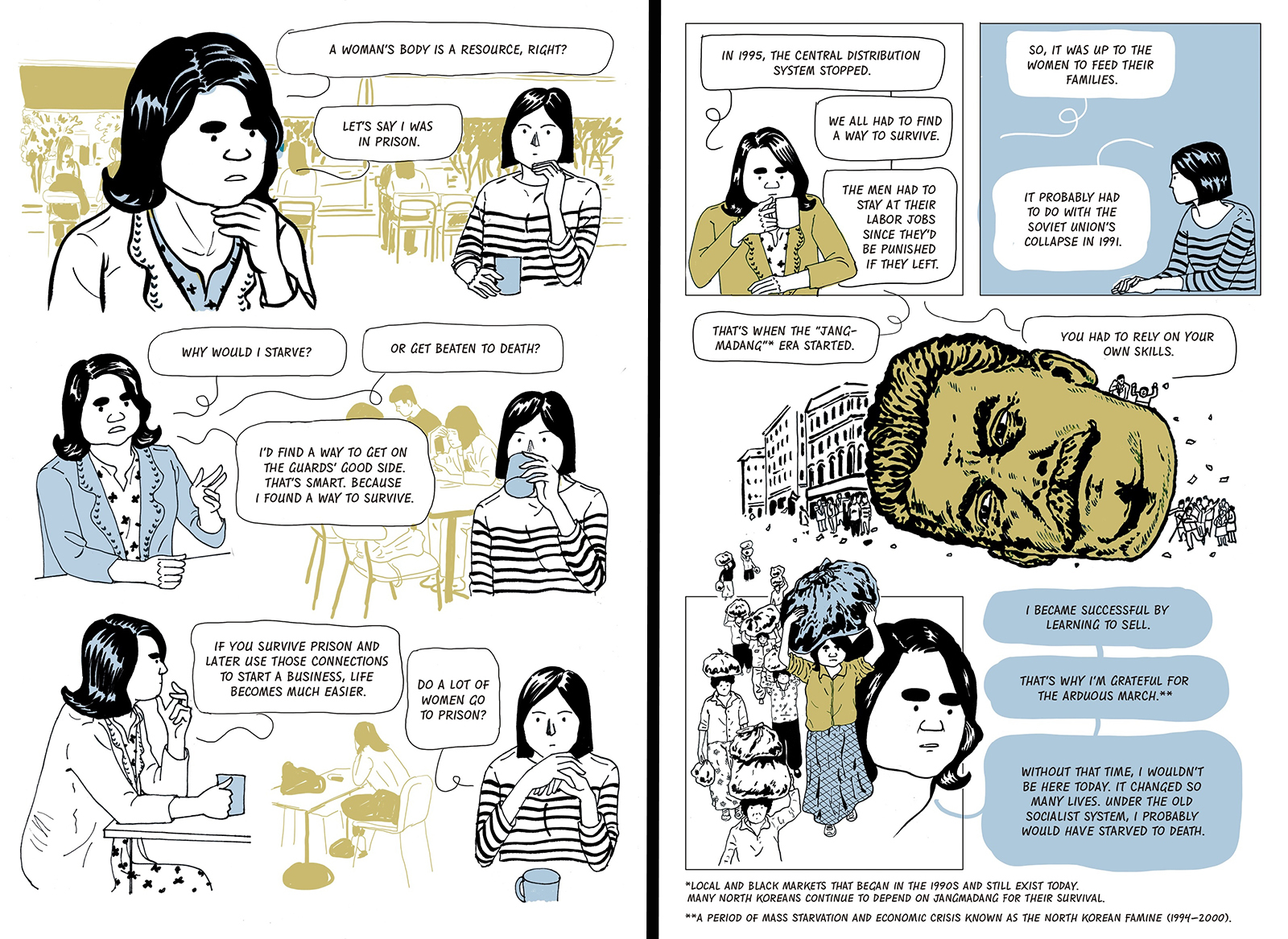
As the woman explains to Kim-Gendry, survival means using everything you have to live, work and feed your family.
The woman states that the concept of sexual harassment doesn’t exist in North Korea; rather, it is viewed as an exchange of resources. Women trade sex for better food, better conditions and favours.
In order to feed themselves and their children during the “Arduous March,” a stretch between 1994 and 2000 known as the North Korean Famine, characterized by its mass starvation and economic crisis, ordinary people did whatever they had to. The estimated death toll varies, but the generally accepted number is somewhere between 500,000 and 600,000.
Here, Kim-Gendry makes a gentle assertion. In such extremity, there is no point in making judgments about women using their bodies to simply survive.
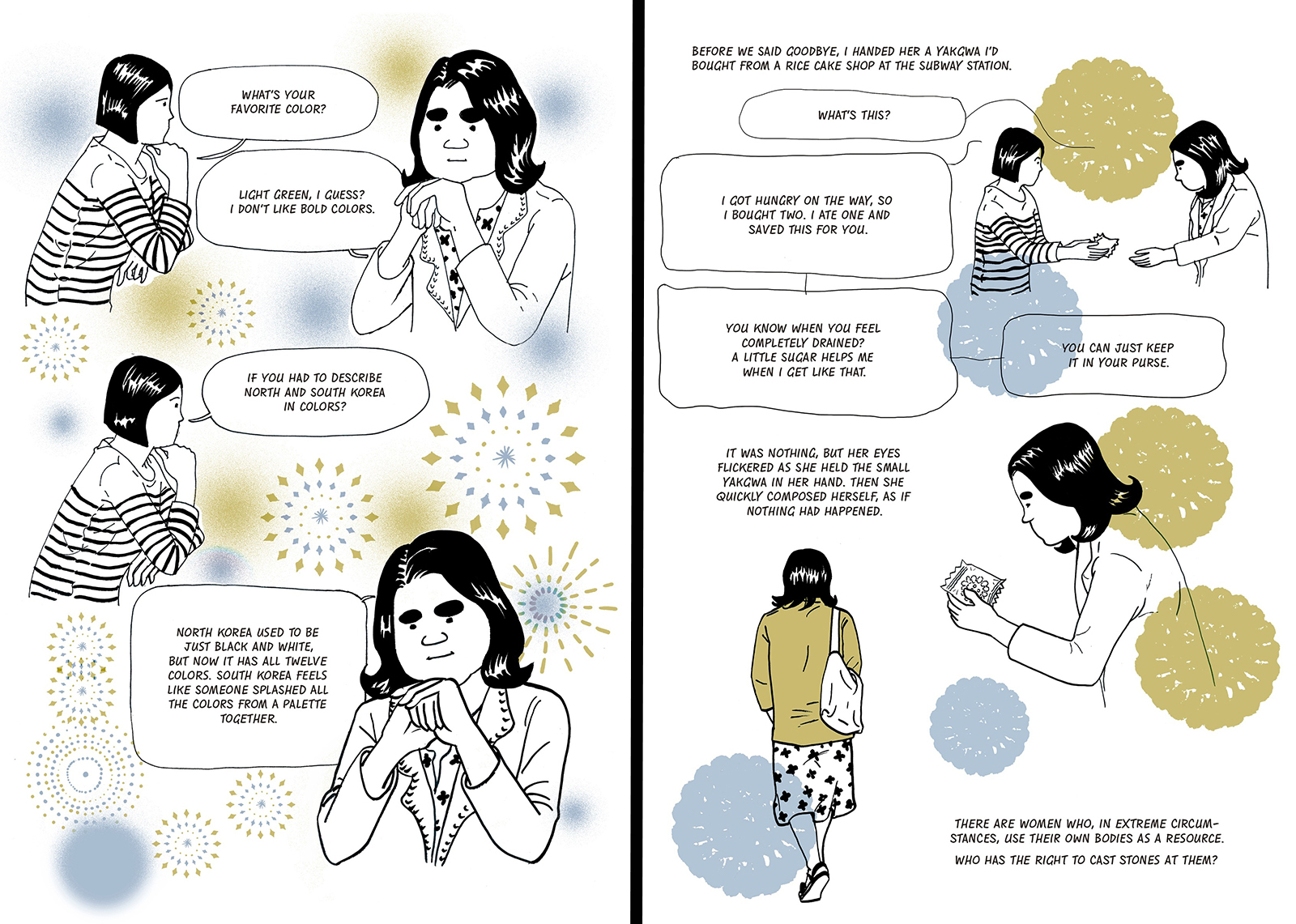
The exchange between the author and her interviewee ends with a small act of generosity and kindness that echoes in a curious way throughout the rest of the story.
Beneath the tectonic, implacable movements of history, people continue to find ways of maintaining humanity, whether it’s comforting a dog terrified by explosions or giving someone a snack cake to tide them over.
Excerpted from ‘My Friend Kim Jong Un,’ copyright © 2026 Keum Suk Gendry-Kim, translated by Janet Hong, courtesy of Drawn & Quarterly. Reproduced by arrangement with the publisher.
Join Keum Suk Gendry-Kim in conversation with her longtime translator, Vancouver-based Janet Hong, at the Vancouver Writers Fest on Oct. 25. Tickets are available online. The next day, the pair will give a public talk hosted by the University of British Columbia’s Centre for Korean Research on Oct. 26. Reserve a spot online. On Nov. 25, Gendry-Kim and Hong will hold a book signing at Vancouver’s Nooroongji Books from 5 to 7 p.m. to close out the 2026 Korean Book Festival. ![[Tyee]](/design-article.thetyee.ca/ui/img/yellowblob.png)
Read more: Books




Tyee Commenting Guidelines
Please note that email notifications for replies are not currently working due to a software issue which may be resolved in a future update.
Comments that violate guidelines risk being deleted, and violations may result in a temporary or permanent user ban. Maintain the spirit of good conversation to stay in the discussion and be patient with moderators. Comments are reviewed regularly but not in real time.
Do:
Do not: