


 SHARE:
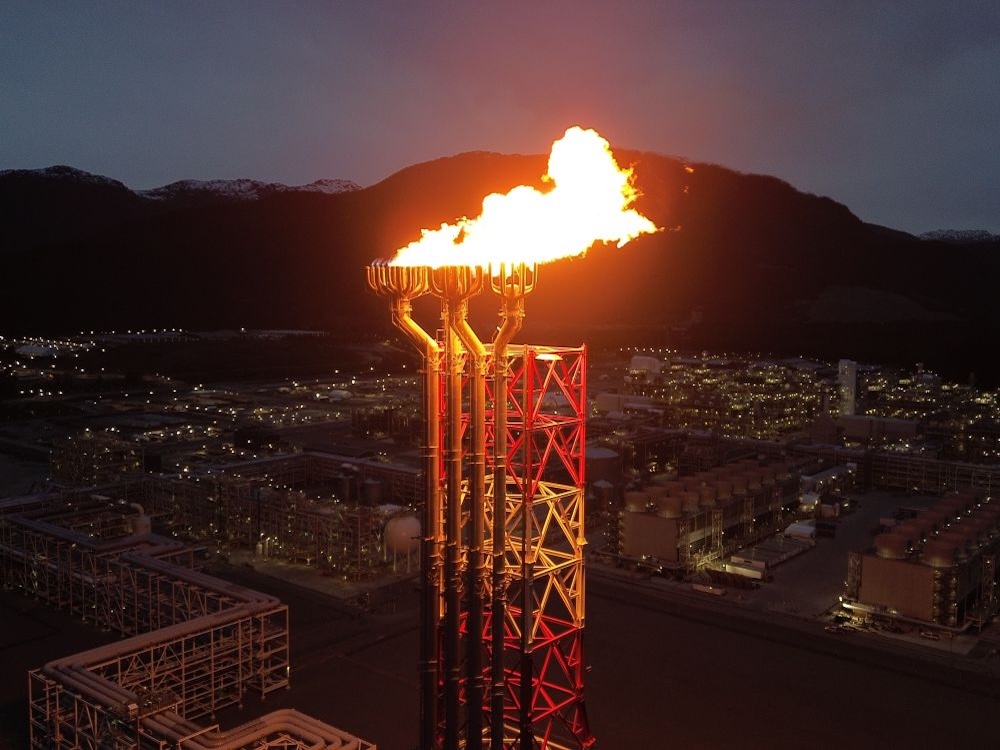
A critical tool for destroying potentially dangerous gases at the LNG Canada facility in Kitimat was out of commission for more days than it operated between September and April.
Before beginning operations, LNG Canada predicted that outages of its two acid gas incinerators could lead to one of its “worst-case flaring scenarios.” But it assured the province that such instances would be rare, occurring “approximately once per year for four to six hours in duration.”
However, over an eight-month period concluding in April, the incinerator for one of the plant’s two production units was offline for 139 days, with one outage lasting two consecutive months, according to the monthly air emissions reports obtained by researchers through a freedom of information request and subsequently shared with media.
LNG Canada’s acid gas incinerators are enclosed burners that destroy dangerous gases such as hydrogen sulphide and benzene under tightly controlled, high-temperature conditions. That level of control helps better ensure the noxious gases don’t escape or form other dangerous compounds during the combustion process.
When its incinerators have gone offline, LNG Canada has directed those gases to one of its flare stacks, boosting the flare temperature with extra gas. According to the company and the BC Energy Regulator, the approach ensures that “the same combustion process takes place — safely destroying the acid gas.”
But Faisal Khan, department head of chemical engineering at Texas A&M University, disagrees.
“It doesn’t work that way,” he said. “If that is the analogy you are providing, then that is scientifically incorrect.”
A flare stack is no replacement for an incinerator, Khan said. Even if extra gas helps boost temperatures, changes in gas compositions and in the environment can transform the way gas burns, leaving some or much of it uncombusted. Plumes of black smoke from LNG Canada’s flare tips provide a visual example of gas particles that the flame has failed to fully burn.
In a pre-operation pollution modelling document obtained by The Tyee, LNG Canada assured the province that it would take action if its incinerator went down for a sustained amount of time “to minimize the amount of acid gas routed to flare.”
According to the company, it would reduce its production to “minimum” levels until the incinerator resumed operation.
Asked by The Tyee whether it had reduced production as promised during its incinerator outages, a spokesperson wrote: “LNG Canada uses a range of operational controls to manage and minimize the volume of gas routed to flare when the acid gas incinerator is unavailable. Specific operating conditions vary depending on the nature of the event.”
LNG Canada’s pollution modelling also estimated that outages of its incinerator would lead to higher levels of volatile organic compounds emitted into the airshed, including benzene, a potent carcinogen.
The company’s acid gas incinerator for its first production unit or “train” was offline for October and November last year and for the entire month of March. In September and December, the incinerator was malfunctioning or offline for about half the month. The second train’s incinerator, which started up and then broke down again last November, was offline for most of December and has spent nine days offline this year.
Acid gas incineration
The acid gas incinerator helps address one of LNG producers’ biggest challenges: the natural gas they receive is laced with compounds that prevent it from liquefying properly.
To strip out those impurities, LNG operators like LNG Canada use a series of processes involving solvents, heat and pressure. But once the compounds are stripped from the soon-to-be-liquefied gas, they need to go somewhere.
Some LNG facilities turn the compounds into commercial byproducts that they sell for use in other industrial processes. But in regions where gas has lower quantities of valuable compounds, the cost and reduced financial upside can leave companies less inclined to spend money on recovery units, Khan said. LNG Canada did not invest in a recovery system for its acid gases and other compounds such as benzene.
But because some of those acid gases and compounds can harm humans and the environment, LNG Canada designed an incineration system to ensure greater control over the burning process. The incinerator allows the company to calibrate the temperature and exhaust based on the composition of gases present. When burned at the right temperature, an extremely poisonous and corrosive gas such as hydrogen sulphide can be transformed into sulphur dioxide, a less harmful pollutant.
But those carefully controlled conditions are key, said Khan.
By sending gas to the flare instead of the incinerator, facility operators lose that degree of control, he said. And if the heat in the flare isn’t high enough, or if there are other chemicals such as volatile organic compounds interacting with the sulphur in the combustion process, that can create a long list of different compounds.
“You don't want any other complex forming during the burning that could be dangerous,” he said. “Incineration helps you control that.”
Matthew Johnson, the head of Carleton University’s energy and emissions research lab, said flares “tend to burn reasonably completely” if the combustion temperature is high enough, but within limits.
“They’re not perfect,” he said, and some can perform poorly, but Johnson said his research found that combustion levels in the high 90 per cent range “are common.”
In an email to The Tyee, B.C.’s energy regulator said it is satisfied with the performance of LNG Canada’s flare systems, noting that the company’s required reporting “showed that the flare systems are operating within the design specifications for efficient destruction of hydrocarbons, even during smoke events.”
LNG Canada did not respond to The Tyee’s questions about why its acid gas incinerators have repeatedly malfunctioned. ![[Tyee]](/design-article.thetyee.ca/ui/img/yellowblob.png)
Read more: Energy, Health, Environment











Tyee Commenting Guidelines
Please note that email notifications for replies are not currently working due to a software issue which may be resolved in a future update.
Comments that violate guidelines risk being deleted, and violations may result in a temporary or permanent user ban. Maintain the spirit of good conversation to stay in the discussion and be patient with moderators. Comments are reviewed regularly but not in real time.
Do:
Do not: