


 SHARE:
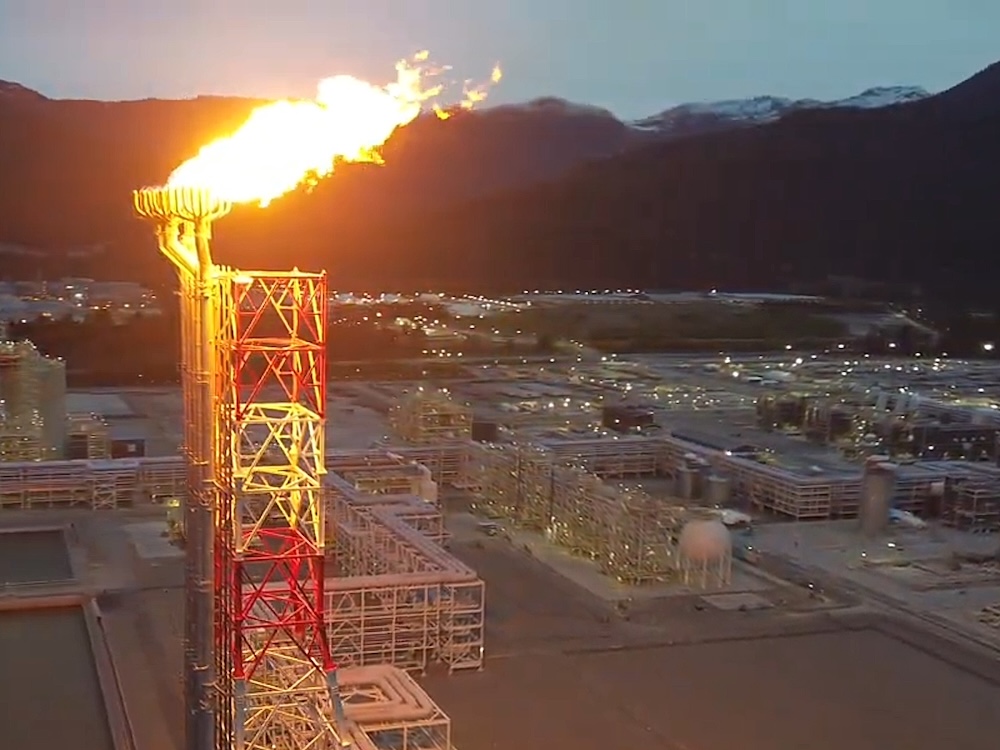
LNG Canada is asking for permission to continuously flare vastly more natural gas than its current permit allows, The Tyee has learned.
The country’s first major LNG operation wants B.C.’s energy regulator to increase its flaring limit tenfold for the next three years.
Having consistently breached its permitted flaring limits since it began production last fall, the company is seeking approval to continuously flare twice as much gas than its average output of routine flaring between September 2025 and March 2026.
The requested limit would not include the much larger volumes of “non-routine” flaring that have dwarfed the facility's continuous flaring levels since production began in Kitimat last fall. There is no regulatory limit for this category of flaring.
LNG Canada has not released public documents on its forthcoming request for a more permissive routine flaring permit, but the company’s deputy chief operating officer, Teresa Waddington, disclosed the plans during a March Kitimat council meeting and at a recent presentation to Kitimat residents. If approved, the new limit would allow the company to continually flare up to 300 tonnes of gas per day, an increase from its current limit of 28 tonnes per day.
The company said the new, more permissive flaring limit would help accommodate operational problems that have led to higher-than-anticipated flaring volumes.
The problems have included a malfunctioning flare tip and a series of leaking valves.
“When we started up, we thought this might be a learning curve,” Waddington said during her presentation to council.
According to modelling from a previous company report, increased routine flaring volume could lead to a tenfold increase in emissions of volatile organic compounds, including harmful pollutants, into the region’s airshed.
Meanwhile, the company’s non-routine flaring stems at least in part from ongoing malfunctions requiring the facility to purge its gas to quickly relieve potentially dangerous pressure levels within the plant.
The pending application is the latest signal that LNG Canada’s ongoing emissions will be higher than previously reported. Before flaring began in August 2024, a promotional video said early flaring events would “decrease significantly over several months” as the company began operations. Years later, elevated flaring rates now seem likely to continue throughout normal operations.
“First it was ‘It’ll only be three months,’” Kitimat Coun. Gerry Leibel said. “Now we’re looking at three years.”
“The community is starting to realize now this is a bit of a Trojan horse.”
Leibel said Kitimat residents are reporting growing alarm about the flaring and its impacts on the community. Local social media posts depict black smoke billowing from the company’s stacks, and Leibel said he has heard residents near the facility compare its noise to a freight train.
In an email to The Tyee, an LNG Canada spokesperson said the facility’s current permit levels were “based on long-term, stable operating conditions” and “did not reflect the higher flaring volumes typically seen during start-up and early operations at an LNG facility.”
However, recent reporting from the Narwhal suggests that LNG Canada’s flaring is not typical. According to estimates based on satellite data, LNG Canada may have flared more gas last year than any LNG facility worldwide.
Ahead of its upcoming permit request, LNG Canada delivered a “pre-submission package” to the regulator in November.
LNG Canada has not submitted its final application package, a spokesperson for the BC Energy Regulator told The Tyee.
“Should an application be submitted, it will be subject to public notification and engagement requirements in accordance with the Public Notification Regulation,” a spokesperson for the regulator wrote in an email, adding that “the BCER does not generally release pre-application materials, as they can contain incomplete data and may not represent the final proposal from the proponent.”
In an email to The Tyee, an LNG Canada spokesperson wrote that the company is undertaking a new health impact assessment in preparation for the application. The spokesperson said the larger volume of flaring “is not expected to materially increase emissions in the local airshed.”
The company has not published the assessment’s findings.
However, the company did commission an earlier study on the potential health effects of added flaring, at the regulator’s request. The study showed that spikes in flaring did not cause substantial increases in nitrogen dioxide and sulphur dioxide emissions.
During the company’s March presentation to Kitimat council, the study’s author, Stantec senior atmospheric environmental specialist April Hauk, said the study showed that “the effect of the increased flare rate on air quality is small-to-negligible.”
But LNG Canada’s study had limitations: it examined a substantially lower flare volume than the 300-tonne-per-day limit the company plans to request. The highest flare volume modelled by the study was 170 tonnes per day, just over half the pending request.
The regulator also didn’t require it to model the potential air quality impacts of increased emissions of volatile organic compounds, including benzene, a carcinogen. It remains unclear how those pollutants would disperse throughout the airshed or what their potential health impacts might be.
The previous assessment also failed to acknowledge that the project's impacts on nitrogen dioxide in the airshed are already expected to exceed Canada’s air quality guidelines. Nitrogen dioxide is a pollutant that can trigger respiratory issues and reduced lung function.

Why is LNG Canada flaring so much?
Flaring at LNG Canada is intended to act largely as a safety mechanism to relieve sudden surges in gas pressure and prevent dangerous explosions. But malfunctioning equipment and other issues mean the plant is now flaring gas at higher-than-anticipated rates as part of its normal operations.
LNG plants like the Kitimat facility are designed to take gas, a vapour, and turn it into a liquid that can be shipped in trucks and tankers. To do that, they employ a series of pressure-cooker and super-freezer-like tanks that pressurize and depressurize at various points along the production line.
First, the tanks use heat, pressure and solvents to remove impurities such as carbon dioxide that keep gas from freezing. Eventually, they send the purified gas to a giant, cryogenic refrigerator that depressurizes the gas, which also causes it to drop dramatically in temperature.
Managing the giant pressure swings is a complicated affair, requiring systems tightly calibrated to accommodate changing conditions inside and outside the plant. The risk of explosions looms large, requiring the company to build in a series of relief mechanisms to keep the gas pressure appropriate to the task at hand.
But at the LNG Canada facility, two of the key pressure-regulating tools have malfunctioned, resulting in a steady stream of flaring that far exceeds the company’s permitted volumes.
That includes one of its flares. The tall, flame-tipped smokestacks are intended to burn off gas to relieve pressure. Although burning gas still creates climate-warming carbon dioxide, it’s preferable to venting, which would release pure methane and other pollutants into the atmosphere.
Last year, one of LNG Canada’s flare stacks began pulling its flame down inside the smokestack — a dangerous situation, given the explosive materials inside the facility. To address the issue, LNG Canada continuously pumped more gas to the flare, pushing the flame farther up the pipe. This spring, the flare cracked in two places. LNG Canada has since replaced it with a “spare” flare, but the company continues to push more gas through to avoid sucking flame back into the smokestack.
The company anticipates replacing its “spare flare” with a new one in mid-2028.
LNG Canada also has a long-running problem with leaking valves throughout the facility.
Under optimal conditions, LNG facilities use valves to prevent leaks while maintaining enough flexibility to release gas when pressure builds. But throughout the facility, LNG Canada’s valves aren’t working as intended and are instead constantly sending gas to the flares unimpeded, a phenomenon LNG Canada describes as “valve passing.”
“The volume that was assumed for valve passing in the original application is significantly lower than what we're seeing right now,” Waddington told Kitimat council in March.
Waddington said the company is committed to “finding and repairing” its leaking valves and fixing its broken flare.
“We are striving to continuously reduce those flare volumes,” she said.
LNG Canada’s non-routine flaring emissions continue to dwarf its continuous flaring emissions. Those irregular bursts flared three times more gas between September 2025 and March 2026 than the routine, continuous flare, according to the company’s monthly air emissions reports obtained by University of Victoria researcher Laura Minet through freedom of information request. Non-routine flaring is linked to major and sudden pressure changes that are sometimes the result of malfunctioning equipment or power outages inside the facility.
The largest non-routine flaring spike so far occurred in December 2025, when a sustained power outage caused the facility to shut down entirely.
The cause of those power outages and other system malfunctions remains unknown.
But there are several reasons why LNG Canada’s mechanical issues are difficult to fix, according to Matthew Johnson, a professor at Carleton University and an expert in oil and gas flaring emissions.
Not only are specialized replacement parts for LNG facilities hard to source, but Johnson said repairing parts of the system likely requires temporarily shutting down parts of the plant or the whole plant — a costly endeavour for the company.
LNG Canada has been ramping up its production in recent months.
“They're not going to shut down until they need to shut down,” Johnson said, adding that companies often wait for planned maintenance windows.
Sustained operational problems like the ones at LNG Canada raise questions, Johnson said.
“What’s the role of the regulator in saying, ‘That’s enough, you’ve got to deal with this flaring?’”
“Those are the kind of very challenging questions that I assume are getting discussed, one would hope, at the highest levels.” ![[Tyee]](/design-article.thetyee.ca/ui/img/yellowblob.png)
Read more: Energy, Health, Environment







Tyee Commenting Guidelines
Please note that email notifications for replies are not currently working due to a software issue which may be resolved in a future update.
Comments that violate guidelines risk being deleted, and violations may result in a temporary or permanent user ban. Maintain the spirit of good conversation to stay in the discussion and be patient with moderators. Comments are reviewed regularly but not in real time.
Do:
Do not: