

 SHARE:
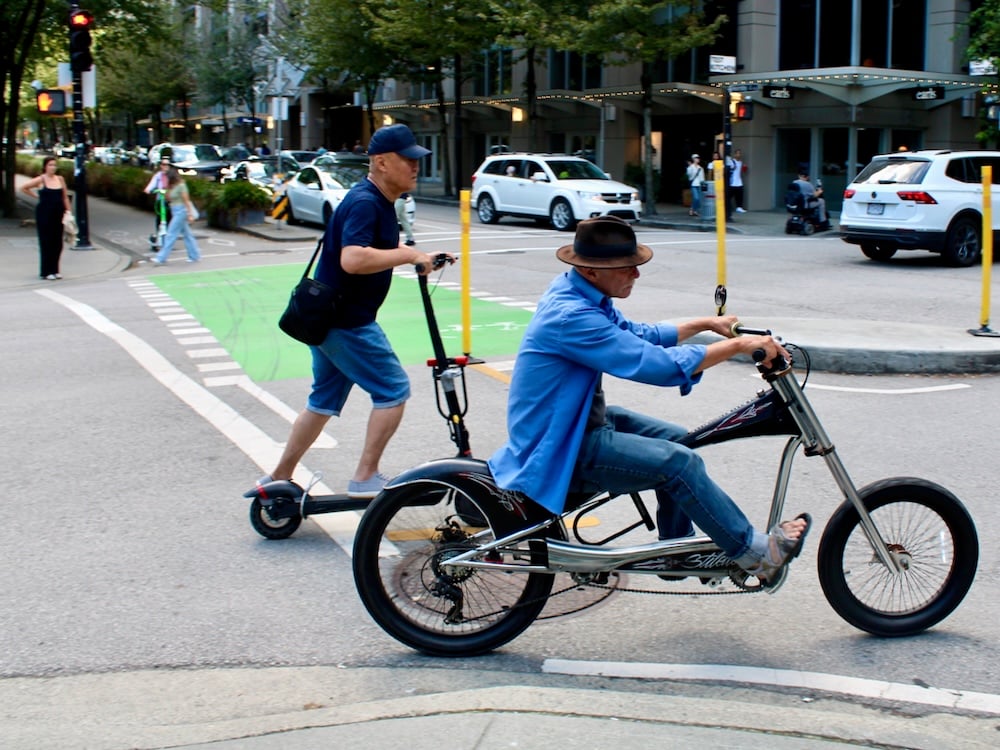
In 2020, there were 6,249 crashes that resulted in injury or death in Vancouver. In 2021, that rose to 7,389. By 2022, the number was 7,464. In 2023, the number dropped slightly to 7,329, before rising to 7,666 in 2024, according to data collected by ICBC.
“We haven’t reached zero yet, and the only acceptable number of deaths and injuries on our roads is zero,” said Lucy Maloney, a Vancouver city councillor. “Worldwide, millions of people die every year on the roads, and that should be something that we don’t find acceptable.”
In Vancouver, 13 people died in vehicle collisions in 2023, the most recent year for which data is available. Ten of those people were pedestrians.
Maloney recently spearheaded a motion to overhaul Vancouver’s action plan towards zero traffic-related injuries and deaths (the motion passed on July 9). The motion was brought forward on the same day that councillors also voted to reduce the speed limit on residential streets to 30 kilometres per hour, a lowered speed limit that has been shown to dramatically reduce the risk of serious injury or death in case of a crash.
Developed in conjunction with Vision Zero Vancouver, Maloney’s motion calls for the City of Vancouver to re-evaluate the action plan previously in place to reduce the number of traffic-related deaths and injuries in the city.
The fact that the motion passed on the same day as the decision to reduce speed in local neighbourhoods to 30 km/h shows that local politicians are stepping away from prioritizing the convenience of cars and looking at the safety of everyone involved, Maloney said.
“People want to know they can walk around safely, to work, to take their kids to school,” said Coun. Lisa Dominato. “We’re densifying our cities, we’re asking people to get out of their cars and move around, but we still have to coexist.”
A new route to an old destination
Preventing traffic-related deaths and injuries is not a new idea. In 2012, the City of Vancouver set a goal of zero traffic fatalities in its Transportation 2040 Plan. The plan outlines that “Vancouver’s ultimate safety goal is to eliminate all fatalities from its transportation system.”
In 2016, the city developed the Moving Towards Zero Safety Action Plan to strategize the city’s movement towards zero traffic-related fatalities.
With this approach, the city installed 33 flashing pedestrian beacons and 24 pedestrian-controlled signals, and piloted a slow zone in Grandview-Woodland in 2021.
Yet advocates at Vision Zero Vancouver have stated that the work completed by the City of Vancouver is not enough.
“The plan was a decade old,” said Mihai Cirstea, a volunteer with the Vision Zero Vancouver advocacy group. “In that time, not only have we not made progress, things [have gotten] static.”
According to ICBC data, 3,505 cyclists and 3,079 pedestrians were involved in a motor vehicle collision between 2020 and 2024 in Vancouver. Additionally, 38,838 crashes over that period in the entire Lower Mainland region ended in injury or a fatality.
Even though city council has supported motions in the past to increase traffic safety, it hasn’t always been easy, explained Cirstea.
“They voted against bike lanes on Broadway, they tore out the bike lane in Stanley Park, they rejected the automated enforcement cameras,” he said.
But in the last few years, Cirstea has seen a change in the city council’s approach to traffic safety. Motions such as reducing the speed limit on residential streets to 30 km/h and increasing the number of dedicated bus lanes and pedestrian-controlled crossings in the city all passed unanimously.
“The sentiment has changed,” said Cirstea. “They know that if they fail to pass these common-sense things, they’re going to take a lot of heat for it.”
The next stages
The next steps for the city following the motion will be re-evaluating the old Moving Towards Zero Safety Action Plan to develop a new Vision Zero Road Safety Policy and Action Plan. The city council will then take the new plan under consideration in 2026.
During their review process, the council will prioritize actions that have proven effective in reducing severe traffic incidents and eliminate those that have been ineffective. They will also examine other municipalities, such as Saanich, that have been successful in achieving their Vision Zero goals.
“I think Saanich is really being a leader,” said Maloney. “It would be nice if the City of Vancouver were the leader, but I’m afraid after the last few years we’re playing catch-up.”
The District of Saanich’s plan has set its sights on eventually achieving Vision Zero, while also cutting serious injuries and fatalities related to traffic in half by 2030.
The Road Safety Action Plan crafted by Saanich focuses on safe speeds, road users, vehicles, road design, post-crash care and land-use planning.
Hoboken, New Jersey, is another city that Maloney is looking to, as it hasn’t had a street fatality since 2019.
Hoboken achieved this by implementing daylight intersections where visual barriers, such as cars parked close to corners, are removed. In doing so, Hoboken improved the sight lines of cars, bicycles and pedestrians using the intersections, Maloney explained.
“When you have parking restricted nearer to the intersection, you can see better,” said Maloney. “Which means you don’t see pedestrians and cyclists jumping out of nowhere in front of your car, so it makes it easier for you to drive.”
Beyond reviewing the old plan, the revised motion might make it easier for Vision Zero initiatives to pass, said Cirstea.
For example, the motion supports the implementation of proven safety measures, Cirstea said. These implementations could include more bump-outs (a term for curb extensions that widen sidewalks), converting more one-way streets into two-way streets (like Cordova Street this summer) and expanding protected bike lanes and pedestrian spaces.
Cirstea pointed to Vision Zero’s advocacy for automated enforcement cameras and banning right turns on red lights as other potential additions the City of Vancouver could consider for moving towards zero.
“We got that framework in from [Maloney],” said Cirstea. “Now we can actually follow that up with real motions that will be backed by staff and that council is going to want to pass.”
While banning right turns on red lights and automated enforcement cameras are not directly in the city council’s jurisdiction, Maloney explained that she hopes this bill helps to show that the City of Vancouver is taking leadership to reduce deaths and injuries.
“That includes writing to the province and asking them for more automated enforcement,” said Maloney. “It includes lobbying the province to reduce speed limits so that we don’t have to spend so much money on signs. It includes lobbying the province to ban turning right on red.”
Potential speed bumps
While the motion was unanimously voted for and supported by all councillors present at the council meeting, Maloney is worried about how far it will be able to go.
“This council’s track record on traffic safety is mixed at best,” said Maloney, noting their voting patterns in the past.
The city plan allocates almost $500 million to street infrastructure, and changes to road infrastructure do come at a cost. For example, pedestrian-activated signals, which are highly effective, are also expensive. For instance, Edmonton recently spent over $58 million to upgrade its traffic signals.
While the City of Vancouver considers cost savings and efficiencies, Maloney fears that it may cut funds allocated towards Vision Zero.
“I’m worried that the speed at which we implement the things that would achieve Vision Zero is going to be slowed, and therefore lives will continue to be lost,” said Maloney.
During the council meeting, Dominato pointed to the work that has already been accomplished. By the end of 2025, the City of Vancouver will have over 350 curb ramps completed and 37 new marked crosswalks.
“This council and our staff have been driving for positive changes, being responsive to occurrences and events that happen in our city,” said Dominato. “I’m really proud of that work, and I think it’s important to continue that work.”
Above all, Maloney emphasizes that this motion will help ensure everyone, from drivers to cyclists to pedestrians, can travel more safely.
“If we want to have a vibrant, fun, safe city where people can get where they want to go in fun ways — like the new e-scooter system — we need to make sure that our roads are safe so that everybody can enjoy getting around,” Maloney said. “Even people who aren’t experienced or brave or reckless.” ![[Tyee]](/design-article.thetyee.ca/ui/img/yellowblob.png)
Read more: Transportation, Municipal Politics
Tyee Commenting Guidelines
Please note that email notifications for replies are not currently working due to a software issue which may be resolved in a future update.
Comments that violate guidelines risk being deleted, and violations may result in a temporary or permanent user ban. Maintain the spirit of good conversation to stay in the discussion and be patient with moderators. Comments are reviewed regularly but not in real time.
Do:
Do not: