


 SHARE:
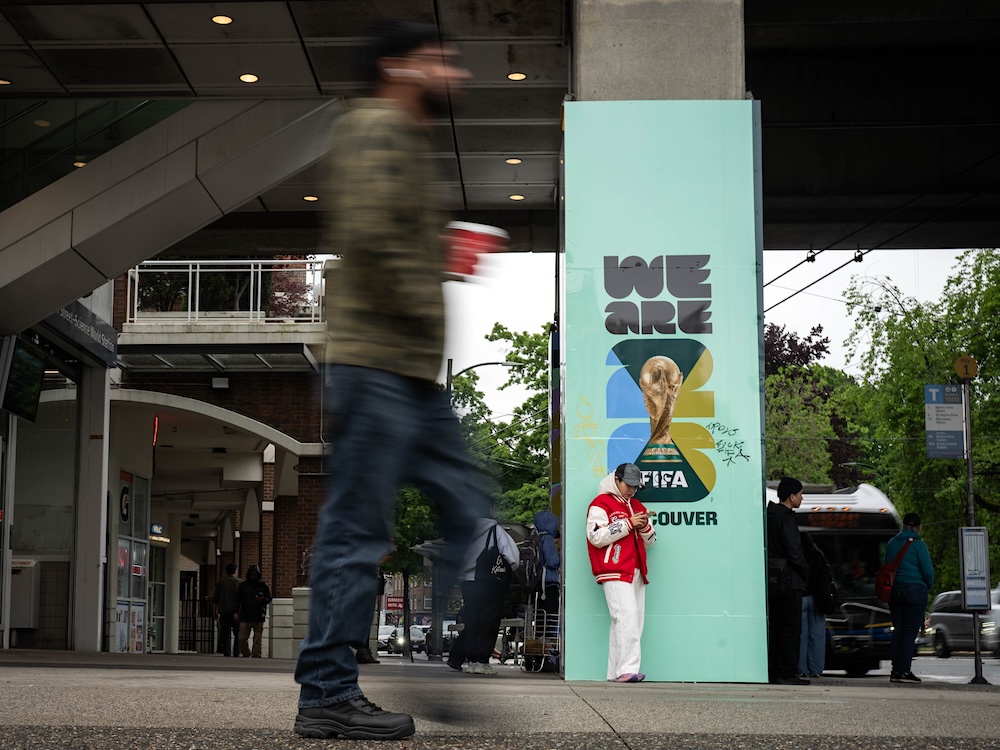
With less than three weeks to go before the first Vancouver match of the 2026 World Cup, the host city’s official human rights action plan has been released.
But advocates don’t see much response to criticisms they raised about earlier drafts. Big holes remain, they say, when it comes to protecting people experiencing homelessness and poverty, and those marginalized for their drug use, mental health issues or survival sex work.
Many people who fit those descriptions live in the city’s Downtown Eastside, which is located within the two-kilometre-radius game zone where some city bylaws have temporarily changed for the almost month-long World Cup.
In a May 27 press release, the Vancouver Anti-FIFA Coalition, which includes organizations such as Pivot Legal Society, the BC Civil Liberties Association and the BC Poverty Reduction Coalition, highlighted their main concerns with the human rights action plan. Their claims mainly fall into three categories.
1. A weak system for reporting abuses
Vancouver’s 311 phone line and website continues to be a recommended outlet for submitting human rights complaints during the games. The municipal service typically used to report damaged garbage cans or a busted street lamp won’t receive additional funding to take on this duty.
“The Plan provides no information on critical procedural fairness details, including: who will be reviewing reports of violations submitted through 311, what reviewers will be looking for, what notice and evidence requirements apply, whether an investigation may occur and what such an investigation might look like, when people can expect to hear back, and what the available remedies might be,” the coalition’s press release states.
Without this information or additional investment into 311 services to accommodate the load, the Vancouver Anti-FIFA Coalition predicts human rights abuses will go undocumented and unaddressed during the games.
The Van311.ca website already has a portal for World Cup-related inquiries and requests. But the multiple-choice options for narrowing down your issue do not currently include human rights complaints.
In an emailed statement to The Tyee, a City of Vancouver spokesperson stated 311 is already used for purposes similar to filing human rights complaints, such as reporting issues related to accessibility and public safety. Except that when a human rights complaint is made via 311, in addition to notifying the relevant city department, the city’s FIFA host committee will also be notified.
“For calls that do not fit within an existing service pathway, or where the appropriate response is unclear, they will be escalated to designated Host Committee representatives for review. These individuals will determine next steps, including whether further followup or coordination across departments is required,” the statement read.
2. Not enough safe options for homeless
The coalition and Downtown Eastside residents have called for expanded daytime shelter hours during the month-long game period where people experiencing homelessness or housing precarity can watch televised games — especially in air-conditioned spaces, as the summer temperatures are predicted to be high this year.
But the human rights action plan is offering extended hours in existing daytime shelter spaces in the Downtown Eastside and south Vancouver during the seven game days only.
“In other words, a handful of days during a weeks-long period of increased policing, tourist surges, and service disruption,” the coalition’s press release reads, adding that the spaces also fail to meet needs because they won’t employ peer workers and offer harm reduction supplies.
“Further, the Plan offers scant details on how these spaces will be made accessible for people who are unhoused or precariously housed, as they are notoriously discriminated against in accessing City-run services.”
While the city’s host committee has pledged there will be no street sweeps targeting people sheltering outside during the game, the plan notes the city’s bylaw officers will be enforcing existing daytime camping bans in parks and ensuring “sidewalks and streets remain safe, clean, and accessible.”
In their emailed statement to The Tyee, a city spokesperson didn’t refute these points but emphasized existing city services for unhoused and precariously housed residents, in addition to the extended hours for some drop-in centres on game days.
3. Little more than warnings for drug users
Advocates said the host committee is failing drug users and going against “evidence-based harm reduction principles” by simply warning people to not use drugs or, if they do, to not use them alone.
The plan directs people to the provincial HealthLink line for more information but does not include information about accessing harm reduction supplies or other services for drug users.
“This is more than a shortcoming, but a decision with deadly consequences for tourists and residents alike,” the Vancouver Anti-FIFA Coalition’s release reads.
The Know Before You Go page on the FIFA host city’s website includes more details about harm reduction services and supports for drug users, a city spokesperson told The Tyee via an emailed statement. This includes information on where to test drugs, access drug alerts, find Naloxone and use the Lifeguard Connect app if they are consuming substances alone.
“Vancouver Coastal Health (VCH) serves as the health authority of jurisdiction within the Host City and is responsible for issuing all relevant public health guidance,” the city’s statement reads.
Police presence will increase within the game zone downtown and near the PNE on the day of and the day before the seven matches. Both the draft and final versions of the human rights action plan reference advanced training in “de-escalation strategies as well as diversity and cultural awareness training.”
The Tyee has confirmed with the Vancouver Police Department that the training is part of regular police officer training, and not special to or in anticipation of the World Cup.
The Tyee reached out to the city about the complaints by the Vancouver Anti-FIFA Coalition and received responses after the story was published. This story was updated on May 29 at 3:30 p.m. to include those responses. ![[Tyee]](/design-article.thetyee.ca/ui/img/yellowblob.png)
Read more: Rights + Justice, Sports








Tyee Commenting Guidelines
Please note that email notifications for replies are not currently working due to a software issue which may be resolved in a future update.
Comments that violate guidelines risk being deleted, and violations may result in a temporary or permanent user ban. Maintain the spirit of good conversation to stay in the discussion and be patient with moderators. Comments are reviewed regularly but not in real time.
Do:
Do not: