



 SHARE:

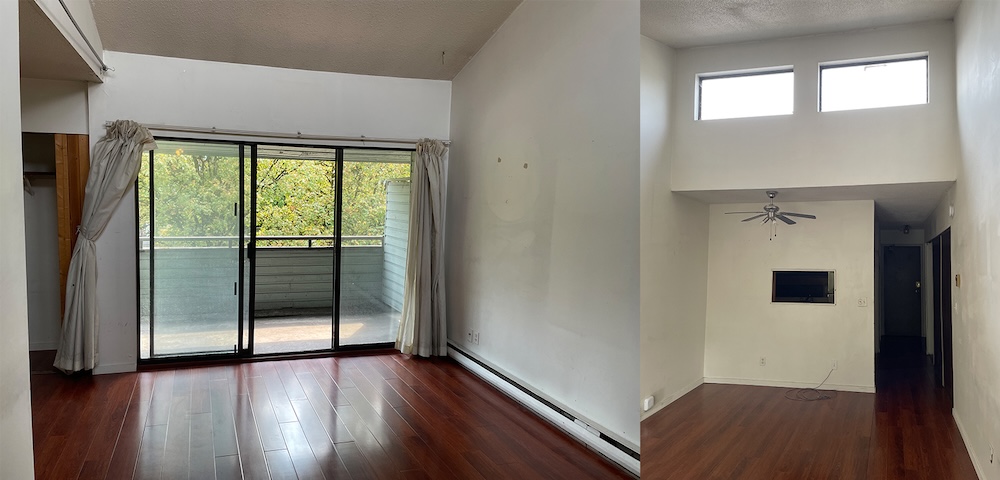
When orange, red, yellow, and purple tulips flanked the apartment entryway, that meant my neighbour Ed was back outside in the dirt after a winter indoors. Coming home to the bloom of those small garden plots was the official first sign of spring throughout my 15-year tenure living in a studio apartment a couple of blocks shy of Commercial Drive on Vancouver’s Broadway.
As the season progressed, Ed would start planting vegetables and update me on how the potatoes, onions and hot peppers were doing when I stopped to chat on my way home from work.
As the years went on and Ed’s mobility and hearing lessened, I’d crouch by his wheelchair with an ear next to the “support your local union” pin on his worn fisherman’s hat as he passed down time-worn wisdom.“You know, crows can’t crap when they fly,” he said. I logged it in my notebook immediately.
When I moved into the building in 2011, my rent was $724 dollars a month. By the time I left in 2026, it was $981 — a 35 per cent increase, but a pittance compared to today’s going rate.
According to recent data from CoStar Group’s Market Trend report and published by Apartments.com, the city-wide average rent for a studio apartment is $2,020. That’s roughly 105 per cent more than what I paid before I moved this summer.
Beyond annual rent increases, a lot of life happens over the course of 15 years.
While calling that small space home, I got, lost, and left a LinkedIn profile’s worth of jobs while I started, abandoned and followed through on several different career paths.
I wrote a couple of books, got them published, and had more manuscripts than I’d like to admit that never saw the light of day.
I made friends, grew distant from others, and attended enough weddings and funerals to rack up serious rewards points on my credit card, which I used to attend even more weddings and funerals.
I also bumbled my way into and out of love enough times, and broke enough bones and tore enough ligaments skateboarding, to know better.
Which is to say, to know you keep trying to get better.
To be a renter is to rely on luck
It’s much easier to push forward through life when you have a semblance of stability. I was fortunate to have a reasonably affordable home.
As my friends and I crept into our thirties, some got married. Some had kids, and many moved away from Vancouver to better afford them. Those departures were often preceded by renovictions, redevelopments, and general struggles to find decent, affordable housing.
A lack of vacancy control in Vancouver exacerbates that frog-in-a-pot reality, as each move means the suite you leave and the one you move into can have the rent increased as much as a landlord wants.
A few years back, a friend rented the studio apartment below mine, a suite that was a duplicate of my own. For $1,300 a month, he had the privilege of paying hundreds of dollars more than me and suffering through such a severe mouse infestation that he eventually moved out.
While I could hear some manner of creature rustling around in the walls at night, I was again fortunate and managed to avoid them becoming roommates.
Luck plays an outsized role in the renter’s life. If you’re looking for or in desperate need of a new home, you’re lucky if you know someone who needs a roommate or is willing to pass their apartment along to you.
You’re lucky if you catch a Craigslist housing rental ad before the query emails flood in and the post gets taken down. You’re lucky if that place isn’t asking for more than a third of your monthly income and isn’t visibly mouldering when you view it.
You’re especially lucky if you sign a lease and the landlord is reasonable and responsive, not a slumlord or absent management firm whose director rips around town in a Ferrari while his company goes to perverse lengths, including surveilling and smearing you, so they can slap an eviction notice on your door and charge whoever occupies the suite next an ungodly sum more.
Political economist and research director at the Canadian Centre for Policy Alternatives, Ricardo Tranjan, describes this reality bluntly in his 2023 book The Tenant Class. “The well-being of a third of Canadian households cannot be left to luck,” he writes.
If readily available access to safe, affordable housing becomes a matter of chance for the 50 per cent of households that rent in Vancouver, that’s a problem.
We have a term for that. The city has been beleaguered by its “housing crisis” for as long as I’ve called Vancouver home; that struggle has only worsened over the years as arguments over supply-side solutions and government intervention never seem to move past talking points or half-hearted swings-and-misses meant to correct the volatility of the market.
That, in itself, is a strange way to think about the necessity of housing. And for the everyday person scraping by to make rent, “the market” is often nebulous until it quickly becomes concrete.
A home in name only
For the majority of tenants, their home is a home in name only. Above all, it’s a financialized asset.
“The purpose of the rental market is not to ensure the highest possible number of families is securely housed,” writes Tranjan. “The purpose of the rental market is to extract income from tenants, and as far as this goal is concerned, it works like a charm!”
That extraction takes different forms, like annual allowable rent increases, but it also has more extreme measures, like mass reno- or demovictions in the name of “urban renewal.”
In July 2026, Vancouver city council’s ABC supermajority voted to approve the rezoning of 75 East 8th Avenue in the Mount Pleasant neighbourhood, the location of a rental apartment building called Myron Manor.
Its 40 residents now face demoviction thanks to the development plans of their landlords, Nicola Wealth Real Estate and Lotus Capital Corp.
Those residents won’t be relocated or given comparable housing.
“This will ruin our lives,” Will Barrocan, a 72-year-old Filipino retiree, told Sarah Grochowski at the Vancouver Sun. “My wife cannot afford to retire as we still need money to live out the end of our days.”
What is proposed to take the place of the Barrocan’s fixed-income home that is close to both their health-care providers and community supports? A 22-storey extended-stay hotel geared toward transient tech workers, known colloquially and derisively as “digital nomads.”
At an Oct. 13 one-on-one with former mayor Ken Sim hosted by The Georgia Straight ahead of the Vancouver municipal election, a 21-year Myron Manor resident asked Sim if there was “anything within the plan for ABC’s platform moving forward” to prevent instances like theirs from happening again. They said they were “concerned about the future of renters” in the city.
“I acknowledge you and thank you for the question. I know whatever I say will probably not make anyone feel better if you’re in that situation… I’m really sorry,” Sim replied.
Pushing back against landlords as a tenant, especially corporate ones, is no easy task. They have outrageous amounts of capital and generally garner support from local governments by “injecting” said capital into the city vis-à-vis new development projects and political donations.
During its years at city hall from 2022 to 2026, the ABC party showed itself to be especially friendly to landlords and, at best, dismissive of the needs of tenants and low-income renters.
Last year, ABC councillors voted for Sim’s motion to freeze the construction of new supportive housing stock and voted against a proposal that would have allowed for social housing towers to reach 20-storey heights.
Early in their time in office, ABC voted along party lines to shutter the city’s renters’ office, which offered support for tenants in a city and province that studies have shown to be the “eviction capital of Canada.”
That brand of governance appeared to backfire in Vancouver’s 2026 municipal election, where voters were eager for change at city hall. The Vancouver Greens earned an historic victory, as mayor-elect Pete Fry ousted Sim from office, and ABC suffered a thorough drubbing at the ballot box, with only one of their 24 total candidates finding success.
It was also a landmark night for the Coalition of Progressive Electors, or COPE, which ran on a housing platform promising to prioritize renters’ rights, stop demovictions and bring back the Vancouver renters’ office.
COPE’s success in the municipal election — where the party saw all 12 of its candidates elected — seemed to reflect a widespread desire to change how rental housing is managed and how renters are protected.
Corporate landlord ownership, after all, continues to expand in Canada, with estimates of “20-30 per cent of Canada’s purpose-built rental housing now owned by institutional investors” along with “one-third of all seniors’ housing,” according to the Canadian Human Rights Commission.
“The market wasn’t presented as a choice — it was presented as the only choice,” wrote Leilani Farha, the former United Nations Special Rapporteur on the Right to Housing and current global director of the human rights organization The Shift, in her 2026 book on housing recently excerpted by The Walrus.
“To question it was to be naive or, worse, to be labelled a ‘communist,’” Farha wrote.
“Generations grew up understanding housing as an asset and the market as the only legitimate answer to human need.”
‘We reject that housing can or should be seen as a ‘commodity’’
The primary bulwark for tenants against an increasingly predatory housing market is on-the-ground organizing. The Vancouver Tenants Union, or VTU, helped mobilize the Myron Manor Collective, which continues its campaign to save their home.
VTU organizer Will Gladman says many of their approximately 3,000 members are “tenants who’ve been through these kinds of experiences for themselves with their buildings, and then stick around so that they can come to other buildings and teach and inspire people.”
The VTU also offers resources to tenants in need, from educational and organizational support to connecting them with legal aid if they find themselves facing the Residential Tenancy Branch, or RTB, the provincial department that deals with tenancy law.
However, Gladman says the VTU has started to shift its focus “outside of those structures.”
“[The RTB] is supposed to be a low-barrier, quasi-judicial tribunal. But because landlords have power, and they have resources, they get lawyers and the whole process becomes so legalistic that it’s actually not really possible for someone without some sort of legal knowledge and experience to effectively represent themselves,” says Gladman.
“We hear from a lot of tenants who’ve already been through the process, and went into it thinking that they were gonna have a chance at justice, and then they saw what it was really like and have come to us for help, but unfortunately, by that point, it’s often too late.”
From problem landlords to broader tenant abuse, Gladman says, the RTB is insufficiently structured to address the challenges renters face.
“To me, it seems like something that needs to get torn down and built up again, because it doesn’t function as a dispute resolution platform; it just reproduces inequities in the housing model that we already have.”
The VTU’s guiding principles address those inequities head-on: “Housing is a human right. Everyone deserves to live with dignity in a safe, secure, clean, affordable and accessible home. We reject the speculative market. We reject that housing can or should be seen as a ‘commodity’ or an avenue to make money.”
The multi-billion-dollar question is: how does housing get disentangled from the financialized market? Is it possible to shift the understanding of a home away from that of a commercial asset?
Gladman cites housing co-ops as one such outside-market initiative, but ultimately, we need to think bigger.
“The thing that we keep coming back to is that the government needs to get back into the business of building housing and providing it, by right, to people who need it,” says Gladman.
“Not just people who are broke and need help staying off the streets, but everyone. Everyone deserves to have housing that’s stable and secure, and that meets their needs.”
A place to call home
This spring, no tulips flanked the entryway to my old building. By the time I moved out of that studio apartment this summer, it had taken my partner and me a full year to find a new place to rent together, one we hoped would meet our needs and our budget.
We viewed more suites than I can remember. Open houses were routinely packed. As we grew more desperate, we filled out applications for places that would have severely strained our finances. Buildings run by property management firms often never replied to our follow-up emails, leaving us to twist in the wind.
Where we ended up met most of our needs but is just over our prescribed budget, at $2,580 for a two-bedroom apartment. That’s something of a steal in the context of Vancouver’s rental market, but expensive by any other reasonable measure. It’s manageable for now. And we were lucky.
We were fortunate to have stable housing while we looked for more, spending Saturdays walking through different neighbourhoods, eyes peeled for the increasingly rare “for rent” sign in a window.
For those who need housing immediately — whether due to eviction or some other emergency — you have to take whatever you can get; desperation is another advantage for landlords.
Even with our buffer of relative stability, we still couldn’t manage to get what we set out for at the price we needed, mostly because it doesn’t really exist.
The housing crisis is often framed as this byzantine problem that can only be solved by study after study and the impartial hand of the market.
If we ever want anything to change, we’ll have to take words like Ricardo Tranjan’s to heart.
“Rents don’t go up. Landlords raise rents.” 
Read more: Housing











Tyee Commenting Guidelines
Please note that email notifications for replies are not currently working due to a software issue which may be resolved in a future update.
Comments that violate guidelines risk being deleted, and violations may result in a temporary or permanent user ban. Maintain the spirit of good conversation to stay in the discussion and be patient with moderators. Comments are reviewed regularly but not in real time.
Do:
Do not: