

 SHARE:
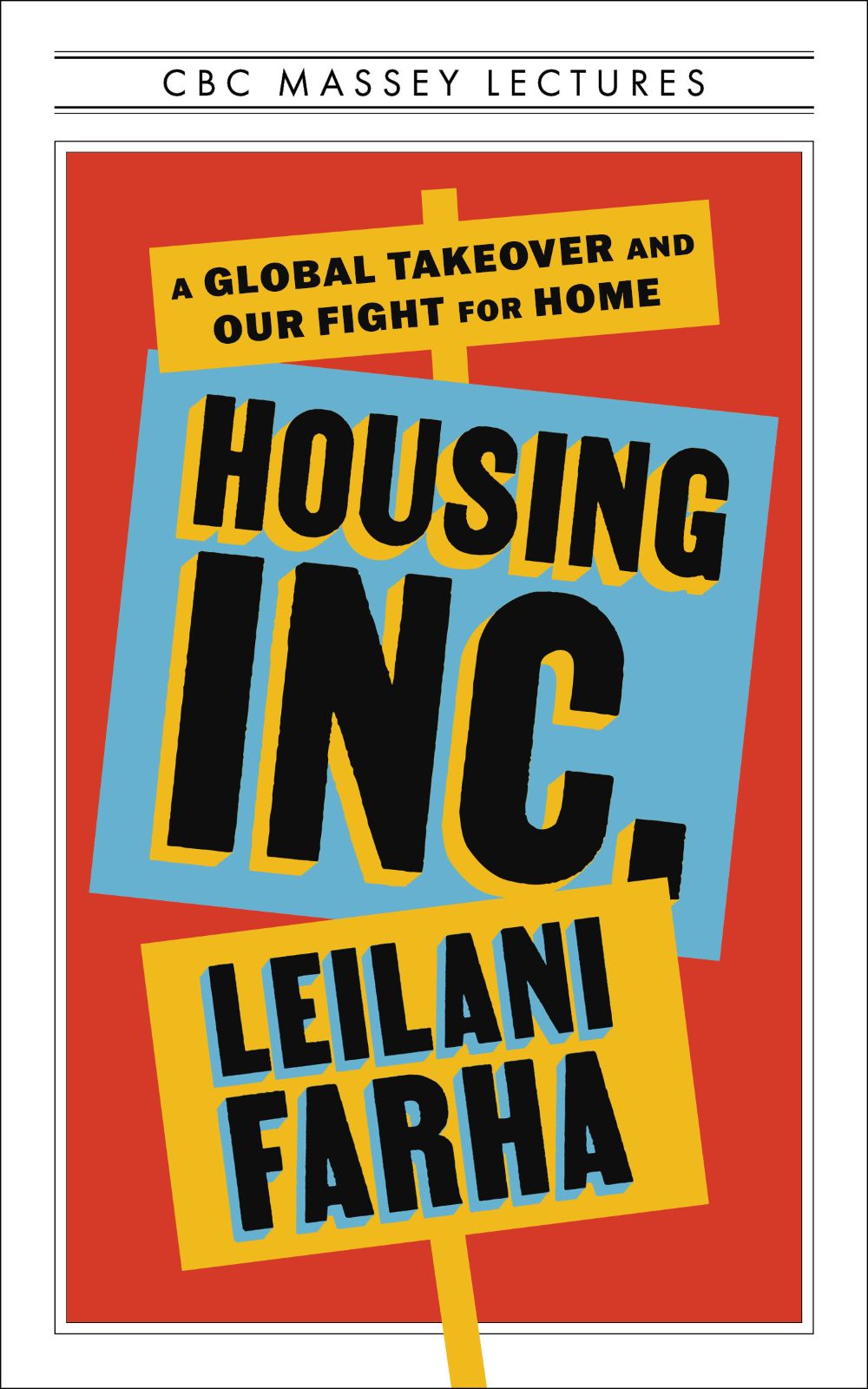
Housing Inc.: A Global Takeover and Our Fight for Home
Leilani Farha
House of Anansi Press (2026)
Some of the most impactful people are those who see the difficult reality of the world as it is while envisioning what it could be, if only creativity and big-picture thinking took the lead. Leilani Farha is one such person.
The first Lebanese Canadian to deliver the annual CBC Massey Lecture, Farha will give two talks in Vancouver on Oct. 22 and 23 as part of a 2026 national tour. That same week on Oct. 21, she will be at the Vancouver Writers Fest to discuss how the financialization of housing has divorced us from understanding it as a human right.
Her message bears repeating and deserves deep listening, particularly as we approach both municipal and provincial elections in B.C.
Farha’s first book Housing Inc: A Global Takeover and Our Fight for Home became an instant national bestseller when it published this fall, with good reason. The book confronts what other writers on the same topic tend to circumvent: that the global housing crisis is the outcome of years of colonialism, racism and the widely held, politically reinforced belief that the market will fix itself.
Farha’s expertise as the global director of the international human rights organization The Shift informs her writing. So does her years of work as a human rights lawyer and the former United Nations Special Rapporteur on the Right to Housing, a role she held from 2014 to 2020.
As special rapporteur with the UN, Farha travelled from her home in Ottawa to meet with hundreds of people around the world living in a range of circumstances, from encampments to their cars. She also visited the residents of informal settlements, renters facing eviction and people who had lost their homes in the 2008 financial crisis.
One community leader showed up late to their appointment because he was struggling to find somewhere to wash his hands before he shook hers. A California woman who lived with her daughters in her car expressed guilt for not being able to provide them with a place to keep milk cold for cereal in the morning.
Conversations and encounters like these formed the basis of her reporting work and efforts to demonstrate how treating housing as an investment and revenue source strips it of its core purpose: to provide residents with a foundation of safety and, importantly, dignity.
“Dignity encompasses both the inherent worth of every person and the conditions necessary to keep that worth intact,” Farha writes. “Housing sits at this intersection — it’s often the difference between dignity being protected or destroyed.”
Farha considers the political decisions that led us to present day, where she, a generation X parent of generation Z, watches her children and their peers struggle to gain independence by forming households of their own.
“It wasn’t supposed to go this way,” she writes. “The postwar human rights framework promised that economic growth would lead to collective advancement — that life would materially improve for everyone. The Universal Declaration of Human Rights enshrined housing as part of its vision.”
Her generation came of age with these postwar values. “Many of us still teach the old promise, because we still believe it could be true. But neoliberal policy is now stealing the future from an entire generation. Housing has become a primary vehicle for this dispossession.”
A ‘slow cancellation of the future’
Housing Inc. blends reporting, analysis and memoir, but some of the most powerful moments in the book arise when Farha turns the lens on her own life.
Growing up in a Lebanese family where household conversations often focused on Palestinian liberation and Israel’s occupation of Lebanon, she was aware, from an early age, of how global injustices impacted her relatives.
“These weren’t history lessons, nor were they grooming sessions for progressive politics,” Farha writes. “They were conversations about our identity, our roots and our culture… like so many migrants and children of migrants, despite successes, despite building a family and rebuilding a life, both of my parents ended up with a foot in two worlds.”
Her grief as she bears witness to the unfolding destruction in Gaza and what she sees as a painful “gap between human rights language and human rights action” finds an outlet in her writing.
Closer to home, she tackles what doesn’t often make it into international housing reports, but which are also indicative of the rapid transformations taking place in Canadian society.
There are memorable scenes where Farha looks back on her young adulthood in Toronto, where she lived for 15 years as a renter in “perfectly imperfect” affordable apartments with thrift-store furnishings. They were the site of spontaneous, crowded parties that spilled out onto the street, and long nights of conversation with friends. These homes were critical to who she would become.
“I worry that for my kids, housing is now so fraught, so expensive, so aspirational and loaded, that there is no longer a backdrop against which to be carelessly young.”
Farha calls this erasure of relatively affordable living arrangements for young people a “slow cancellation of the future.”
Many young people have stopped imagining things will get better and have learned instead to censor themselves from wanting more, because, as Farha writes, they have learned that “dreaming of a home of their own is naïve and unrealistic.”
“This is its own dispossession: not just the home they cannot have, but the future they do not allow themselves to picture.”
To Farha, the solutions to the housing crisis are neither complicated nor new, but their realization requires massive societal transformation. “What’s needed is something outside and beyond — an overhaul of what’s valued, what’s imagined and the people we trust to lead us there.”
She sees the same four recommendations coming up repeatedly across years of work: “Protect people’s security of tenure; stop treating housing as a financial investment; only build housing that serves people and communities, not investors or speculators; and enforce real accountability when rights are not realized.”
In other words: “Home is not an asset; it is where we belong.”
Join Leilani Farha for a Vancouver Writers Fest conversation with Tyee senior editor Jackie Wong on Oct. 21. Farha will deliver the 2026 CBC Massey Lecture in Vancouver on Oct. 22 and 23. ![[Tyee]](/design-article.thetyee.ca/ui/img/yellowblob.png)



Tyee Commenting Guidelines
Please note that email notifications for replies are not currently working due to a software issue which may be resolved in a future update.
Comments that violate guidelines risk being deleted, and violations may result in a temporary or permanent user ban. Maintain the spirit of good conversation to stay in the discussion and be patient with moderators. Comments are reviewed regularly but not in real time.
Do:
Do not: