

 SHARE:
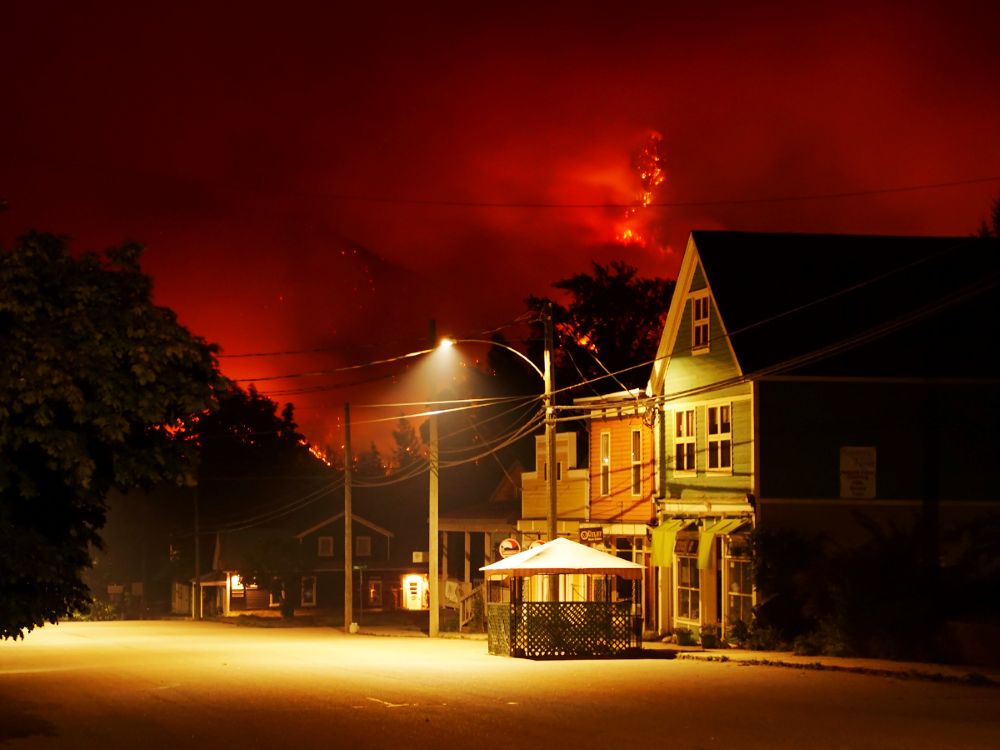
Petra Hekkenberg sat on the shore of Slocan Lake and watched a wildfire charge across a wilderness mountainside in Valhalla Provincial Park across the water.
It was early evening in the small Kootenay village of New Denver in a summer Slocan Valley residents will never forget.
“The fire was just leaping hundreds of meters at a time through the park,” she remembers. “A wall of fire with trees candling ahead of it.”
In 2024 five simultaneous wildfires terrorized Slocan communities, threatening homes from all directions. Silverton and Slocan were evacuated and for several weeks the highway connecting the two towns was closed.
At the lakeshore, Hekkenberg decided to go for a swim.
“I wanted to go for one last apocalyptic swim with this fire backdrop,” she said.
The fire was two kilometres away, but as she moved out into the lake, Hekkenberg glanced over her shoulder toward her house north of town. In the distance, on the shore, she saw a plume of smoke.
The fire had jumped the lake.
In search of Safe Keeping
A year after flames hit the Slocan, Hekkenberg stood in a New Denver studio charting that difficult summer.
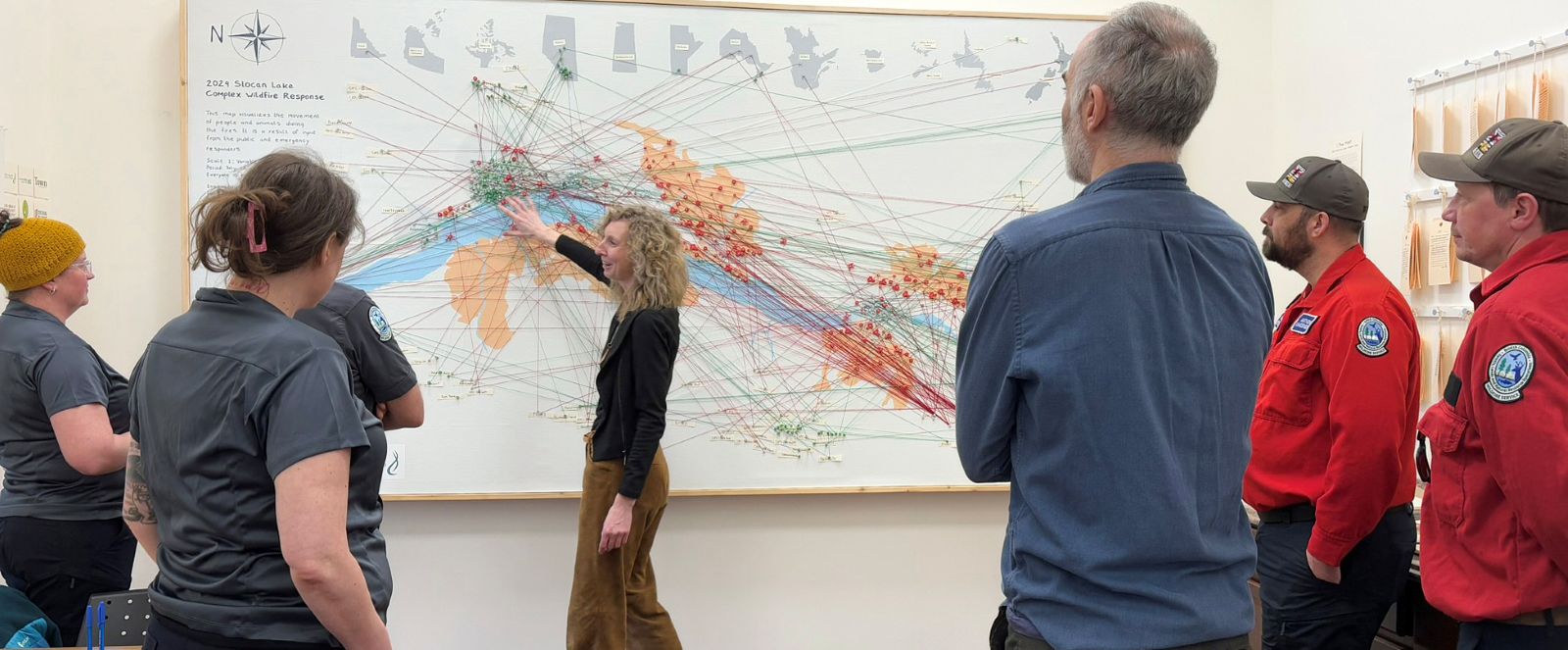
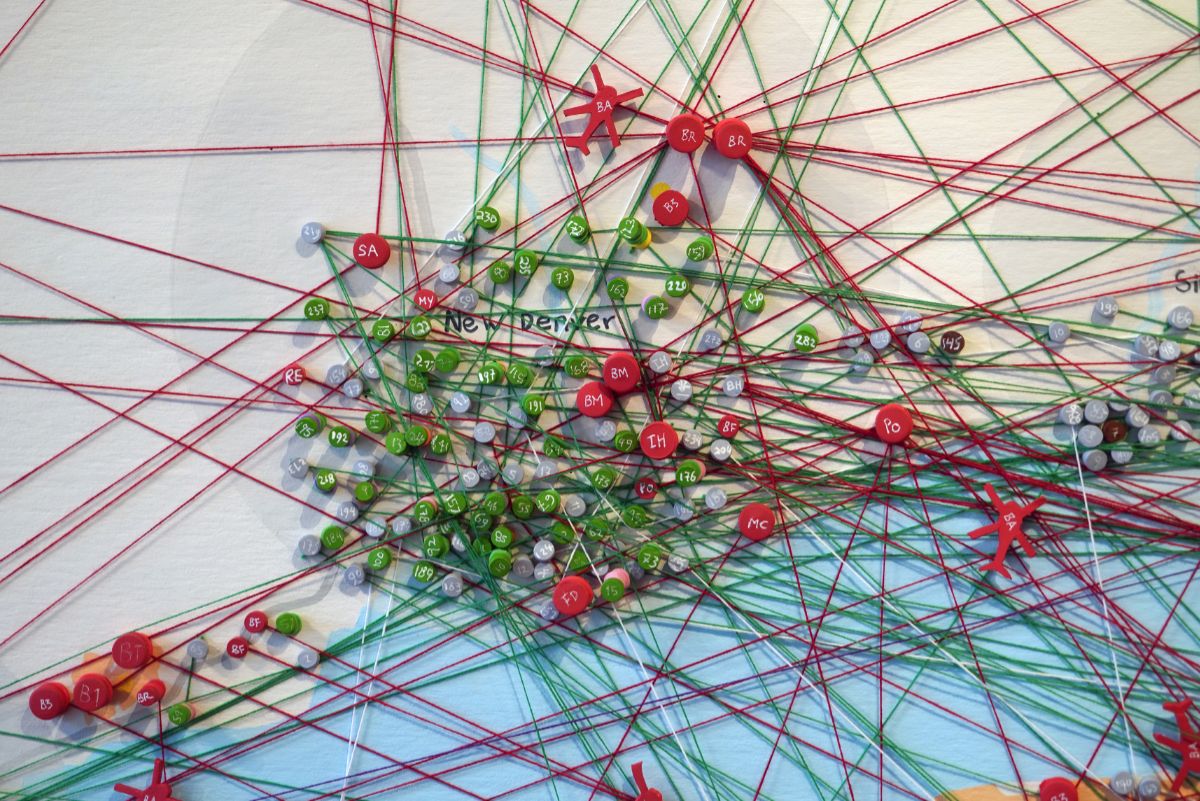
Hekkenberg is an artist and the fires had inspired her to consider that summer’s uncertain legacy. The result was The Art of Safe Keeping, a remarkable participatory art exhibit exploring the stories of evacuees and firefighters.
The project included a series of drawings and writings, but its centrepiece was a six-by-twelve-foot map on which a complex maze of colour-coded pins, discs, dots and string traced the movements of individuals and households during the fires. The map chronicled not just residential evacuations, re-evacuations and returns, but also the movements of first responders. In the studio, more than 200 locals mapped their dislocation the previous summer. She also gleaned and added information about the comings and goings of those helping the evacuees and battling the flames.
After the fire jumped the lake, Hekkenberg had frantically driven home. She discovered her house was safe but, deciding it was time to leave, packed and moved to a friend’s house in New Denver.
There, she had wandered the streets at night, worried that a fire might start in town. She also immediately joined a crew of volunteers at a New Denver community centre, where they made meals for firefighters and evacuees. She witnessed how the social life at the centre gave evacuees some relief from their fear and dread.
Although Hekkenberg and most other valley residents eventually returned to their properties, the experience left a mark that continued to reverberate. The experience is increasingly common in British Columbia where flames now frequently force thousands of people from their homes during the summer.
Hekkenberg saw the evacuations as displacement and migration and knew the effects would linger after the smoke receded.
“The fires were over, but I was left with that feeling of, it’s not truly over,” she said.
Thus began the Art of Safe Keeping.
During the mapping sessions, participants lingered at a dining room table and chairs, talking with Hekkenberg and each other. Some returned several times, finding it a place of solace.
Not everyone initially wanted to participate. But some who initially said they didn’t want to then changed their minds, drawn in by the conversations.
Some participants told Hekkenberg that the process was more emotionally difficult than they expected.
“It was overwhelming for some of them,” she told The Tyee. “It stirred up emotions they didn’t know that they had.”
As part of the exercise, participants listed the precious things they would never leave behind in an evacuation. The items, which were listed on luggage tags, were incredibly diverse and included Japanese knives, Amish sleigh bells, bicycles, a cedar strip canoe, childhood puppets, a grandmother’s chair, Pokemon cards, artwork, lottery tickets and a tractor.
Hekkenberg also hosted visits to her map by firefighters and other first responders, with the aim of improving understanding between them and the evacuees.
“I wanted the emergency responders to be able to see this map and the show, and see the impact on residents,” she said. “And I wanted the residents to be able to be like, ‘Whoa, there’s a lot involved in an emergency response and it’s very complex and there are like 1,570 people that came out to help us.’
What she learned
The project and the Slocan Valley’s experience revealed areas where authorities can better support evacuees in the future, Hekkenberg said.
Although she respects the firefighting effort and complexity of managing a large evacuation, she said people dealing with fear and loss needed more emotional support. Some went for weeks not knowing whether their house was still standing. Others moved two or three times to friends or relatives. Some evacuated great distances, to friends or family outside the area. Other families were separated as one member stayed behind the fight the fire. Weeks of thick smoke added an apocalyptic hue to the obscured landscape. For some who live alone, the evacuation intensified their solitude.
“They were alone in their anxiety and dealing with it,” Hekkenberg said. “Some who evacuated away from the community felt very isolated because they weren’t part of the community coming together.”
“When a whole community gets evacuated, you’re all spread out and it’s hard to not be with people that understand how you’re feeling in that moment.”
Hekkenberg said communication challenges between residents and various authorities were also instructive.
“I think the hardest part in our area was that communication wasn’t prioritized. And in a way I get it, because they’re trying to fight fires to save people’s homes.”
She said residents did not receive enough updates on the progress of the fires and the status of evacuation alerts and orders — or the information was not given consistently in media that people could access.
“Better updating would prevent a lot of trauma,” she said. “That was one of the hardest parts: the unknown, the not knowing whether your house is still there, not feeling like there is a place for you to talk, to ask questions.”
The map, luggage tags and drawings have toured the West Kootenay during 2025 and 2026, including a lengthy run in the Nelson office of Kootenay Central MLA Brittny Anderson.
A book has also been compiled, and is now available at Kootenay book stores and online. It contains photos of the map and the fires, Hekkenberg’s drawings and first-person accounts of the evacuation from residents and first responders. ![[Tyee]](/design-article.thetyee.ca/ui/img/yellowblob.png)
Read more: Art

Tyee Commenting Guidelines
Please note that email notifications for replies are not currently working due to a software issue which may be resolved in a future update.
Comments that violate guidelines risk being deleted, and violations may result in a temporary or permanent user ban. Maintain the spirit of good conversation to stay in the discussion and be patient with moderators. Comments are reviewed regularly but not in real time.
Do:
Do not: