


 SHARE:

The Canadian Craft Brewers Association says it represents the interests of nearly 1,200 craft breweries, brew pubs and suppliers across the country.
It has also been actively advocating against developments in health policy related to alcohol.
Alcohol is considered a leading preventable cause of death in Canada. The risks are well established. Increased consumption raises the likelihood of cardiovascular issues, liver disease and at least seven types of cancer. In Canada, alcohol is responsible for nearly 9,500 new cases of cancer and 4,000 cancer deaths each year.
“The bottom line is, and this is where the science is absolutely consistent, that if you drink, when it comes to health, less is better,” said Dr. Tim Naimi, a physician and director of the Canadian Institute for Substance Use Research at the University of Victoria.
In recent years, public health leadership has been working to stem some of the harms of alcohol. Health Canada funded new guidance on alcohol and health published in 2023, which reduced consumption guidelines.
There have also been calls at the federal and provincial levels to put health warning labels on alcohol, similar to those used for tobacco and marijuana.
These initiatives have received predictable resistance from the alcohol industry — and that pushback isn’t limited to the international conglomerates often referred to as Big Alcohol.
The Canadian Craft Brewers Association and the BC Craft Brewers Guild, more often associated with neighbourhood small businesses with meaningful roles in their communities, have also been actively involved in advocating against these initiatives.
Not everyone these associations represent agrees with this advocacy.
“I think we are on the wrong side of history,” one B.C. craft brewery owner, who said he appreciates many of the benefits offered by being part of the association, told The Tyee. The Tyee agreed not to name the owner, who feared that industry retribution could have a serious impact on his small business.
“Alcohol is a deadly poison that you can become addicted to and that’s just a scientific fact, and the idea that an organization I’m affiliated with is trying to make that harder to find out is troubling to me,” he said.
He believes informing customers of the risks is the right thing to do. “It’s not fair to the consumer if you’re not giving them all the information,” he said.
Beer, “done responsibly,” can be very enjoyable, he added. “You have to decide as a consumer to balance those benefits against the risks.”
The debate around updated drinking guidelines and warning labels comes at a time when the craft brewing industry is facing rising costs and shrinking margins. Last year, Business in Vancouver reported that 20 of B.C.’s 240 craft breweries had recently shuttered.
The Tyee reached out to nearly 100 breweries across the province. We learned that brewers on both sides of the debate are reluctant to speak publicly, demonstrating the conflicted positions of these small businesses between economic success and sometimes survival, industry solidarity and their relationships with their consumers and communities.
The Tyee contacted the Canadian Craft Brewers Association for comment on this story, but it declined. Instead, the association suggested a conversation with an unaffiliated professor who told The Tyee he didn’t “know anything about their advocacy around health at the federal level.”
Responding to new health information
The alcohol industry, like many other industries, lobbies federal public office holders on a variety of topics, often predictably economic. However, since 2023, the Canadian Craft Brewers Association reported at least 44 lobbying meetings with federal officials on health issues, specifically related to updating the 2011 low-risk alcohol drinking guidelines and proposed warning labels.
Health is an area some believe the industry shouldn’t be involved with at all.
“When the alcohol companies start sort of interfering or trying to obstruct stuff related to health, that’s not their lane,” Naimi told The Tyee.
Adam Mills, co-founder and general manager of Four Winds Brewing in Delta, generally supports the Canadian Craft Brewers Association’s advocacy. However, he acknowledges there is a conflict when it comes to issues of health.
“I don’t necessarily think they should influence the health advice,” he said, “because they’re not health experts.”
In 2020, Health Canada funded the Canadian Centre on Substance Use and Addiction to compile the best science available to update the 2011 low-risk alcohol drinking guidelines. These guidelines suggested women consume no more than two standard drinks per day and 10 standard drinks per week, and men, three standard drinks per day and 15 standard drinks per week.
The updated guidance released by the Canadian Centre on Substance Use and Addiction in 2023 reduced these targets substantially.
The 2023 guidelines say that at three to six standard drinks per week, the risk of developing several types of cancer, including breast and colon cancer, increases.

While provinces such as British Columbia and Alberta have formally incorporated the updated guidance into their provincial recommendations, Health Canada itself has not shared them on its website. The reason is unclear, but those following the issue believe pressure by the alcohol industry has played a role.
“The industry has been on record as being very active in lobbying on this front,” said Naimi. “I’ll just say they’ve been successful.”
The Canadian Craft Brewers Association is advocating that Health Canada keep its 2011 guidance, urging the department to let Canadians know it has not changed.
“The lower limits that you may have heard about are a set of recommendations contained in a report from an advisory group that was asked to do a review of the current LRDG [low-risk drinking guidelines]. The recommendations have not been accepted by Health Canada at this time,” its website says.
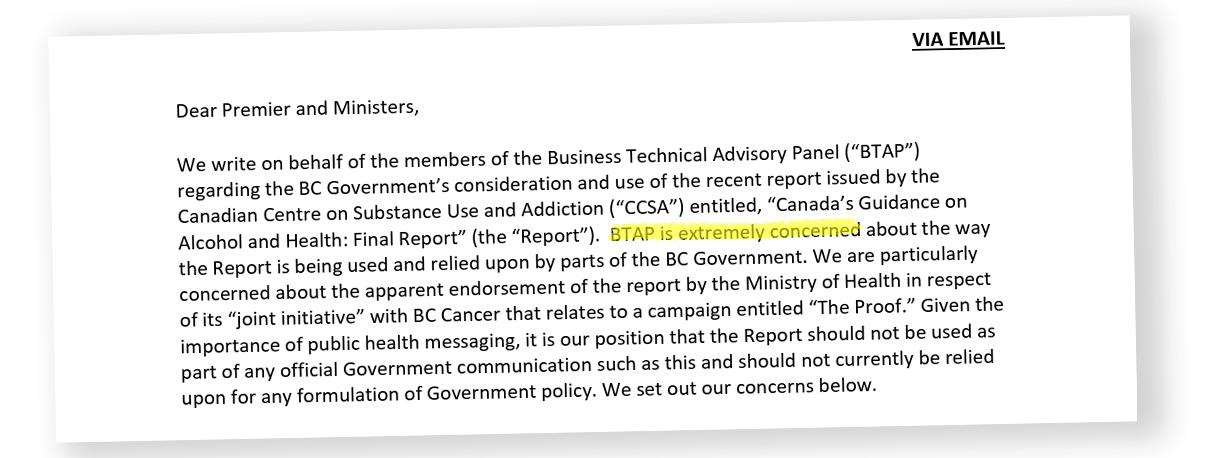
This position is also supported by the BC Craft Brewers Guild, which represents over 200 breweries and brew pubs. The guild wrote to Premier David Eby to say it was “extremely concerned” about the way the new guidance is being relied upon by the provincial government.
The BC Craft Brewers Guild declined to comment for this story.
While Health Canada provided $1.5 million to create the guidelines and an additional $2 million following their release to mobilize knowledge around alcohol use for Canadians, not formally posting them has created confusion about their legitimacy.
“They don’t even agree with themselves or haven’t figured it out yet, because they haven’t adopted those guidelines on the actual Health Canada website,” said Mills of Four Winds Brewing.
Health Canada refused questions on why it had not posted the new guidance but sent a statement.
“Any amount of alcohol consumption has health risks,” Karine LeBlanc, senior communications adviser for Health Canada, wrote in an email. “Health Canada continues to emphasize that any reduction in alcohol use has health benefits, and that individuals who do not drink are not encouraged to start.”
Warning labels
In 2017, the Yukon introduced alcohol warning labels as part of a study led by the Canadian Institute for Substance Use Research.
Four weeks into the eight-month study, the territorial government paused research, saying it could not afford potential litigation costs amid significant opposition from the alcohol industry.
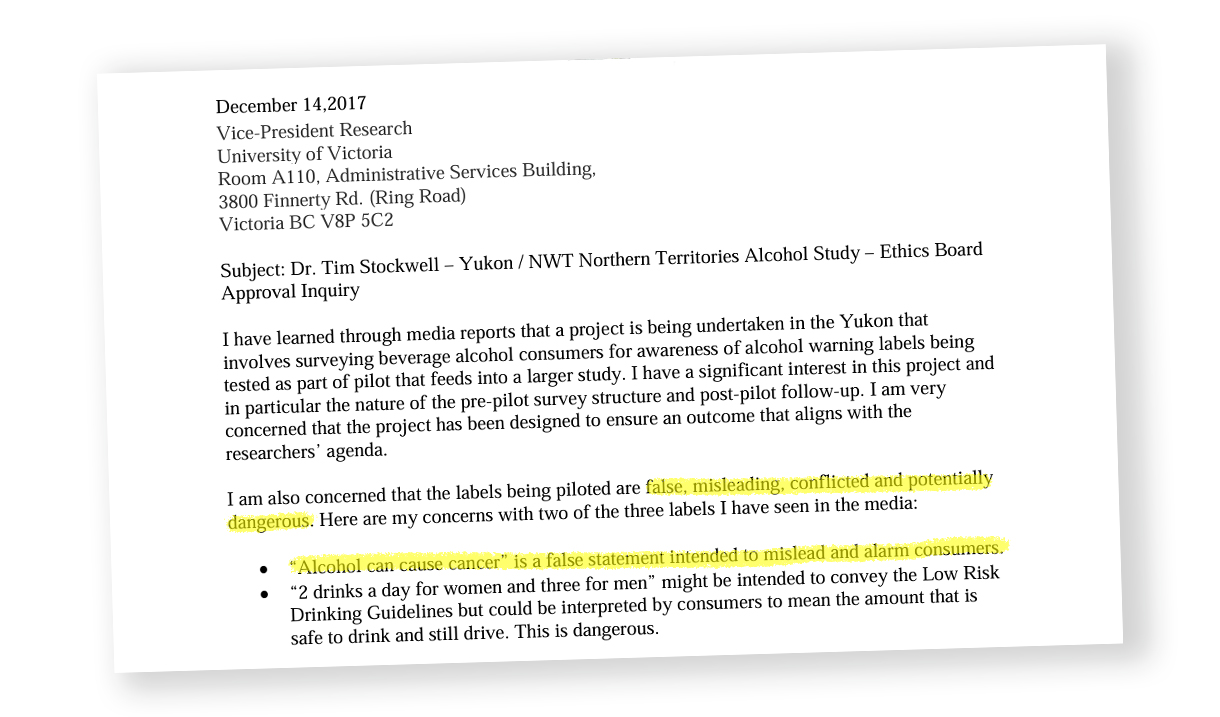
Part of this opposition came from the BC Craft Brewers Guild. It sent a letter to the vice-president of research at the University of Victoria to express concern about the study, calling the labels “false, misleading, conflicted and potentially dangerous.” The guild specifically pointed to a label that said, “Alcohol can cause cancer,” calling it “a false statement intended to mislead and alarm consumers.”
The evidence that alcohol can cause cancer, however, is well established. Nearly 40 years ago, the World Health Organization classified alcohol as a Group 1 carcinogen alongside tobacco and asbestos.
Currently, labelling has been suggested federally, through Senate Bill S-202, and provincially, through Dr. Bonnie Henry’s 2026 annual report.
The provincial report noted that many British Columbians are unaware of the full health risks associated with alcohol use and recommended the province require evidence‑based labels on alcohol packaging warning of risks of cancer, to pregnant people and of fetal alcohol spectrum disorder.
The Canadian Craft Brewers Association is lobbying at the federal level against the Senate bill, which it claims “proposes to over-simplify these issues in a manner which is misleading.”
Lobbyists from the association met with senators 13 times while warning-label legislation was being studied in the Senate. This included a 2025 meeting with B.C. Sen. Duncan Wilson, who recently unexpectedly halted debate on the bill, pushing back progress to the fall after months of study, when it had been expected to move to the House of Commons this spring.
Positions on warning labels among brewers is mixed. The unnamed brewery owner supports bringing in warning labels and believes they are an inevitable development. He hopes the Canadian Craft Brewers Association will change its position and play an active role in negotiating how they are implemented, such as creating labels that preserve brewery branding. He also pointed out that changing labels would come at a cost to brewers; he said he hoped there could be some support for small businesses when this change comes.
Rob Davis from Foamers’ Folly Brewing Co. in Pitt Meadows believes clear and accurate information should be available to consumers.
“I do think that the customer should be informed on what is safe and what’s not,” said Davis.
But he argued that if warning labels are too complicated or detailed, customers simply will not read or care about them. He is concerned about alcohol getting cigarette-level warnings and thinks that placing “This causes cancer” on every can without clear context will trigger an unintended fear response rather than providing helpful guidance.
Mills of Four Winds Brewing said he supports public education and informing consumers about responsible, moderate drinking. He specifically supports the Senate bill’s proposal to put standard drink counts on cans or bottles.
However, he objects to the part of the bill that says a warning label would contain a message about a direct causal link between alcohol consumption and the development of fatal cancers.
“By putting a label of that nature right on the product, I think that we’re running the risk of conflating a very casual beer consumer drinking a few beers a week or even a few more to, you know, a heavy daily drinker,” said Mills.
Mills said he does not have enough information to comment on whether alcohol is a carcinogen. Before any health warning labels are implemented, he believes there must be a definitive, conclusive scientific consensus and more comprehensive, in-depth studies, rather than what he perceives as potentially “cherry-picked” data.
Another way forward
Kara Thompson, an associate professor of psychology and research chair in substance use policy and prevention at St. Francis Xavier University in Antigonish, Nova Scotia, said she’s heard the concerns of the craft beer industry about labelling but doesn’t believe they outweigh the obligation to inform consumers.
“The idea that alcohol is for some reason exempt from having to tell consumers that their product carries risk when alcohol, ethanol, has been a carcinogen for 40 years, is insane,” she said.
She spearheaded a small, grant-funded study where she partnered with Candid Brewing Co., a local craft brewery in Antigonish, to place more than 7,600 warning-labelled cans into circulation, surveying a group of consumers over six months to evaluate label noticeability, knowledge improvement and support for labelling.
Thompson said Candid Brewing participated in the study because the owners were interested in the research, wanted to be involved in something innovative and felt a strong kinship to their community.
When the study launched, Bryan Druhan, co-owner of Candid Brewing, told CBC: “It’s nice to be out ahead of it. It’s certainly happened in other jurisdictions, so having a chance to be in collaboration.”
The results will be published later this year. Thompson believes they will show brewers that fears about labelling drastically changing their businesses are unfounded.
“We all know that things are bad for us and we continue to do them anyway,” she said.
“Knowledge does not directly translate into behaviour change, but knowledge is a right as a consumer.” ![[Tyee]](/design-article.thetyee.ca/ui/img/yellowblob.png)
Read more: Health












Tyee Commenting Guidelines
Please note that email notifications for replies are not currently working due to a software issue which may be resolved in a future update.
Comments that violate guidelines risk being deleted, and violations may result in a temporary or permanent user ban. Maintain the spirit of good conversation to stay in the discussion and be patient with moderators. Comments are reviewed regularly but not in real time.
Do:
Do not: