


 SHARE:
At the end of the summer, it’s natural to think about the world ending.
The number of films that have taken inspiration from the end of all earthly matters is legion, and English sci-fi director Ridley Scott’s latest is yet another to the ongoing list.
Scott’s The Dog Stars wandered into theatres last month and will likely wend its way to streaming services soon. The box office numbers have already spoken, and the news is not good.
Dog Stars is not an exceptional outing for Scott, the creator of such stone-cold classics as Alien and Blade Runner. But the film’s lack of remarkability is perhaps its most interesting aspect.
Bear with me for a moment for further explication. First, a rundown of the story.
The Dogs Stars takes place in the year of our lord 2035, a scant nine years from present day. A global pandemic has ended most of human life on Earth. The rest of the planet’s inhabitants including deer, fish, bison and lots of stray dogs are having a groovy time, roaming about and living large.
Without the burden of people, the planet has re-asserted itself, becoming lush and verdant once more. Wild new growth has subsumed urban centres, covering everything from McDonalds’ golden arches to local hospitals in a layer of leafy green. Paradisical is the word that springs to mind.
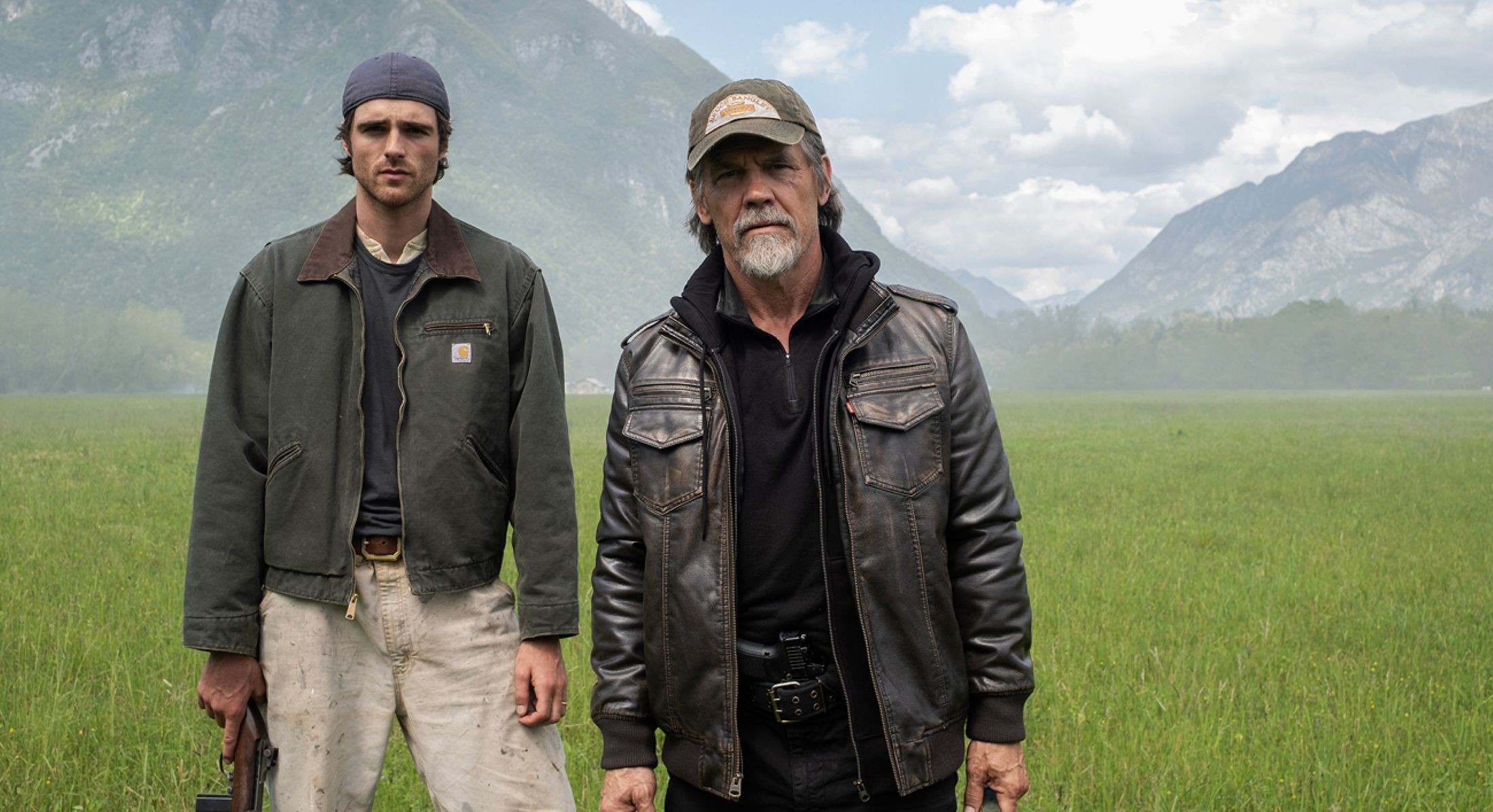
In the opening act of the movie, all of this is presented as a fait accompli. People are over and the planet is back. The remaining human survivors are scratching out an existence in isolated pockets. Two of these people are Hig and Bangley, played by the ridiculously handsome Jacob Elordi and the still pretty durn attractive Josh Brolin. In his infinite wisdom, the creator of this cinematic universe has spared the beautiful people from extinction. Thanks, God!
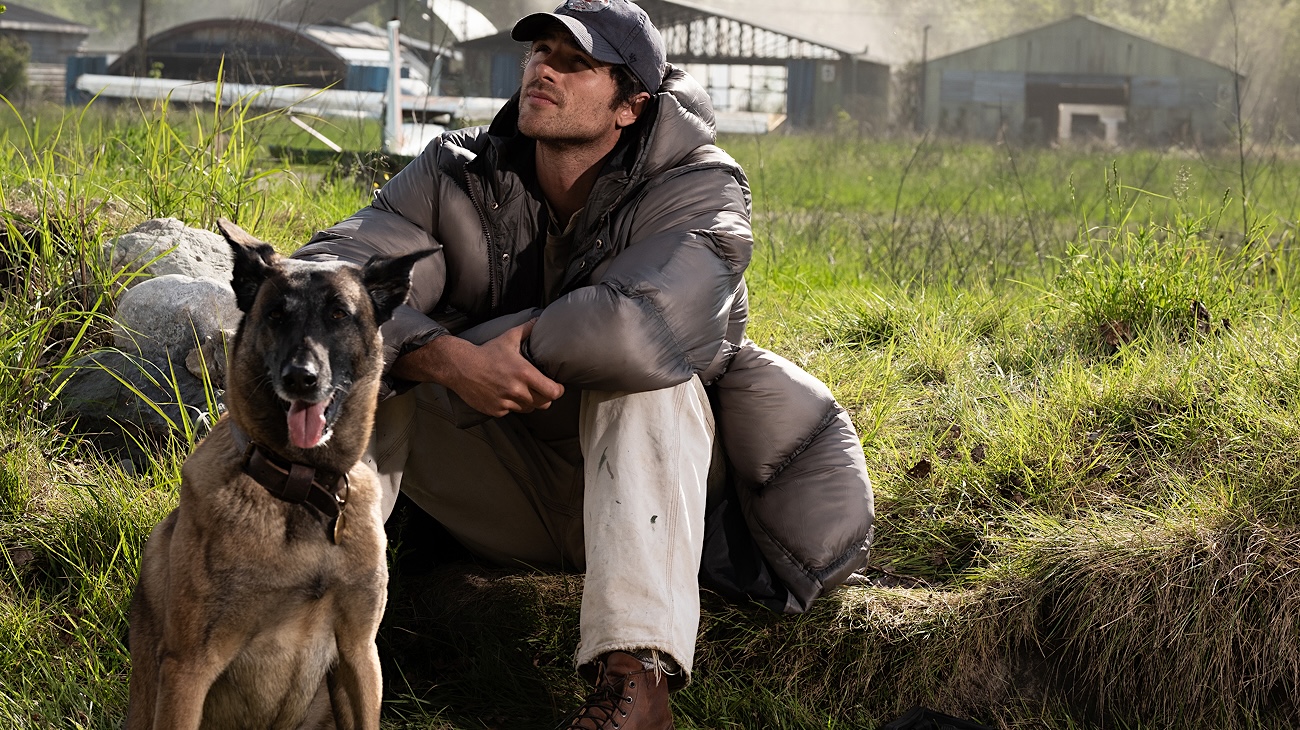
The handsome dudes have fashioned a home base in a rural airport outside of Erie, Colorado. Their partnership is based on mutual support. While Hig flies off in his dilapidated Cessna to search for supplies, his faithful dog Jasper at his side, Bangley quite literally holds down the fort. Ensconced in a wooden watchtower, machine guns at the ready, he scans the perimeter for any scavengers who might want to steal carrots and potatoes.
Invariably, when bad people do show up, they’re gross. Not attractive in the slightest. Blech. They’re done and dusted and torched for their troubles. That’s the law of survival here on this fallen planet: ugly folks get killed. Sorry, I don’t make the rules.
Unlike his partner in survival, Hig isn’t quite ready to give up on humanity. Much to Bangley’s disdain, he delivers food and treats to a nearby Mennonite community, and generally mopes about. Memories of the former world resurface in flashbacks of his wife and unborn child who were lost to the pandemic.
Bangley’s story remains something of a mystery, although his handiness with a weapon suggests certain things.
The first third of the film moves at treacle pace, and just as one is thinking, “this apocalypto stuff sure is boring,” another battle with a roving gang ends in tragedy.
Determined to discover whether any remaining bits of society managed to stick it out, Hig sets forth in his little plane, only to experience engine trouble and crash land in a nearby valley. Here, he discovers another pair of survivors, a father and daughter. Pops (Guy Pearce) and Cima (Margaret Qualley) are also eking out an existence on a tiny homestead complete with chickens and donkey.
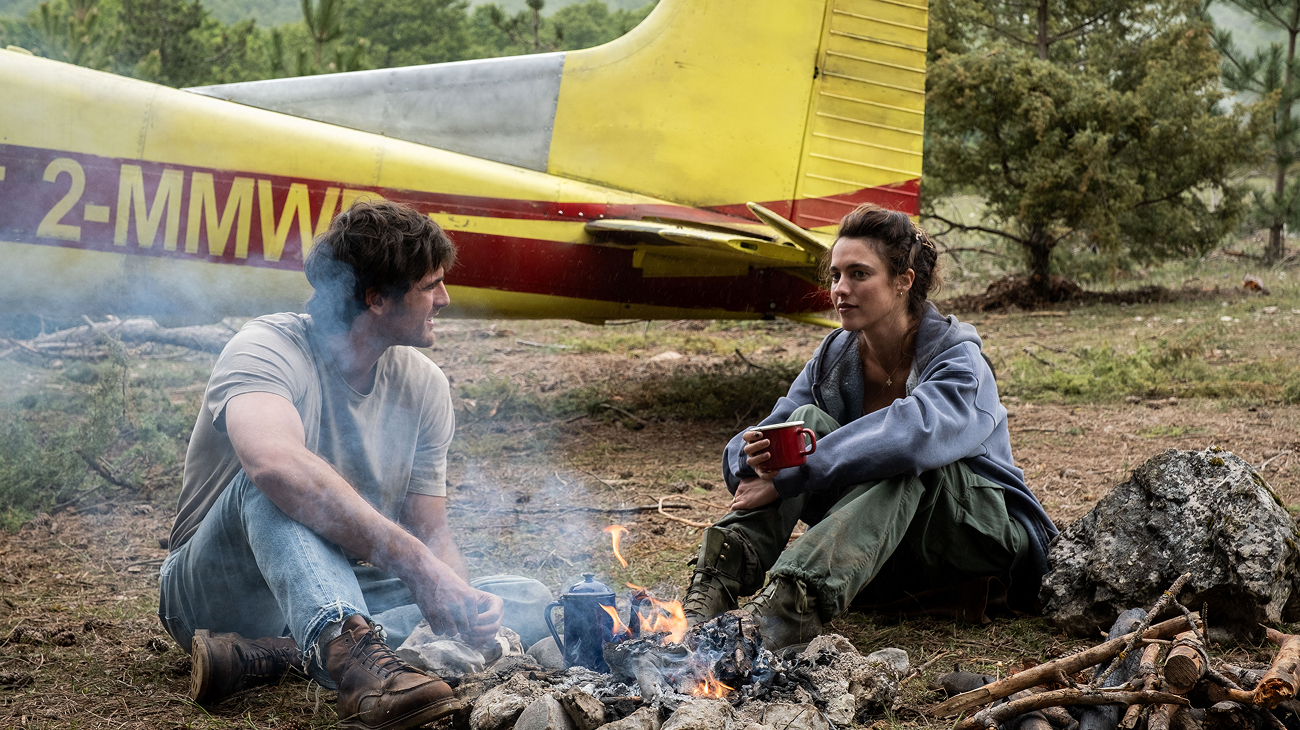
After some initial bristling, the trio bond over the hard work of pulling stumps and clearing a path for Hig’s downed plane to take off again.
Sima and Hig, both big winners in the genetic lottery of good looks, are obviously meant to be a couple. Both are nursing deep grief from losing their former partners in the pandemic, but this bruising sorrow only serves to make them even more attractive.
But before any sexy stuff can happen, yet another group of killers shows up, this time on horseback with bows and arrows.
It was at this point in the film that a thought crossed my mind. Are the marauders in this scene supposed to be Indigenous? What the hell?
It was also here that I had a flashback to an earlier version of the fantasy return to a simpler age when white men with valour, guts and lots of guns ruled the roost.
A cowboy ideal has shaped the Trump administration
In her spring 2025 talk at the Chan Centre for the Performing Arts in Vancouver, American historian and author Heather Cox Richardson made the point that the current U.S. government lives in a fantasy version of the past.
This cowboy version of governance had informed the Trump administration’s approach to everything from women’s reproductive rights to gun control.
In many aspects, The Dog Stars is a nouveau Western, resurrecting tropes associated with classic films like The Searchers and Shane.
I’m not the only critic who noted the similarities. In her review for the Jacobin, writer Eileen Jones states it bluntly.
“Who wants to go back to that when you can return to the restored wilderness as a heroic white settler in the world where men are men again, fulfilling their Manifest Destiny, and women appreciate them properly?” Jones writes.
“When you can start all over again with tons of land to spread out on and all the resources that the deceased population of the world won’t be needing anymore?”
Here is where a silly box office bust starts to feel slightly ominous. It falls squarely within a genre that has come to parallel and inform things that are taking place in the real world, often with dire consequences.
A ubiquitous regression
One of the things that often happens in a dystopia like the one depicted in Dog Stars is that societal infrastructure gets stripped bare. All niceties and politesse fall away, and a rawer, ruder reality emerges, like a rusted-out car wreck in a river.
In this world, men are men, women are subservient, and guns are everywhere. If this were an isolated thing, I wouldn’t make much of it, but this retrograde version of the future is ubiquitous.
What Cox Richardson calls “cowboy individualism” isn’t just the idea that white men and their ilk should be in charge of things. The conservative ideological framework suggests that the natural order has been supplanted and perverted, and the forces of woke have ousted the rugged tough dudes and replaced them with whiny women and people of colour.
In her talk at the Chan Centre, Cox Richardson summed up this fever dream of an imagined past: “Those people who embrace cowboy individualism believe that a true American is a man who operates on his own outside the community. He needs nothing from the government, he works hard to support himself, he protects his wife and his children, and he asserts his will by dominating others."
The cowboy hero is certainly not a new invention, but it has surfaced with increasing regularity over the past four decades.
Even before former president Ronald Reagan channeled his Hollywood personae into a made-up version of history, the lone cowpoke remained a fixture in American culture, emerging in a major way after the Civil War.
In her talk, Cox Richardson explained the birth of this concept.
“The cowboy image actually faded in the early 20th-century progressive era, which is itself an interesting story. It sprang back to prominence in the 1950s and the 1960s as a propaganda tool to oppose the wildly popular, post-World War II government,” she said.
“People who were determined to get rid of government regulation and taxation resurrected the myth of the American cowboy. They championed this idea of cowboy individualism. They embraced the idea that a government that worked for ordinary Americans was a form of socialism because it redistributed wealth from hard-working white people to Black Americans, people of colour and women who demanded equal rights.”
The myth of cowboy individualism became central to the culture of Republication politics, she added. It was used as a strategy for Republican politicians to win the support of voters in their aims at destroying federal programs that helped them.

‘They dismissed all government policies’
In addition to neo-Westerns like Dog Stars, other cinematic genres have adopted similar ideologies. I would argue that the “old white man revenge film” featuring aging action stars like Liam Nisson, Jason Statham, Clint Eastwood — even Bob Odenkirk for Christ’s sake — are doing something similar.
In the film Normal, released earlier this spring, Odenkirk plays a small-town sheriff named Ulysses (no less) who is forced to pick up a gun and head off the Yakuza. There’s not much point in revisiting the plot of the movie except to say, old whitey wins again. Yeehaw!
You don’t have to go very far to find similar narratives: men, guns, vengeance, all in the ultimate service of power and control.
So, are there larger conclusions to draw from this formulaic exercise in another dystopic version of the future? It’s just a movie, right?
Films are not only a reflection of current social realities. They are also, perhaps, a rehearsal for things to come.
It’s here where something as unremarkable as a bad Ridley Scott film gives me pause.
Again, I defer to the inestimable Cox Richardson to put into clear terms the forces moving beneath our feet.
“The rhetoric of cowboy individualism became more and more extreme. They demonized non-white Americans and women in the public sphere,” she told the audience at the Chan Centre.
“And they dismissed all government policies that promoted social co-operation, whether at home or abroad….and in place of the post-World War II idea of co-operation among equals, they replace that idea with the idea that individual men should dominate society, ordering it as they thought best.”
After epic bloodshed and violence at the end of The Dog Stars, a bucolic vision of a neo-agrarian existence is reasserted. There are women in bonnets and men in straw hats and overalls, whooping it up under the benevolent heavens. ![[Tyee]](/design-article.thetyee.ca/ui/img/yellowblob.png)
Read more: Rights + Justice, Film












Tyee Commenting Guidelines
Please note that email notifications for replies are not currently working due to a software issue which may be resolved in a future update.
Comments that violate guidelines risk being deleted, and violations may result in a temporary or permanent user ban. Maintain the spirit of good conversation to stay in the discussion and be patient with moderators. Comments are reviewed regularly but not in real time.
Do:
Do not: