


 SHARE:

Vancouver makes a good setting for the future. A great many science fiction films and series have been made here. We’ve seen everything from wine-dark vampire movies to nitty gritty cyberpunk stuff.
Ryan Reynolds’ most recent film, The Adam Project, joins a long list of slightly altered versions of Vancouver. The Vancouver-born Hollywood actor and celebrity Tyee supporter has a fondness for his hometown.
Reynolds, on a junket to talk about his new film, was forthcoming about wanting to make the movie here, not only because of the local crews and other production folks, but also because of the city itself.
“Typically in these larger scale-scale movies, you skim the background for visual effects. I love Vancouver. And every opportunity I could, I said, ‘Could we just leave UBC, do we really need to change it all, let’s just save some money and leave it as is, it looks great,’” Reynolds said. “For the most part, I tried to keep as much of Vancouver in there as possible.”
The man is certainly no stranger to setting films in his hometown. Deadpool shut down the Georgia Viaduct for a good portion of time in summer 2017. Landmarks like The No. 5 Orange strip club and the Cobalt Hotel also had cameos.
Many of the settings in The Adam Project will be intimately familiar to anyone who lives here, although there is a fair amount of movie-making manipulation. The Vancouver Convention Centre stands in for the technocrat villain’s villainous lair, complete with a giant video projection of her likeness. Other notable locations include Jack Poole Plaza, Park Royal mall and the Blarney Stone pub.
Ryan Reynolds is a very pleasant and thoughtful person. Maybe he just wants to come home, make movies and eat at Minerva’s restaurant every night. There’s nothing wrong with that.
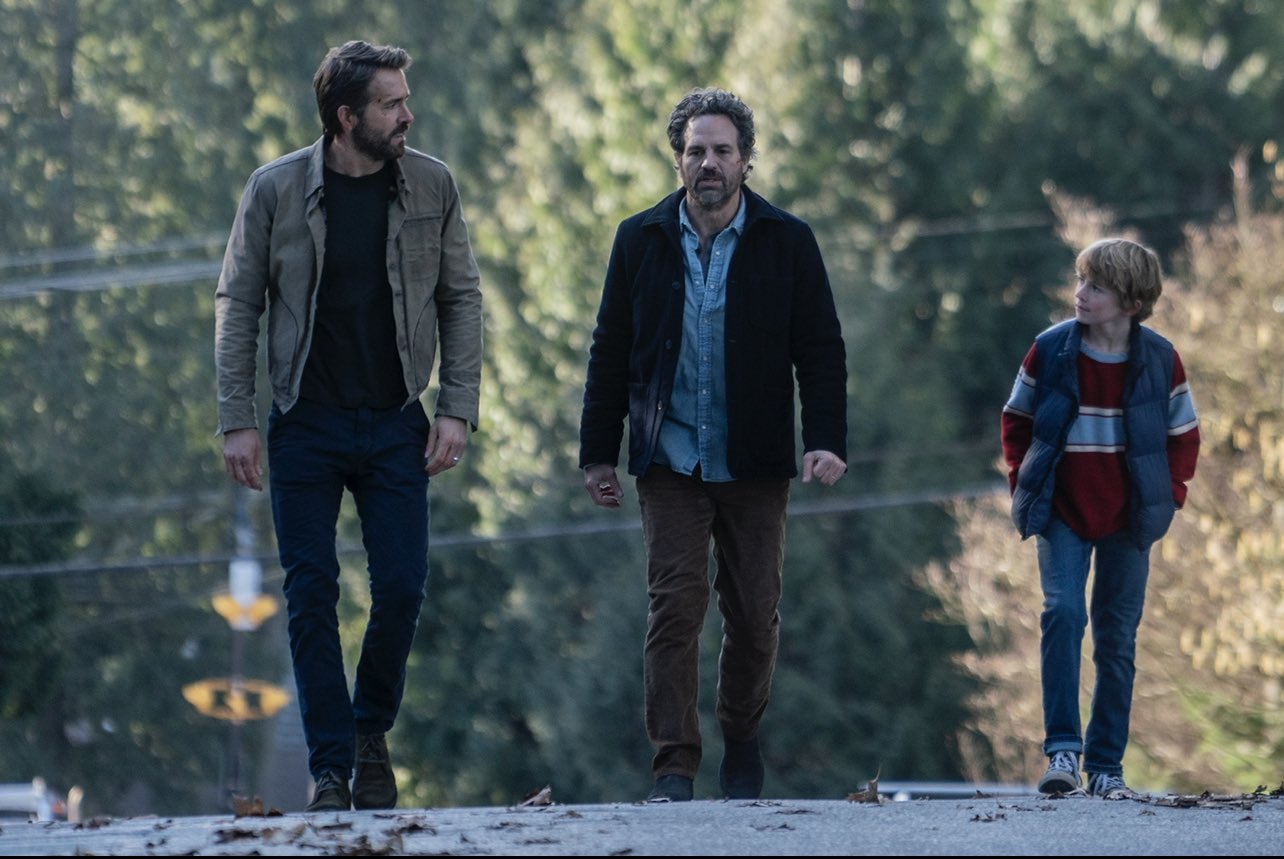
“I’ve properly produced four films: Deadpool 1 and 2, Free Guy, and now The Adam Project. I usually push films to Vancouver,” Reynolds noted.
“It’s home for me and there’s a selfish component. But the crews are top-notch, so why not go home, it’s a great town to shoot a movie in. Also selfish, but they’re huge job generators and I like being able to bring scaled projects that have that kind of enterprise vibe about them to my home.”
Vancouver’s ability to play something other than itself is well-documented, but there is nothing that can yank you out of a film like seeing familiar streets and buildings onscreen that you’ve passed on your own feet. When a car chase starts in the downtown core and seconds later is out by the Tsawwassen ferry terminal, a cynical corner of one Vancouver viewer’s brain might say, “That can’t be right?”
So, what makes the city such an ideal place to make movies from the future? Is it the perpetual rain, the terminal city vibes, the weird melange of different architectural styles or the tax credits? Let’s head to recent past to find out.
The Burrard bridge and Vancouver law courts: cinematic heavy hitters
I remember thinking, “Wait a minute, this looks familiar!” while watching the 1984 film Runaway starring Gene Simmons and Tom Selleck. Directed by author Michael Crichton (Jurassic Park), the film was supposed to launch Selleck into movie stardom. At the time the actor was riding the wave of television fame with Magnum P.I. The film also offered Simmons his first acting role as the ruthless Dr. Luther.
Simmons would go on to embody startling characterizations, such as Velvet Von Ragnar in perhaps one of the worst films ever committed to celluloid, Never Too Young to Die, wherein he rubbed up against John Stamos, singer Vanity, and George Lazenby of James Bond fame. WHAT??! You say.
But I digress, back to Runaway.
In the film, Vancouver stands in for an unnamed city of the future, where a special police squad is dedicated to dealing with disobedient robot helpers. The hero, one Jack Ramsay (Selleck) has a debilitating fear of heights and the city’s towering towers only compound the problem.
Famous local faces like actors Jackson Davies and Babz Chula pop up in supporting roles, but the heavy lifting is taken on by landmarks like the Burrard Bridge and the Vancouver Law Courts plaza, transformed into a swanky outdoor restaurant, wherein hero and villain stage a showdown. To be fair, in spite of its clunky premise and Simmon’s pop-eyed over-acting, there is a lot of charm and even a wee bit o’ silliness that makes it an amusing and nostalgic look back at futuristic Vancouver.
Runaway had the unfortunate timing of landing in theatres just as James Cameron’s Terminator hit the big screen — its nasty little spider-bots never really stood much of a chance. But Vancouver held up particularly well as a sci-fi city.
Rain-washed streets, slippery with reflected streetlight, trees, ocean, mountains, and so on: it’s all useful. Certain places show up and over again. The high brutalist style of Simon Fraser University’s Burnaby campus makes an ideal backdrop for Orwellian compounds and monstrous corporate headquarters. The Lion’s Gate Bridge has been cinematically obliterated so many times I’m surprised people are still okay to drive over it. What if Godzilla shows up, yet again, and takes out both you and your minivan?
Science fiction series like Battlestar Galactica, The X-Files and Altered Carbon have all been filmed here and the city is currently hosting shows like The Flash. Anyone who has worked in the downtown core has had the experience of having to walk through film crews or been sitting in your office watching some dude in a red rubber costume trudge by your window.
Witnessing the back end of a film shoot, like seeing the back end of anything, kind of takes the magic out of it.
An ideal site for futurism
The people who live here might have different feelings about seeing familiar settings pop up in the background of a superhero movie, somewhat like an overly dramatic extra who won’t stop looking at the camera.
Still, there is something about this place that lends itself easily to becoming other places. The argument could be made that Vancouver is ideal site for futurism, not just for practical reasons (tax incentives, locations, film crews) but for more ephemeral things.
Science fiction is, after all, a form of fantasy, and this place has long held fantasies about itself. This species of imagining, of taking on different identities, might be a consequence of the city not really knowing itself very well. World Class City, Tech-tropolosis, gritty cyberpunk town — it’s all been tried on.
While little Ryan Reynolds was still reciting the alphabet, William Gibson was creating the cyberpunk genre. The original impulse for Gibson’s grimy, patched-together vision of the future came directly from these rain-soaked streets and supposedly a cheap apartment in Chinatown.
But even before Gibson’s Neuromancer, another writer had also taken inspiration from Vancouver.
Philip K. Dick moved to Vancouver in 1972 and proceeded to get up to all kinds of madness.
His novella Do Androids Dream of Electric Sheep? formed the basis of Ridley Scott’s Blade Runner, which in turn also influenced Gibson.
Gibson detailed some of his experience of seeing the film in an interview with The Paris Review. The interview begins with a rather romanticized description of the city:
“Vancouver, British Columbia, sits just on the far side of the American border, a green-glass model city set in the dish of the North Shore Mountains, which enclose the city and support, most days, a thick canopy of fog. There are periods in the year when it’ll rain for 40 days, William Gibson tells me one mucky day there this winter, and when visibility drops so low you can’t see what’s coming at you from the nearest street corner. But large parts of Vancouver are traversed by trolley cars, and on clear nights you can gaze up at the wide expanse of Pacific sky through the haphazard grid of their electric wires.”
Vancouver’s history and future have long been wrapped up with science fiction, a quality that seems unlikely to change as film productions continue to crowd the streets and landmarks. Sometimes it feels like this place is like an overly pliant partner who will do anything to accommodate her current beau. But there is a price to be paid for this level of malleability.
As Tony Zhou notes in his film essay Vancouver Never Plays Itself, the ability to transform into anything for anyone means that the authentic and real experiences of this place aren’t documented very often.
“Because films can preserve a particular time and place,” says Zhou, “Not as a documentary, but as a fictional story about the real world.”
Vancouver has given herself away so often that maybe she doesn’t really know who her real self is anymore. ![[Tyee]](/design-article.thetyee.ca/ui/img/yellowblob.png)
Read more: Local Economy, Film, Science + Tech




Tyee Commenting Guidelines
Comments that violate guidelines risk being deleted, and violations may result in a temporary or permanent user ban. Maintain the spirit of good conversation to stay in the discussion.
*Please note The Tyee is not a forum for spreading misinformation about COVID-19, denying its existence or minimizing its risk to public health.
Do:
Do not: