

 SHARE:
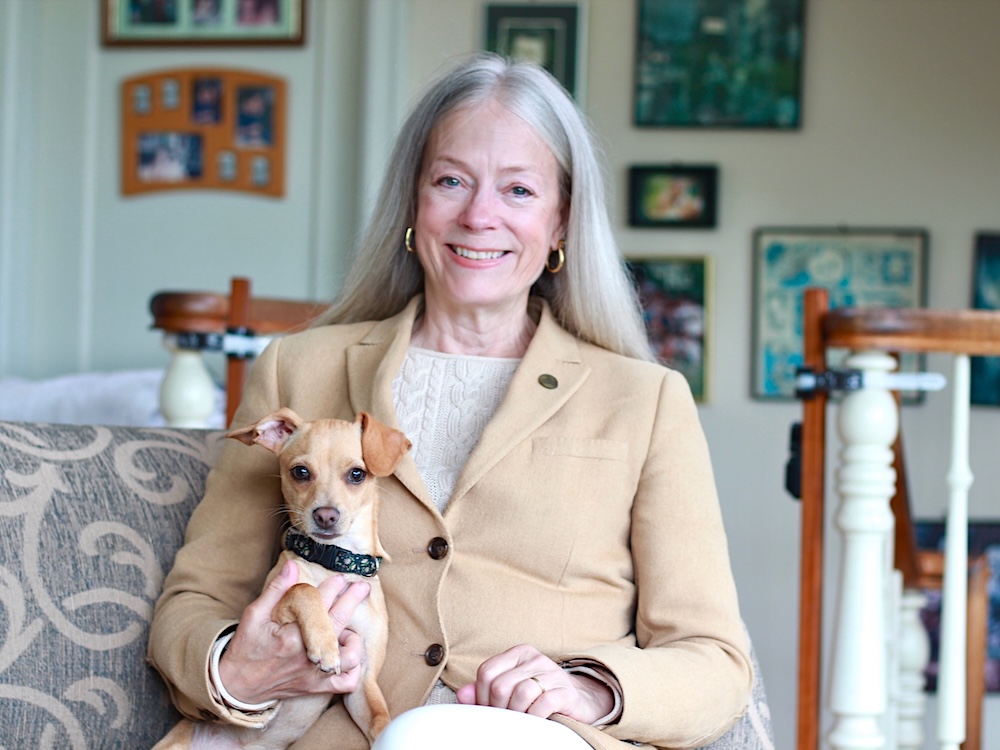
Colleen Hardwick’s single-family home is part of Vancouver history.
The Kits Point house was purchased by her parents in the early 1980s. Hardwick, a third-generation Vancouverite, purchased it from her mother’s estate in the 1990s.
Yet it retains the look of a house firmly rooted in mid-20th-century architecture and interior design — something that feels like it’s disappearing in Vancouver’s near-constant state of multi-unit residential redevelopment.
Hardwick’s father, urban geography academic Walter Hardwick, sat on Vancouver city council from 1968 to 1974 under the TEAM municipal party. Today he’s most famous for helping turn False Creek South from a swampy industrial zone into a mixed residential and commercial neighbourhood, with low-rise strata, rental and co-op buildings.
“I literally grew up with urban land economics at the dinner table, because my dad taught urban geography” at the University of British Columbia, Hardwick said in a mid-May interview with The Tyee at her home.
Initially the younger Hardwick followed in her father’s footsteps, pursuing an undergraduate degree in urban geography at UBC. But Hardwick took a detour into local film and television production from the 1980s to the early 2000s, working on projects starring the likes of David Bowie, Reese Witherspoon, Mark Wahlberg and Dennis Miller.
Hardwick raised her own children in the Kits Point home. Today she and her husband, actor Garry Chalk, live on the upper floors of the house. The basement suite is occupied by one of Hardwick’s daughters, her son-in-law, two grandchildren and their dog, Bear.
Urban planning is still a household topic of discussion, because Hardwick is once again running for mayor.
A city councillor from 2018 until 2022, Hardwick was initially a member of the Non-Partisan Association, better known as NPA. But in 2021 she and fellow NPA councillors Sarah Kirby-Yung and Lisa Dominato left the party to sit as independents.
Hardwick developed a reputation on council of voting against new housing developments. She repeatedly asked city staff to provide data supporting the city’s housing targets — data that Hardwick is still waiting for today.
Hardwick is also a stickler for what she considers staying within a municipality’s jurisdiction, even if the province and federal government aren’t fulfilling their responsibilities regarding housing, transit or reconciliation with First Nations.
In 2022, Hardwick revived her father’s party, now called TEAM for a Livable Vancouver, and ran for mayor. She pledged to stop residential upzoning and end the city’s dependence on community amenity contributions, or CACs, from developers. She’s also promised to crunch the numbers on how many homes Vancouver actually needs. Then, as now, Hardwick maintains that residential towers are bad for residents’ mental health.
In 2022, Harwick placed third behind incumbent Kennedy Stewart and his successor, current mayor Ken Sim. Undeterred, Hardwick is running for mayor again this fall with TEAM.
“I’m doing this because I feel a deep sense of responsibility to apply substantial background knowledge and experience in this area,” she said, adding she isn’t aware of any other mayoral candidates who understand the history and context of Vancouver urban planning like she does.
“My objective is to course correct and to recover balance for the city in a sustainable way for future generations.”
When The Tyee met Hardwick at her home in mid-May, the dining room wasn’t available for urban planning discussions like she used to have with her dad. All available space was taken up by outerwear and hallway furniture to accommodate an expected carpet cleaner.
Instead we sat in her home office just across the hall. A small room lit up by a big window, the space feels even more cramped by the shelves upon shelves of urban planning, filmmaking and Vancouver history books, not to mention the stacks of file folder boxes, some with papers dating back to her time on council.
Candy, Hardwick’s new golden-hued puppy, curls up in the crook of her arm. It’s where the pup will stay for the duration of our hour-plus interview. This conversation has been edited for length and clarity.
The Tyee: Everyone has their own version of what kind of city Vancouver is. What kind of city is it to you?
Colleen Hardwick: Well, it’s my hometown. I was born and raised here, as were both my parents. My grandparents came here as children with my great-grandparents, always to seek out a better life, jobs and opportunity. That’s why people generally move to new places. They don’t leave where they’re from because things are good there.
Vancouver exists because it was the terminus of the railway, the port to the Pacific. And it grew off the back of natural resource extraction industries: forestry, fisheries, mining. But we’ve seen a marked shift over the last 40 years since Expo 86, from resource-based to real-estate-based economy.
Now I have two grandchildren living here, and I’m very invested in making sure that they can afford to live here for future generations.
Why are you running for mayor again?
The city is out of balance. We should be seeking a sustainable future, one that recognizes that pace of change is important. I’ve seen, particularly since 2008 and the financial crash, a push towards promoting growth. Real estate development at the expense of everything else.
Only since 2008?
It coincided with Gregor Robertson and Vision Vancouver’s election with a majority council, which they maintained for a decade. They effected regime change. They fired the long-term city manager and brought in Penny Ballem, who was a medical doctor and health administrator, and restructured the city’s business and financial plan. And regularized developer contributions as a revenue stream in the capital budget.
At that point, staff success shifted from successful community-based planning to promoting rezoning for revenue. They may have been well-intentioned in the beginning. But what they failed to take into consideration was the inflationary nature of upzoning.
I don’t want to get too much into the weeds. I can give you the encyclopedia of the last 50 years of Vancouver.
That’s a lot.
This was really existential because it changed the relationship between the city and its neighbourhoods in a way that has affected where we are today. Vancouver had the legacy of being the livable city, livability being defined as balancing housing with infrastructure. Because if you can’t afford to live there, what’s the point?
They didn’t take into consideration the inflationary nature of upzoning. Because every time you upzone a piece of property, you inflate its value to highest and best use. What it’s done is widen the gap between global wealth and the local economy, pricing our kids out of the market.
The city has to wean itself off its dependence on CACs and developer contributions. This is happening anyway, because of changes in legislation at the provincial government level.
Now that we’re in a downturn, the developers, we’re seeing a bunch of bait and switches. “We know we promised you were going to get this, but we can’t afford to do that anymore. So we want the public to pay for it.”
To what do you attribute the downturn?
There’s a whole series of things that have had an effect. A large amount of what they were building for was offshore wealth. I don’t think the empty-homes tax had that big of an effect, because you just build it into your business model. But so much of what was being sold was being sold to China, the Middle East, Dubai, places like that.
That’s why we’re seeing stuff going on with Westbank, for example. We’re seeing a lot of concern about their expected pre-sales, because they weren’t selling to the local market. They were selling to offshore wealth.
The chaos with Trump and the tariffs, those things have had a big impact. But these are macroeconomic global changes, and it’s not just affecting Vancouver; it’s affecting all of what they’ve described as gateway cities. Which have again been ways for them to get their capital out of countries like China.
Do you think that’s why rents are dropping now?
That’s one of the reasons. There are other factors like the international student market. And then that goes into all the housing, and there’s been the impact of that evaporating as well, right? So there are a number of different factors that have had an impact on this.
When I was on council, I pushed together with a number of my academic colleagues to get housing data. Because what I observed was that the city was setting housing targets that were not based on data. These were aspirational targets. That’s a quote from city staff. Not based on the census, not based on the regional growth strategy attribution for Vancouver.
I was working with David Ley at UBC Geography, Andy Yan at [Simon Fraser University], John Rose at Kwantlen [Polytechnic University]. We were all trying to get a handle on what was really going on in the housing market, so that we could try and set reasonable, evidence-based policies. It was in May 2020 that I got the motion passed to get the housing data. And it’s never been provided.
I tell you this because we accept a lot of the time things on the surface. Narratives that are being sold rather than digging in and making sure that we have evidence-based policies.
The city has been moving forward with trying to reach its housing targets. How do you think increasing the amount of supply impacted rents?
They’re desperate in many cases to fill what has been built. Population is the fuel for housing production. We saw over the Trudeau Two decade immigration pushed to unprecedented levels. And that has slowed down. That the external pressures coming down are making it more affordable.
I’m not sure what the rental vacancy rate’s at. It was at three point something the last time I looked, which is great. Because it’s allowing locals to get into the market. But what I’m talking about is the upward inflationary pressure that was put on through these external factors.
Immigration has always been the primary driver of population growth in Canada. But it’s a question of how much, how fast, what industries and what jobs. My grandma’s family from Newfoundland, they came here because of fisheries. My other grandma’s family came from Ireland because the Canadian government was seeking out farmers to open up the prairies. It was always that we as a country were looking at what we needed to build our industries, jobs and opportunities as the driver for population growth.
That changed over that decade. It was very much tied to housing production as the principal driver. This is one of the reasons why I’m pushing and continue to push hard for diversification of our local economy. Our dependence on real estate as the primary driver is unsustainable as a model.
If you became mayor, how would you address both the housing affordability crisis and the homelessness crisis?
The objective has got to be recovering balance. That’s what livability is about, is about balance. But the good news is there is so much existing zone capacity.
Think of it like a big Plexiglas box around the city of height and density that you can grow into. There was, for example, a 2012 Coriolis report on CACs that said that there was 20 years of existing zone capacity to grow into, back then. And we just continued to rezone like it was going out of style.
The four years I was on council, there were 259 rezoning applications. One hundred per cent of every rezoning application was approved. We’ve got to stop inflating land values, and then be finding more cost-effective and efficient ways to be building within our existing zone capacity.
Do you know where the existing capacity is?
Again, this was data that I tried to get when I was on council, and I got stonewalled by staff. There are zoning maps that you can look at. If you don’t inflate and you stay within the existing zone capacity. So that would be approving things at the development permit board level, as opposed to rezoning at council.
Now, people that are all hell-bent on inflating their property values are not going to want to hear that from me. But if you think it through, it becomes quite clear that doing more of the same and expecting a different outcome is the definition of insanity.
I look at my kids downstairs; there are so many families that you see like that now where the kids are living in the basement suite, as we’re all trying to make ends meet and try and be able to stay here. For people that have lived here, as opposed to people that are coming in.
Are you foreseeing a future where everybody owns their own home? Or would there be a mix?
There’s a mix. I point to both False Creek South and Champlain Heights, which were the poster children for the “Livable City.” Go back to the ’70s, and it was all about sustainability and balance. The housing was a third, a third and a third between income groups.
Not everybody is going to be owning homes. I use the term “home” loosely, because I think it’s become more of a marketing term than anything else.
What we’re seeing is so many, as I’ve heard others describe, dog crates. Safety deposit boxes in the sky. They’re not really homes, but that’s the way they market them.
Would units be bigger under a Colleen Hardwick mayoralty?
I don’t want to get out too far ahead of it. I still want the data that we have never been provided with.
Why do you think you’ll be successful running for mayor this time?
Well, it’s an interesting landscape right now. The last time it was just Ken Sim versus Kennedy Stewart, and they were going, “Don’t split the vote.” I had so many people come to me afterwards and said, “We should have voted for you.”
Very frustrating for me that we keep finding people that get catapulted into these roles that have no foundational knowledge. And then you get buyer’s remorse after that. I think anybody that’s been paying attention over the last four years should not be going down the Ken Sim ABC road again.
The intention of TEAM, I point out the logo: it’s red, blue, green, orange. That’s because we have members from across all political parties. We have always viewed this as what I call pan-partisan, because we’re focused on the municipal government.
One of my big frustrations is that a lot of people don’t know the difference of what one level of government does from the other. And as a result, what we’ve seen happen over the last 18 years is that the city has taken on more and more of that downloading from the senior levels of government.
What’s the city responsible for? It’s the roads, the sidewalks, the tree canopy, the parks, the schools and the community centres. Yes, it’s the police and fire. That’s what binds all of us together, is that we’re concerned about the city. And as Patrick Condon would say, it’s all about the dirt.
We’re focused on residents and neighbourhoods, because residents matter. Residents are being summarily dismissed, and our local democracy has all but disappeared, apart from an election every four years where 35 per cent of the electorate vote.
We need some form of local representation, whether that’s a ward system, a hybrid system, a neighbourhood council system. We had neighbourhood planning in this city, into this century.
But instead the city adopted the Vancouver Plan, which took a top-down deterministic model, as opposed to a bottom-up grassroots and more community-driven democratic model. The end result in both cases would be a document that would be called an official development plan.
Would you redo the official development plan?
Oh, absolutely. Without a doubt. It’s upside down and backwards. And besides, yes, the province has dictated targets and development targets. Sixteen other municipalities in this province had stood up to the province and said, “No.” I would be there with those other 16 municipalities.
We also have a toxic drug crisis in the city, and a lack of mental health resources, as well. How would you address this as mayor?
Doing a thorough audit of the Downtown Eastside as the central focus for this, although I know it’s distributed around the city. It’s got to be an evidence-based approach, and it’s been very difficult to get fulsome data to be able to do that. I know the province hired Larry Campbell to do that. I sure would love to see a report.
It’s something that I relate to personally, through my family. I won’t go into details. I just want you to know that’s something I’m very sensitive to. And something that I’ve watched go down.
When I go back to the mid-’80s when I was working in the movie business, I first went out to Riverview [Hospital] when they first emptied out the West Lawn building. At the time the pitch was “Moving Closer to Home.” They always have a slogan for these things. And the thought was we’re going to move all these people that are in Riverview. They essentially moved into SROs in the Downtown Eastside. And then the predators moved in.
So it’s been very toxic for a very long time. People then get displaced. First it was the Expo, then it was the Olympics, now it’s FIFA. We rationalize bringing in these big events, thinking this is going to be good for the economy. And it just crushes people at the lower end of the social spectrum.
I want to get in there, roll up my sleeves, get a clear picture of what’s going on. And come up with some solutions that are working at the local level. I sometimes think people don’t want to do the work, or maybe they just don’t understand. They want simple solutions to complex problems. If it was a simple solution to dealing with our toxic drug problem, or crime in the Downtown Eastside, don’t you think it would have been solved already?
There’s been a lot of emphasis on public safety and people feeling unsafe in the city, even as violent crime rates have dropped. How would you address people’s perception and actuality of safety in the city?
I always come back to the facts. If, as you describe, our violent crime rates are declining, why don’t people know that? Could it be because people get incited? Things upset them, and people play into that. Politicians, in particular, will play into that, without naming names. I think you know where I’m going with this.
It is an issue. Kids are afraid to walk to school. Maybe if they had a stronger sense of community, that might help assuage some of those concerns. Depends on what part of the city you’re in. This is why I emphasize the importance of community.
There are parts of the city, like going down to the Downtown Eastside, that are scary for most. And it’s going to take a lot of work to get that dealt with. One of the things that I’ve learned over time is that people vote when they’re angry or afraid. And for politicians that tap into that, that’s going to get their vote out. So just be mindful of that.
The police ask for a budget increase every year. How would you respond if they come and ask for another budget increase?
I would start by analyzing what they do. Because if I’m chairing the police board, I’m going to dig into their budget like nobody’s business. I think that’s what people thought when they elected Ken Sim: “Oh, I’m an accountant.” He would know this.
But he sat where you’re sitting back in 2018 and I gave them 90 minutes of the last 50 years of Vancouver politics. There seems to be a resistance to doing the work. And I’ve never been one to shy away from doing the hard work. I want to figure out what’s really going on.
Everybody wants to be safe. I want my grandchildren to be safe. But it’s how you go about doing it. If you want to effect change, you need to be in a position to effect change. That’s why TEAM is going to run seven candidates for council. You need a majority to effect a turnaround.
And for those that say, “Oh, we need to run the city like a business,” no, you don’t. Because the city is not a business. It is in the public service. Businesses exist to produce profit for shareholders.
Ultimately, our job is to weigh the pros and cons. To analyze, and then to adjudicate and make decisions in the best interest of our residents. And I’m not convinced that that’s what’s been going on.
What’s your big hopeful vision for the city? And how do you afford it?
I seek to recover balance, focus on municipal issues and do the work that needs to be done. And like I say, I have a strong sense of responsibility to do that.
So city revenue would not be coming from community development contributions. Would it come from increasing property taxes?
No, no. We have seen double-digit inflation on the property taxes. There’s two sides to the budget, right? There’s the operating budget, which is funded through property taxes and user fees and things like dog licences and parking permits. And it’s all annual. And then there’s the capital budget. And the capital budget is project based, and it’s supposed to be about infrastructure.
Historically it was funded through debt, through debenture borrowing off of plebiscite. Once upon a time, we used to have a stand-alone plebiscite, like when they replaced the Cambie Street Bridge. And the people approved it, because then the money you borrow has to be paid back over time. Long amortization, like 40 years out of the operating budget.
But what happened in 2008 was they changed that model to regularize developer contributions, CACs. And if you look at the capital budget today, it’s 50 per cent. But just as they’ve increased the revenue side, they’ve also increased the expense side. So what are the things that this city has been taking on that are outside of scope?
I got our former chief financial officer to produce a report that showed the downloading from senior levels of government onto the city, on both operating and capital side of the budget.
So if we want to reduce our dependence, and that’s what I’m saying specifically on the upzoning revenue, then we also have to look at the expense side of the equation. We have to push back to the senior levels of government and say, “Hey, this is your job. And you have revenue availability that we don’t at the city.”
The city is just 114 square kilometres from Boundary Road to the University Endowment Lands. All we can do is make money within this space.
What expenses would you cut?
I would be looking specifically at the things that have been downloaded from the senior levels of government. Which I can provide you if you’re interested.
Yeah, can you give me some examples?
I don’t have them at my fingertips. But I’m happy to share, for example, the document that I’m describing to you that the financial officer produced in December of 2021.
It’s an audit process. One thing I did manage to get done in the last term was to get the office of the independent auditor general in there. Because up until that point, astonishing as it is, there was no independent oversight over spending in the city.
We’ve just hit the tip of the iceberg, for example, in the real estate division. So I want to see the books. I want to see what’s really going on. I want to see line-item detail. I want a baseline back to 2008. Year over year, department by department — where have the head count increases been? And again, how is that tied to downloading?
With that in mind, how would you approach an annual budget process?
Can I have a line-item budget, please? [Laughs.] It’s a problem when I’m looking for line-item detail, and the other councillors I’m dealing with can barely read a balance sheet.
And I used to run into this all the time, like, “Oh, Coun. Hardwick’s being mean, being hard on staff.” No, I’m not. I’m asking for things that I should be able to receive. I’m an elected official. I should be able to get a real budget.
I want to do what I tried to do when I was on council, which was to get to the bottom of things through a baseline review. We need to really get into the guts of it. The devil is in the details. I learned that back in my movie business days: you’ve got a lot of moving parts, millions of dollars, a lot of people doing different stuff. To come in on time and on budget, you need to know where everything is and what everybody’s doing.
I haven’t seen this new city manager that they brought in. I don’t know him at all. But I can look at what I saw happen from 2008 until recently in management. I’ve seen massive ballooning. We’re still talking about the same 114 square kilometres.
How do you respond to the criticism that, because there are so many people running for mayor now, they could be cancelling each other out and Ken Sim will win again?
I don’t think Ken Sim has a snowball’s chance.
Based on the polling that I’ve seen recently, and going back to prior to the byelection. He had the worst favourability rate of any mayor in Vancouver. I know he’s wearing a suit and glasses to try and counteract his earlier image. But I don’t think that’s a reasonable expectation.
If you were to become mayor, how would you approach a relationship with both the urban Indigenous population and the host nations, səlilwətaɬ (Tsleil-Waututh), xʷməθkʷəy̓əm (Musqueam) and Sḵwx̱wú7mesh (Squamish)?
Well, again, what is the responsibility of the city? And the extent to which it intersects?
Ultimately, strictly speaking with anything to do with treaties, this is at the federal and provincial level, and outside the scope of municipal jurisdiction. So as long as we are abiding by and respecting that, I think that that’s the right direction for the city.
That said, we have the Musqueam down at the river, and always have been. That community is well established within that 114 square kilometres. Now that Sen̓áḵw is being developed, that ceded land is also within the boundaries. Tsleil-Waututh, not so much as again within the 114 square kilometres. So the relationships there are as respective land owners.
We know there’s a difference, though, between where we’ve got ceded land and we have unceded land that is being developed by developers like the MST Development Corp. So as long as people differentiate between the two.
[Editor’s note: The Tsleil-Waututh Nation says its traditional territories, which it has ‘never ceded or relinquished’ responsibility for, include the current city of Vancouver.]
Most of Vancouver is unceded land. There are no treaties here. So it puts you in that strange sort of position.
No. Well, sorry, this Sen̓áḵw land has been ceded, that 10.5 acres right over here. That was ceded specifically —
[Editor’s note: Sen̓áḵw is a small slice of what was once Kitsilano Indian Reserve No. 6, an 80-acre site. In 1913, the provincial government illegally annexed the land and displaced the Squamish people who were living there to Howe Sound. Over the years, other levels of government and private companies took more and more of that original parcel of land. In 2001, after a lengthy court battle, the Squamish were awarded a 10.5-acre site that is part of the Sen̓áḵw parcel.]
But the rest of the city.
And the Musqueam land down by the river is pretty — I’m not sure that it was ceded, but it’s —
It’s a reserve.
It’s a reserve, so it’s recognized. But again, this is outside of the scope of municipal jurisdiction determination about treaty, or any land ownership; it’s not up to the city.
OK, but then how do you work with the nations? The fact that it is not settled, and the federal government and the provincial government don’t seem to be in any rush to sign treaties?
It’s still not the city’s jurisdiction. This is again a concern of mine about overstepping municipal jurisdiction. But you always want to work with people, and my relationships are intergenerational with First Nations in this city. It’s family.
And the urban Indigenous community?
I don’t know what to say there in particular. That is an ethnic group moving across the land. There are many ethnic groups moving across the land.
But it is different, especially for the Musqueam and the Squamish. My Newfie great-grandfather, by the way, that had the store up here at First and Maple, his main trading partners were the Squamish there.
And I think it was 1913 when they were barged out over to the North Shore. He was not happy. Because that ate away at his primary trading relationship. I’ve mentioned this because there’s legacies of these things that go back a long way, and these were friendly and family relationships.
How would you approach environmental sustainability as mayor? Both from an energy consumption point of view, but also for preparing the city for climate change?
Well, again, within the scope of municipal jurisdiction, one of the key things is our tree canopy. I’m obviously very concerned with the rampant development.
What we’re seeing a lot with, like, the multiplexes in particular, they’re going in and they’re doing max height and density. So if there’s any trees or canopy around it, they’re gone. It’s mission critical that as we continue to densify the city, we maintain our tree canopy and our green space.
When we get into energy sources and things of that nature, we can be co-operating with the entities that are developing it, but it is strictly speaking outside the scope.
But parks, parks we control. And I support the park board.
What about things like, for example, the seawall being impacted by climate change? Or how the sea level is expected to rise to a point in False Creek that it could impact some of the houses there? Or Kits Beach, with increasingly intense winter storms and sea-level rise damaging the pool?
I’d sure love to see some of the data behind this. But it is inevitable that there’s going to be deterioration of things like the seawall, and they need to be maintained. But gosh, they’ve been maintained for a long time now. Just costs more to do it.
If TEAM were to win a majority on council, would you require TEAM councillors to vote the same way you do?
Our candidates need to be onside with TEAM policies. I would say that that’s a more accurate approach. I want to know going in that we’re all singing from the same song sheet.
You previously said that you were against towers and that they were unhealthy for people.
There’s a lot of research that has shown that, cognitively, we relate to things that we can see at a certain height and distance. Roughly six storeys is where we start to disconnect.
We also know from a lot of studies that have been done that when people live in highrise towers, they disassociate. You don’t know who lives on your floor. It’s a very isolating kind of experience. And some people have mental health issues as a result of that.
We know that there are alternatives. Patrick Condon talks about it quite a bit as well, that you can accomplish the same density. You just don’t need to go up to the same heights. But again, it all boils down to how do you make the most money? And developers make more money through highrises than they do low-rises.
And six-storey buildings is something you, as a mayor, would be looking to see if the data supports it?
From everything that I have read over an extended period of time, that is a level that people cognitively respond to that’s healthy and in balance from a livability perspective. So that’s what I look at. Rather than packing it up vertically, let’s see if we can do it horizontally in a different form within the same landscape.
*Story updated on June 12 to correct that Colleen Hardwick did not renovate her Kits Point house as previously stated. It was also updated to correct that Walter Hardwick was an urban geography academic and not an urban planner. We apologize for the errors. ![[Tyee]](/design-article.thetyee.ca/ui/img/yellowblob.png)
Read more: Municipal Politics


Tyee Commenting Guidelines
Please note that email notifications for replies are not currently working due to a software issue which may be resolved in a future update.
Comments that violate guidelines risk being deleted, and violations may result in a temporary or permanent user ban. Maintain the spirit of good conversation to stay in the discussion and be patient with moderators. Comments are reviewed regularly but not in real time.
Do:
Do not: