


 SHARE:
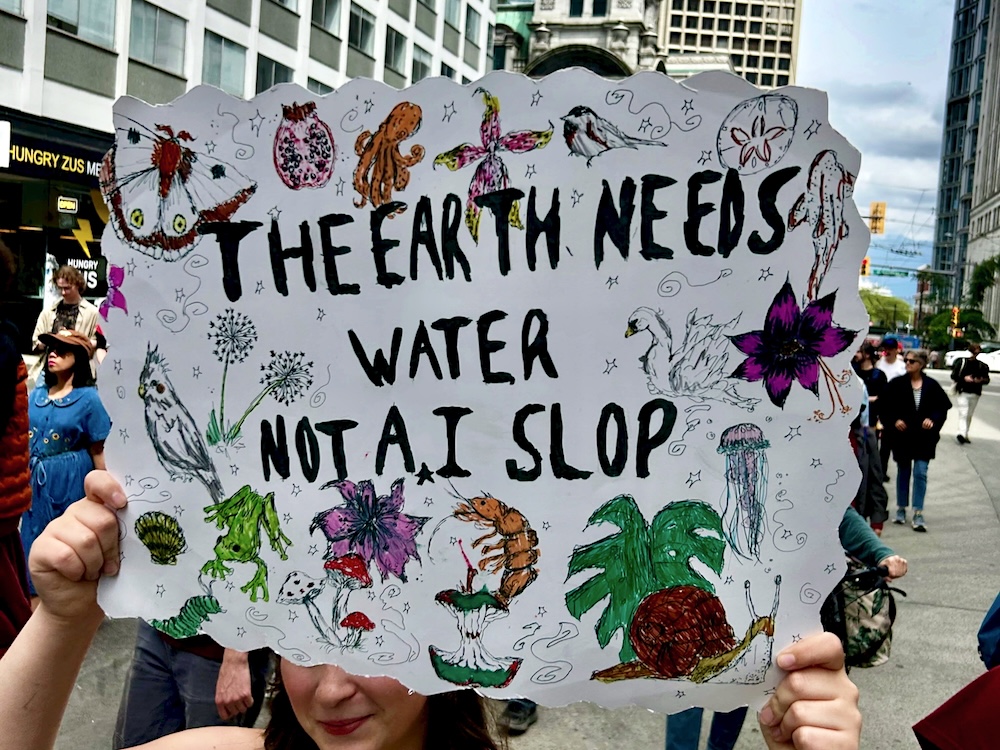
In late May protesters marched through Vancouver in an attempt to halt two AI data centres that Telus is planning for the city.
They called out the massive energy demands to power all the computers inside the centres and the vast quantities of water that would be used to keep them cool, especially as the region faces water restrictions. The demonstration came just weeks after the federal government threw its support behind the project.
Of course, they were focused on not just data centres, but the chatbots and generative AI tools they were being built to power.
By early June, the Vancouver School Board started rolling out chatbot accounts for students aged 13 and over, despite the research suggesting it could affect students’ critical thinking skills and cognition, not to mention ongoing media reports about the effects chatbots have had on teens’ mental health.
Those details should have been red flags for administrators; they certainly were for some parents.
A group called Parents for AI Caution in Education Spaces is now seeking signatures to demand a two-year pause on the rollout of chatbots in Vancouver schools until there’s better data on the technology’s effects on students. Those ideas are spreading, not just in British Columbia but across Canada. But you might not get that impression if you listen to the federal government.
On June 4, Prime Minister Mark Carney rolled out his long-awaited AI strategy. Called “AI for All,” it laid out an ambition to invest in domestic AI infrastructure such as data centres, significantly increase the adoption of AI by Canadian businesses and begin to address some of the concerns with generative AI that are stymying what the government described as people’s trust in the technology.
The centrepiece of the strategy revolved around the concept of AI literacy. Carney acknowledged that trust needs to be established, which at this point is an understatement. Recent polling from the Angus Reid Institute suggests 68 per cent of Canadians want to see strict regulation of artificial intelligence, even if it slows development. But the prime minister is not seriously trying to address the concerns of those in the streets who oppose data centres, or of parents concerned about what chatbots might mean for their children.
Instead, the government is positioning the disconnect over the exuberance of industry — not to mention Carney himself and Artificial Intelligence Minister Evan Solomon — and the public’s skepticism as the product of a knowledge gap. The plan seeks to invest millions to educate Canadians on how to use AI, in effect increasing their “literacy” of the technology. They will give chatbots to every university student, train 90,000 young people to be advocates of the technology in small and medium-sized businesses, and equip more than 3,000 educators to provide AI training accessible by all Canadians.
The government acknowledges that the sector will need to be regulated, but the changes to privacy legislation, measures to protect children and their data, and restrictions on the production of deepfake images are only the tip of the iceberg of the concerns that civil society groups and many ordinary people have with generative AI.
Canadians are seeing their own social media feeds filled with AI slop and misinformation. They’re reading stories of people taking their lives after forming dependencies on chatbots. People who live in quiet small towns fear that proposed data centres will threaten their quality of life. Artists are seeing their work ripped off by AI companies. And who can forget how OpenAI refused to report the troubled 18-year-old shooter in Tumbler Ridge months before that devastating tragedy took place?
There’s so much more than a literacy gap leading Canadians to push back against having generative AI forced on them in so many areas of their lives. The government itself should know better. It has already tried to roll out a chatbot to give Canadians tax advice, only for the auditor general to find it provided incorrect information 66 per cent of the time. More recently, its use of generative AI in immigration was found to have denied a woman’s permanent residency application after the system made up parts of her submission.
Just weeks before Carney stood in front of medical workers from the University Health Network in Toronto to announce his strategy and talk about how beneficial AI will be in health care, the auditor general of Ontario had released a scathing report on AI scribes. Those chatbots, used to transcribe conversations between doctors and patients, are currently used by over 5,000 doctors in the province. But the technology sold as a means to save time had been regularly registering incorrect information and making up details about patients’ health. It was so bad that the AI scribes were recording the wrong drug prescribed to patients 60 per cent of the time.
This isn’t just a problem in the public sector. As Carney’s strategy seeks to boost business adoption of AI from 12 per cent today to 60 per cent in eight years, there are growing reports in the United States of companies pulling back on AI spending as the growing costs are not delivering the expected benefits or efficiencies. In May, the president of Uber even admitted that AI spending was becoming “harder to justify” as the company burned through its annual AI budget in just four months.
It’s clear that Carney and Solomon have bought the industry narrative hook, line and sinker. They seem to firmly believe that chatbots are the foundation of the next industrial revolution, but that claim is based more on faith — and the hype needed to boost the valuations of AI companies — than on hard data. In fact, it requires actively ignoring the stories of the very real harms of the technology that continue to pile up.
There’s a certain irony in the federal government’s belated focus on legislation to address the harms of social media, beginning with plans for a higher age limit to keep those 16 and under off the platforms — because even as that delayed online harms legislation moves forward, the age limit won’t be extended to cover AI chatbots.
We’re now playing catch-up on social media safety because we believed the companies’ narratives for far longer than we ought to have, and now our society is paying the price. Instead of being proactive on generative AI, the government is failing us all over again — all in the name of trying to attract some of the many billions flooding into AI investment to Canada.
If anyone needs better literacy on AI, it is not the public, but Carney himself.
Canadians may not know exactly how a large language model functions, but they can see how the chatbots and image generators they’ve made possible have changed society for the worse in just a few years. At this point, I’d put far more trust in the data centre protesters and the concerned parents to craft a real AI strategy than in the prime minister.
This article is part of The Tyee’s reader-funded Reality Check project exposing and explaining the rise of digital disinformation. ![[Tyee]](/design-article.thetyee.ca/ui/img/yellowblob.png)
Read more: Health, Education, Science + Tech












Tyee Commenting Guidelines
Please note that email notifications for replies are not currently working due to a software issue which may be resolved in a future update.
Comments that violate guidelines risk being deleted, and violations may result in a temporary or permanent user ban. Maintain the spirit of good conversation to stay in the discussion and be patient with moderators. Comments are reviewed regularly but not in real time.
Do:
Do not: