


 SHARE:
In any other year, choosing to experience emotional pain in the name of entertainment or edification is doable. But it feels less so at the moment. When every nerve ending is scraped raw, the idea of watching something that brings on additional suffering feels much harder.
But against all odds, there are still some happy endings in VIFF’s cinematic selection this year. In order to get there, however, you still have to go through all the feels. Good and bad.
Nothing quite contains these two polarities quite like Flee.
Winner of the World Cinema Grand Jury Documentary Prize at Sundance this year, Flee is filled with its fair share of horrors — the refugee crisis, human trafficking, the Taliban. Just when you’re about to run screaming from the theatre, some small miraculous thing happens. The darkness of the world is met and matched by kindness, generosity, family and the musical stylings of Norwegian synth-pop band a-ha.
The film uses animation to tell the story of Amin Nawabi’s struggle to leave Afghanistan and make a new life for himself and his family.
As a child in 1980s Kabul — whether bopping along to pop songs while wearing his sister’s dress, or harbouring a secret crush on martial arts star Jean-Claude Van Damme — Nawabi was unafraid to stand out. When Afghanistan fell to the Taliban, his father was among the first wave of people to be disappeared by the new regime. Nawabi’s family never saw him again and, as the film notes, they still don’t know what happened to him.
After his father’s arrest, Nawabi and his family fled the country, arriving in Russia only a year after the fall of communism. As Nawabi drily notes, “It was a strange time.” With the wrong papers, the family were easy prey for corrupt Russian authorities, who stank of vodka and took whatever they could steal.
The only people worse than the police, Nawabi explains, were the human traffickers who ferried would-be refugees out the country for a price. While Nawabi’s older brother worked as a cleaner in Sweden, scraping together enough money to pay off a trafficker, the family camped inside a bleak Moscow apartment block, watching Mexican soap operas and avoiding the authorities.
Their first attempt to escape to Sweden went horribly awry when the boat commandeered to take the refugees broke down and began to take on water. The passengers were forced to bail for their lives. The appearance of a Norwegian cruise liner initially seemed like a heaven-sent rescue, but quickly turned to a version of hell when the refugees were returned to the Estonian border patrol.
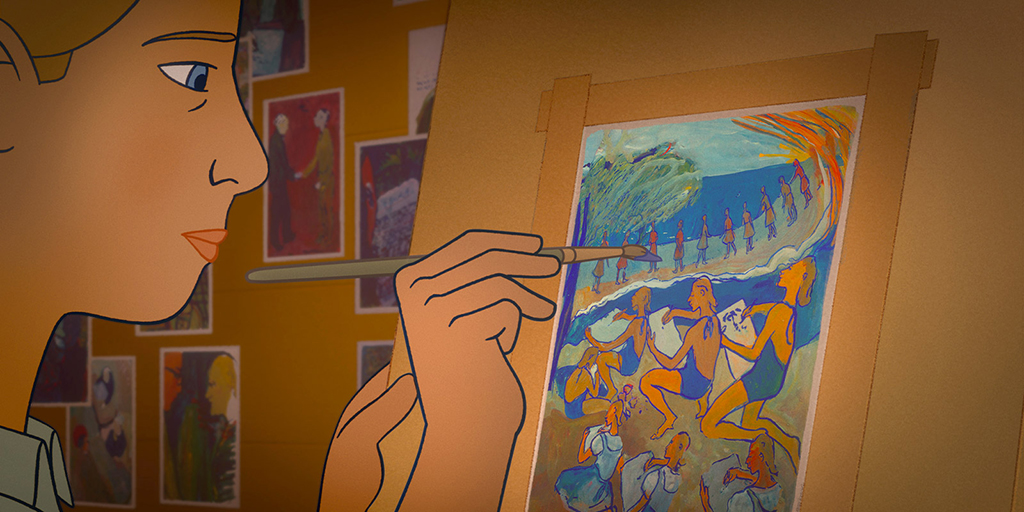
Director Jonas Poher Rasmussen weaves Nawabi’s first-person narrative with news footage and experimental animated elements. In a series of extended interviews between Nawabi and Rasmussen, who are long-time friends, his story unfolds, not unlike a dark fairy tale, filled with moments both terrible and sublime. The film is graced with a number of wonderfully idiosyncratic moments, like Nawabi’s first night at a gay nightclub, and a gentle moment of solidarity in the back of a van with another teenager.
In one remarkable sequence, the experience of refugees trapped inside a shipping container is captured in all of its clawing, claustrophobic terror. Black and white drawings viscerally recreate the nightmare scenario in a strange convergence of beauty and horror.
In order to begin a new life with his husband, Nawabi must first contend with his past. Telling his story is a critical and cathartic step on his long journey to find a sense of home. The film’s resolution offers a reminder that in spite of all the horrors humans inflict upon one another, love persists, foundational as granite. Happy endings can still happen.
Sometimes, they happen even when the people at the centre of a story do not survive.
The film Charlotte, also animated, captures the unbridled creative outpouring of a German Jewish artist named Charlotte Salomon.
Born into a life of both pain and privilege, Salomon developed her artistic talents early. After losing her mother to suicide, she grew up in Berlin with her father, a doctor, and her beloved stepmother, an opera singer. A precocious and talented young woman, Salomon was accepted into the prestigious United State Schools for Pure and Applied Arts, located in Berlin, in spite of the college’s strict policy against allowing Jewish students to enrol. After a brief period, her studies were interrupted by the rise of the Third Reich and the growing climate of anti-Semitism in Germany.
Following the arrest of her father, Salomon fled to France, where she reunited with Ottilie Moore, a family friend who was also sheltering Salomon’s grandparents. Moore is perhaps deserving of her own biopic — a wealthy German American, she rescued a number of Jewish children, offering them refuge in her estate, called L’Ermitage. But even in the sunny climes of southern France, the long arm of the Nazi regime was active. Aged 26, five months pregnant with her first child, Salomon was seized by German soldiers and sent to Auschwitz, where she was killed on the day of her arrival.
The fact that her masterwork, Life? Or Theatre?, survived is something of a miracle. Often called the first graphic novel, the collected paintings were created over the course of two years while Salomon was living in France.
A staggering work of autobiographical art, the book consists of 769 paintings that depict every memory that the artist could summon of her childhood, adolescence and young womanhood. Salomon’s Expressionist work condenses the fancifulness of childhood alongside world-changing events. Images of Kristallnacht and Nazi parades run next to more intimate scenes of school, family and friends. Prior to her death, Salomon entrusted the work to a friend, requesting that he keep it safe. The collection of her paintings was discovered by her parents, who survived the Holocaust, after the end of the war.
Co-directors Eric Warin and Tahir Rana take inspiration for their film directly from Salomon’s work, recreating some of her most imagistic work in bright sequences that dance across the screen in loopy lines and saturated colour. Actors Keira Knightley, Jim Broadbent and Brenda Blethyn bring Salomon and her family to vivid life — but ultimately it is the ferocious determination of the artist to insist on the value and resplendent joys and sadness of her life that lives on. A record for the ages.
For those seeking lighter film offerings, Records might just do the trick. Or maybe turn the table?
In his latest film, documentarian and professional curmudgeon Alan Zweig spins another look at vinyl records and the men and women who love them. The impulse to collect seems to bite vinyl obsessives particularly hard. As several people interviewed in the film take pains to note, it’s the music that drives their habit, although for many enthusiasts this is the just the entry point to the habit of a lifetime.
For some collectors, sheer numbers alone — more, even more, the most — is the impulse that compels people to keep adding, even as they run out of space. An added bonus to the funny, idiosyncratic and often revealing conversations in the film is the opportunity to see how people manage their massive collections in ordinary houses and apartments. One word: shelving!
A companion to Zweig’s earlier film Vinyl that also explored the community of people and their records, this latest outing finds the filmmaker in a happier position in life. Married with a kid and still collecting himself, Zweig appears more at peace with the world. As he says in the film, if Vinyl was about failure, Records is about acceptance.
In contrast to Records, Charlotte and Flee, there is one VIFF film that you should only take in if you have time and attention to spare.
The title of Claudia Schmid’s documentary about the creative process of German painter Rolf Kuhlmann tells you everything you need to know. Clocking in at 135 minutes, the film feels like The Endless Moment of watching paint dry — and not even in a metaphorical way. Kuhlmann’s work is interesting, but there’s a reason that painting is primarily a private and solitary act.
As always at VIFF, there’s an epic variety of short films on offer. A few standouts are Lauren Grant’s directorial debut, Things We Feel But Do Not Say, and Brenden Prost’s Heavy Petting.
Whatever your pleasure or pain, there’s a film for that, either to release feelings in a cathartic blowout or quietly soothe the awkwardness and loneliness of the human condition. ![[Tyee]](/design-article.thetyee.ca/ui/img/yellowblob.png)
Read more: Film









Tyee Commenting Guidelines
Comments that violate guidelines risk being deleted, and violations may result in a temporary or permanent user ban. Maintain the spirit of good conversation to stay in the discussion.
*Please note The Tyee is not a forum for spreading misinformation about COVID-19, denying its existence or minimizing its risk to public health.
Do:
Do not: