


 SHARE:
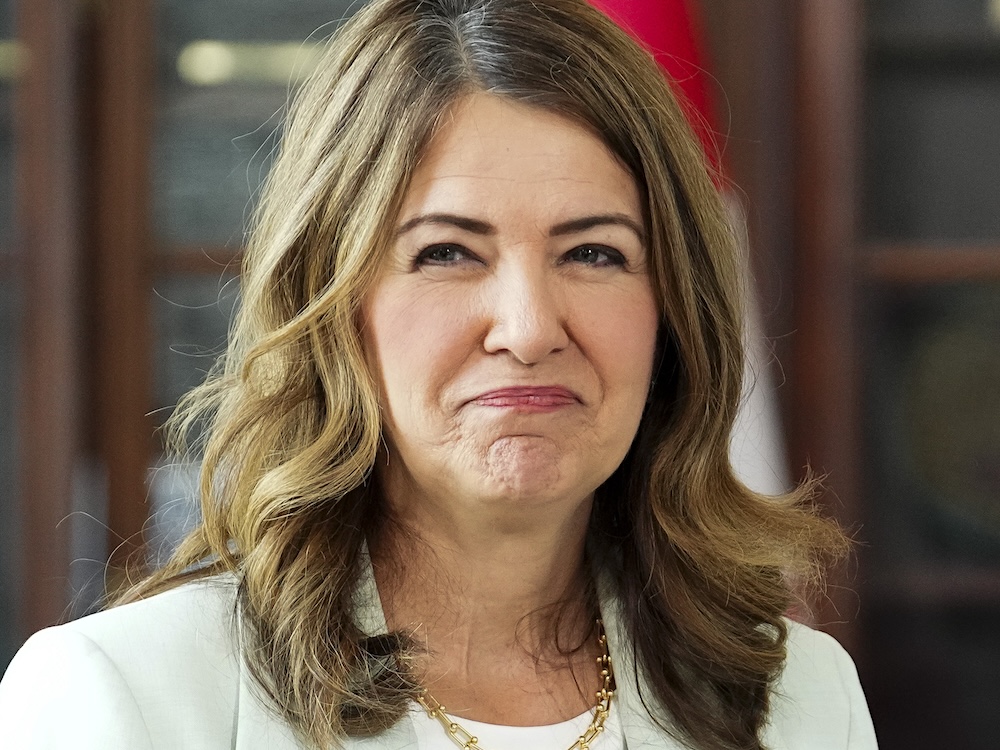
How will Alberta’s ridings be reshaped and who will draw the lines? The answers could affect the outcome of future elections for generations. But New Democrats claim Premier Danielle Smith has brazenly tilted the scales in her party’s favour.
So who has the United Conservative Party government put in charge of the controversial process and what reassurance can citizens take from their backgrounds?
If, that is, Albertans aren’t worn out by what one expert calls Smith’s “flood-the-zone” barrage of contentious political moves.
First, Smith’s government effectively rejected the majority report of an independent electoral boundaries commission that had spent a year on public hearings and reviewed more than 1,140 submissions, at a cost of more than a million dollars.
Then, the UCP appointed three of the five members of a panel to conduct another review. Except this one will be carried out behind closed doors with no public input, at an additional cost of a half-million dollars.
The NDP has accused the UCP of setting the table for gerrymandering, changing the riding boundaries to favour the UCP.
Their fears were bolstered when the UCP-dominated Select Special Committee on Electoral Boundaries met last week. Every motion advanced by the two NDP committee members in an attempt to increase transparency and prevent inappropriate political contact with panel members was voted down.
“The entire process is illegitimate,” Calgary NDP MLA Kathleen Ganley told reporters after the meeting. “What I think became incredibly clear today is that the UCP intends to cheat,” she said.
NDP house leader Christina Gray, too, called the process “illegitimate” as well as “likely unconstitutional.” She reminded that “even the acting chief justice of Alberta flagged it as irregular.”
Who is Brian O’Ferrall?
Facing such stormy waters, the UCP chose retired Calgary Court of Appeal Judge Brian O’Ferrall to chair the panel. He was one of only two applicants for the job.
Why was the field that small? Citing “the irregularity of this process,” acting chief justice Dawn Pentelechuk had declined a request from UCP MLA Brandon Lunty, the select committee’s chair, to distribute a job notice to sitting and former judges. The Law Society of Alberta and the Canadian Bar Association also declined to distribute the notice.
A review of donation databases dating back to the early 1990s reveals O’Ferrall has been a reliable and generous financial supporter of both Alberta and federal conservative parties in the decades before and years after he served as a provincial civil court small claims judge and then as a justice with Alberta’s highest court after Stephen Harper leapfrogged him to the Court of Appeal in 2011.
O’Ferrall’s first donation after retiring from the bench in 2022 was to the Calgary-Elbow UCP riding association. Now in his late 70s, O’Ferrall served as the official campaign agent for former Alberta premier Ralph Klein in that same riding for the 1993 and 1997 elections.
O’Ferrall donated another $1,000 to the UCP in 2024 and $1,287.50 in 2025.
Smith has demanded more input in how higher court judges are selected to better reflect what she says are the province’s values and “distinct legal traditions.” But a decade ago, Harper took matters into his own hands — and one beneficiary was O'Ferrall.
A 2015 investigation by Globe and Mail reporter Sean Fine detailed how Harper had sought to stack the judiciary with right-leaning judges.
A source told Fine the Harper government took “deliberate steps,” at least in Alberta, to evade appointment committees because they sometimes stood in the way of judges it wished to appoint.
“Those tended to be right-of-centre judges with a known track record,” Fine wrote.
A judge already appointed to a lower provincial court could not be vetted by a federal judicial committee, so Harper created an “express lane” to bypass the committee.
And this, Fine wrote, is how O'Ferrall, a provincial court judge, “made an unusual leap straight to Alberta's highest court, the Court of Appeal, in 2011.”
“This is not against the rules,” Fine stressed. “The appointments system has wide discretion.”
A former Court of King’s Bench justice, who knows O’Ferrall personally, said the sense among judges when he was appointed to the Appeal Court was that he would struggle with the workload and the wide variety of legal work “since his practice was largely environmental law” and his work at the provincial court was as a small claims judge, which “is pretty low key.”
“I don’t think there is any thought that he was overly friendly to conservative governments or hostile to liberal ones,” said the former justice, who spoke on condition of anonymity.
“He was a free thinker and small-c conservative in his writing — no scandals or controversies,” he said, adding that he was surprised that O’Ferrall took the job.
“It is thankless and will drag him into the public eye.”
O’Ferrall declined an interview request.
A panel further tilted UCP
Another UCP appointee, the former Reform MP Monte Solberg, is a registered lobbyist. He has donated thousands of dollars to the UCP in recent years and is now lobbying Smith and Finance Minister Jason Nixon, whose riding was eliminated in the original commission’s report.
The third is consultant Darwin Durnie, who made a 198-page submission to the first commission. The website for Durnie’s consulting business lists the Government of Alberta as a client.
Transportation Minister Devin Dreeshen posted a photo in May 2024 of himself with Durnie and his consulting partner, Michelle Tetreault, in the legislature’s rotunda.
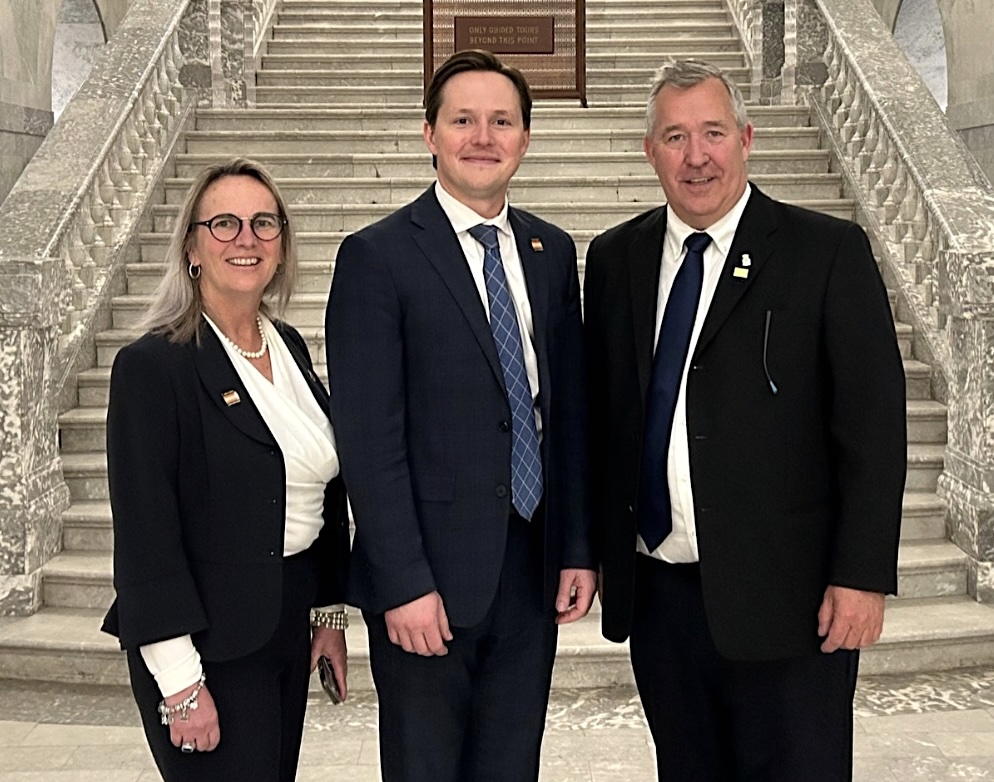
Tetreault made headlines in 2014 when CBC revealed she claimed $330,000 in expenses in a 20-month period conducting advance trip preparation, such as checking out restaurants and meeting venues, for then-premier Alison Redford and her entourage in India, China, Switzerland and other destinations.
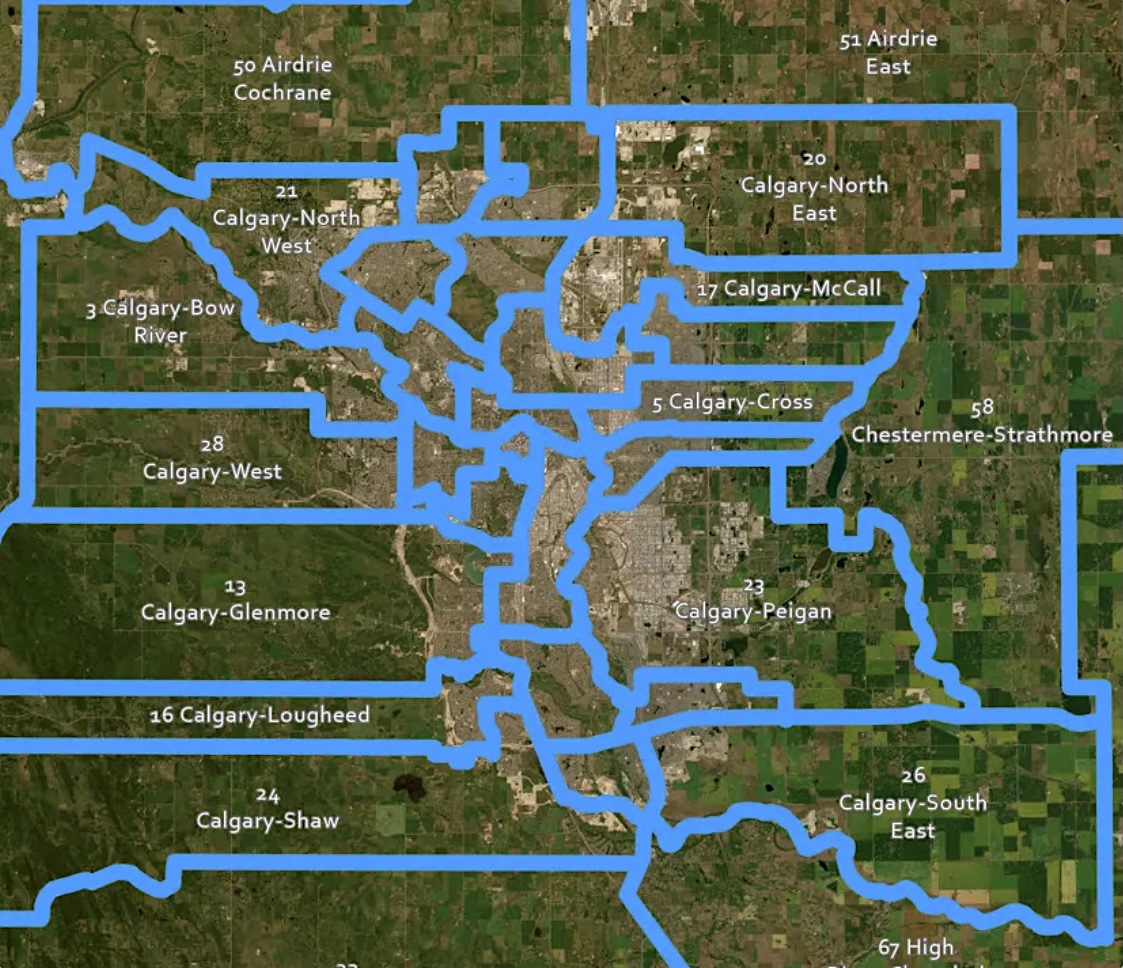
Kathleen Ganley, the NDP MLA, told reporters last week that if Durnie’s recommendations were implemented, Calgary would be sliced up “like a pizza.”
In Durnie’s submission, the boundary lines for several Calgary ridings stretch for hundreds of kilometres from Calgary east and west into rural Alberta, creating hybrid rural-urban ridings.
Ganley said it represented “transparent gerrymandering in order to dilute the voices of Calgarians.”
The NDP’s two panel appointees are University of Alberta law professor Gerard Kennedy and former Okotoks councillor Brent Robinson. Neither has donated to any political party either provincially or federally.
UCP’s picks to figure the cost of separation
The outrage over the boundaries panel was still on the boil on Friday when the UCP announced yet another study on the economic cost of Alberta’s potential separation from Canada.
The subject matter, like the question of new electoral boundaries, is potentially highly divisive and vulnerable to political manipulation.
That’s familiar ground for Lennie Kaplan, a former Alberta Treasury Board and Finance Ministry manager who served as executive director for the MacKinnon Report on Alberta’s Finances. It reviewed the province’s finances in 2019 and provided recommendations to balance the budget.
Kaplan recently told The Tyee the UCP should select a panel of independent and impartial public policy and economic experts to develop the methodology and terms of reference — with no government input — and then hire an outside firm to conduct the analysis.
The UCP chose the University of Calgary’s school of public policy to conduct the economic analysis. And it also announced an expert advisory panel to review the policy school’s final report, expected by summer’s end, and provide a separate assessment.
In a news release, the government said the advisory panel "will allow for further and potentially differing views to be shared, ensuring Albertans are equipped with all the facts."
The advisory panel will be chaired by Calgary economist Jack Mintz, who has been appointed by a succession of conservative Alberta governments to lead, or be a member of, numerous panels and committees.
In a 2018 Financial Post opinion article, Mintz asserted Alberta had better reasons to leave Canada than Britain did with Brexit. In another for the National Post, he advanced the claim that a separate Alberta pension plan could be a “huge win” for the province.
Political scientist and former provincial Conservative cabinet minister Ted Morton is another hand-picked member. Morton was one of the six authors of the 2001 Firewall Letter, sent by future Conservative prime minister Stephen Harper to then-premier Ralph Klein.
The letter called on Klein to build “firewalls” to protect Alberta from intrusions by the federal Liberal government and to implement several measures to make the province more independent.
Does the public care?
Polling over the past several months has consistently shown that about 70 per cent of Albertans support remaining in Canada while support for separation has been dropping.
The only reason an economic analysis is needed now is that the UCP cleared the way for a referendum on separation. Critics have said the referendum is an attempt by Smith to appease the party’s far-right fringe that has threatened to depose her and splinter the party.
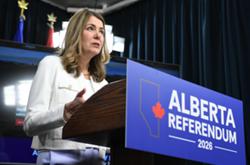
But the promised referendum has not appeased the party’s separatist faction because it’s not a direct vote on secession. The question on the referendum, scheduled for Oct. 19, will ask Albertans whether they want to remain in Canada or begin the legal work for a future binding referendum on separation.
Constitutional lawyers, political scientists and other critics have excoriated the question for being intentionally confusing, legally pointless and politically manipulative.
The referendum includes nine other questions related to immigration, social services and judicial appointments.
Five of the 10 questions focus directly or indirectly on limiting immigration and restricting access to social services for new immigrants. The NDP alleged the UCP is using the referendum to weaponize immigration and scapegoat immigrants to deflect attention from the government’s mismanagement of core services such as health care and education.
Because the UCP eliminated electronic tabulators — despite conceding there was no evidence of any issue with the machines — Elections Alberta has said it will have to hire about 60,000 people to hand count about 45 million individual ballots within 48 hours at a cost estimated to potentially reach $100 million.
Recent polling conducted for Global News shows 56 per cent of Albertans disapprove of the job Smith is doing and 58 per cent disapprove of her handling of the issue of Alberta’s potential separation from Canada.
Why then is Smith ramming through her unpopular agenda — inviting charges of gerrymandering and pandering to separatists — while ignoring evident conflicts of interest?
“Some observers think that the UCP doesn't care what the public thinks about them,” University of Alberta political scientist Jared Wesley said. “I'm more persuaded that the UCP don't think the public cares, and there is a difference between those two.”
Wesley said the UCP may think the timing of the referendum, with at least 10 questions, will distract people.
“I think they feel like this flood-the-zone strategy will help them to hide things like a gerrymandered map, if that is what they choose to do,” he said.
Smith’s response to low polls by leaning into unpopular, high-stakes gambits offers some similarities to Donald Trump’s behaviour nearly a year into his second term as president. Judith Levine, a Guardian columnist, has noted that Trump is openly using the presidential imprimatur to flagrantly enrich himself and his family. That projection of impunity — “the expectation of unaccountability” — is a tactic meant to breed cynicism among the public, which in turn enables autocracy as people give up and stop paying attention.
“The autocrat does not just defy the popular will; he dismisses it,” Levine wrote.
Wesley sees that tactic at play in Alberta.
“Part of the goal of flood-the-zone strategies, like the UCP is orchestrating, is to wear down opponents and make them feel like there is no alternative but the government's agenda, and as a result, you either shut up or ship out.”
If you have any information for this story, or information for another story, please contact Charles Rusnell in confidence via email. ![[Tyee]](/design-article.thetyee.ca/ui/img/yellowblob.png)
Read more: Alberta





Tyee Commenting Guidelines
Please note that email notifications for replies are not currently working due to a software issue which may be resolved in a future update.
Comments that violate guidelines risk being deleted, and violations may result in a temporary or permanent user ban. Maintain the spirit of good conversation to stay in the discussion and be patient with moderators. Comments are reviewed regularly but not in real time.
Do:
Do not: