


 SHARE:

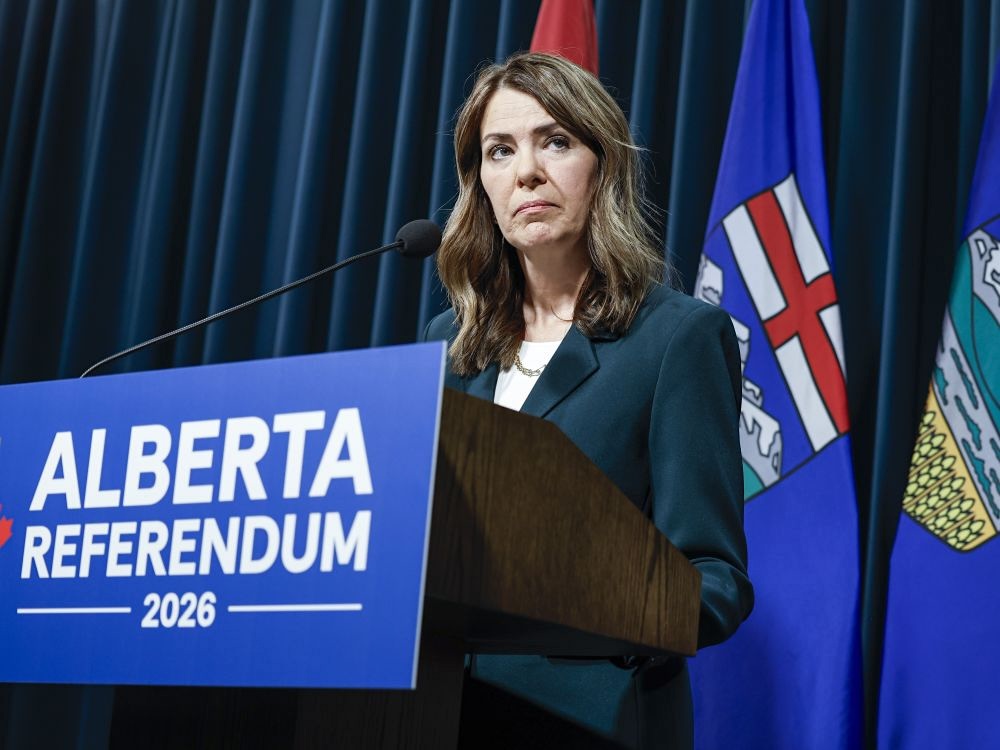
Ric McIver must be counting his lucky political stars.
In May 2024, as the United Conservative Party’s municipal affairs minister, McIver eliminated electronic vote-counting tabulators while readily admitting there was no evidence of any problems with the machines.
“This isn’t about evidence. This is about the confidence of the people,” McIver told CBC.
A year later, McIver’s fellow MLAs elected him Speaker of the Alberta legislature, which fortuitously shields him from questions about his foundational role in what critics are calling the most expensive, pointless and polarizing voting boondoggle in Alberta’s history — the Oct. 19 referendum.
If an estimate by a former chief electoral officer is borne out, the UCP government of Premier Danielle Smith will have spent at least $130 million for a referendum on secession and nine other questions related to immigration and constitutional change that no one asked for.
An Elections Alberta spokesperson said the final cost will be produced for the next sitting of the standing committee on elections, which has yet to be scheduled.
The separatist question drew worldwide attention, including unwelcome interference from the Donald Trump regime. Response to the question was a blowout. More than 75 per cent of Albertans voted to remain in Canada, nearly exactly the same outcome as polls dating back years.
“The 50-point margin is the largest of its kind in similar secession referendums across the globe,” University of Alberta political scientist Jared Wesley wrote. “Most questions with answers this clear are never asked in the first place.”
Feodor Snagovsky is Wesley’s colleague.
“My assessment is that we are fundamentally in the same spot as we were in February,” he told The Tyee in an interview.
Millions spent to peddle leading questions
The four constitutional questions related to the UCP’s quest for more autonomous power were defeated, and the five questions related to immigration, which critics excoriated as racist scapegoating, passed with bare margins.
The questions, Snagovsky said, “were written in a way that was leading and [the UCP government] spent $4 million campaigning on the outcome.”
“If ever there was a push poll, this would be it, and so I think their mandate on the immigration questions is very weak, considering how narrowly they passed,” he said. A push poll employs leading questions to produce a predetermined outcome.
The 10 double-, triple- and even quadruple-barrelled questions, all created by the UCP with no public input, were so confusing that community associations and seniors facilities asked Mount Royal University political science professor Lori Williams to provide information sessions.
“I encountered a whole lot of overwhelmed, confused people, and a lot of them were just angry that they were being forced to go through all of this when they don't even know what the government is going to do in response,” Williams said.
‘Undemocratic and unfair’
Duff Conacher of Democracy Watch said a referendum may be a useful democratic tool, but “Alberta’s process was undemocratic and unfair in many key ways.”
“Too many questions, government-drafted questions, misleading and vague questions, no court review of the questions, government spending, undemocratic flaws in donation and spending rules, lack of foreign interference and disinformation protections and the lack of a quorum all combined to make Alberta’s referendum process undemocratic and unfair,” Conacher said.
Political observers, including Snagovsky, have pointed out that the UCP could have tested public response to these issues by including them in its last election platform, or the government could have spent less than $100,000 on a high-quality poll and obtained the same results.
Post-referendum, there is clear evidence that McIver’s hand-counting policy has seriously undermined public trust in Elections Alberta. It forced the beleaguered independent agency to hire an army of 47,000 temporary staff — it failed to recruit the 60,000 it needed — to count more than 20.5 million ballots.
More than 100 polls opened late, there was confusion with mail-in ballots and at polling stations, some First Nations ran out of ballots, the vote counting stretched three days past the 48-hour legislated deadline, and social media is now rife with conspiracy theories about the legitimacy of the entire process.
The UCP has wasted money before, Snagovsky said, citing the tens of millions of dollars still to be recovered — if ever — from the so-called Turkish Tylenol scandal. But lost taxpayers’ money seems abstract to most voters, he said.
This potentially squandered $130 million is different.
“Albertans had to participate in the referendum, so the resentment for spending that much money on something that we all kind of resented having to participate in, I think, will resonate.”
What if the $130 million went to health care?
Recent polling shows Albertans are also acutely aware of the chaotic state of the province’s health-care system, created by the UCP’s ill-conceived restructuring of Alberta Health Services, or AHS. They want the government to move on from the referendum and address real issues such as health care and affordability.
The Tyee asked former senior AHS executive Stacey Litvinchuk what $130 million could have bought for the shambolic health-care system.
There is an acute shortage of nurses and doctors. Based on an assumed salary of $100,000 a year, AHS could have hired 130 registered nurses for 10 years, or 30 doctors for 10 years at a salary of about $429,000 a year.
Waiting lists for various orthopedic surgeries are now years long, and even critical cancer surgery patients are waiting beyond prescribed times.
The $130 million could have funded 12,790 knee or hip replacements, or 3,250 cancer or 3,625 coronary bypass surgeries, or 260,000 cataract surgeries.
Churning the waters
Smith has marketed the referendum as direct democracy, but critics view it as a transparent attempt by the premier to appease the separatists who now command a majority in the UCP. The separatists, who grew out of the anti-vax movement, helped elect Smith as premier after they made good on a threat to depose Jason Kenney for enacting pandemic restrictions.
Furious after their thrashing in the referendum, one separatist faction is now hectoring for a putsch of Smith while another faction has pledged support. The two sides are now fighting like crabs in a bucket on social media over who is in control of their movement.
There has been no grace in defeat, and all that remains is the seemingly incessant turmoil, uncertainty and brazen gaslighting from a premier who advanced a referendum that veteran Calgary Herald columnist Don Braid called “the most egregious political hoax inflicted on the Alberta public since Social Credit printed funny money.”
Snagovsky said this brand of cynical, increasingly authoritarian politics is spreading around the world in lockstep with the rise of right-wing populism.
He said what delineates Alberta’s referendum is the scale of the campaign and the amount of spending.
“There are differences in magnitude rather than differences in kind,” he said.
“But I don't think we should normalize this kind of behaviour. I think it is important to condemn it when we see it because it is contrary to a democratic society.”
If you have any information for this story, or information for another story, please contact Charles Rusnell in confidence via email. 
Read more: Alberta





Tyee Commenting Guidelines
Please note that email notifications for replies are not currently working due to a software issue which may be resolved in a future update.
Comments that violate guidelines risk being deleted, and violations may result in a temporary or permanent user ban. Maintain the spirit of good conversation to stay in the discussion and be patient with moderators. Comments are reviewed regularly but not in real time.
Do:
Do not: