


 SHARE:

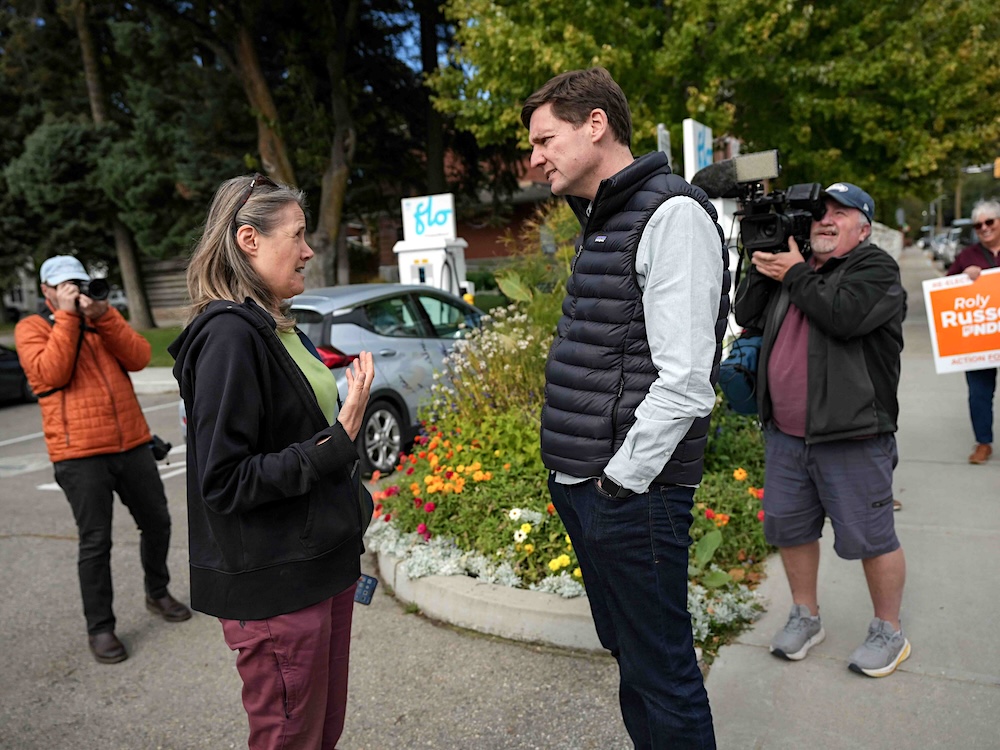
British Columbia’s forestry industry is struggling.
Logging and mill companies have grappled with climate change, new U.S. tariffs, invasive pests and forest management practices.
The result has been a decades-long wave of closing mills and thousands of lost jobs across British Columbia.
In the weeks before Premier David Eby called a snap election, forestry stakeholders including the United Steelworkers, the BC Council of Forest Industries, the Truck Loggers Association and the BC First Nations Forestry Council told the provincial government the industry was at a breaking point.
A month later, ahead of the provincial election on Saturday, B.C’s Conservative, Green and New Democratic parties have put forward their plans for the industry’s future.
The United Steelworkers union, which represents 10,000 B.C. forestry workers, has welcomed the NDP’s plan as a positive step toward protecting jobs.
Meanwhile Gary Bull, professor emeritus of forestry at the University of British Columbia, said that while both parties have made some steps toward sustaining the industry, neither the Conservatives nor the NDP offered a dramatic shift in the province’s approach to forest management.
“They are amazingly similar in many areas, which surprised me, to be honest,” Bull said. “I thought there would be a more dramatic difference, but the proof is in the pudding.”
Last week Eby outlined his party’s plan for forestry, which includes helping retrofit mills for new manufacturing, a new task force dedicated to keeping mills open and $120 million over two years for forestry workers and mills at risk of closing.
Scott Lunny, United Steelworkers Western Canada director, said he welcomed the plan, but it doesn’t go far enough to protect jobs.
“All of those are good things and positive things for the sector, and we’re happy about that,” Lunny said. “And it talks about a new task force, but I think we need something that has more teeth.”
Lunny is calling for the province to establish a forestry jobs protection commissioner focused on preserving existing jobs in B.C. communities. He noted that B.C. had a jobs protection commissioner from 1991 until the BC Liberals eliminated the position in 2002.
Lunny said he hadn’t heard much from the other parties about forestry but hopes whoever forms the next government takes serious steps to protect the industry. The union is calling on all parties to commit to ensuring a timber supply for forestry companies and make logging rights conditional on providing forestry jobs.
“We welcome all of the parties to lay out how they're going to help stabilize and then grow the forest sector and the wood manufacturing sector in this province so that it can be a thriving industry again,” Lunny said.
Forestry researcher Bull added that the NDP has also made efforts to protect jobs on the manufacturing side, including supporting value-added manufacturing and modular housing companies that employ forestry workers.
“The NDP has shown some street cred by actually getting it done at smaller scales, but that doesn't address the bigger challenge, like the lack of a coherent forest policy that deals with restoring forests or improving forest health,” Bull said.
Meanwhile, the Conservative Party of BC has attacked a recently surfaced part of the NDP’s forestry plan.
As first highlighted in an opinion piece in Northern Beat, the B.C. government was negotiating a proposal to transfer 400 plots of Crown land back to First Nations. The plan included setting limits on the amount of compensation owed to the companies holding timber rights on those parcels.
In a press release Thursday, the Conservatives said the plan may cause forestry companies to sue the provincial government for curbing their compensation while taking away logging permissions.
The Conservatives’ plan, announced Monday, includes proposals to increase the province's annual economically viable harvest (the amount of wood allowed to be harvested each year) to 45 million cubic metres from 29 million cubic metres.
This summer, the NDP government also committed to raising the annual harvest to that level.
It’s a measure the forest industry has asked for. In their September open letter, forestry stakeholders urged the government to raise the economically viable harvest to exactly that level.
The Conservatives have also pledged to extend the B.C. Manufacturing Jobs Fund — a $200-million program to help manufacturing companies create jobs — as well as cut taxes for value-added wood manufacturers and reduce permitting costs for B.C. mills.
Bull said the Conservatives have also signalled interest in reforming the stumpage fee system, a method the government uses to collect revenue from cutting trees on publicly owned land.
Bull said both parties’ platforms were still missing details about how to finance better forest management.
“I'm disappointed in both parties for a lack of any prescription for how we're going to fund and pay for the management of forest,” he said.
The BC Green Party’s forestry platform includes implementing recommendations made in the Old Growth Strategic Review, rejecting the proposed 45-million-cubic-metre annual harvest level, ending clearcutting and dedicating up to 50 per cent of B.C.’s fibre toward value-added production.
While the platform mentioned jobs and workers, Bull was not convinced it included a clear plan to preserve a healthy forest industry.
“The idea of managing forests to produce wood products is just not in their platform,” Bull said. “They mention these words like workers, communities and First Nations, but I don't see anything specific that would indicate to me that they have given this enough serious thought.” 
Read more: Labour + Industry, BC Election 2026, BC Politics






Tyee Commenting Guidelines
Please note that email notifications for replies are not currently working due to a software issue which may be resolved in a future update.
Comments that violate guidelines risk being deleted, and violations may result in a temporary or permanent user ban. Maintain the spirit of good conversation to stay in the discussion and be patient with moderators. Comments are reviewed regularly but not in real time.
Do:
Do not: