


 SHARE:
Leaving a career in sawmills wasn’t easy for Tim George. Nor was it his choice. Having grown up in Port Alberni on Vancouver Island, George said his options were to work either in forestry or at the local seafood processing plant.
He started at the local Errington sawmill when he was about 22 years old, and would spend the next two decades working at various mills in the area.
But in 2019, the Errington sawmill went bankrupt and laid off 50 workers. After a career in Port Alberni’s defining industry, George found himself out of a job.
For years, George jumped around, he said. He tried his hand at a local recycling company. He found sporadic work at a sawmill near Whisky Creek, which he said was about a 45-minute drive from his home when there isn’t tourist traffic.
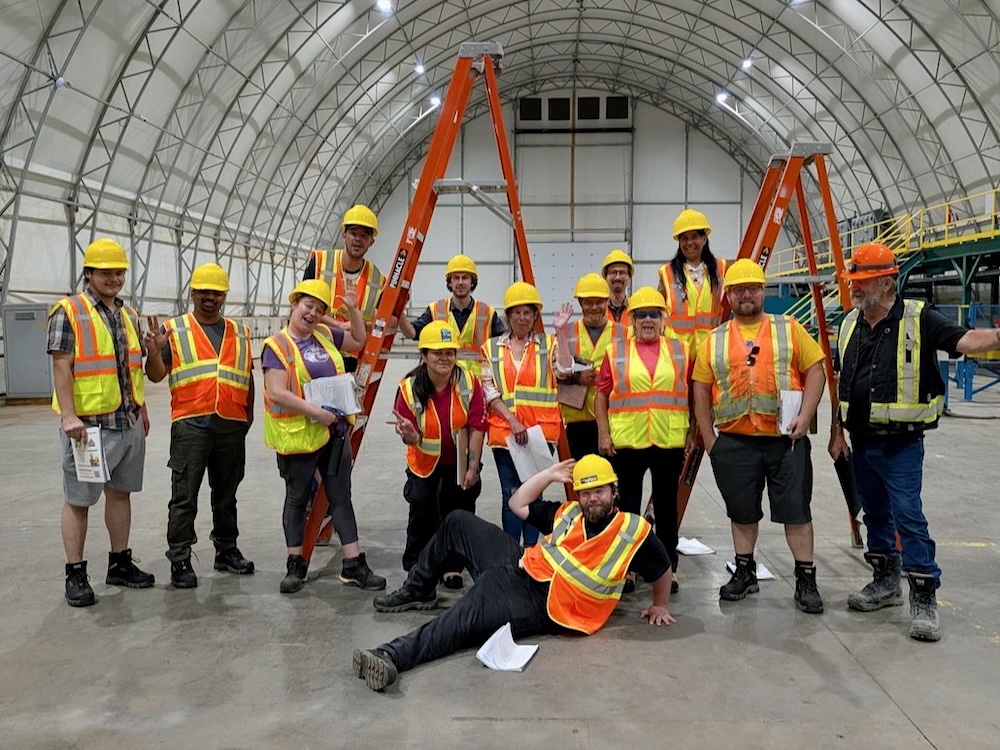
But last year, he saw a job posting for IGV Housing. The Port Alberni-based housing construction startup partnered with a local college to retrain more than two dozen displaced workers for manufacturing jobs.
“I was living paycheque to paycheque, worried that I might not be working next month,” George said. “Having some financial relief, with a regular Monday-to-Friday job that doesn't look like it's going away any time soon, has been really important to me.”
The steady work close to home meant George could help his wife support their four kids. He’s one of two dozen displaced workers to be retrained for work in manufacturing, and one of the 12 hired by IGV Housing so far. For Port Alberni, the retraining program has made a meaningful difference.
But Arnold Bercov, a former worker at the Harmac pulp mill north of Crofton and former president of the Pulp, Paper and Woodworkers of Canada, said that while the startup is great news for about two dozen workers, it doesn’t make up for the thousands of forestry job losses across B.C.
“Losing your job is heartbreaking,” he said. “So these guys getting a job is a great thing, but with the amount of timber we have and the opportunities we have, there’s so much more opportunity to move this industry forward and employ people.”
George is one of the thousands of B.C. workers affected as mills shutter across the province and forestry companies take their business to the United States.
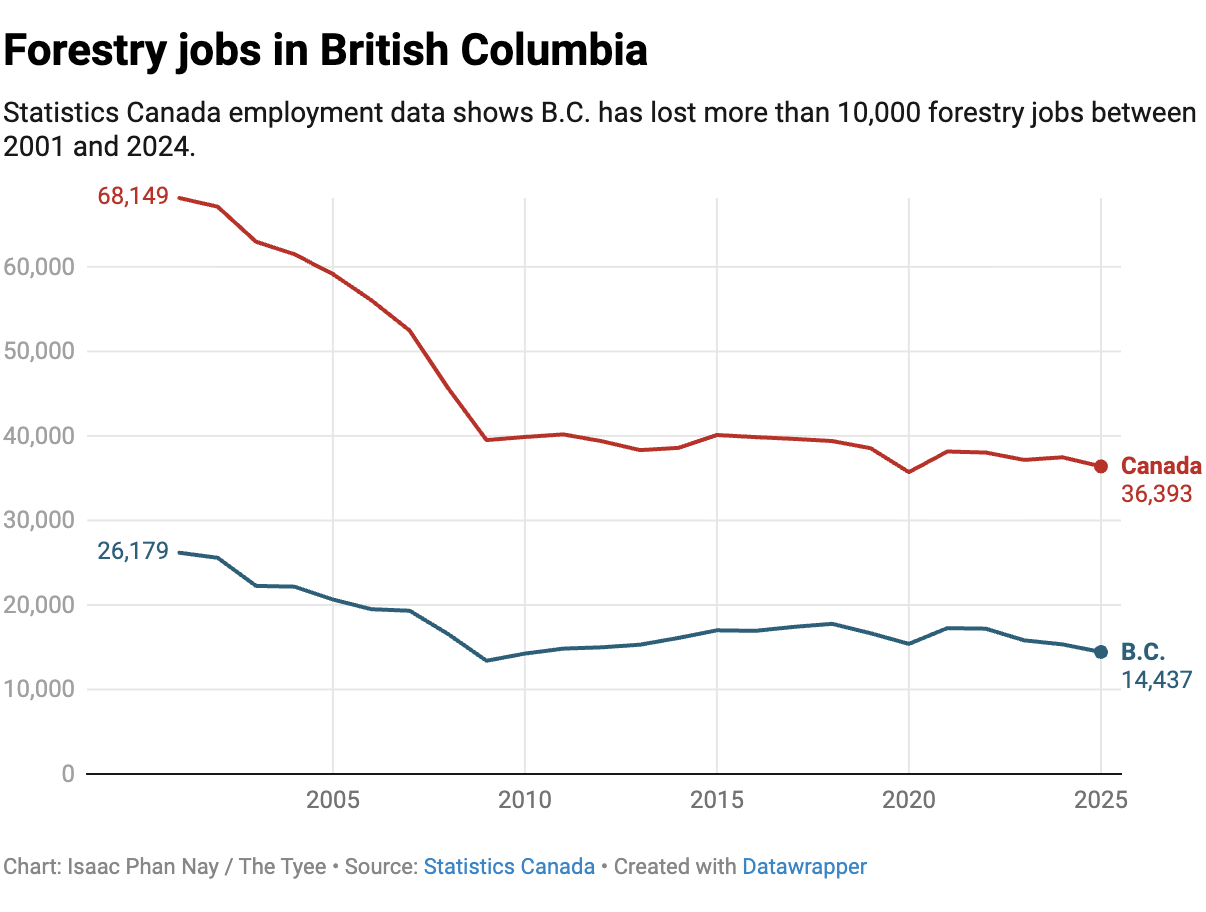
Canadian employment data shows the province has lost more than 10,000 jobs in forestry since 2001. That’s not counting the supporting service, hospitality and other jobs lost in towns affected by the industry’s decline.
Port Alberni has been hit especially hard. The city, located at the head of the Alberni Inlet about 62 kilometres west of Nanaimo, has a long history as the forestry hub for Vancouver Island.
Each sawmill closure there was uniquely painful. More than 100 Port Alberni workers were laid off when Western Forest Products closed its local sawmill in 2022. Another approximately 75 people were laid off when the Coulson sawmill curtailed operations in 2024.
For George, the closures were devastating. He knows people who took minimum wage jobs to put food on the table or started flying out of town to work on oil rigs.
“I was worried,” he said. “There's not a lot of jobs in Port Alberni, and there's not a lot of places to work.”
IGV Housing’s manufacturing plant was a welcome addition to the city, said Port Alberni Mayor Sharie Minions. The startup put in a bid for the former wood remanufacturing site owned by San Group Inc., the company that owned the Coulson sawmill before going bankrupt.
“We were really nervous about what might end up going there,” Minions said. “We were extremely thrilled when IGV ended up getting the property.”
The company plans to employ a total of 80 workers by the end of the year. Minions said she expects a large portion of those jobs will go to former sawmill workers. She said those jobs will let those workers and their families — often employees who work in other industries in town — stay in Port Alberni.
“I can't tell you how meaningful it is for our community,” she said. “It really matters on a person-to-person basis in this town.”
IGV Housing manufactures components for single-family homes and says its process speeds up construction and lowers building costs.
From the repurposed manufacturing floor, IGV Housing plans to prefabricate housing components that can be delivered to a construction site and assembled.
For example, according to chief of staff Jodie Thompson, the company will manufacture a house’s “smart core” — a pre-assembled structure that includes the kitchen, electrical system, plumbing and HVAC — which can be delivered to a construction site and finished with windows, doors, floors and all the other parts of a house.
“It’s all done before it arrives on site, before it’s ready to plug and play,” she said.
She expects the factory to be operating in full swing this summer. By August, Thompson estimates, the company will be able to produce two smart cores per day.
Thompson said the company was specifically interested in hiring displaced logging workers because of their experience in a factory setting.
IGV Housing partnered with North Island College to come up with a five-week training program to reorient sawmill workers for its factory floors. They selected a cohort of 15 workers to attend the program, which was funded in part by the Synergy Foundation, a Victoria-based non-profit established to support sustainable development.
The first cohort, which included George, started the training program in March. By April 22, they had completed training and were on shop floors. Twelve stayed on at IGV Housing, while three went on to work for other employers.
While many of IGV Housing’s machines are new to the sawmill workers, Thompson said they had transferable skills that meant they could pivot to the job with only a month of training.
“They've got great work ethic and they've got great experience,” Thompson said. “They all arrived at this as this cohesive team that had spent five weeks bonding together, so they're all as thick as thieves.”
In total, IGV currently employs 45 full-time staff. At least five are directly displaced sawmill workers and six more were indirectly affected by sawmill closures. A second cohort of about 15 more employees, which Thompson estimates is mostly displaced workers, finished training on Friday.
In an email, a company spokesperson said it pays production operators $25 per hour, while team leads and other specialized roles are paid at or above market rate. All the employees get four weeks of leave per year.
But Bercov pointed out that one new startup doesn’t solve the broader problem.
“It’s a great story, but that’s not going to save the industry,” he said. “There's a whole bigger picture here that needs to happen.”
Bercov was one of the mill workers who bought and revived the Harmac mill in Nanaimo, saving hundreds of jobs. That was back in 2007.
And while Bercov said individual success stories are great when they work out, he urged the province to overhaul its forestry policy to prevent B.C.’s remaining saw and pulp mills from closing.
“It destroys that community and its tax base,” he said. “Once those mills go down and they’re torn apart, they’re not going to build new ones.”
‘What are you going to do for work when the mills are all done?’
Back in Port Alberni, George said the training program felt like high school. He recognized a couple of the other trainees and had worked with one for about 20 years.
“It was weird that we all showed up in the same course,” he said. “Really, comes down to ‘What are you going to do for work when the mills are all done?’”
According to George, the course mainly involved learning how to operate new factory machines, including one that he affectionately refers to as the Hundegger. It’s a robotic chop saw that cuts wood precisely to certain lengths.
About two months later, George had full-time work at the manufacturing plant in his home city. He said the factory is a two-minute drive from his home, meaning he’s close enough to help his wife get their children to dance practice, hockey, girl guides, boy scouts and more.
But most importantly, George said, the steady work is a huge financial relief.
“Our town needed something like this to keep it from becoming a retirement home,” he said. “I’ve done mills my whole life. This is such a nice change.”
*Story updated on June 25 at 12:30 p.m. to to clarify that workers were retrained after the factory was open, not before. ![[Tyee]](/design-article.thetyee.ca/ui/img/yellowblob.png)
Read more: Labour + Industry









Tyee Commenting Guidelines
Please note that email notifications for replies are not currently working due to a software issue which may be resolved in a future update.
Comments that violate guidelines risk being deleted, and violations may result in a temporary or permanent user ban. Maintain the spirit of good conversation to stay in the discussion and be patient with moderators. Comments are reviewed regularly but not in real time.
Do:
Do not: