


 SHARE:
Incumbency doesn’t mean much in Penticton.
Over the last three decades, a mayor has won re-election just once, and as Julius Bloomfield attempts to buck the fate of his predecessors he’ll need to defeat a former MLA who happens to be the last mayor to accomplish the feat.
Bloomfield, a former deputy leader of the Green Party and local businessman, is facing off against former BC Liberal MLA Dan Ashton in a mild-mannered contest in which bike lanes have been a central debate point.
Bloomfield is proud of his council’s record over the last four years, pointing to declining crime, increased childcare spaces and strengthened partnerships and responses to homelessness, addiction, mental health and public safety concerns.
The campaign has been cordial and Bloomfield’s challengers have launched few direct attacks. Ashton, the one challenger with political experience, has complimented complimentary council’s work and has blamed the province more than his opponent for challenges it is facing.
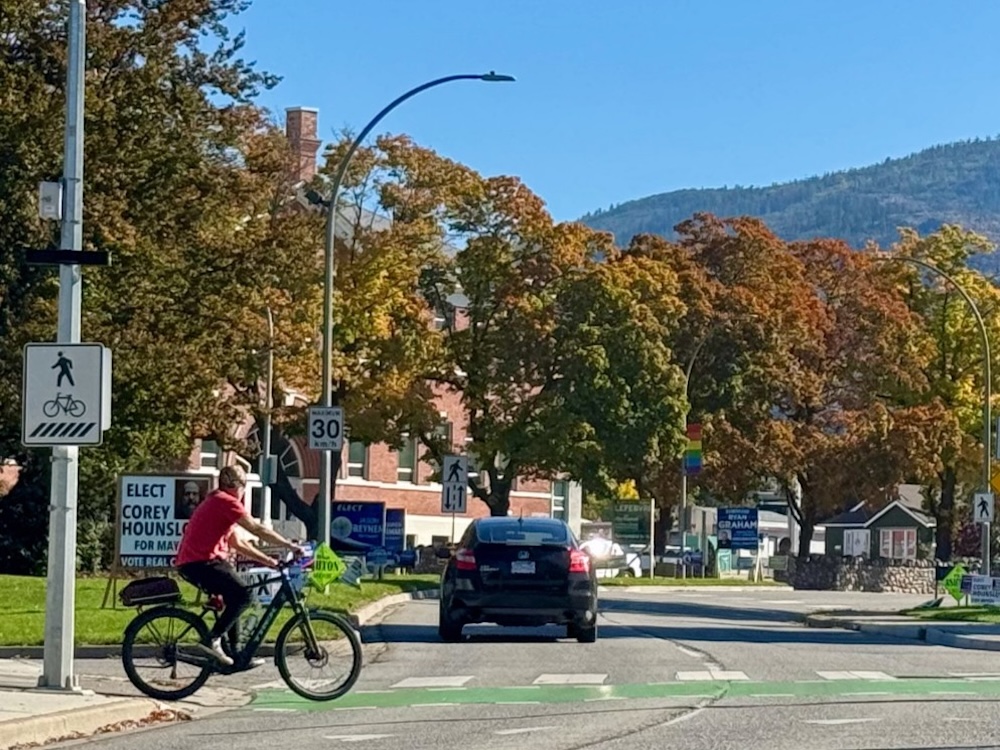
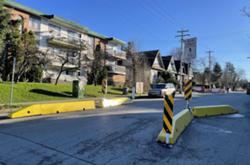
Amid the general politeness, the clearest division between challengers and incumbent has revolved around Penticton’s network of bike lanes. The city spent millions to build a protected bike route between the two lakes that bracket the town, but three years ago, council narrowly voted to halt plans for additional separated lanes. Bloomfield was opposed to the stoppage.
The city also implemented a “sign diet” in response to concerns about excessive signage on a new route between Okanagan and Skaha lakes.
Penticton has continued to build infrastructure for bikes, but the newer lanes are less costly and separated from road traffic by raised curbs, rather than barriers and bollards.
At a candidate’s meeting in late September, many of Bloomfield’s challengers, like businessman Jordan Iannone, called for a halt to bike lane expansion.
“There’s stuff that maybe we didn’t have to spend money on — bike lanes, or half the bike lanes,” he said.
Ashton had a similar message.
“I am not against bike lanes,” he said. “I think they’re imperative, but there’s a better way to do it.”
The bike lanes were part of a larger focus on how Penticton is reconfiguring its streets, with some challengers also taking aim at traffic-calming infrastructure, like speed bumps, that have been added to city streets.
Some, like local radio host Dave Del Rizzo, found the focus on bike lanes disappointing and surprising.
“Are bike lanes the biggest concern that is facing the city at this time?” Del Rizzo asked his fellow co-host on community radio outlet CFEZ following the forum.
Bloomfield was mostly silent on the bike lanes at the forum, but he later told The Tyee that the bike lane discussion is a reflection of the city’s progress on other issues.
“The bike lanes is a catalyst for everything that angry people can be angry about,” he said. “It’s really because we’ve covered a lot of ground on everything else and it’s really the only wedge issue that they have.”
The lanes reflect the fact that Penticton needs to densify as its population grows because its land base is confined by lakes and mountains on all sides.
Bloomfield says that since the first forum, his opponents seem to have mellowed on the bike lane issue.
“Most of them went, ‘OK, yeah, we’re really not against bike lanes, we just don’t like the way they’re built,’” he said. “Everybody’s tempered their view.”
The yin and yang of Penticton politics
But even if the bike lane issue is diffused, Blomfield knows all too well that he won’t have an easy time winning re-election.
He and Ashton have been entrenched in the region’s politics for more than a decade. Indeed, this won’t even be the first time Ashton and Bloomfield have fought a mayoral battle against one another.
Fifteen years ago, in 2011, Ashton was the one-term mayoral incumbent and Bloomfield the challenger. Ashton won and became the first Penticton mayor to win re-election since 1993. But he did so by a thin margin, beating Bloomfield by just 146 votes. The opposition vote was also split, with a third candidate receiving more than 2,000 votes.
In 2013, Ashton resigned to run provincially, triggering a by-election. Although there was speculation Bloomfield would run again he had moved beyond city politics, instead buying a Naramata hotel.
However, Bloomfield returned in 2018, winning a seat on council. Four years later, he staged a successful mayoral campaign in a narrow race he won by less than 200 votes over another challenger. Incumbent John Vassilaki finished third, garnering barely 20 per cent of the vote. Before the election, Vassilaki’s brother and sister had accused the mayor of threatening to kill them in a family dispute. Vassilaki denied the accusations, but was later ordered to pay $14,000 to his brother. This year, Vassilaki was found to have misappropriated more than $800,000 from a family company.
Bloomfield has enjoyed a quieter four years as mayor after running on a platform that called for the city to pursue broad strategies to address housing, financial, and infrastructure challenges.
As he campaigns for re-election, he’s running on his record.
Ashton, meanwhile, has taken a mild approach — generally applauding council’s last four years, while saying that his Victoria experience will help the city better lobby the province. The rest of the mayoral field has generally focused on the need to reduce city spending, address road infrastructure like the bike lanes, and tackle issues related to public drug use and visible homelessness.
What kind of change do voters want?
Bloomfield has shaped his message around the theme of progress. But he knows that message doesn’t always appeal to voters.
Bloomfield said the city’s anti-incumbent past reflects Penticton’s population, which is split between large cohorts of long-time residents and newcomers from larger cities.
He said the city’s politic scene is like a “pendulum” and driven by voters’ contrasting views on the city changing. Mayors that attempt to preserve the status quo or reduce the pace of change tend to inspire a backlash from voters who want progress. They elect change-promising mayors, who then face their own push back.
“People come in, like myself, and make lots of change, and the people that don’t like change, they get angry and get out and elect somebody who promises no change,” Bloomfield said. “It’s very simplified, but that’s the dynamic.”
Whether Ashton will mobilize those anti-change voters remains to be seen. Neither Ashton nor Jordan Iannone, Bloomfield’s two Penticton challengers with websites, returned The Tyee’s request for an interview.
Ashton’s campaign has focused on the need for the city to facilitate more access to treatment for those suffering from addictions, while taking aim at the province for insufficient social programs. At the recent forum, he pointed to the city’s hiring of more bylaw officers to address issues stemming from addiction and social issues, and says the province needs to deliver more assistance.
“Thanks to the council for stepping forward, but it’s not our responsibility to look after issues from the province,” he said.
In mid-sized B.C. cities like Penticton, mayoral races can come down to which candidate seems most competent or best captures the mood of voters. The power of municipalities is limited by provincial and federal jurisdiction, and most city spending goes towards water, sewer, roads, policing and fire needs. Within those confines mayors — who have just a single vote on council — has even less power. They can help shape a city’s agenda and lobby senior levels of government, but they need the support of others to accomplish their goals.
So in Penticton, as in many cities, elections often come down to whether voters feel their city needs to change course or continue heading in the current direction. Even then, it’s often hard to reckon what, exactly, voters want.
“Everybody wants progress,” Bloomfield said. “Nobody likes change.” ![[Tyee]](/design-article.thetyee.ca/ui/img/yellowblob.png)








Tyee Commenting Guidelines
Please note that email notifications for replies are not currently working due to a software issue which may be resolved in a future update.
Comments that violate guidelines risk being deleted, and violations may result in a temporary or permanent user ban. Maintain the spirit of good conversation to stay in the discussion and be patient with moderators. Comments are reviewed regularly but not in real time.
Do:
Do not: