


 SHARE:
I was looking forward to the drive. I had just visited friends near Langley, and was about to enjoy some time alone on the drive back to my apartment in Vancouver.
Then my GPS led me to a new exit I was unfamiliar with, towards the Port Mann Bridge. Normally, I drive to Vancouver through North Delta, my hometown.
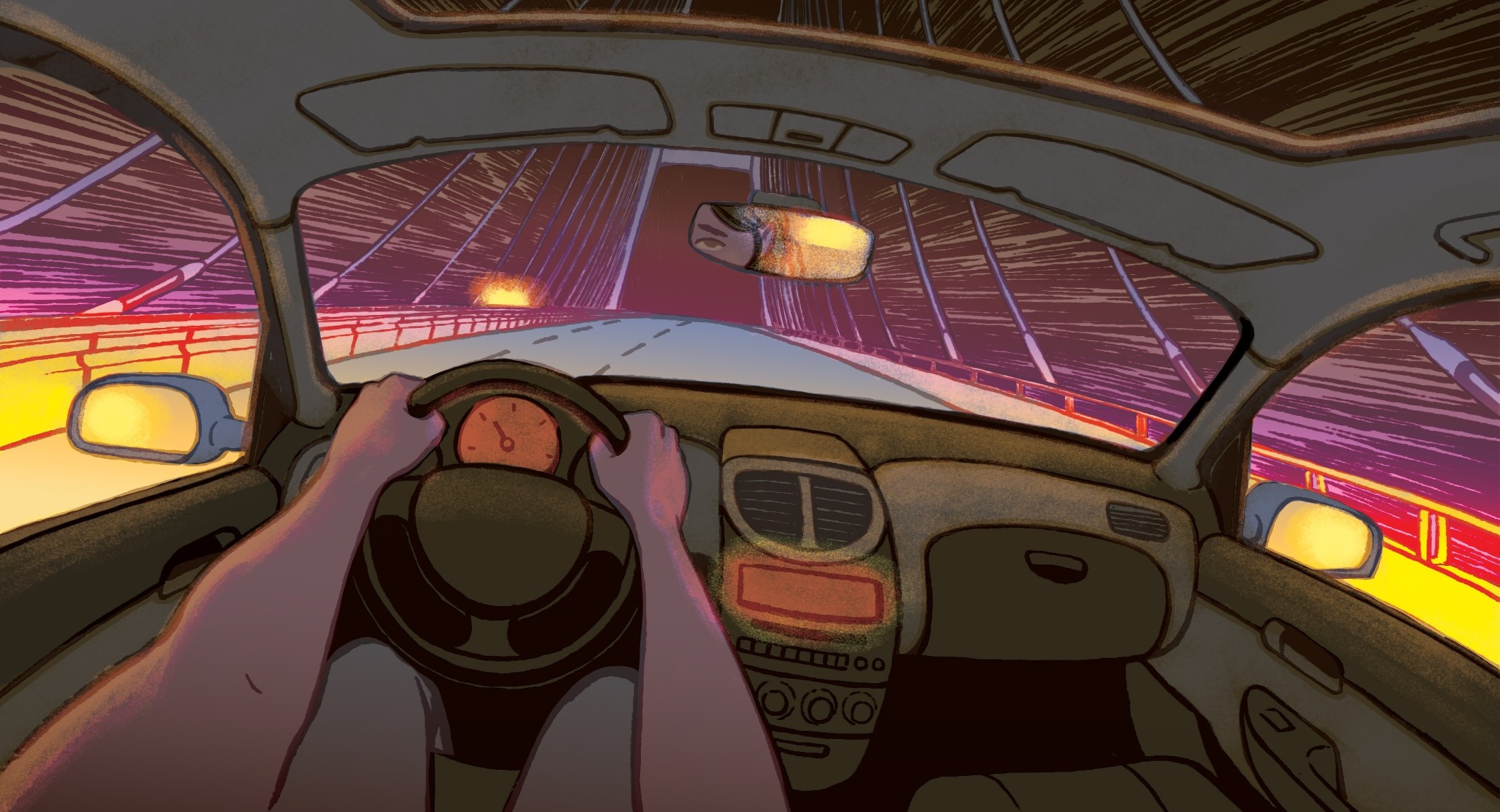
Confused, I looked around the 10-lane bridge. It was dark and I didn’t know where I was going. Suddenly, my car felt like a sauna, my heart rate rose, and I started to feel dizzy. For the first time, I thought, what if I faint right now?
After this, I kept driving. I drove from Vancouver to my hometown, North Delta, every weekend. The trip didn’t take me over the Port Mann, but it did involve crossing the Alex Fraser Bridge. Each time, the same thought popped up. What if I faint right now? The thought grew louder each time I crossed. Soon enough, even looking at the bridge began to make me afraid.
The Alex Fraser Bridge looms over North Delta. It’s as high as a 50-storey building, with a bridge deck of 930 metres. While it should only take a few minutes to cross, heavy traffic sometimes makes it take an hour.
Soon, I started avoiding the bridge altogether, taking the George Massey tunnel under the Fraser instead. But the avoidance made things worse. The intrusive thought expanded. I became afraid of fainting in the tunnel too. Then, on the highway. Then, anytime I was driving.
Intrusive thoughts can consist of thoughts, images, or impulses that arrive uninvited and are bothersome, says Ingrid Söchting, the director of the UBC Psychology Training Clinic. “They don’t feel like they belong to you, and they typically scare you.”
Most people experience intrusive thoughts — one study estimated they affect 80 to 99 per cent of us.
But only some intrusive thoughts become debilitating.
After a year of therapy, I made it across the Alex Fraser Bridge one time. Then I began avoiding it all over again, and my intrusive thoughts intensified. Finally, a panic attack on the highway made me pull over. The battle had become insufferable. Once, I was a person who could go cliff jumping. Now I’m someone who shakes at the sight of a bridge.
So, I set out to conquer my fear.
A disease of doubt
When I was 11, I placed my head down on my pillow and began to pray. “Dear God,” I started. But I was interrupted by a thought that appeared out of thin air. It screamed, Devil! The thought emerged like a voice in my head that I couldn’t control, like someone had made themselves at home in my mind.
The more I tried to quiet it, the louder the thought became. Soon, it happened every night. Then, during the day, any time I had a moment to myself. Not knowing what else to do, I prayed more often.
The next thing I knew, I was having new intrusive thoughts. Scrub your hands again, you’re not clean enough. I washed my hands until the skin was so raw that it bled.
From the age of 11, I thought there must be something wrong with me. At 19, I started therapy, and it was finally confirmed — I was suffering from obsessive-compulsive disorder.
OCD involves recurring intrusive thoughts (“obsessions”) that are followed by mental or physical responses to relieve the discomfort that the thoughts bring (“compulsions”). The presence of intrusive thoughts alone does not constitute an OCD obsession; it’s only when they are highly repetitive and cause enough distress to seriously disrupt a person’s everyday life.
OCD, which affects about two per cent of adults at some point in their lives, is sometimes called the “disease of doubt,” because it makes sufferers doubt their own sense of self because of dissonance between their thoughts, senses and beliefs and those imposed by intrusive thoughts.
The distress the disorder causes can feel inescapable. It can make me feel like I’m on the edge of madness, consciously watching myself tumble down a cliff, with no way to stop the momentum.
Obsessions normally oppose what a person with OCD believes. Before OCD intruded, I loved driving. Receiving my driver’s license was the most in control I’d felt in years.
And then that was taken away.
In vivo, imaginative, interoceptive
Exposure-response-prevention, a type of exposure therapy, works by informing the patient about what OCD is while helping them gradually confront the fears related to their intrusive thoughts. This part of the therapy is the “exposure” aspect. Then, the patient is instructed not to perform any of their compulsions. That’s where “response-prevention” comes in.
One of three main types of exposure-response-prevention is called “in vivo exposure,” where patients confront their fears in real-life situations. For me, this means looking at the bridge.
I park my car in the parking lot of a dive bar located in a relatively secluded area near the Alex Fraser Bridge. As I step out of my car, I can smell cigarette smoke, and immediately feel self-conscious knowing there are other people around.
But I stare up at the bridge anyway. I can hear the cars crossing it rapidly. There’s a small pinch in my chest, but I’m not heating up or feeling dizzy. I feel a small burst of confidence.
My anxiety about looking at the bridge has drastically decreased since last year.
Another type of exposure-response-prevention is the “imaginal exposure.” In my case, this consists of listening to a voice recording of myself depicting the worst-case scenario, which is fainting on the bridge.
The description details my deepest fear — the way my body starts to heat up, the dizziness that creeps up out of nowhere, the feeling that my head is wrapped in a plastic bag and I’m slowly losing air, all while driving, until finally, I pass out.
“I creep onto the bridge, the walls of my car feel too close, too confining. My hands are shaking on the wheel, my vision starts to narrow.”
As I hear myself speak, I can’t help but feel lost. If the idea of crossing the bridge makes me this nervous, how am I ever going to actually cross it? But as I finish the exposure, I’m less anxious than I thought I would be. The relative ease I feel indicates that I need to move on to a harder exposure.
The following day, I’m getting ready for my “interoceptive exposures” — physical exposures that simulate the anxiety your body feels in order to get accustomed to it and realize it isn’t a threat. My task is to breathe through a straw, which mimics shortness of breath.
Since my imaginal experience was manageable, I decide to combine the two kinds of exposures: I’ll listen to my voice recording while breathing through the straw.
I turn on the voice recording, pinch my nose and start breathing through an orange straw I found in a cabinet in my kitchen. It is making me feel claustrophobic, but I force myself to sit through the entire three minutes and 41 seconds of the recording.
For the first few minutes it almost feels like I am holding my breath underwater until I start to feel light-headed. The remaining minute and a half, I’m relatively calm.
While that should be a positive, it only makes my fear stronger. I’m getting closer to the point where effective exposure-response-prevention won’t be attainable from the comfort of home, or the relative comfort of the dive bar parking lot. I’ll have to actually drive.
For the next few weeks, I take a daily trip around town. Often, driving for even five minutes makes the intrusive thought blare like an alarm built into my ears.
Then, on a random Monday, my partner, Khiel, is driving us across the Burrard Street Bridge. The bridge is short, and lacking the vertiginous rise of my nemesis, the Alex Fraser.
“Why don’t I start with a less daunting bridge?” I ask.
Exposure-response-prevention
A few weeks later, Khiel is driving towards downtown Vancouver from North Delta. He drives over the Alex Fraser with complete ease.
I cry for 20 minutes straight. While I’m afraid, I’m mainly crying because I feel I’ve lost a piece of myself.
We pull over a few blocks from the Burrard Street Bridge. Khiel and I switch positions.
The bridge should take approximately two minutes to cross. If you didn’t know there was water on either side, it would look like a regular road. It’s only about 20 metres tall, almost miniature in comparison to the Alex Fraser.
I start driving. The most important thing is that I don’t pull over, I think. I look ahead. I start to feel hot, dizzy. I try to take some deep breaths but the entire time I feel like I can barely breathe. I’m going to faint, my brain screams at me.
I park at a gas station on the other side. I’ve made it. “Ready to go back?” Khiel asks.
I drive back across. I’m barely afraid. I give Khiel a shy smile. It isn’t the Alex Fraser, but it’s a bridge. And I crossed it.
Bridge over troubled water
I still haven’t crossed the Alex Fraser. I wish I could say I had. I want this to be a story of triumph. More importantly, I want to cross the bridge. But I’m not ready yet.
Recently, I was a passenger in my mother’s car. I was staring out the window at people who were driving and wishing so badly to be one of them. Instead, I felt 15 again, needing my mother to drive me around.
Tearing up, I reached over and turned up the car audio’s volume dial, hoping for a distraction. Then I recognized the song. “Your time has come to shine. All your dreams are on their way. See how they shine.”
I started crying harder.
What an irony — weeping about a bridge while listening to Simon and Garfunkel’s song about a bridge being a symbol of peace.
But the moment led to a realization: my fear is only one part of the problem. The way I demean myself while in distress is the other part. More than I am afraid, I am angry at myself for being afraid. I know the shame I feel is typical of people suffering from OCD, but knowing hasn’t made it easier.
Acceptance will, though. I may always have these intrusive thoughts. And it may always be a struggle. I need to accept this struggle. Hating intrusive thoughts comes with the territory, but you can’t let them make you hate yourself.
The tears rushed down my face.
And the song continued. “Like a bridge over troubled water, I will ease your mind.” ![[Tyee]](/design-article.thetyee.ca/ui/img/yellowblob.png)
Read more: Health












Tyee Commenting Guidelines
Please note that email notifications for replies are not currently working due to a software issue which may be resolved in a future update.
Comments that violate guidelines risk being deleted, and violations may result in a temporary or permanent user ban. Maintain the spirit of good conversation to stay in the discussion and be patient with moderators. Comments are reviewed regularly but not in real time.
Do:
Do not: