


 SHARE:
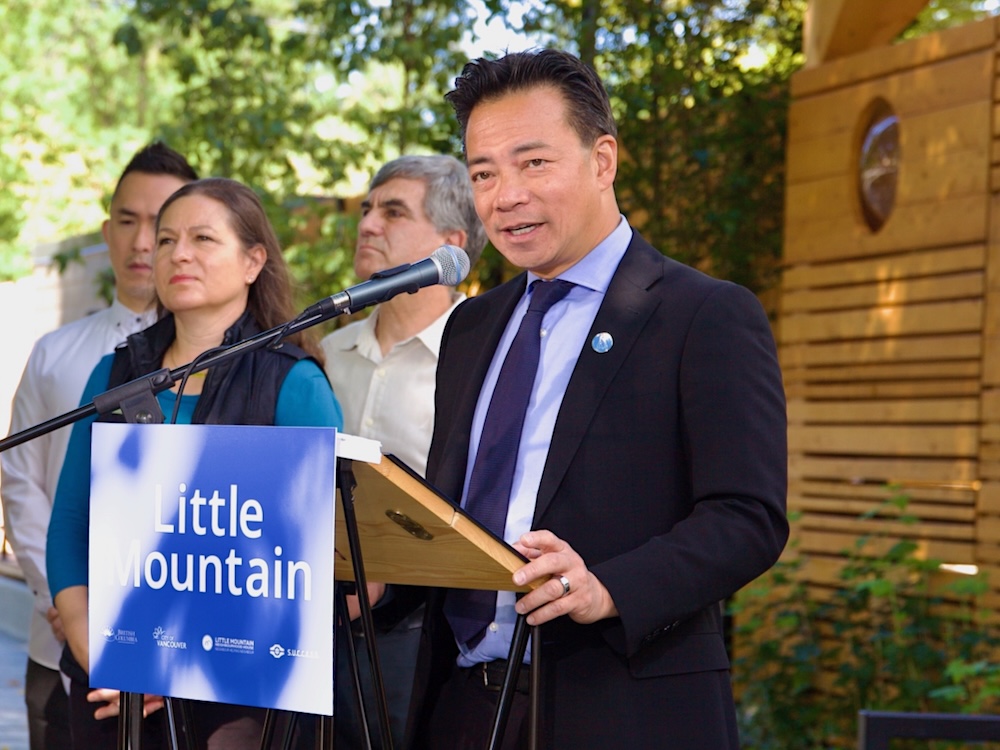
Vancouver Mayor Ken Sim is not popular. And yet, he is the current front-runner to win the city’s mayoral election when ballots are cast in two months.
A crowded field of opponents splitting the vote among Vancouverites opposed to Ken Sim partially explains this contradiction. But beneath that arithmetic is a deliberate political strategy that inverts the big-tent approach that first swept Sim and his ABC Vancouver party into office in 2022.
Instead of preserving that original, broad coalition, Sim and ABC have consolidated a smaller, more durable and distinctly conservative electoral fortress.
The strategy becomes clearer in recent polling.
An August Research Co. survey found that 39 per cent of Vancouverites view Sim favourably, while 52 per cent view him unfavourably.
Thus, Sim’s net favourability sits at minus 13, the worst of any mayoral candidate tested.
The Vancouver Greens’ mayoral candidate, Pete Fry, enjoys the strongest net favourability at plus 12, followed by the Vancouver Liberals’ mayoral candidate, Kareem Allam, at plus 10.
Yet among decided voters, Sim leads the mayoral race with 30 per cent of support, a staggering 11 points ahead of both Fry and Allam, who are tied for second at 19 per cent each.
Somehow, currently, the candidate Vancouverites view least favourably is the candidate they are most likely to elect.
The paradox can be explained by parsing through Sim’s support by demographic.
Among decided voters who own their home, Sim has 36 per cent support, nearly double that of the next closest mayoral candidate. Among renters, however, Sim falls to 22 per cent, in a virtual dead heat with both Allam and Fry.
In terms of voting intention, Sim leads across genders, every age bracket and primary residence status. But his electoral advantage is, by far, the largest among Vancouverites who own their home.
That contrast reveals the foundation of Sim and ABC Vancouver’s fortified castle of support: homeowners.
That fortress is considerably smaller than the coalition that elected Sim as mayor and ABC to a supermajority on city council four years ago.
In the same survey, nearly 40 per cent of decided voters who backed Sim in 2022 now intend to support someone else for mayor. Much to Sim’s electoral benefit, however, those voters have scattered in different directions, as no other mayoral candidate has captured more than 16 per cent of Sim’s 2022 voters.
So while Sim has lost a substantial portion of the coalition that delivered ABC’s landslide win four years ago, remarkably, he may not need them this October.
The polling reveals who forms the strongest part of Sim’s electoral fortress. But ABC Vancouver’s deliberate policy and ideological choices reveal what is holding that support base together.
The pillars of ABC Vancouver’s stronghold
Homeowners are the foundation of Sim’s support, especially after ABC Vancouver already delivered its most potent pitch: the “zero means zero” budget.
Despite three consecutive years of property tax hikes (10.7 per cent in 2023, 7.28 per cent in 2024 and 3.9 per cent in 2025), ABC Vancouver eventually fulfilled its 2022 election promise of a zero per cent property tax increase in 2026. More importantly for the coming election, ABC appears to be the only major party promising a property tax freeze for 2027.
It should be no surprise then that homeowners form Sim’s strongest base of support.
But tax restraint is only one pillar of Sim’s smaller, yet more durable, coalition.
An unwavering commitment to public safety has defined Ken Sim’s identity for years.
In 2022, Sim campaigned heavily on reducing crime and social disorder, most notably promising to hire 100 additional police officers and 100 mental health nurses. Public safety was so central to the campaign that the Vancouver Police Union endorsed Sim for mayor, marking the first time in its history that the union made a mayoral endorsement.
Within a year of becoming mayor, Sim fulfilled his pledge to hire 100 cops, without hiring even a tenth of the nurses he had promised. By 2025, the ABC-majority council’s track record of providing any requested resources to the Vancouver Police Department was so consistent that — off the top of his head — Sim struggled to identify a single example of his administration denying a VPD request.
Whatever nuance may have existed in ABC’s original “100 cops, 100 nurses” sloganeering, Sim’s record in office leaves little ambiguity about which side of that equation he prioritizes.
Ahead of October’s election, public safety remains central to Sim and ABC Vancouver’s political message. Only now, ABC Vancouver’s vision of public safety extends beyond simply putting more police officers on city streets. It includes blocking overdose prevention sites, freezing the construction of new social housing and amplifying the idea of a two-pillar (instead of a four-pillar) drug strategy that largely rejects harm reduction services such as safe drug consumption sites.
Together, property tax freezes and public safety give Sim and ABC a clearly defined political lane that no serious challenger has managed to crowd, let alone disrupt. Their electoral base may be smaller than it was in 2022, perhaps even less enthusiastic, but it is consolidated. ABC Vancouver has effectively narrowed its political appeal toward a more conservative electorate, which the other municipal parties have largely ignored.
For voters who believe Vancouver property taxes are too high or that the city’s response to public disorder has been too permissive, there is little ambiguity about which mayoral candidate is speaking to them.
And increasingly, Sim has set his focus past his opponents on the ballot and onto a bigger target that conservatives of all types can rally against.
Sim’s main opponent isn’t running for mayor
Sim has effectively cast himself as the only mayoral candidate in Vancouver willing to take the fight to the politician his conservative base despises most: B.C. Premier David Eby.
After Eby indefinitely delayed Sim’s commitment to abolish the Vancouver Park Board, Sim became an increasingly outspoken critic of the NDP-led provincial government. For over a year, Sim has repeatedly blamed the province for failures in the mental health-care system, street disorder and its response to the toxic drug crisis. Sim has also demanded the province fund and operate more involuntary care beds in Vancouver, even while his ABC majority on council moved to pause the construction of new social housing units.
Public safety is no longer just a policing issue for Sim. It is the frame through which he wages his broader political fight against Eby and the province.
Sim has positioned himself as both a governing incumbent at Vancouver City Hall and an opposition politician holding Victoria accountable. He takes credit for the choices his party makes at city hall. At the same time, he’s deflected blame for the city’s most persistent, structural challenges toward a premier whose popularity has plummeted to new lows.
Eby has even helped validate these criticisms. The province’s retreat from decriminalization lent credibility to conservative critiques linking harm reduction to public disorder and to the portrayal of B.C.’s response to the toxic drug crisis as a failed experiment. Eby, for his part, caved to the narrative that the very premise of decriminalization was a mistake, rather than limiting his criticism to his government’s design and implementation of the policy.
This backpedalling from Eby allows Sim to claim vindication. It gives the mayor legitimacy when he speaks directly to a Vancouver voter who believes that the city’s problems are principally the product not of city hall, but of provincial policy and mismanagement, particularly under Eby.
No other major mayoral candidate in Vancouver has made this case, allowing Sim to monopolize this political lane and build higher walls around his electoral fortress.
This makes Eby an unusually useful political foil for Sim. For the voters inside ABC Vancouver’s base of support, every fight Sim picks with Eby reinforces the idea that Sim is not just sympathetic to their grievances, but willing to directly confront the government they blame.
The obvious vulnerability to ABC Vancouver’s strategy is that most voters remain outside its walls.
At the current trajectory, roughly two-thirds of decided Vancouver voters will cast their mayoral ballot for someone other than Ken Sim.
This is the opportunity for the Vancouver Greens’ Pete Fry and the Vancouver Liberals’ Kareem Allam. Neither needs to run the fool’s errand of penetrating ABC Vancouver’s strongest group of supporters. Instead, they need to consolidate enough of the voters outside of that coalition — the voters Sim and ABC have effectively stopped trying to win over.
Sim and ABC Vancouver have built a durable campaign strategy that may need to capture only about a third of the vote. The gamble is that this smaller coalition — anchored by homeowners, defined by conservatism and galvanized by opposition to Eby — will survive whatever happens outside of it.
Unless enough voters outside of ABC Vancouver’s support base coalesce around a single alternative, Sim will not need most Vancouverites to like him, let alone vote for him.
He will just need his Vancouverites. ![[Tyee]](/design-article.thetyee.ca/ui/img/yellowblob.png)
Read more: Municipal Politics


Tyee Commenting Guidelines
Please note that email notifications for replies are not currently working due to a software issue which may be resolved in a future update.
Comments that violate guidelines risk being deleted, and violations may result in a temporary or permanent user ban. Maintain the spirit of good conversation to stay in the discussion and be patient with moderators. Comments are reviewed regularly but not in real time.
Do:
Do not: