

 SHARE:
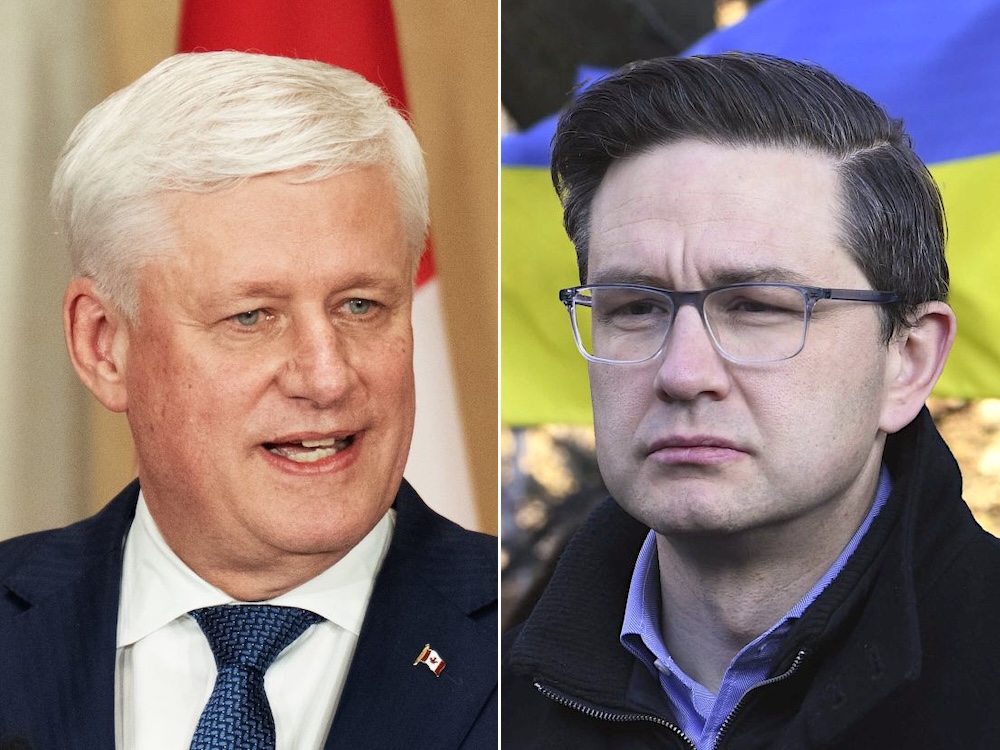
The crisis facing the Conservative party is so acute that when Canadians recently were asked who on the right has the best chance to unseat Liberal Prime Minister Mark Carney, the name most offered was not Pierre Poilievre.
Turn back time, urged 16 per cent of the Nanos survey respondents. The man for the moment, they said, is Stephen Harper.
Only 15 per cent chose Poilievre, whose feckless style makeovers are increasingly improbable. Message to P.P. — flexing your newly pumped-up biceps for the camera during a barbecue in Ontario isn’t likely to win hearts and minds. The people who attended the event at the Aurora Soccer Club came for hamburgers, not a politician hamming it up.
More on that Nanos poll. The biggest chunk of respondents, 33 per cent, said no Conservative has a chance to oust Carney. The next biggest group, nearly one in five, said they had no idea who could do it. Ontario Premier Doug Ford was thought to have the best shot by 11 per cent of those surveyed, while Peter MacKay came in fourth at nine per cent.
Meanwhile, when Canadians are asked who they want running the country, Carney holds a 36-point lead over Poilievre.
None of this is lost on Poilievre’s caucus. On the heels of the Nanos findings, CTV spoke to 17 Conservative MPs and all but two agreed the pollster painted a grimly accurate picture. Some doubted Poilievre would last until the next federal election.
In short, the Conservative Party of Canada is wandering in the political wilderness with a weak leader and no strong heir apparent to inspire the troops.
Might Stephen Harper heed the opportunity offered by such a vacuum? Not likely, but not out of the question either.
After all, Poilievre continues to play to the same base that supported Stephen Harper — yet he does not manage that base with anything like Harper’s skill.
A recent case in point. Conservative infighting erupted after Poilievre’s comment about “Liberal lobbyists from out east,” a sarcastic reference to Kory Teneycke. It was a foolish shot to take at the longtime Conservative strategist who has carried so much water for the party. Teneycke had given Poilievre sound advice about how to win the 2025 election — take Donald Trump’s threat to this country seriously. His counsel was ignored, leaving it to Carney to score all the political points for standing up to a belligerent U.S. president.
Poilievre’s snarky jibe probably worked well at the Calgary Stampede. But in the rest of the country it was just another unforced error, further proof of poor judgment like the viral video where he challenged a journalist while rudely munching on an apple. True, that gotcha performance generated international attention for Poilievre, catching the approving eyes of Fox News and Elon Musk. But in Canada it raised questions about character. Poilievre just can’t seem to drop his yippy-yappy attack dog persona — even against party veterans like Teneycke.
The act is wearing thin. Campaigning after Justin Trudeau quit, Poilievre refused to pivot from outdated research and sloganeering. The populist trucker convoy message he rode to the Conservative leadership and beyond was no longer working. Canadians had moved on, but Poilievre and his campaign manager, Jenni Byrne, who guided Harper’s 2011 winning campaign and his 2015 losing campaign, had not. They stuck to their original playbook, which proved an unmitigated flop against Carney.
Fast-forward to today’s dismal polls. How fast is Poilievre’s leadership crumbling? The federal byelections on Aug. 31 may tell the tale. The Chicoutimi-Le Fjord byelection is the one to watch. Conservatives narrowly won it in 2025. Should his party fare poorly in the byelections, Poilievre will be in peril. Recall that in tough times Conservatives have a history of swallowing rather than following the leader. The party summarily ditched Andrew Scheer and then Erin O’Toole.
Here’s another moment worth remembering. When everything was different, just a few days before Trudeau announced he’d be stepping down, right-wing media star Jordan Peterson released a podcast interview with Poilievre. What would Canada’s top Conservative do to save a country so “broken”? Up 20 points in the polls at the time, Poilievre repeatedly stressed that his party wanted to return to the policies of former PM Stephen Harper.
Imagine if now the Conservative faithful resonate so fully with Poilievre’s lionization of his mentor that they clamour for Harper’s return to save their broken party.
That choice would be not just ironic but doomed. Harper left politics as one of the most unpopular PMs in history. Given what he has been up to since, his resurrection would be highly problematic with Canadians.
A case in point. Starting in 2018, Harper has chaired the International Democracy Union, an alliance of right-wing political parties from 65 countries. In that capacity, while visiting Hungary back in July 2023, Harper praised the country’s then-leader, Viktor Orbán, an ultra-nationalist. Orbán tweeted about his “great meeting” with Harper.
Donald Trump, too, was a big fan of the Hungarian autocrat. Trump sent his vice-president, JD Vance, to support Orbán during his failed bid for re-election in April 2026. It would not be difficult to paint Harper and Trump as birds of a friendly-to-fascists feather.
An earlier ghost likely to haunt Harper is his infamous speech to the Republican right. In June 1997, just after then-prime minister Jean Chrétien’s election victory, Harper addressed the Council for National Policy, or CNP, described by the New York Times as “the most influential conservative leaders in business, government, politics, academia and religion in the United States.”
Wealthy right-wing donors to the CNP continue to use such closed-door meetings to network with operatives and plan long-term strategy. Their agenda includes cleaving to Christian heritage, unqualified support for Israel, a strong military, gun rights and traditional values — as well as gaining political power for the Republican party.
So what did Harper have to say to such a group? For starters, he criticized his own country as a “northern European welfare state in the worst sense of the word.” In stark contrast to his Canada-bashing, Harper offered fulsome praise for both the United States and Republican politics. “Your country and, particularly, your conservative movement, is a light and inspiration to people in this country and across the world.”
Harper proceeded to show his disdain for Canadian parliamentary institutions as compared with the U.S. system of government, where cabinet ministers do not have to win election.
How would all this play now, as Trump bashes Canada? Three decades after throwing this country under the bus to a roomful of Republican power brokers, is Stephen Harper preparing for a comeback? It can’t be ruled out entirely, given Poilievre’s dismal standing.
Like a lot of would-be candidates, Harper does have a memoir coming out in November. The title is interesting: Here for Canada. Will he explain to Canadians how he never loosened his deep ties to what has become the U.S. party of Trump, including his close bond with legendary Republican strategist Arthur Finkelstein, who laid the groundwork for Trump and also helped Viktor Orbán and Benjamin Netanyahu gain power?
Harper might try to divert attention from the orange elephant in the room by claiming that he is best qualified to revive the Canadian economy as demonstrated by his record as prime minister. The problem is that if the election were to be held today, Carney would have at his disposal certain current facts.
Canada added 75,000 jobs in July and unemployment was at 6.4 per cent, a two-year low.
Canada has been creating jobs at twice the rate of the United States.
Canada has an annualized growth rate of 3.4 per cent, higher than the Bank of Canada’s projected growth of 2.5 per cent and more than double the annualized rate of 1.5 per cent in the United States.
The most foreign money in over a century has been invested in Canadian stocks and bonds — $183 billion.
And PM Carney can credibly argue that he made it happen.
A strong democracy needs a strong opposition, but one pulling on the same oars in stormy times. The polls show few believe Poilievre is the man for that job.
Were Stephen Harper to again try for the role, he would face one question repeatedly. As Canadians sail into rough and uncharted seas, why should they hand the tiller to yesterday’s man? ![[Tyee]](/design-article.thetyee.ca/ui/img/yellowblob.png)
Read more: Federal Politics









Tyee Commenting Guidelines
Please note that email notifications for replies are not currently working due to a software issue which may be resolved in a future update.
Comments that violate guidelines risk being deleted, and violations may result in a temporary or permanent user ban. Maintain the spirit of good conversation to stay in the discussion and be patient with moderators. Comments are reviewed regularly but not in real time.
Do:
Do not: