


 SHARE:
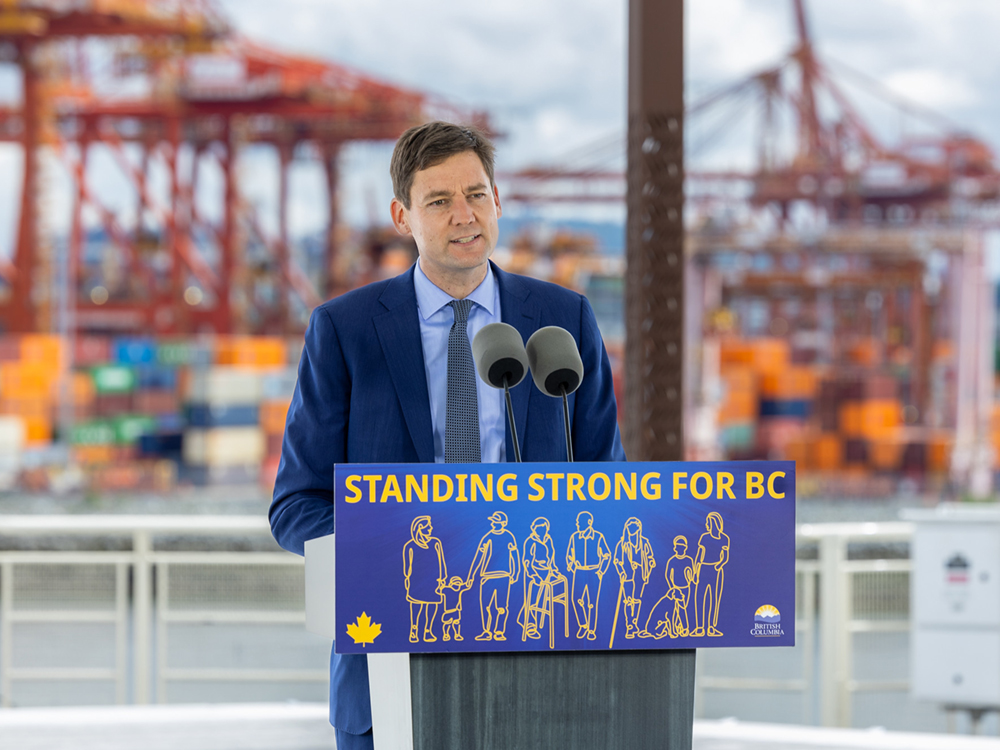
Premier David Eby says that if a key bill aimed at speeding construction of the North Coast Transmission Line fails to pass in the legislature, he’s willing to call an early election.
“This bill is of crucial importance to British Columbians,” said Eby, adding that the project will generate 10,000 jobs. “I would stake our government on that. We have to be ready. The last thing I want is an election, and with that said, this bill is a non-negotiable for me.”
Despite the recent disarray in his own party, Conservative Party of BC Leader John Rustad responded to the premier’s threat by saying, “Let’s dance.”
On Oct. 20 Energy and Climate Solutions Minister Adrian Dix introduced Bill 31, the Energy Statutes Amendment Act, 2025, saying it will enable BC Hydro to enter co-ownership arrangements with First Nations and allow the utility to implement a framework for allocating electricity.
The changes would take away the requirement for the BC Utilities Commission to review the North Coast Transmission Line. Normally the BCUC assesses whether new projects are in the public interest and whether they are built in a way that’s fair to existing ratepayers.
On Tuesday there was some nervousness on the government side before a Conservative motion to delay debate on the bill by six months was defeated. With 47 seats in the 93 seat legislature, the NDP has the narrowest possible majority.
The legislature’s two BC Green MLAs, who have expressed concerns about the bill and have not committed to supporting it, voted with the government against the Conservative motion.
If all 46 opposition MLAs vote against the government it would result in a tie. The Speaker, NDP MLA Raj Chouhan, can break the tie, but convention is for him to vote to maintain the status quo or continue debate.
The NDP has an agreement with the two Greens to give the government a bigger margin, but it leaves the MLAs free to decide whether or not to support government bills that aren't specified in the agreement and that they do not agree are confidence motions.
The bill’s passage is not assured with the current NDP votes.
“Unlike the Conservative motion, the NCTL is not a stunt,” Eby said Wednesday. “It’s not a joke, it is the economic future of this province. It represents 10,000 jobs. It represents $50 billion in investment.”
The line is intended to provide power for new mines, port expansions and reducing carbon emissions from liquefied natural gas facilities.
The effort to derail the bill was “reprehensible,” Eby said. “Any attempt to delay or prevent from going ahead, allowing us to realize that economic future, is a direct threat to the economic prosperity of British Columbians and Canadians as a whole.”
The project is planned in three phases. The first would be a 164-kilometre line from Prince George to Fraser Lake, the second a 275-kilometre line from Fraser Lake to Terrace, and the third a 350-kilometre line from Terrace north to Bob Quinn Lake.
The government estimates the first two phases will cost $6 billion. It has no estimate for the third phase. Construction is planned to start in 2026 and be completed by 2034.
Rustad said it’s not a “stunt” to engage in debate in the legislature and that he has been clear that the new transmission line is not needed.
“We do not have the electricity to be put in the line, so we’re going to be spending $6 billion building a line without the ability to actually put any electricity in it for the needs of the northwest,” he said. It would be much cheaper to generate power in the northwest where it is needed, he added.
“If the premier wants to go to this brinkmanship, I can tell you, as the Conservatives we will be voting against Bill 31, so if he wants to go to the polls, drop the writ, let’s go dance,” said Rustad.
“We’ll see what the public think about the way he’s handled private property rights, how he’s handling health-care crisis, how he’s handling the drugs and crime, how the fact that the forest sector is in shambles, how the fact that the entire economy quite frankly is in shambles, not to mention bankrupting this province.”
The leader in the house for the BC Green Party and the MLA for West Vancouver-Sea to Sky, Jeremy Valeriote, said his party supports co-ownership of the line with Indigenous people but that parts of the bill that bypass the BCUC and reduce transparency are concerning.
“The premier can call an election if he wants,” Valeriote said. “If the premier wants to have an election and he wants to use that as his excuse, that’s his prerogative.”
The Greens voted against the Conservative motion because they want the bill to proceed to the next stage of debate where hopefully the problems with it can be worked out, he said.
He has also previously said that supplying electricity to LNG projects is not the best use of the province’s power.
“I’m not comfortable with the bill as it is,” he said. “It’s always a problem when politicians are picking and choosing winners and projects and sectors to favour without an objective criteria that are agreed upon out in the public.”
The BC Greens’ Emily Lowan, who was elected leader in September and does not have a seat in the legislature, said the party needs to be ready for a snap election. “We’ve seen this before from the NDP government, that they have opportunistically capitalized on moments of fracture to increase their majority.” ![[Tyee]](/design-article.thetyee.ca/ui/img/yellowblob.png)
Read more: Energy, BC Politics








Tyee Commenting Guidelines
Please note that email notifications for replies are not currently working due to a software issue which may be resolved in a future update.
Comments that violate guidelines risk being deleted, and violations may result in a temporary or permanent user ban. Maintain the spirit of good conversation to stay in the discussion and be patient with moderators. Comments are reviewed regularly but not in real time.
Do:
Do not: