


 SHARE:
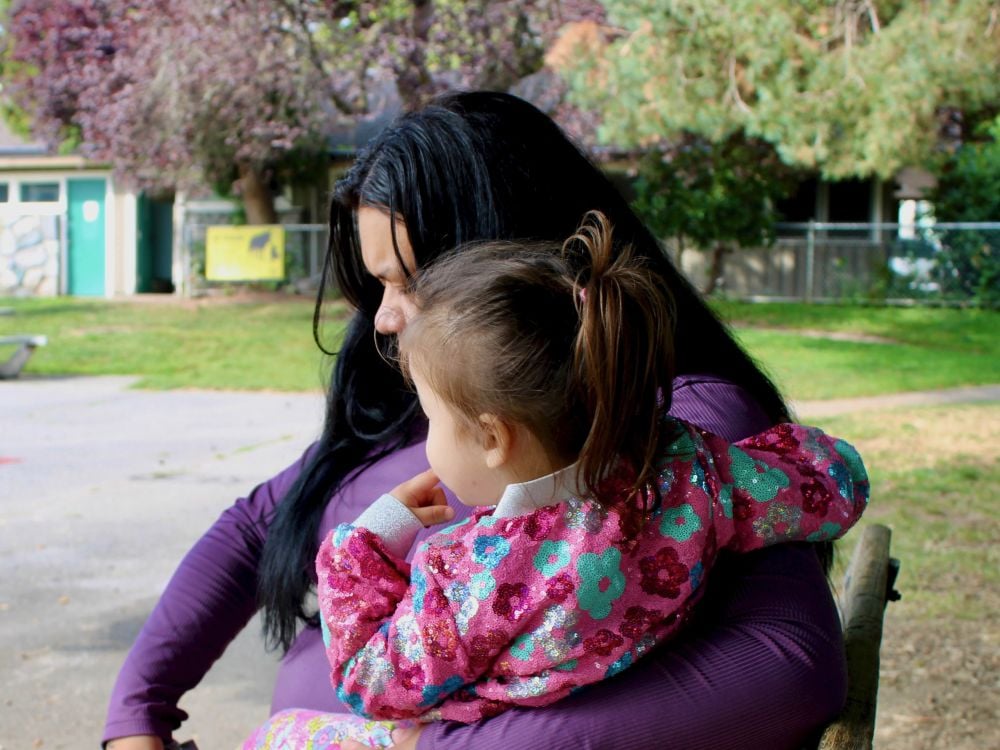
Julia has cared for her niece Olivia since she was three months old. Olivia, now three, has lived with her full-time since March 2024.
Julia has a private family care agreement from another province and expects to be the main caregiver for the child for the future. In British Columbia, this type of agreement is referred to as a kinship care agreement.
But despite having the family care agreement to care for her niece, Julia was told by S.U.C.C.E.S.S., a social housing operator in the Downtown Eastside, that her application for housing for her and Olivia could not proceed because she couldn’t provide proof of legal custody.
Julia said she wanted to speak out about the issue because of the high number of Indigenous residents in the Downtown Eastside who care for children under family care agreements, also known in British Columbia as kinship agreements.
These arrangements don’t involve the caregiver taking on legal custody, even though the child often lives with the caregiver full-time.
“I can’t help but wonder how many other aunties and grandmas and Indigenous caregivers have been denied housing,” Julia told The Tyee.
The Tyee is using pseudonyms to preserve her and her niece’s privacy and not revealing other identifying details.
According to the B.C. government, 68 per cent of the children in government care in 2024 were Indigenous, despite Indigenous people representing just six per cent of B.C.’s population.
Family care agreements have become more common as advocates, caregivers and First Nations have focused on ways to keep Indigenous children out of government child welfare systems.
The agreements see children placed with family members or close family friends rather than foster care. The B.C. government has touted them to show progress on keeping Indigenous children out of government care.
Jane Bouey, executive director of the Parent Support Services Society, said she’s not aware of widespread problems with housing providers denying applications from people with kinship agreements.
But Bouey said that even though kinship care agreements have become more widely used, there’s still a lot of ignorance about them at many institutions and non-profits.
“We even struggle with social workers and lawyers not understanding the various arrangements,” Bouey said. “Our advocates do a lot of education with organizations.”
Bouey confirmed that many kinship agreements do not involve the caregiver having legal custody.
Bouey said an added complication in Julia’s case is that the documentation she has comes from another province, and each province or territory has different laws and paperwork when it comes to kinship agreements.
Julia said she was committed to being her niece’s caregiver since she first learned her brother and his partner were expecting. While Julia said she has previously held administrative jobs in government and the mining sector, she said she’s currently not working because her niece requires full-time care.
“I didn’t want to see my niece in the system, and I knew that I was the only stable family member,” Julia said.
“Pretty much as soon as I found out that they were having a baby, I already knew I would eventually have to take care of this baby — so I was there for her birth.”
In March 2024, her brother was charged with drug trafficking offences. That’s when Julia brought her niece to Vancouver to live with her full-time under a family care agreement. She expects her brother will be incarcerated for years and her niece will need to stay with her for her entire childhood.
Julia said she had no problem getting her niece listed as a dependent on her social assistance file, BC Housing waitlist application and with the Canada Revenue Agency to receive the child tax benefit.
At the time, Julia was living in transitional housing for women in a building run by the housing operator Atira. While Atira staff supported Julia’s niece living with her, the unit she was living in was a studio and would soon become too small. And because the building is transitional housing, Julia was supposed to have moved out by November 2023.
A nearby building seemed to be the perfect solution. The social services agency S.U.C.C.E.S.S. had just completed building Bob and Michael’s Place, a 231-unit building at 32 W. Hastings St. that included family sized units.
The building is located at the site of a 2016 homeless camp and Bob and Michael’s Place is the result of an agreement made between then-Vancouver mayor Gregor Robertson and advocates involved in supporting the encampment. That agreement promised to build welfare-rate housing for residents of the Downtown Eastside. The project was able to break ground after substantial funding from the Chinatown Foundation.
Today, the building includes 120 social assistance shelter-rate units, and 111 units that are rented as ordinary market rentals with rates set at the “low end” of rents for the area.
Julia applied for a shelter-rate two-bedroom unit in the spring of 2024 and got an initial interview. Income assistance provides $695 for shelter for a family like Julia’s.
According to email correspondence between Julia and S.U.C.C.E.S.S. reviewed by The Tyee, she was told repeatedly her application could not proceed unless she could provide legal custody documentation.
Julia says she did have extensive documentation showing the family care arrangement, including government documents, but was told multiple times that only legal custody documentation would be accepted.
Julia then applied for a rental subsidy and asked if she could apply for a market rental unit in the same building, but was told the same guidelines would apply when it came to requiring proof of legal custody of her niece. Market rentals for two-bedrooms at Bob and Michael’s rent for $2,300 a month, according to the website for the building.
BC Housing told The Tyee that they accept a wide variety of care agreements, including kinship care agreements from B.C.’s Ministry of Child and Family Development or other provinces and territories. Applicants do need to provide documentation showing that the child will be living with them for the foreseeable future. Housing operators that have operating agreements with BC Housing are expected to follow the same guidelines.
S.U.C.C.E.S.S. told The Tyee that staff follow those BC Housing’s guidelines.
But email correspondence between S.U.C.C.E.S.S. staff and Julia show that for months the housing provider told her they would only accept legal custody documents.
Finally, over one year since Julia first applied to live at Bob and Michael’s Place, S.U.C.C.E.S.S. staff told Julia on May 28 that they would accept other documentation, such as child tax benefit statements and income assistance documentation, in line with BC Housing’s guidelines on dependents.
But by then, Julia was told, all of the two-bedrooms at Bob and Michael’s had been rented.
Julia was able to move to another one-bedroom apartment at a different building. She’s again living in a transitional housing unit and will have to move out in 2026.
Julia said she made a formal complaint about housing discrimination to BC Housing, and staff began an investigation of whether S.U.C.C.E.S.S. had followed their operating agreement with BC Housing.
That investigation wrapped up on Sept. 12, with BC Housing telling Julia that their investigation had found that S.U.C.C.E.S.S. had not violated their operating agreement. The letter from BC Housing, which The Tyee has reviewed, does not explain how BC Housing came to that determination.
Julia now plans to file a human rights complaint with the BC Office of Human Rights.
“I don’t know where we’re going to go next. I still don’t know,” Julia said, referring to the limited time she and her niece can stay in their current housing.
“We’ve already been in our place for almost a year, and we have another year here. It’s something that’s always in the back of your mind — this is not our home. This place, it’s not our home.” ![[Tyee]](/design-article.thetyee.ca/ui/img/yellowblob.png)
Read more: Rights + Justice, Housing












Tyee Commenting Guidelines
Please note that email notifications for replies are not currently working due to a software issue which may be resolved in a future update.
Comments that violate guidelines risk being deleted, and violations may result in a temporary or permanent user ban. Maintain the spirit of good conversation to stay in the discussion and be patient with moderators. Comments are reviewed regularly but not in real time.
Do:
Do not: