


 SHARE:
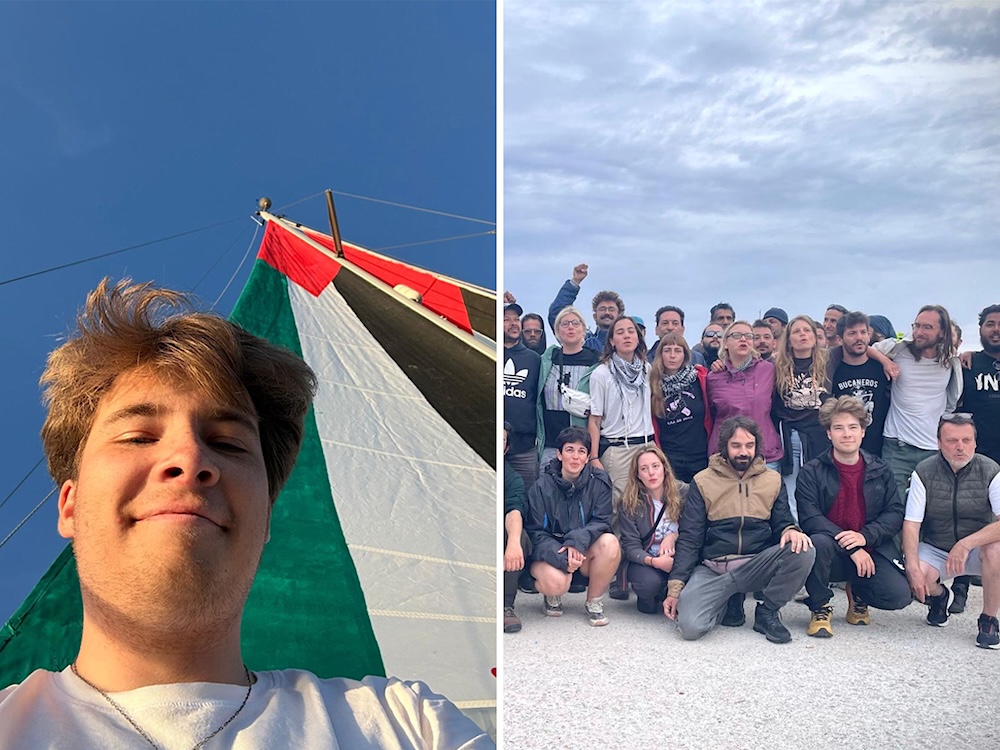
Sebastian Tow is a 24-year-old activist from Vancouver and one of 12 Canadians who tried to sail to Gaza with hundreds of others in April to deliver humanitarian supplies.
Similar flotillas have been sailing since 2008, but in 2025, the Global Sumud Flotilla's attempt to break through Israel’s blockade amid war and deprivation gained international attention when climate activist Greta Thunberg was among the participants detained by Israel. Thunberg and other activists said they’d been mistreated while in Israeli custody, something Israel denied.
This time, over 400 flotilla participants were intercepted and detained by Israeli forces.
And a video of Israeli National Security Minister Itamar Ben-Gvir berating flotilla participants as they knelt with their wrists shackled sparked condemnation. Some of the activists have now alleged they were sexually and physically assaulted while in Israeli custody.
Canada’s foreign affairs minister, Anita Anand, said she had raised concerns about flotilla participants being denied access to consular services and being mistreated with Israel’s foreign affairs minister. Prime Minister Mark Carney’s office said he also raised concerns about the treatment of the activists with Israeli President Isaac Herzog and called for an independent investigation.
Even Israeli Prime Minister Benjamin Netanyahu said on social media that “Israel has every right to prevent provocative flotillas of Hamas terrorist supporters from entering our territorial waters and reaching Gaza.
“However, the way that Minister Ben-Gvir dealt with the flotilla activists is not in line with Israel’s values and norms.”
The Canadian flotilla activists are now calling on the Canadian government to do more to call out the alleged mistreatment.
Tow told The Tyee he’d become passionate about the Palestinian cause as a university student in the United States. He took part in campus protests following the Oct. 7, 2023, Hamas attack on Israel that led to an intense bombing campaign in retaliation and strict control of the food and medicine allowed to enter Gaza. Amnesty International and two Israeli human rights groups have written reports saying that Israel committed genocide in Gaza.
“The response that we got from professors, from parents, from administrators and from peers, it really changed me,” Tow told The Tyee, “because many people I trusted that I thought were humane... I was taken aback by their really sort of lazy and timid reaction to the genocide.”
After graduating, Tow said, he applied to be a member of the spring 2026 flotilla and got word he’d been accepted just a few weeks before the boats were due to attempt to sail from Athens to Gaza. Tow said he was a member of the eight-person crew of a sailboat that was intercepted by Israeli forces southwest of Cyprus.
Now back in Vancouver, Tow spoke to The Tyee about what happened after Israeli forces boarded the boat. This interview has been edited for length and clarity.
The Tyee: Can you tell me what happened when Israeli forces boarded your boat?
Sebastian Tow: We saw them on the horizon. There were about 15 commandos, they were masked and they had several assault rifles pointed right at us when they sped their boat close to ours. They were yelling at us to turn off the engines and keep our hands up. We already had our hands up, and we had already run the engine to a standstill. It was very dangerous, because when they climbed on the back of our ship, they made us scooch forward out of the deck and onto the front of the boat, and we were in high waves in the middle of the sea.
I was the designated speaker. Nobody else wanted to engage with them, and our agreement to one another was that we would not name the crew and captain. So I was to speak to the commandos and say, “Look, we're lawful humanitarians in international waters, this is illegal. You cannot abduct us. There is no captain.”
That was very difficult, because there were some who were sort of listening to me, and then there was some commandos yelling at me to shut up, and the whole time we were crammed on the end of the boat, trying to stay safe while we had our hands raised in the air.
Why was it important to not say who the captain was?
If they know that someone's a captain, it could have been that they just used them to close the sails, or it could have been that when they dragged them back to the prison ships they would tell their other soldiers that this person is a captain, and they could have used this to say, “Oh, let's beat him up more” or “Let's torture him more.” We had no idea. It was just a safety measure, just like we wouldn't pick out who was the political organizer for the boat. We wouldn't have said who was the doctor on the boat. We didn't want to give them any means to inflict more violence than they did.
Can you tell me what happened after that? Were you taken to shore?
We were on the speedboat, then taken to a modified warship, and as soon as I went up the rope ladder under gunpoint, I was grabbed and thrown down on my knees in a puddle on the deck and zip-tied. And then my shoes and everything I had on, my sweater, everything down to my pants and undershirt, were taken off me.
In the middle of the deck were about five shipping containers constructed in a square to make an open-air prison. The one entrance was a dark shipping container that was the only exit and entrance. Every single one of us was taken down immediately after we were stripped of our stuff.
I could already hear the screams and the thuds against the walls of that shipping container as I was taken past it, and then my zip tie was taken off, and I was thrown into the dark chamber, and there were about maybe four or five masked men. As soon as I was in there I was kicked in the chest, beaten over the head, then held down by the neck and Tasered several times, and then kicked in the neck and tossed out by my hair into this open-air prison where they had us surveilled under gunpoint for the next two days.
Did you see other detainees also being treated in a similar way?
Yes, every single one of us. The only entrance to that open-air prison was through that torture chamber.
At the very minimum, we were just beaten, but there were over 10 cases of sexual assault in that shipping container. There were over 30 cases of broken and fractured ribs, and punches in the eye and broken noses.
[Editor’s note: The Israeli military and prison service have dismissed abuse allegations as false. The Canadian government says it has received information about the allegations, while Germany and Spain have confirmed injuries, according to reporting by the BBC.]
How many days were you held?
I was held that evening, that night, a full day, one more night and then the morning. They tossed our shoes out to us after they'd beaten a group of us, but there was nothing to sleep on — we slept on stale bread and shoes and some plastic water bottles.
There was that highly circulated video of Minister Ben-Gvir berating people in kind of a humiliating way. Did that happen to your group?
That video was mild. That was taken when we were in Ashdod, which is a port, and when we were taken through Ashdod, yes, they made a point of roughing us around.
We were all taken through tents and made to kneel on the pavement, and then many of us were beaten again in those tents. What the video showed of our comrade, her forehead being forced down, that happened every five minutes to every one of us, and that was the most mild treatment. They took us around to maybe 10 different tables where our photo was taken, our passwords were taken, and then we were interrogated. When we were moved, a young prison guard or an [Israel Defense Forces] soldier would grab us by the neck, by the hair, by the back of the shirt, by the neck, and then sort of parade us around.
Luckily Ben-Gvir actually did post a photo of what was one of the worst tortures: he posted a photo of the prison ship of all 180 of us kneeling down in the hot sun.
There were people on that boat who could hardly stand, and their arms were broken, ribs were broken, knees were giving out, elderly people, beaten people, and they made every single one of us get in rows with our hands zip-tied tight and kneel down in a position where blood could not flow to our feet. Within five minutes, my feet went numb and my knees were giving out, but every time I tried to adjust myself to move a little bit, I could hear shouts behind me saying, “If you fucking move, we're gonna fucking shoot you, fucking terrorists.”
How did you make your way back to Canada?
Turkish Airlines paid out of their own pocket to pick us up, and I imagine Israeli authorities made that deal with them, but it's important to emphasize that none of us knew where we were going — they didn't tell us anything when we were still in the prison ship.
Some of us were speculating about whether or not they'd tossed us out in Cyprus. We had no idea where we were when we were dragged off to Ashdod. The only indication of where I was was... someone shouting at me, “Welcome to Israel.”
When the prison van door was open, and I stumbled out after being confined in there for six hours in handcuffs, I was able to breathe. I looked around me and I realized I was in an airport. Through that six hours, I don't know if they're taking me to another prison, I don't know if they're taking me to my consulate.
When you got back to Canada, and you saw how Anand and Carney had responded, what were your thoughts about what they said about this incident?
The testimonies are that for four days we were beaten, Tasered and raped and tortured... so for Prime Minister Carney, for the foreign minister and for the rest of their political party to have a reaction of slight condemnation of Ben-Gvir, it's spineless. Not only that, it's in contradiction with the principles that, as modern liberals, they're supposed to be upholding. ![[Tyee]](/design-article.thetyee.ca/ui/img/yellowblob.png)
Read more: Rights + Justice, Politics





Tyee Commenting Guidelines
Please note that email notifications for replies are not currently working due to a software issue which may be resolved in a future update.
Comments that violate guidelines risk being deleted, and violations may result in a temporary or permanent user ban. Maintain the spirit of good conversation to stay in the discussion and be patient with moderators. Comments are reviewed regularly but not in real time.
Do:
Do not: