


 SHARE:
Walking into the Stínestin Gallery is like being welcomed into a home. The entrance is tucked around the back of a building in a neighbourhood on Kamloops’ North Shore.
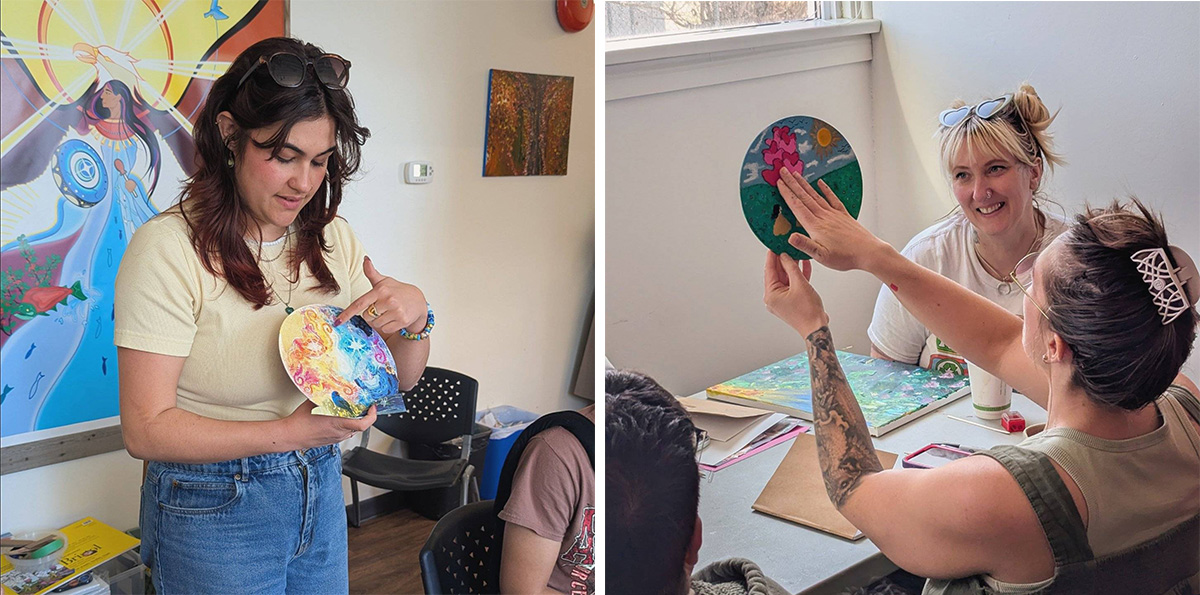
Once you enter, you walk down a hall that sends you in the direction of a small room that looks like a kitchen with a large collapsible table and a wall-sized shelf full of art supplies, mugs and paper plates.
This is the room where workshops with names such as “Doing Ugly Things” and “Ribbon Garment” are held as well as storytelling circles and artist talks. Just from looking at photos of the events on social media, you can hear laughter.
Next to the workshop room is a gallery featuring 50 square feet of wall space that boasts a dizzying display of artwork in a range of mediums. The gallery creates a kind of perceptual distortion because of how much it holds despite its small size.
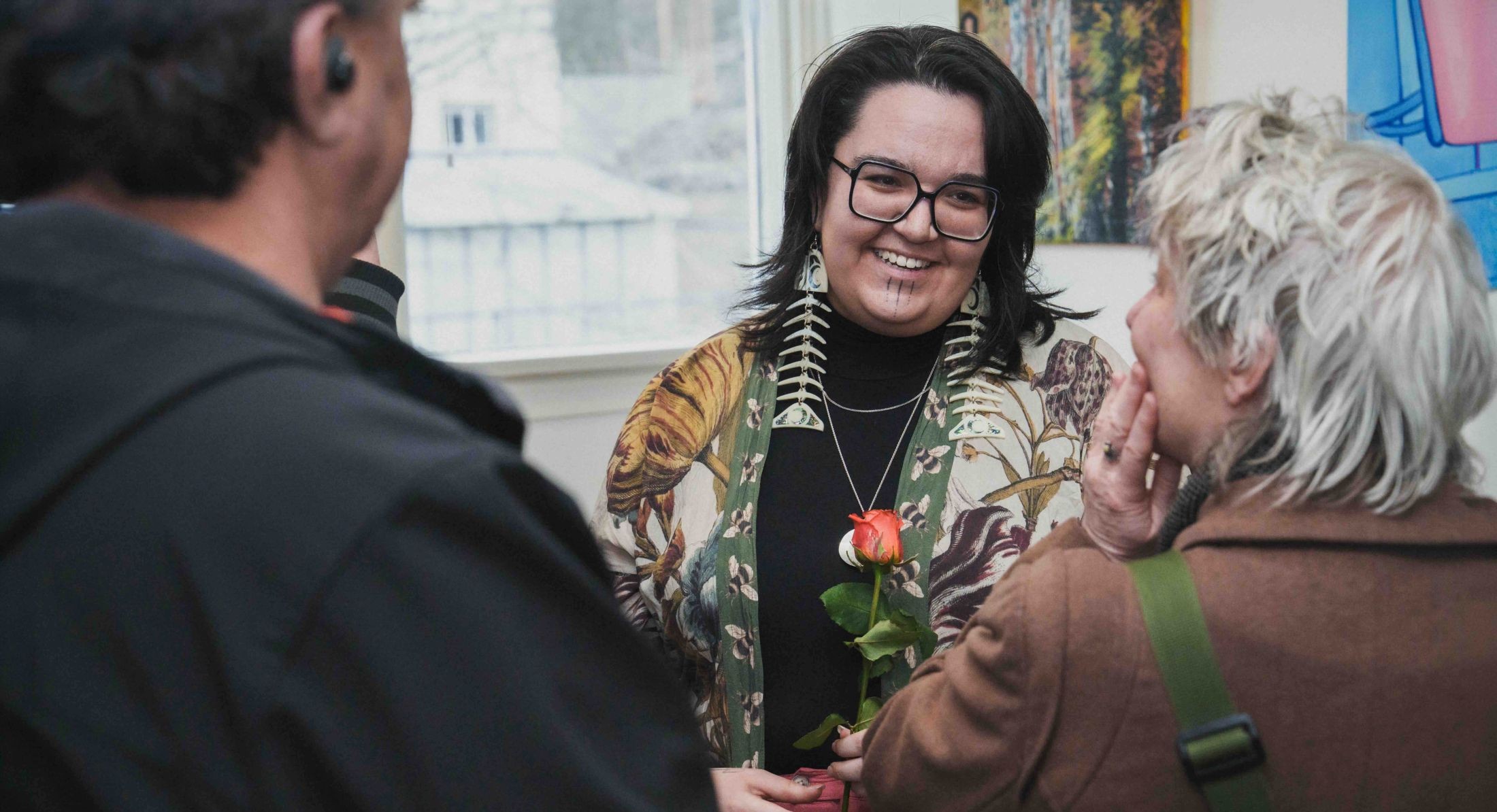
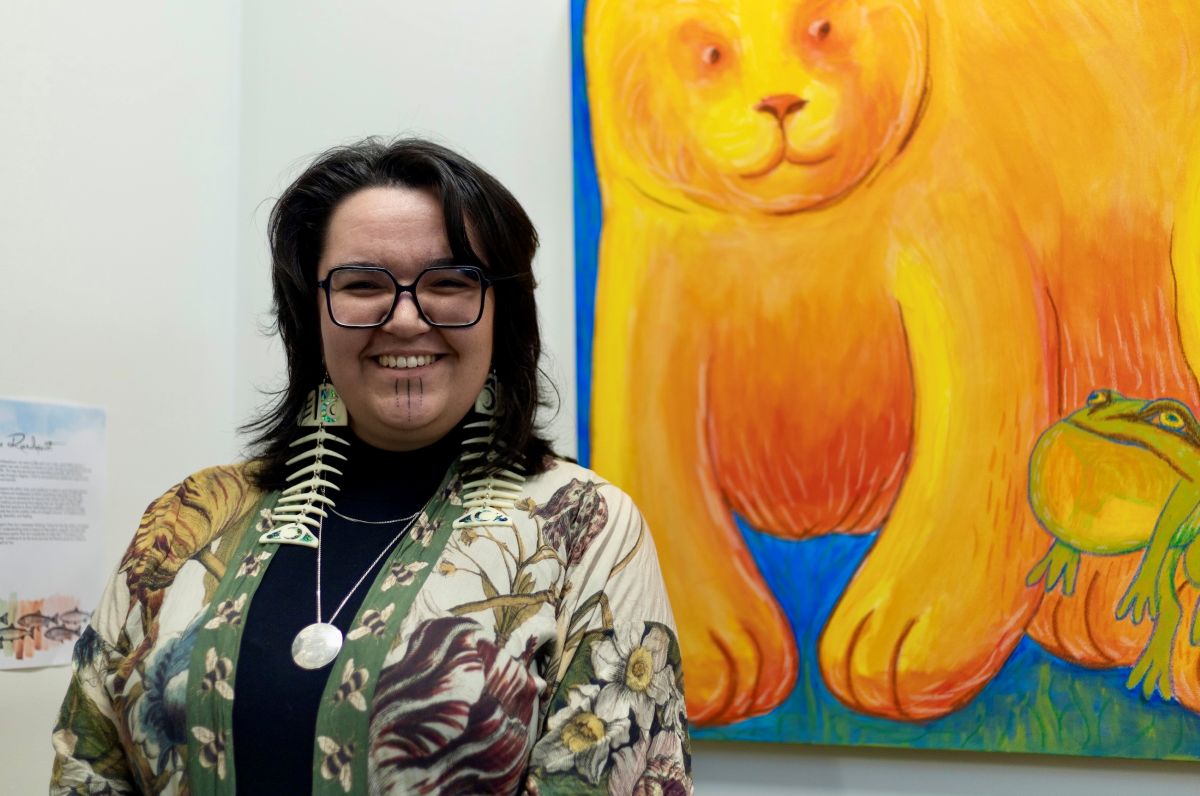
There’s a palpable soul to the space embodied by its creator, Shay Paul, the project director and gallery curator. She describes herself as an artist, organizer and facilitator and yet she’s redefining each one of those roles, not only for herself but for the community of artists around her.
The Stínestin Gallery was born out of the Indigenous Resurgence Project, which Paul launched in 2021 as a Kamloops-based arts collective that shares and showcases the work of Indigenous artists. She describes that at the heart of the Indigenous Resurgence Project is “a commitment to community, belonging and self-determined creativity.”
While the Indigenous Resurgence Project is about supporting local artists, the gallery is the showcase of their work.
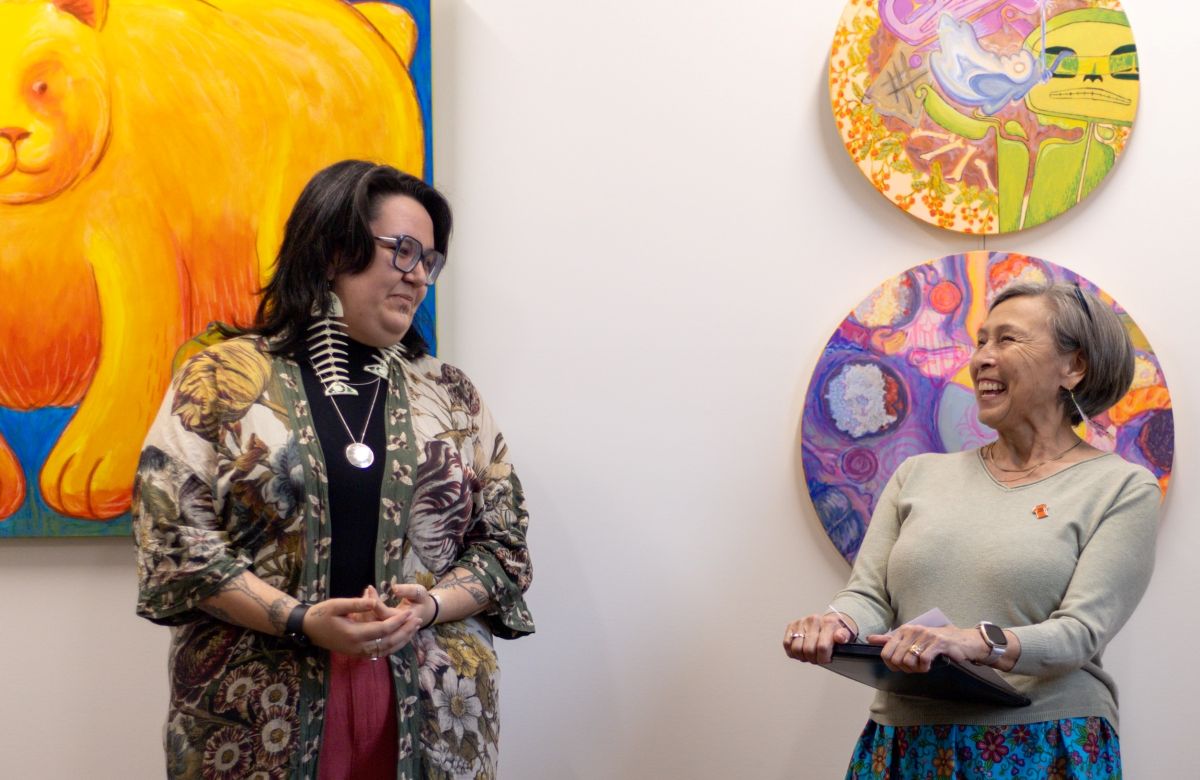
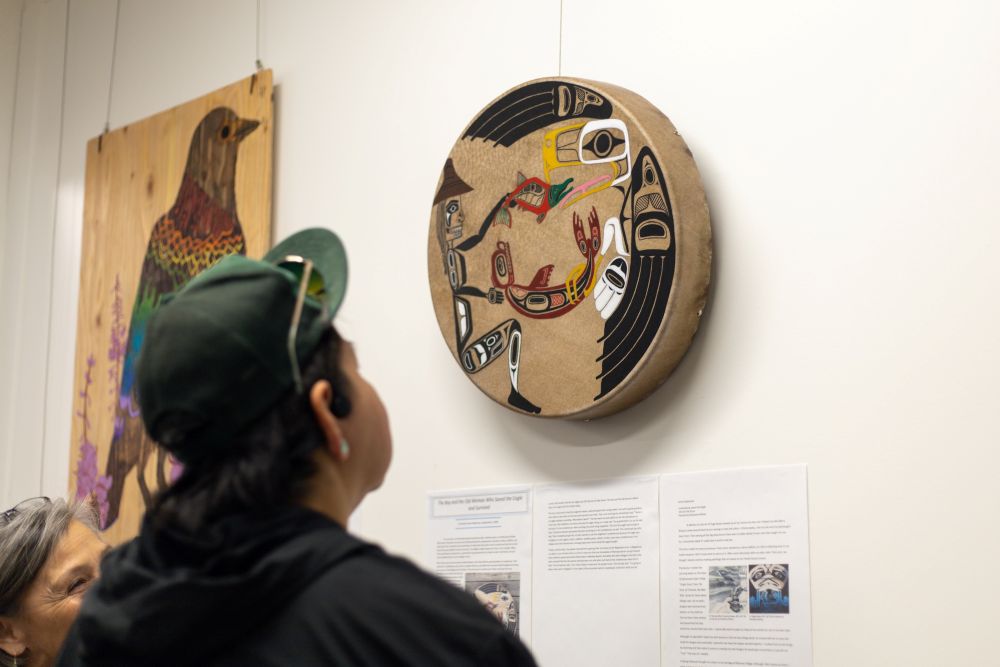
A recent showcase was an exhibition that ran from March to May 2026 called Trout Children. It brought together 10 Indigenous students and alumni from Thompson Rivers University whose work centred around art as storytelling. The artworks ranged from vibrant oil paintings to rawhide and drum paintings, photographs and intricate beadwork.
“Some people don’t even realize that they’re really walking into a gallery at first,” Paul said, referring to the accessible, lived-in sensibility of the place. “It’s demystifying the professional arts and it’s also making it more tangible and obtainable to the general public.”
The reconciliation committee of the Kamloops United Church made an in-kind donation to bring the Stínestin Gallery space to life. Paul suspects that in a couple of years, she will run out of room. Growth is certainly where things are going.
We sat down together this spring to discuss the community she’s helping to build, the need for artists to feel a sense of belonging and what drives her forward.
This interview has been edited for length and clarity.
The Tyee: How do you describe the Indigenous Resurgence Project?
Shay Paul: I describe this project as an artist-led, artist-organized collective for artists. At the root, that is very much what this project is, not only to me, but to the people who engage in activities and programing and exhibitions. It’s a space to come together and to socialize and make connections and friendships and learn from one another and grow together.
Why is that so important to you?
When I talk with people and I talk about what it is that they want to see in the community or how they think there are gaps that they’re experiencing or challenges that they’re facing, it all kind of wraps back around to belonging and place and how do you connect with other people?
That is the No. 1 question with all the artists that I work with. Where do I belong and who do I belong with, especially in the Kamloops area?
I find that there’s a very interesting identity in Kamloops, and there’s a lot of different perspectives and a lot of politics around that. We have the presence of Tk’emlups here and that is a very prominent presence and as it should be, and I’m a Tk’emlups member, I’m proud of that as well.
But when we look at the overall identity of Kamloops, it’s very multicultural because of Thompson Rivers University. We are very privileged to have such a vibrant cultural tapestry here in Kamloops and that also extends to Indigenous folks as well.
The urban Indigenous population in Kamloops is so vast, and it actually makes up a majority of the Indigenous people who are self-identifying in the area. The majority of them are urban from other areas or other Nations.
So when we think about that and this project and all of the other intricacies that make up Kamloops and the people who live in it, how do you find connection when you feel disconnected in the community, in the city?
Where do you look for connection?
And for Indigenous artists and for urban Indigenous folks in general, where do they know that they are welcome?
How do you fill that hole of belonging and connection for those Indigenous creators who are coming from all over?
One of our main focuses from the project perspective is redefining what Indigenous art is. That is how the gallery is somewhat executed and the programing, the exhibitions that come through not only the Stínestin gallery, but our external partner projects as well, and partner exhibitions, they all focus on redefining that idea of Indigenous art.
Many people might have a pre-existing idea or image or visual in their head when they hear the term “Indigenous art.” And the whole point of the programming and the shows that we do here is to flip that on its head and recognize that art cannot be simply put into a box or into a category or into a similar style.
When we’re doing an art call or we’re doing a new exhibition or a new program, that’s always at the forefront — is that we’re looking for any artists.
I’ll give an example. We have an annual exhibition called Redefining the Perspective and there are only two requirements to exhibit in that show. The first requirement is that you need to be self-identifying Indigenous. The second requirement is that whatever piece the artists are submitting needs to be made by their hands.
Can you tell me more about that?
It really opens up the idea of how art can exist in a gallery space, and it also acknowledges how Indigenous artwork can differ from what we might traditionally see in a gallery setting, or what we might traditionally think of. So this includes textiles, it includes carvings, jewelry, leather work, sculpting, metal work. Basically, if it is made by their hands in some way, shape or form, and we can fit it in the gallery, then I would love to have it in the gallery.
Can you talk a little bit more about why that sense of belonging is so important? I get what you’re saying about the strong presence of Tk’emlups and there’s the presence of established art galleries but why is it so important for Indigenous creators to feel that there’s a home for what they are wanting to create?
I love that you actually phrased it that way too, because I get to be a nerd about this a little bit. Through my academic background, my research background, it came up with the idea of place identity theory and furthermore urban place identity theory and then looking at that and paralleling that with Indigenous experiences.
So, when we think about the Indigenous experience and the history of colonization behind that, the disconnect people feel, I’m looking at using that place identity theory when it comes to establishing an identity within an artist. So, for example, the artist that I work with, many of them being urban Indigenous, they don’t feel connected here. And I see that from a representation point.
So looking at, say, public art policy or like so many of us, we feel empowered and we feel appreciated and validated when we can see ourselves in the world around us. So when those identities or those cultural backgrounds are erased or pushed aside or just not brought forward, it creates this more complex and conflicting feeling for so many artists.
If they can’t see themselves represented in the community that they live in and the world around them, then how are they supposed to feel welcomed and accepted to be their true, authentic selves?
Because art is such a vulnerable thing to put out into the world, that I believe that when an artist creates something, they leave a piece of themselves in that artwork. So if these artists aren’t feeling comfortable enough to share that, then they’re not truly sharing the artwork that means something to them.
Tell me about a piece of artwork that you’ve been able to display that represents that effort.
The most moving piece about doing any of this and what really keeps motivating me and driving me forward and allowing me to know that I am moving in the right direction is seeing the way that artists see themselves on the wall.
When I do a group exhibition and I get to see these artists who may have never even been in an art show before, they walk into the room and they see their piece on the wall for the first time. That is a look that I cherish every show.
To be able to hear from them and their family members that this is so special for them, that this means so much to them that they’re able to put their piece on the wall.
And time and time again, show after show when I do group exhibitions, I always get a few artists that I’ve never met before or I’ve never spoken to, or I didn’t know in any other context, and they’re always very nervous and they go, “I didn’t think you were going to accept my work because I didn’t think I was an artist” and to then watch them throughout the process of when we bring that artwork in, they get accepted, we have conversations, I start curating the pieces and they have that validation.
That change in them, that shift in them is so important. It drives me and everything that I do with this project and what I want to see and why I do what I do.
It’s those individual artists who change the way that they see themselves, because now they’re seeing themselves appreciated and celebrated in the community.
What’s not being said is that there is a need for them to be seen for themselves.
In Canada with colonization and the residential school system, we have taken away those stories, we have erased those stories, and many artists have not had a chance to share who they are because that has been taken away.
And so here, what you’re providing is a space for people to create that for themselves. It’s not just a given that an artist knows what their voice is.
That whole point goes directly back to that idea of the preconception of what is and isn’t Indigenous artwork. So there have been categories created by, I want to say, just society in general. This can come in part from ignorance or in part from simplicity, but this idea of different styles and to name a few, we have the coastal form line artwork that is so popular and recognizable in B.C., or say, the Woodland School of Art. And those are very visually recognizable.
And when we think about that sort of high-level recognition that anyone really in Canada can kind of look at those and go, oh, I recognize that as an Indigenous art style, it’s when placing that against the artists that I’m working with, like that’s why there is that sense of, “Oh my goodness, I’m being accepted in this space.”
Because if the artwork that they’re making doesn’t fit into those categories, then they’re not as readily celebrated.
This whole thing can be described as something called visual sovereignty. It is just the control and the ownership and the autonomy to make and create things according to how the artist wants to create them.
And so the gallery here, Stínesten Gallery, is all about that visual and narrative sovereignty. Putting the control back in the hands of the artists on how they want their artwork to be showcased and displayed to the public.
And the meaning behind the name Stínesten is “cedar root,” correct?
I wanted to find a name that ties and recognizes the local Nation and also because I am Tk’elumps, there is a part of me that did want to see if I could pull some inspiration from my heritage and from Secwepemctsín.
The idea of the cedar root is that we are entwining the roots and creating a route network or a foundation with each other.
And that that is how our social structures are and how we are not only accessing friendships and relationships and professional networks, but resources and opportunities and learning experiences.
And I very much see this space as a network, as a root network for people to plant themselves, to stretch their roots out and grow outward. ![[Tyee]](/design-article.thetyee.ca/ui/img/yellowblob.png)
Read more: Indigenous, Art










Tyee Commenting Guidelines
Please note that email notifications for replies are not currently working due to a software issue which may be resolved in a future update.
Comments that violate guidelines risk being deleted, and violations may result in a temporary or permanent user ban. Maintain the spirit of good conversation to stay in the discussion and be patient with moderators. Comments are reviewed regularly but not in real time.
Do:
Do not: