


 SHARE:

When Naheed Nenshi was elected in June 2024 to helm the Alberta NDP, it signalled a further tilt to the centre for a party focused on gaining more middle-class voters.
The former Calgary mayor has famously adopted purple as his trademark colour, a blend of Liberal red and Conservative blue — a visual cue to Nenshi’s post-ideological ethos.
But is the Alberta NDP, a party first led in 1963 by an oilpatch union leader, paying a big price by failing to tend to its working-class roots?
Vocal about his commitment to good policy over ideology, Nenshi, who became a member of the Alberta legislature in July, argues voters are hungry for a pragmatic leader in a province ruled by a polarizing government.
But as the cost of living rises, wages stall and job stability dwindles in Alberta, some question the effectiveness of a middle-of-the-road approach to the pressing issues facing workers.
“Alberta workers seem to really like populist, progressive ideas,” said Gil McGowan, president of the Alberta Federation of Labour, or AFL, pointing at the widespread popularity of a range of initiatives supported by his organization’s worker agenda, which include a $20 minimum wage, rent control, public auto insurance, regulated power rates and a bill of rights for gig workers, among others.
Working-class Albertans, however, have yet to see any of these ideas championed by the party that’s supposed to have their backs.
“On the Alberta political spectrum, it’s clear that New Democrat members are much closer to us in terms of their values and priorities,” McGowan told The Tyee, noting that delegates of the Alberta NDP convention supported many of the ideas put forward by the AFL’s worker agenda.
But McGowan says the party’s caucus has been slow to embrace those ideas. And he cautions that a failure to do so could affect the party’s success come the 2027 election.
“Working-class voters have gravitated towards the right of the political spectrum, whether it’s Danielle Smith at the provincial level or Pierre Poilievre at the federal level,” McGowan said. “Until the NDP recognizes that problem and finds a solution for it, they’re going to continue to come up short.”
As the Alberta NDP bends to appeal to a fiscally conservative, socially progressive middle class, that leaves a hole in provincial politics, said Roberta Lexier, a professor in Mount Royal University’s department of humanities.
“A lack of a party centred on the working class in Alberta means that we’ve abandoned all concept of an alternative way of improving the lives of workers.”
A post-2023 election brief completed by Common Ground, a research group of the University of Alberta, indicates that one of the reasons the Alberta NDP came up short was that the party struggled to make a clear connection between its perceived strength in handling social issues, and the top priorities of Albertans, namely affordability and the economy. Rather than present a compelling alternative to the status quo, in the run-up to the 2023 provincial election, the Alberta NDP pledged to balance the provincial budget while maintaining low taxes.
More than 777,000 Albertans voted NDP in the last provincial election, a record for the New Democrats. Yet it was the United Conservative Party that won the majority of the vote and has governed with a commitment to bolstering private profits. That ideological stance, states Unifor, Canada’s largest private sector union, hasn’t made things better for most Albertans.
The office of Premier Danielle Smith did not respond to a query from The Tyee.
Speaking directly to workers
To make the system work for working-class Albertans, progressive politicians could begin by recognizing that the priorities of employers and employees are often at odds, notes Jason Foster, a professor of human resources and labour relations at Athabasca University.
“There is significant conflict between the interests of workers and employers,” he said. “It’s the nature of the system.”
Although both groups share an interest in ensuring a workplace remains afloat, their priorities differ in that the mission of any business enterprise, big or small, is to maximize profit, whereas employees seek to optimize their wages relative to the amount of work carried out. While employers perceive wages as a dent in their profit margins, for most workers, wages are their only source of sustenance.
Governments have a host of tools at their disposal to balance the disparity between workers and employers, from establishing a livable minimum wage and creating publicly owned enterprises, to employer subsidies and incentives. The policy choices a government ultimately makes are bound by the principles guiding the party in charge.
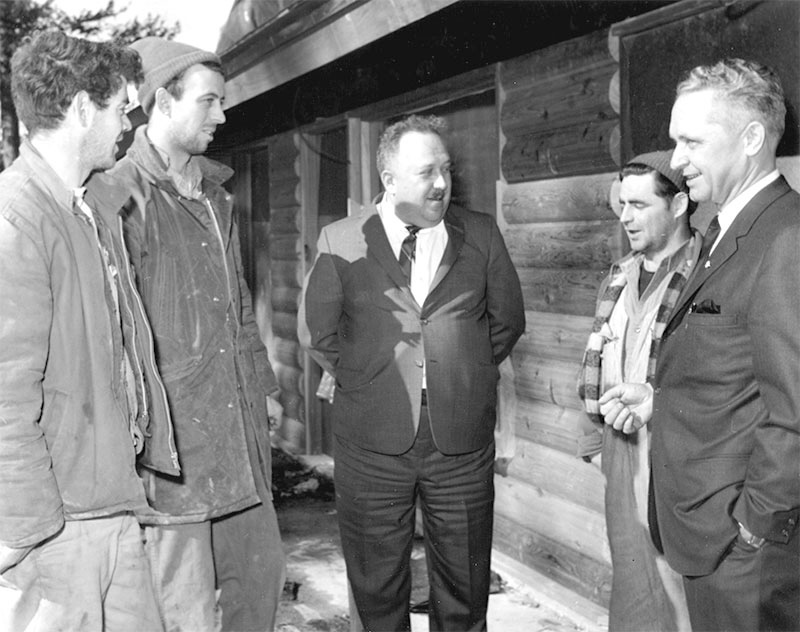
Nenshi defends his steering of Alberta’s NDP. “The values that we stand for under my leadership in this party haven’t changed,” he told The Tyee in a recent phone call. “We stand for the dignity of every human being. We stand for the opportunity for every single person to thrive on this land, and we stand for the importance of public services in making sure that people have that opportunity to thrive — but we have to be able to find policy that makes sense fiscally, that makes sense in terms of outcomes.”
A former business professor at Calgary’s Mount Royal University, Nenshi has characterized small businesses as the backbone of the economy.
“We live in a world where we need economic activity,” Nenshi said. “And that economic activity is brought by the business sector. Businesses that do not value the people that go to work every single day are not going to be successful.”
Tell that to Keenen Noel.
Born and raised in Calgary, Noel has worked in retail his entire adult life. Like many of the 381,600 Albertans employed in this sector, Noel faces the precariousness inherent to inadequate wages and irregular work schedules, seldom knowing if he’ll be able to make rent at the end of the month. Meanwhile, his private liquor store employer is profitable and growing.
“Retail work has not improved in any meaningful way in 16 years,” Noel said, listing a number of small businesses he has worked for and left, seeking to improve his livelihood. “It’s low wages, high turnover, irregular hours, shift work, and no matter what they say, there isn’t that much room for advancement.”
Making about $18 an hour, Noel can consider himself lucky, as half of part-time retail workers in Alberta earn less than $16 per hour, just $1 above the provincial minimum wage, the lowest in Canada.
Workers in this sector frequently piece together different jobs to complement their income, sometimes working more than 50 hours every week to fill the gap created by an ever rising cost of living and stagnant wages.
“People have to actually care about retail workers for anything to change,” Noel said. “Nothing will change unless people want it.”
In an ideal world, the 34-year-old would like to work a predictable number of hours and earn a livable income, with wages tied to the cost of food, housing and transportation. Moreover, he believes the provincial government should regulate rent increases. Not long ago, Noel had to move in with a friend, after his landlord doubled his rent.
“Landlords shouldn’t be allowed to raise people’s rent to a price they can’t afford anymore,” he said.
Noel is not alone.
A recent survey commissioned by the Alberta Federation of Labour found that an overwhelming majority of respondents, regardless of their political leaning, are supportive of rent controls and a $20 minimum wage, as well as regulating electricity prices and introducing a public auto insurance system, all initiatives aligned with the AFL’s worker agenda.
“Everything that I keep hearing from the provincial NDP is about Danielle Smith and her crazy plans,” Noel said. “I’m genuinely tired of that; I want to hear what we’re going to do when she’s gone.”
With the next provincial election two years away, working-class Albertans are due for a lengthy wait.
Nenshi’s current focus
Cognizant of the challenges facing Albertans, the provincial NDP is exploring policy options on auto insurance, electricity costs and housing, Nenshi says. But he remains vague about his party’s plans to woo workers.
“One thing you never want to do as a politician is reveal your platform too much before the election,” Nenshi said. “Because the other people will steal your ideas.”
At the moment, Nenshi sees a chance to gain support by opposing the threat of secession.
“People are unbelievably angry about separation and what the government is doing,” Nenshi said, noting that leaving Canada could hurt Albertans in the trades. “Instead of doing what every province is doing, which is removing barriers to labour mobility, this government, with its talk of separation, is making it harder and harder for people to hire Alberta workers.”

To address anxieties about Alberta leaving Canada, the Alberta NDP is holding a series of town halls across the province.
“This isn’t meant to be a partisan, ‘vote for me’ event,” Nenshi told a packed room on a recent Monday evening in Lethbridge, where the inaugural town hall of this series took place. “This is about hearing from all of you about what is important for Alberta, about helping us understand where you’re coming from and what your concerns are, so that we can amplify all of that.”
The energy of the room was cheerful in Lethbridge. But few of the more than 250 faces congregated appeared to be under the age of 60, a stark contrast with the demographics of a city where roughly seven in 10 workers are younger than 45.
“It’s a good thing,” Nenshi told The Tyee in a media scrum after the town hall. “These are leaders in the community, people who’ve worked really hard for a very long time. It is a matter of privilege to be able to take a weekday evening to come to a thing.”
It is true that an event scheduled at dinnertime on a Monday leaves many people out, but part of the issue could be that too few working-class Albertans are inspired.
“Alberta workers are hungry for progressive alternatives,” said McGowan of the Alberta Federation of Labour. “They’re just not on offer from either of the major political parties — and that’s a problem.”
The void left by an absence of concrete proposals to support workers is being deployed by the United Conservative Party government to divide Albertans with MAGA-style politics, McGowan added. “Our current government would rather engage on culture war politics than on doing things that would really help working Albertans.”
Across Canada, the power disparity between workers and employers is growing larger, and the more one relies on wages to survive, the more vulnerable one becomes to the whims of an exploitative system. Work precariousness is no longer limited to occupations in retail and hospitality.
Because the productivity gains afforded by automation, artificial intelligence and gig work threaten the livelihoods of working-class Albertans, policy proposals that champion their priorities could be key to winning Alberta’s next provincial election.
For academic Lexier, the trends are clear. “Capitalism in its current form has devastated the working class,” she said. Any political party faces less relevance “if we’re forgetting that there’s all these other people who are scraping by, and we’re not advocating on their behalf to try to temper the system and make it work better for them.”
McGowan urges a sharp pivot for Nenshi and the Alberta NDP. “What our poll shows is that Albertans are inspired by progressive populist policies, like a dramatically increased minimum wage, making it easier for people to join unions, public auto insurance and re-regulated power,” he said.
“Those are the ideas that get people excited, not warmed-over incrementalist policy. We feel strongly that it’s time for the Alberta NDP to adopt a different approach. That means taking the progressive populist high road, rather than trying again with the mushy centrist middle.” ![[Tyee]](/design-article.thetyee.ca/ui/img/yellowblob.png)
Read more: Labour + Industry, Alberta









Tyee Commenting Guidelines
Please note that email notifications for replies are not currently working due to a software issue which may be resolved in a future update.
Comments that violate guidelines risk being deleted, and violations may result in a temporary or permanent user ban. Maintain the spirit of good conversation to stay in the discussion and be patient with moderators. Comments are reviewed regularly but not in real time.
Do:
Do not: