


 SHARE:
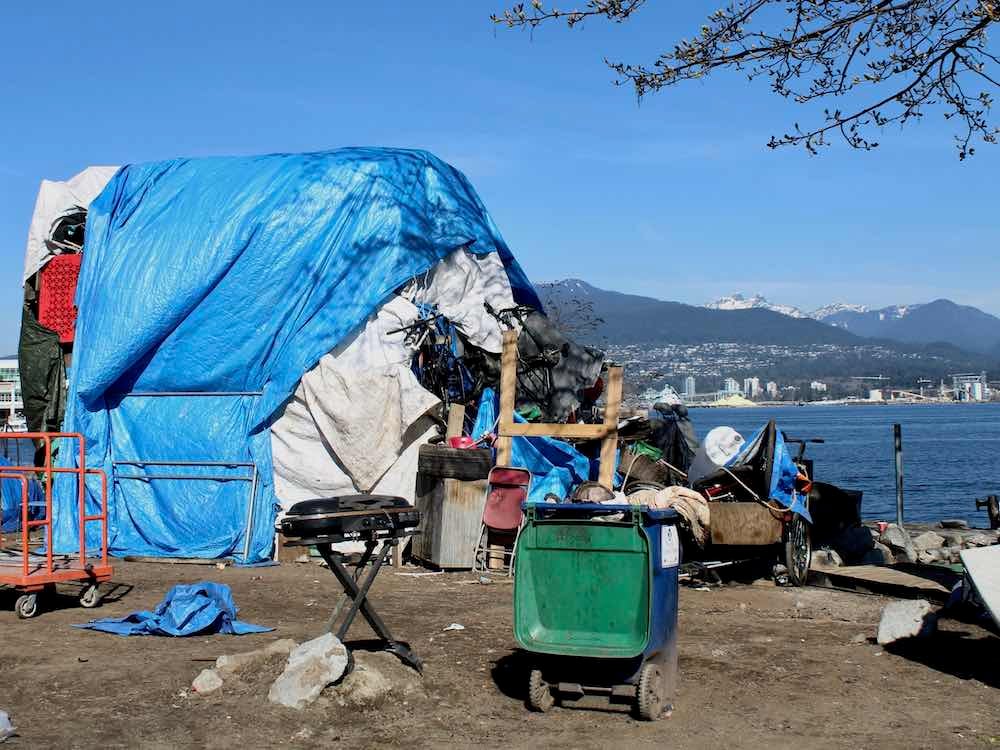
Conservative Party of BC Leader John Rustad promised this week to clear all tent cities in the province, prohibit drug use in supportive housing and use new involuntary care legislation to confine people with addictions.
Rustad’s plan includes building “low secure units” for “the treatment of individuals who pose a risk to themselves or others.”
So if people use drugs and are evicted from social housing, and there are no tent cities, where would current residents go? Would they be held for involuntary treatment?
Melissa De Genova, the Conservative candidate for Vancouver-Yaletown, did not directly answer the question when The Tyee spoke to her following a press conference Monday.
“My understanding is that our plan for supportive housing [includes] 24-hour wraparound supports, and there will be different levels,” De Genova said. “Right now, what we see under the BC NDP government is a one-size-fits-all model.”
Julia Riddle, a lawyer who has represented residents of tent cities, called the plan unrealistic, dangerous and unconstitutional.
“I don't think it's ever been tried. What we're talking about is effectively criminalizing being homeless,” Riddle said.
“We're talking about saying you can take away someone's fundamental liberty rights and force them to go stay in this pretty heavily policed facility just because they're homeless,” she added.
“Right now we don't say, ‘Hey, the government gets to forcibly take you and force you to live somewhere else,’ unless you've committed a crime or unless you need that for the benefit of your own care.”
Cities and towns across British Columbia have been struggling to deal with tent cities following a sharp rise in homelessness that started during the COVID-19 pandemic.
During the initial pandemic period, the BC NDP bought or leased several hotels, motels and single-room occupancy hotels to quickly house people. But in some locations neighbours have complained about visible drug use, mess outside the buildings or an increase in crime.
On tent cities, the BC NDP’s platform promises to work with more B.C. communities to bring an end to encampments by housing people who live in tents. In an attempt to make supportive housing safer, earlier this year the BC NDP government made changes to the province’s Residential Tenancy Act, giving housing providers more power to enter tenants’ units to ensure they are safe and to control the number and frequency of visitors.
While several cities across Canada have attempted to clear homeless camps, the courts have often stepped in with rulings that establish that homeless people have the right to shelter if housing is not available.
For instance, in 2021, when the City of Prince George attempted to clear the Moccasin Flats encampment, a judge ruled the city had breached an earlier court ruling that allowed the tent city to remain in place until suitable housing and a daytime shelter were available.
In Vancouver, the city had an established practice of slowly closing tent encampments by offering spots in single-room occupancy hotels and homeless shelters over a period of several months, before moving in to close the camps.
However, in January 2022 a court ruling found that process wasn’t offering people adequate housing that met their needs and often the shelter spots being offered did not actually exist.
That ruling allowed an encampment located at CRAB Park to stay; however, the City of Vancouver still plans to close that tent city by this winter because of safety concerns.
Many supportive-housing buildings are chaotic, with some residents using drugs in common areas, and Riddle said she knows many people who would rather live in buildings where constant open drug use isn’t happening.
“I think they could build it, offer people spots, and I would be shocked if those spots don't get filled,” she said.
Riddle questioned how the Conservatives’ plan to make all supportive housing in the province abstinence-only would work and how soon the government would be able to remove all homeless encampments, given how long it takes to build new housing or new institutional facilities.
“You have housing, completely dry, with a zero-tolerance policy and under strict conditions,” Riddle said. “Well, that does sound a lot like a jail.”
De Genova said the Conservative plan would be “comprehensive” with different stages of housing, and would be designed to offer different levels of care depending on need.
“The system right now is failing,” she told The Tyee. “These individuals, and many of them, aside from being drug addicted, are also concurrently mentally ill, and they deserve better. Also, there should be options for supportive housing in the community when and if individuals are ready for those options.”
Want to get even more of The Tyee’s election coverage? Sign up today for The Run. It’s a free B.C. election newsletter full of smart voices unpacking key issues, fact-checking politicians and exposing disinformation to clarifying light. Go beyond the horse-race headlines and subscribe now. ![[Tyee]](/design-article.thetyee.ca/ui/img/yellowblob.png)
Read more: Rights + Justice, BC Election 2024, BC Politics











Tyee Commenting Guidelines
Comments that violate guidelines risk being deleted, and violations may result in a temporary or permanent user ban. Maintain the spirit of good conversation to stay in the discussion and be patient with moderators. Comments are reviewed regularly but not in real time.
Do:
Do not: