

 SHARE:
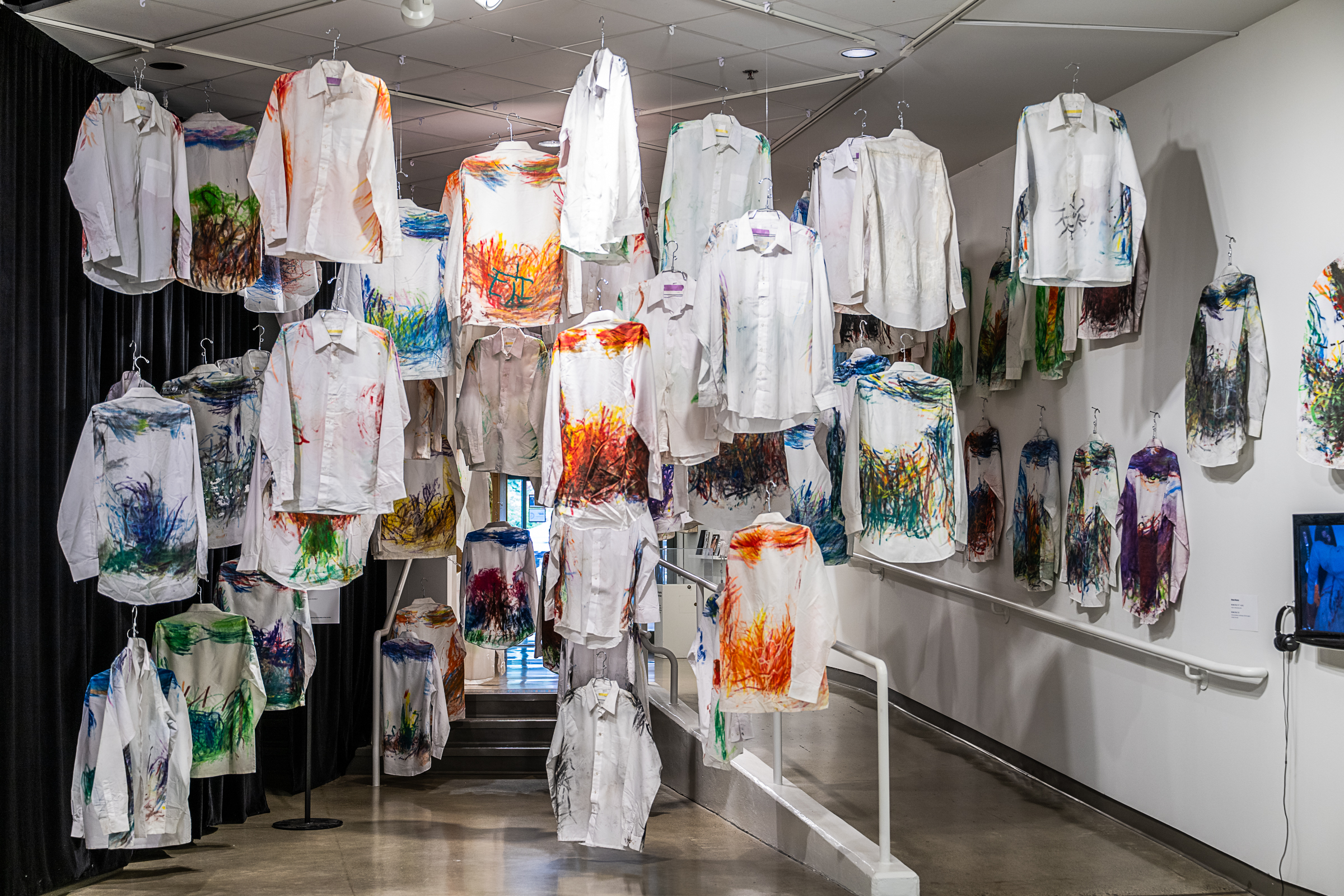
To gain entrance to the Richmond Art Gallery’s new exhibition Ongoing / Pacific Crossings, one must make one’s way through a host of white dress shirts, each coated thickly in layers of paint.
The shirts function as an archway of sorts, shepherding visitors into the space. With its reference to torii, traditional Japanese archways that mark the transition from the mundane to sacred, the shirts are a fitting way to enter an art gallery. What other place mixes the sacred, the profane and even the absurd into an encompassing whole?
The work of Mineki Murata introduces the exhibition, and it combines all of these aspects. Born in Gunma, Japan, and currently based in Tokyo, Murata’s body of work is just that, a body, emphasizing not only the corporeal, physical nature of live performance, but also the lingering effects of the experience, caught and made permanent in marks, colour and gesture.
The title of Murata’s My Back Talk references the Japanese idiom of “speaking with your back,” meaning to let actions speak louder than words, but it could also incorporate the Western version of the phrase, meaning to give somebody lip and to stand up authority, whether in the form of one’s parents or the police.
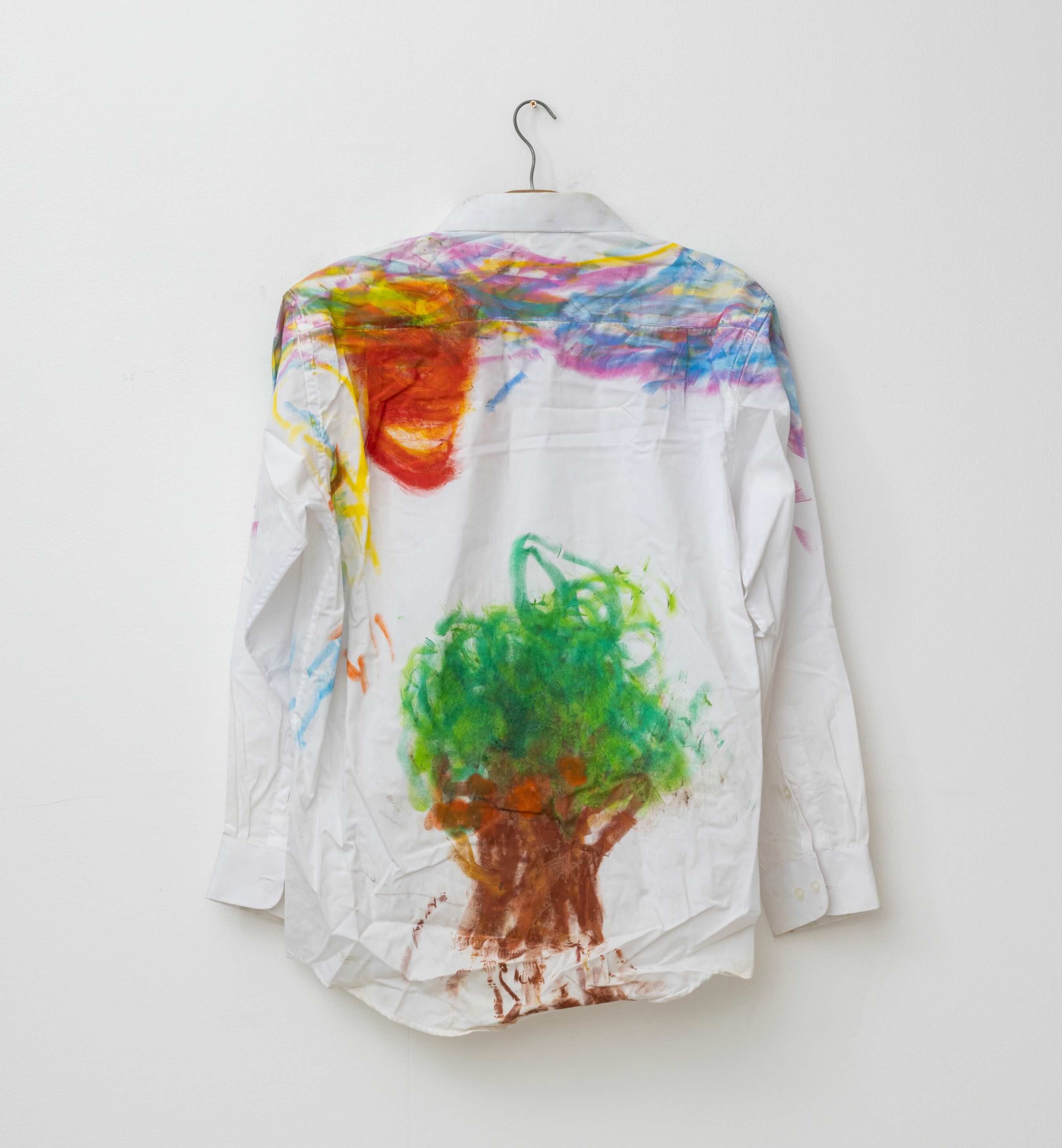
In the video documentation of the performance that took place at the Richmond gallery, Murata twists and contorts his body, reaching backwards, grunting loudly and scratching coloured marks on the white cotton of a men’s dress shirt. In the background, onlookers, including a fair number of younger kids, watch. Some seem a bit confused, while others are looking on in evident glee. It’s a reminder that kids make some of the best audiences for contemporary art.
Ongoing / Pacific Crossings is, in some fashion, a natural fit for children, who are innate connoisseurs of the weird and wild, unafraid of experiences that stretch and warp the fabric of reality and consciousness. After all, play itself is a serious business, incorporating experimental takes on big ideas, but also opening body and mind to let imagination do its thing. Inside this freewheeling space, all things are possible.
Taking this approach to the show is useful, eschewing the more academic and theory-based interpretations to simply see the work.
With almost a dozen artists working in a dizzying array of mediums, the exhibition also includes a number of short films housed in a black box theatre. Co-curated by independent Makiko Hara and Nozomu Ogawa, the director of Tokyo’s Art Center Ongoing, or ACO, the show comes out of seven years of meetings, gallery visits and dialogue.
The mandate of ACO is to provide a place for artists to make work, hang out and discover each other — in essence, to offer a hub for creative exchange. Across the ocean, the Richmond Art Gallery is doing something similar. It is an interesting partnership highlighting not only the commonalities of the two different places but also exploring some of the thornier issues between the two nations.
Artwork on immigration, internment and displacement
Some of these find a home in Yusuke Shibata’s HAPPYLAND.
One of the largest of installations in the exhibition, taking up the entirety of the back of gallery, the piece takes inspiration from the original name of the East Vancouver amusement park now known as Playland, which borders Hastings Park and the Pacific National Exhibition site.
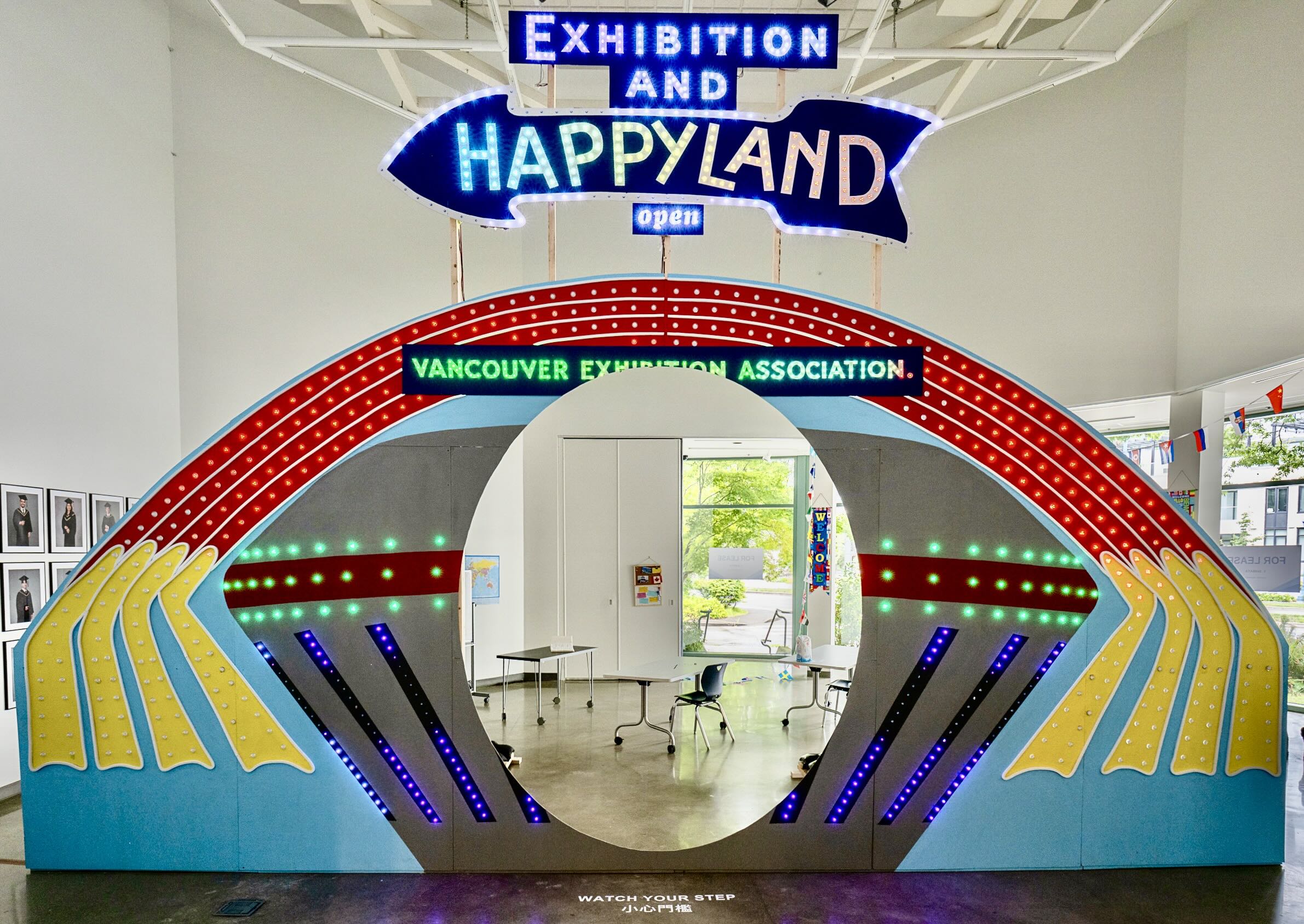
After the bravura introduction of a towering entranceway and sign, glittering with lights, the rest of the installation is meant to be something of a serious letdown.
Dust, garbage, droopy flags and battered classroom tables and chairs summon an abandoned language school. On one wall, bits of signage reference fruitless job searches, while on another, a series of graduation portraits, generated by AI, look on with desert emptiness.
The faded hopes for a better life in another part of the world perfumes the air with bitter, almost acrid disappointment.
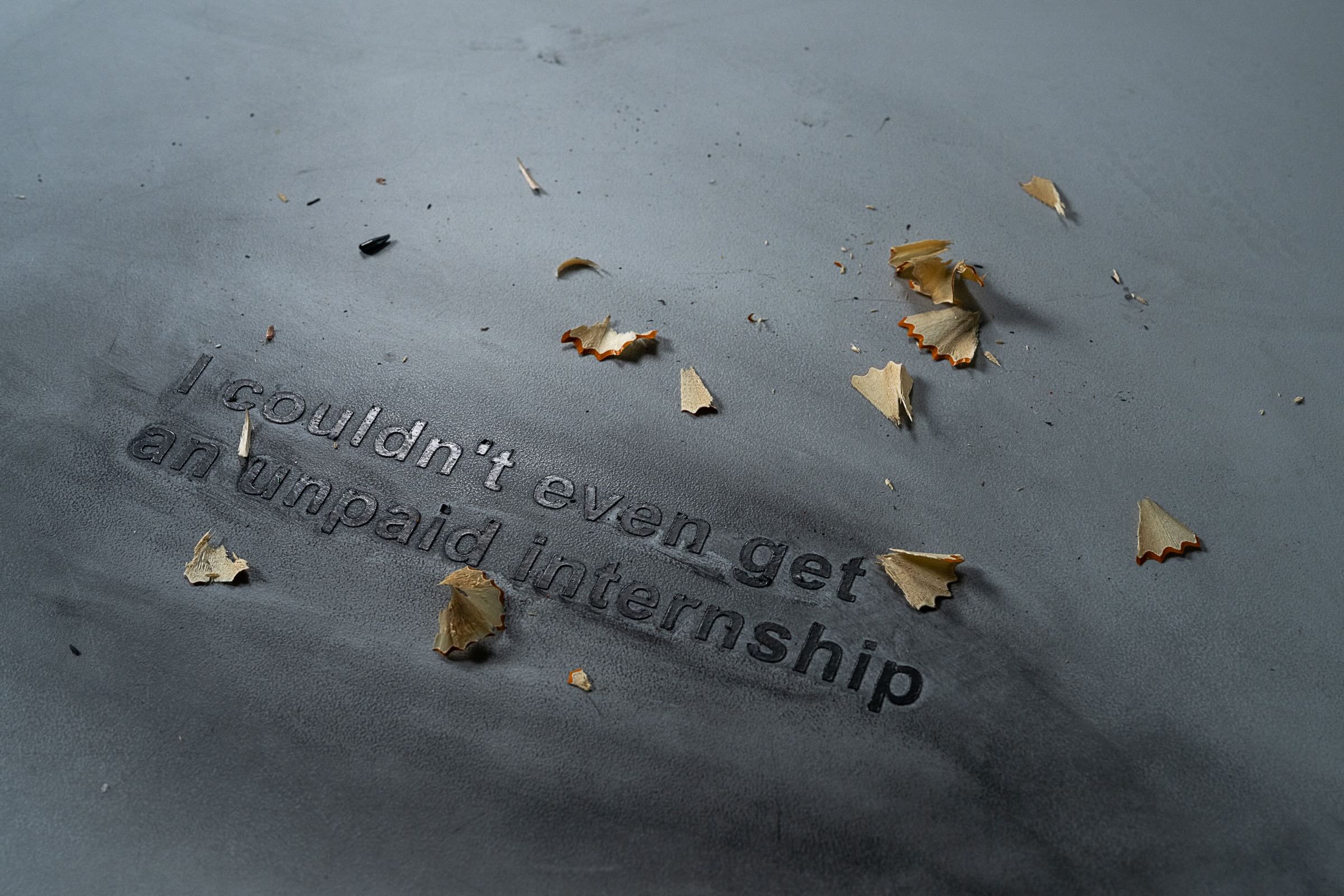
For plenty of Vancouverites, Hastings Park is a place of warm summer memories, cotton candy and roller coaster rides. But for Japanese Canadians, the place has other connotations. This is a truth made explicit in another recent public art installation entitled The Hollow Man.
Jon Sasaki’s sculpture depicts Ian Alistair Mackenzie, the architect of Japanese internment policy during the Second World War. Cast from aluminum, the hollowed-out figure faces the livestock barns that were used as a processing centre for Japanese Canadians during the war years. During the unveiling ceremony of the work in Hastings Park earlier this year, City of Vancouver staff explained that the sculpture was meant to function as an “anti-monument,” meaning that the public is implicitly invited to vent their feelings about this dark chapter in the province’s history.
HAPPYLAND does something similar, inviting viewers to look beyond the shiny edifice of a welcoming new home that promises jobs, belonging and a better life. The reality of immigrant experience can be much drearier and harsher, as generations of people from across the globe have discovered.
The bleakness is somewhat overwhelming, but there are also elements of humour.
As curator Makiko Hara recounts, one of the younger visitors to the Richmond Art Gallery remarked of the work, “So, this is Happyland?”
Yeah, sorry kid. It ain’t all it’s cracked up to be.
An effervescent spirit of experimentation
Some artists in the show are well established, while others are more emergent on the scene. If there is one uniting factor, it is pure eclecticism, the fizzy effervescence that comes from making things, exploring ideas, picking up the tail of some interesting creation and following it to its logical or illogical conclusion.
This spirit of experimentation, characterized by equal parts playfulness and serious intent, finds full expression in the work of Marico Aoki. Her Nurture feelings of love involves an old nightgown, a mysterious mask and a video installation of the artist painting the garment, one fingerprint at a time, dipping her finger in small bowls of colour and daubing individual marks onto the fabric.
As Hara explains, the work was not meant as a public spectacle, but rather as a private and deeply personal ritual. Intimate and slow, the piece moves at a human pace. Once you accept its rhythms, a curious sensation of calm starts to ripple out like a feeling of new growth.
Aoki describes her work this way: “People live their lives alongside ‘emotions,’ which are elusive entities... In this piece, I liken the emotion of love to a plant. I conceived of emotions as independent entities, expressing how they dwell within my body and grow on their own.”
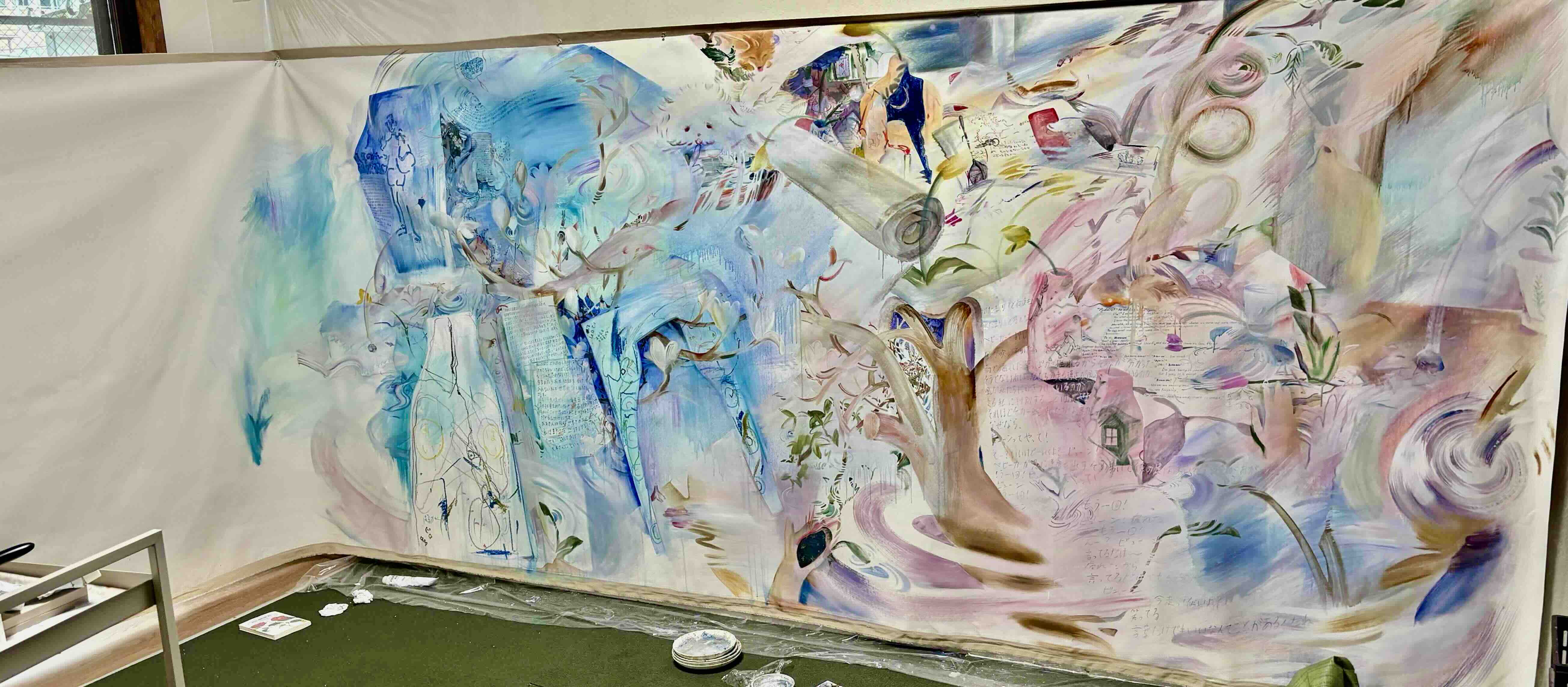
Haruka Saito takes a similarly immediate and intimate approach. At first glance, Saito’s Hidden Dimension is a bewildering convergence of different elements: tree branches, rolled-up paper scrolls, human figures and scratchy bits of writing. What does it all mean?
An earlier iteration of the work at the Helsinki International Artists Programme, or HIAP, offers some answers. The concept of time figures large but so does play and the creative rhythms of childhood. Part of the work, Saito explains, is “treating life and art as inseparable.”
In addition to drawings, paintings, sculpture and performance, Ongoing / Pacific Crossings includes a number of films and videos. Short and mid-length films from Maiko Jinushi, Masahiro Wada, Takuro Kotaka and Kent Nito offer a cross-section of contemporary art film.
A gentle heads-up: the inclusion of film in a gallery can be a complicated experience. Not everyone has the time to take in 150 minutes of cinema in a single go. Repeated visits to the gallery are one way to approach it, but some of the video work can be found online for curious souls.
Some of the films in the show are more accessible than others, but Takuro Kotaka’s The Man Who Cannot Use Telepathy is well worth the visit. Filled with both humour and pathos, the film explores ideas of conformity, community and the need for belonging in a mockumentary that freely mixes non-fiction and creative license. It’s indicative of the overall approach of the show: eclectic, odd, but also brimming with all manner of meaning and manifestations.
As Nozomu Ogawa, the director of the Tokyo Arts Center and co-curator of the Richmond show asks, “What can art do for us now?”
It’s a question that I think about a fair amount. There isn’t one answer, but a bouquet of potential directions. In this flowering, it’s interesting to think about the different needs of the artists involved, as well the people who show up to galleries to take it in. The viewers will experience their own reactions, and form their own queries, thoughts and reactions. In so doing, they close the circuit, only to open up another loop with the next show.
‘Ongoing/Pacific Crossings’ runs until Oct. 4 at the Richmond Art Gallery. ![[Tyee]](/design-article.thetyee.ca/ui/img/yellowblob.png)
Read more: Art

Tyee Commenting Guidelines
Please note that email notifications for replies are not currently working due to a software issue which may be resolved in a future update.
Comments that violate guidelines risk being deleted, and violations may result in a temporary or permanent user ban. Maintain the spirit of good conversation to stay in the discussion and be patient with moderators. Comments are reviewed regularly but not in real time.
Do:
Do not: