


 SHARE:
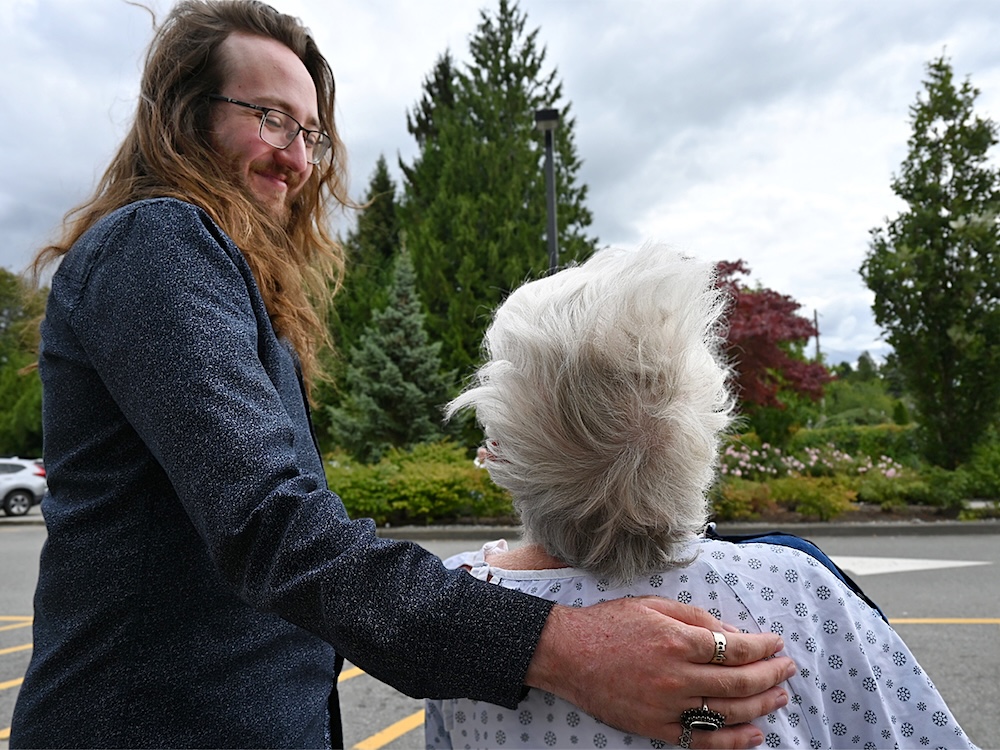
Elizabeth Davis is a bit of a firecracker.
She dedicated her 30-year career to social work, working with unhoused people and women fleeing abuse, and later as an advocate for the Squamish Nation.
She also learned ballet in her 30s and enjoyed a short performing career.
But now, at 78 years old, her health has taken a turn for the worse, and she’s found herself unhoused.
Davis has spent most of the past three months in hospital. During that time, she lost her apartment and her family was given 48 hours’ notice to clear out her things.
Davis invited The Tyee to visit her in hospital, where she is continuing to receive care.
“I’ve gotten to the point where I can’t really look after myself anymore,” she told The Tyee.
“So unfortunately this is going to be my future,” she added, gesturing to her hospital surroundings.
Davis is supported by her small, close-knit family, who lives in the Lower Mainland.
However, her family cannot provide the level of care or housing accessibility that she needs, Nathan Davis, her grandson, told The Tyee.
For example, Nathan’s home doesn’t have a spare bedroom and his bathroom is upstairs.
Davis can walk only a short distance and relies on a wheelchair to get around.
Davis worked until she was 74 and was left with a pension that barely covers the cost of living, Nathan said.
It’s a “horrible feeling” to not be able to financially support his grandmother, he added.
Davis has been in and out of hospital eight times over the past three months. Most recently, after losing her apartment, she was discharged to a shelter in the Downtown Eastside.
Discharged to a shelter
Nathan said the family was notified at 2 p.m. on Aug. 17 that Davis had been medically cleared and would be discharged from Royal Columbian Hospital once a safe place was located. The family hoped that meant an assisted-living or long-term care facility.
An hour later she was discharged to the shelter.
Nathan said the family was not notified that she had been sent to a shelter in the Downtown Eastside.
He said Davis sent out a “panicked and scared” text late that night asking for help.
Her family didn’t see the text until the morning. By that time, Davis’s shoes and phone charger had been stolen, and she had been readmitted to care at St. Paul’s Hospital, Nathan said.
Davis has since been moved to a hospital in the Fraser Valley where she is closer to her family.
While Davis offered a rosier recollection of the shelter, she said she’d been surprised to be discharged from hospital in the first place, because she didn’t feel that her health had improved at all.
“The people at the shelter were incredibly kind and the place was spotlessly clean — you could end up in worse places,” Davis said. “I used to work for the welfare department and the way some of my clients lived was bloody awful.”
But being discharged to the shelter also didn’t feel like a long-term solution to Davis.
“I want to go someplace that’s more like a home where I’ve got my own room and no noisy roommates,” she said, adding she would appreciate access to a library or to have a room with a TV in it.
Davis said her social worker told her she has not yet been assessed for placement in supportive housing or long-term care because she is still recovering her health.
Davis told The Tyee she’s not sure if she needs the high-acuity care of a hospital — but she knows she still needs regular medical care.
“I could be somewhere else where I’m a little bit more independent, as long as the meals are provided because I’m not up to cooking,” she said. Before she was in hospital, she was often missing meals because she was not able to shop, she said.
She also hopes to be able to stay in the Fraser Valley close to family.
“It’s hard for seniors who are not well,” she said. “I’m starting to gain a real appreciation for that because it’s not something I ever thought of before. I mean, I only stopped working four years ago.”
Nathan said his grandmother was given a list of phone numbers for long-term care facilities to call before she was recently discharged from hospital.
It was a list of phone numbers for private facilities, which are financially out of reach even if the family pooled its resources, Nathan said.
A Fraser Health spokesperson told The Tyee in an emailed statement they are sorry to hear about the Davises’ concerns.
The spokesperson said they couldn’t comment on Davis’s case but could provide information on discharge policies.
When a patient can live independently and does not qualify for placement in subsidized long-term care or assisted living, the health authority will provide the patient and, if appropriate, their friends and family with information about shelters, transitional housing and other types of housing and work with them to answer any questions, the spokesperson said.
When an unhoused patient is discharged, the care team will connect the person with services, such as having community care service teams visit them in temporary housing, they added.
A long-term care assessment can be done while a patient is in hospital and evaluates a patient’s care needs, the spokesperson said. Contact information for private long-term care homes is provided on request, they added.
The stats on senior homelessness
Davis’s situation is familiar to Dan Levitt, who works as B.C.’s seniors advocate.
“We hear calls from seniors living in their cars, they’re couch surfing or at the verge of homelessness,” he said. “It’s not unusual for us to get a phone call at the end of a workday from someone who doesn’t know where they’re going to spend that night.”
Seniors are one of the fastest-growing segments of the unhoused population in Metro Vancouver and make up 22 per cent of the local unhoused population, according to the 2025 Metro Vancouver homeless count.
About 45 per cent of seniors involved in the count said they had their first experience being unhoused once they were over the age of 55.
“This trend is deeply concerning,” Levitt said.
While many seniors end up sleeping in shelters, the facilities are not purpose built for seniors, who are more likely to have mobility, health and accessibility needs, he added.
The number of unhoused seniors is rising because fixed incomes aren’t able to keep pace with the rising cost of living or rent.
“Unfortunately, many seniors are one unexpected expense or rent increase away from losing their housing,” he said.
In B.C., a quarter of all seniors live on less than $2,000 a month and the median income for seniors is just over $3,000 a month, Levitt said. Annually, that’s an income of $23,000 and $37,000 a year, respectively.
Supports for seniors are stalling while the population of seniors in B.C. is expected to grow by 265,000 people over the coming decade, according to the province’s demographic projections.
The Shelter Aid for Elderly Renters, which provides rental assistance for eligible low-income seniors, has not kept pace with actual rent increases and cost of living, Levitt said.
It should instead be indexed to inflation and reflect current rents, he said.
Last year there were 13,000 applications across the province for subsidized housing for seniors, and only seven per cent of those who applied got a unit, he added.
“We’re not seeing subsidized housing grow quickly enough,” Levitt said. “In fact, many projects that were planned have been cancelled because of the financial situation of the province, and we’re just not keeping pace with the growing number of seniors in the population and the rising housing costs.”
Programs that are designed to help seniors live independently longer are also falling behind, because many people cannot afford the province’s co-payment model for publicly subsidized home supports.
Levitt said a senior living on $31,000 a year who needed one hour of daily home support would need to pay $10,000, compared with Alberta and Ontario, which do not charge for home supports.
This can push seniors into living in subsidized long-term care facilities earlier than they need to, he said.
There are three times more seniors on wait-lists for long-term care than there were a decade ago, and people are waiting an average of 10 months to be placed in a facility, Levitt said. A decade ago, the wait time was five months.
Last year there were 6,000 seniors in B.C. waiting for long-term care. While people wait, they generally are either staying in hospital beds or discharged home. Seniors who do not need the high-acuity care of a hospital but are not well enough to be discharged are referred to as alternate level of care patients.
This is putting either more strain on the health-care system or more strain on families, Levitt said.
BC Housing and community organizations can help seniors look for and secure appropriate housing, but affordable and accessible homes are in short supply.
Ultimately, Levitt said, the province needs to focus on how to keep seniors housed, because once they’re unhoused, “the consequences can be devastating and catastrophic.”
He is calling on the province to establish a cross-ministerial seniors plan to better address the needs of seniors, including housing, income, health care, transportation and community care.
As for Nathan, he just wants to be able to protect his grandmother and make sure she is not “shipped off to fend for herself again.”
Nathan is in the process of filing a complaint with the hospital. In the meantime, he spends most of his free time with his grandmother, chatting about their shared passions of ballet, classical music and art.
*Story updated on Sept. 8 at 11:45 p.m. An earlier version of this story said 45 per cent of people experiencing homelessness for the first time are over the age of 55; it’s in fact about 45 per cent of seniors experiencing homelessness who had their first experience of being unhoused after the age of 55. ![[Tyee]](/design-article.thetyee.ca/ui/img/yellowblob.png)








Tyee Commenting Guidelines
Please note that email notifications for replies are not currently working due to a software issue which may be resolved in a future update.
Comments that violate guidelines risk being deleted, and violations may result in a temporary or permanent user ban. Maintain the spirit of good conversation to stay in the discussion and be patient with moderators. Comments are reviewed regularly but not in real time.
Do:
Do not: