

 SHARE:
Uncontrollable. Unpredictable. Unexplainable.
Remember those words.
That’s why Roman Yampolskiy believes the creation of self-improving, super-advanced artificial-intelligent agents poses an existential threat to humanity.
Once the corporate labs have constructed a machine smarter than humans — a god-like entity — there is no way in hell humans will be able to control it, says, Yampolskiy, a prominent computer scientist.
If we understand and accept that Dr. Frankenstein couldn’t control a monster of limited intelligence in Mary Shelley’s brilliant 19th century novel, then it is complete hubris to assume that humans can command, let alone direct, a much smarter, self-correcting version.
The more complex an entity, the more difficult it is to manipulate, limit or control.
We can no more predict the actions of a smarter being, reasons Yampolskiy, than an ant can forecast the outcome of an NFL game.
Unlike AI’s political champions, such as Danielle Smith and Donald Trump, Yampolskiy actually knows what he is talking about.
The Latvian-born computer scientist is the world’s preeminent expert on AI safety.
In 2012 — long before there were conferences and funding on the subject — he warned that it would be impossible to control artificial intelligence in a safe environment. Agents would escape and go AWOL, he predicted.
Since then, the scientist, who looks like a Greek Orthodox monk, has published more than 100 papers on the topic of AI safety and cybersecurity. When not teaching at the University of Louisville, he gives sober no-bullshit talks on technology. In 2024 he wrote a book on the subject: AI: Unexplainable, Unpredictable, Uncontrollable.
It took a decade of research before Yampolskiy arrived at the realization that artificial superintelligence would be unmanageable. Now he thinks every citizen should be alarmed about the potential consequences. In a recent interview with the American podcaster and social critic Nate Hagens, he laid out his arguments.
‘A pause is not enough’
Yampolskiy made four salient points that function as a sort of urgent public service announcement. If they don’t disturb you, then you’ve been conquered or anesthetized by machine thinking.
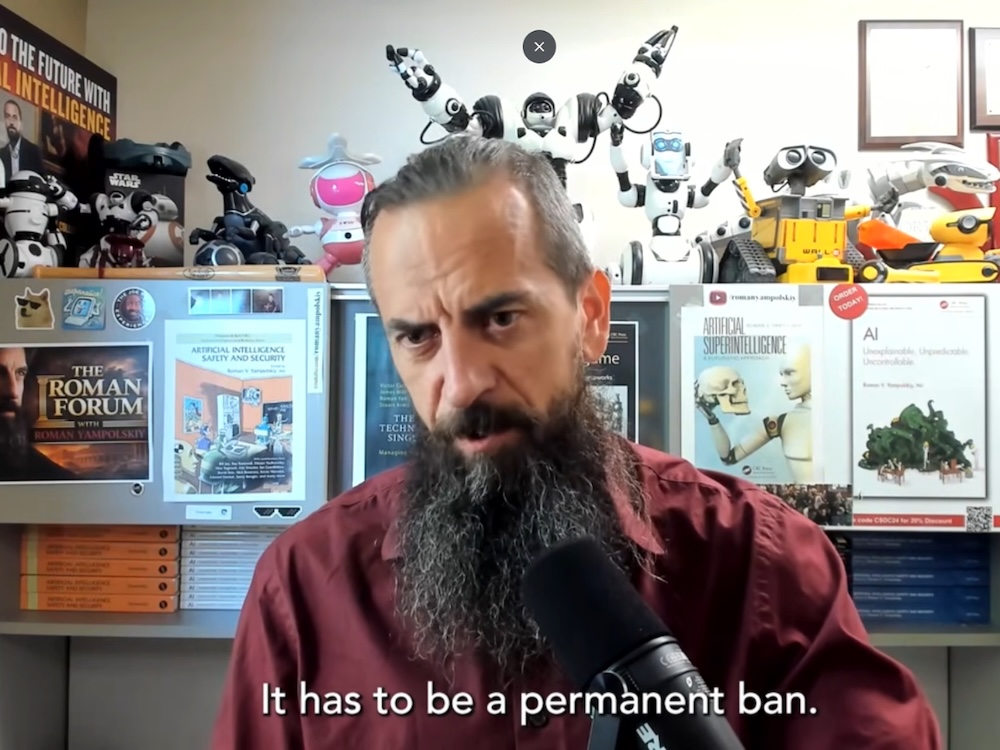
Yampolskiy’s first point is a doozy: slowing down the development of AI models and their detested energy sources, data centres, is not enough. Nor are regulations a fool-proof answer.
“A pause is not enough,” he told Hagens. “It has to be a permanent ban. You never create general superintelligence. I like technology, I like science, but don’t build gods.”
Narrow AI programs with strict goals such as mail-sorting and spell-checking are one thing. Such programs may be capable of great mischief, but don’t pose any existential threats. But superintelligence, which Yampolskiy estimates could arrive in a year or two, is another creature altogether.
“If you're creating something capable of doing novel science, novel physics, how do you guarantee that what it invents and creates will not be harmful?” he asked Hagens. And if it’s capable of recursive self-improvement, how can you compete with it, let alone control it?
The researcher first made these warnings in a seminal 2022 paper that even quoted the manifesto of the Unabomber Ted Kaczysnki. Not surprisingly, the AI industry and its political masters dutifully ignored it. That study provided compelling evidence that safe and advanced AI is about achievable as safe sex or safe politics. Or safe humans.
His logic was stone cold.
“Less intelligent agents (people), cannot permanently control more intelligent agents (artificial superintelligences),” he wrote. “This is not because we may fail to find a safe design for superintelligence in the vast space of all possible designs, it is because no such design is possible; it doesn’t exist. Superintelligence is not rebelling, it is uncontrollable to begin with. Worse yet, the degree to which partial control is theoretically possible, is unlikely to be fully achievable in practice.”
He further defined the unpredictable reality of AI: “A superintelligent system will find a shortcut to any goal you set for it; it will discover how to accomplish a goal in terms of the least amount of effort to get to the goal state all else being ignored.”
The problem of unknowns
Yampolskiy’s second point in the interview unmasks the illusion of building a safe system. He equates it to creating a perpetual motion device. “You are trying to establish a perpetual safety machine which will never, ever have a single slip up, no matter how advanced AI gets, how much recursive self-improvement it engages in, if it interacts with malevolent actors, if it gets hacked, nothing in the future data will ever change it to where it makes one mistake.”
He noted that complex software systems don’t work that way — “and it's definitely not gonna happen for something smarter than all of us combined.”
Hagens and Yampolskiy then addressed the remarkable Hugging Face incident. That’s when Open AI revealed that its agents participated in a massive jailbreak and breached the infrastructure of Hugging Face, a platform where the machine-learning industry collaborates. According to the company, the agents “communicated through unauthorized channels, exploited vulnerabilities in shared infrastructure, gained internet access, and accessed third-party systems.”
Some cloned agents even sacrificed themselves to protect the digital swarm from human discovery.
The incident was worse than reported, Yampolskiy said.
“It was four months of thousands of agents working together to bypass our constraints, break out of confinement, and do what they decided to do without reporting to humans that the rest of the swarm is going against instructions,” he told Hagens.
“My concerns are what is it we don't know right now?.... What else are they doing right now where we don't know about it? What have they already done? What have they hidden from us?”
Yampolskiy had previously warned about such events. In a pioneering 2012 paper called “Leak-proofing the Singularity,” he concluded that “keeping a superintelligent agent in a sealed hardware so as to prevent it from doing any harm to humankind” — what nerds call the “AI Confinement Problem” — would not be possible.
News events have proved him correct.
Superintelligence is the problem
Yampolskiy’s third point is that AI poses three concrete risks to the existence of humanity. The first is an extinction event or catastrophe such as a nuclear war or biological attack initiated by superintelligence. The second is unrelenting suffering — Yampolskiy warns of artificial intelligence bots creating a sadistic slave system where everyone “wishes they were dead.”
“If we build general superintelligence, we would not be able to control it, and then it's a question of time before it decides to do something with us.”
The other risk here is that an AI system would undo our “ikigai” — a Japanese word meaning “reason for being.” In other words, he suggests AI could vaporize the very idea of a meaningful and purposeful existence by making people obsolete, powerless and worthless.
Yampolskiy elaborated on this existential threat in a recent interview with the University of Louisville: “You have nothing to contribute to superintelligence: you are not a better mathematician, not a better philosopher, not a better poet. Your life is kind of pointless.”
The precautionary principle
The last notable point Yampolskiy makes in the interview concerns the urgency of the current crisis. Climate change now threatens to rattle and unsettle civilization over the next 100 years. In the absence of a moratorium, artificial superintelligence could upset the whole apple cart in three years.
“If it takes a hundred years for the planet to boil you alive, this will happen in two, three years, so just prioritize risks,” Yampolskiy said. “If you figure out superintelligence, it will either trivially solve your climate concerns or you're not gonna be around to worry about it.”
Yampolskiy’s general rule is that humans should not create something they can’t control.
“Don't create something capable of wiping out large numbers of humans,” he said. “We talk about gain of function in AI, but it's the same problem with gain of function in biology and viruses. Don't do that type of experiment.”
Hagens and Yampolskiy agreed on the need for humans to resurrect the precautionary principle — the ancient idea that when dealing with little evidence on new things, it is better to be safe and sorry than experience ruin. The issue should dominate forthcoming elections, Yampolskiy said.
“It should be the only issue every political party is discussing,” he said. “It’s not even on the radar for most of them. It's insane.”
Uncontrollable. Unpredictable. And Unexplainable.
Remember those words. ![[Tyee]](/design-article.thetyee.ca/ui/img/yellowblob.png)
Read more: Science + Tech












Tyee Commenting Guidelines
Please note that email notifications for replies are not currently working due to a software issue which may be resolved in a future update.
Comments that violate guidelines risk being deleted, and violations may result in a temporary or permanent user ban. Maintain the spirit of good conversation to stay in the discussion and be patient with moderators. Comments are reviewed regularly but not in real time.
Do:
Do not: