

 SHARE:
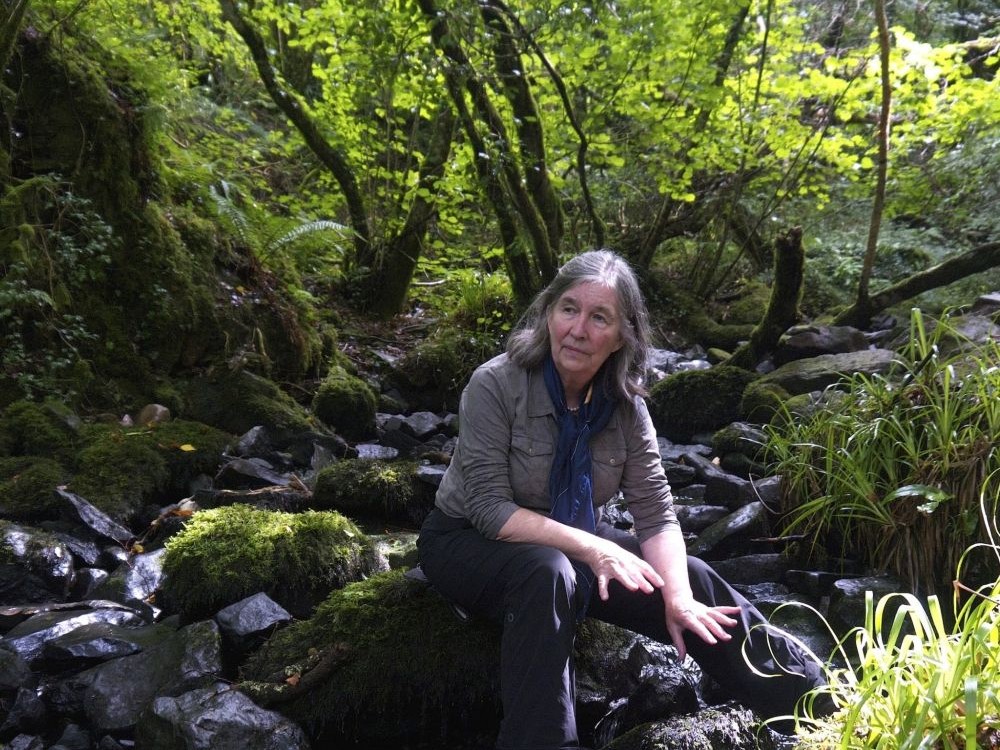
I have Diana Beresford-Kroeger on the phone and the first thing the famed botanist wants to address is the sense of unraveling that is causing dread and anger in many citizens of western democracies.
She promises “not to the add to the nastiness” this Friday when she gives a Vancouver talk on the consciousness of trees, the importance of lichens and the necessity of defending old-growth forests.
Instead, the groundbreaking scientist and unapologetic tree hugger will offer her antidote for the chaos. A preview:
“I will ring a bell for goodness and the importance of doing good in our lives and in our forests.”
Just because a society has lost its good sense and manners doesn’t mean that one must succumb to disorder and distress in one’s own life, she says.
“I think what is happening is that a great Mixmaster has been set off in the world spewing everyone in different directions,” confides Beresford-Kroeger.
The calamity has upended lives and preoccupied our private thoughts, setting off flight or fight responses. “The cortisol levels in our bodies are rising and that is not good,” adds the bestselling author of To Speak for the Trees, Our Green Heart, The Sweetness of a Simple Life, and The Global Forest.
Faced with so much distress, Beresford-Kroeger believes, we must “take a rein hold” of our lives and conduct them with some semblance of decorum and purpose.
And she has a digital device-free “trick” for that.
Every morning Diana and her husband Christian start the day with tea and a little bit of breakfast at their kitchen table in Merrickville, Ontario.
Then, instead of consulting some electronic screen, the couple remove a 120-year-old book from the shelf. “It’s from my uncle’s library,” says Beresford-Kroeger.
Christian then reads a short passage from Under the Cedars and the Stars by Canon Sheehan.
Sheehan, an Irish priest, wrote novels, poetry and engaging essays about his encounters with parishioners as well as ruminations on cedars and the stars.
“His writings are very charitable and kind, and full of hope and forgiveness for people in their errors. There is a democracy in the book I like,” says Beresford-Kroeger.
As they go on through the day Diana and Christian hold the essays close up to themselves. “Sheenan is full of poetry,” she says, “poetry makes you rise above the humdrum.”
And that’s the best way to deal with a shambolic world because there is nothing new about the mayhem of power-hungry potentates in an age of lies.
She assures me that poetry and prayer (“the written word is like steel”) can help anyone shake away the shadow of “the bully” and help you hold hands with others.
And by bully she doesn’t just mean the megalomaniac running the United States but the political order itself. The best way to deal with any bully is to ignore him, she adds. “Sometimes it is easy, and sometimes it is difficult.”
It might also help to heed the 18th century poetic invitation proffered by William Woodsworth: “Come forth into the light of things, let nature be your teacher.”
The global forest, of course, has been Beresford-Kroeger’s formidable instructor, and she is full of news about these critical climate and water regulators which she will also share while in Vancouver.
You must mention the bark study, she insists.
So here’s the thing: a group of Australian scientists recently discovered earlier this year that the bark of trees teems with microbial life. This wealth of bacteria not only purifies the air but removes greenhouse gases such as the potent climate disruptor, methane. Other microbes pull hydrogen from the atmosphere on a highly significant scale while others gobble up toxic carbon monoxide in cities.
Incredibly, the researchers discovered that every square metre of bark can hold up to six trillion microbial cells. That’s more units of life than the number of stars in 60 Milky Way galaxies.
If you took off all the bark from the world’s three trillion trees, says Beresford-Kroeger, “it would cover all seven continents if they were ironed out like some blanket.”
The discovery of the barkosphere raises all kinds of questions for scientists. Which tree species eat the most methane? Which forests remove the most gases? How does climate change affect their behavior?
“So there is a miniature world going on that we had never known about,” says Beresford-Kroeger. It is also reminder that it is nature and not machines that make the world work. Without forests and ocean plankton we would not be breathing oxygen.
And then there is the world of lichens. On Friday, biochemist Beresford-Kroeger will be sharing her latest thinking on these amazing air purifiers with a tale from Prince Edward Island.
Nearly a dozen years ago, the unconventional scientist found herself on the island when a helicopter suddenly descended out of the sky. A man popped out and asked if she was the Irish botanist? Would she like to visit a little-known ancient forest sacred to the Mi’kmaq that had never been cut?
Yes, of course.
“So we got to this forest and I just almost collapsed. The trees were enormous, absolutely enormous. And I saw all the rare species in there and, oh my God, the trees were so tall. And then as we walked into darkness it was like the forest had subtracted every noise.” An extraordinary quiet enveloped Beresford-Kroeger, the kind of silence only a forest can create.
“I kept on going and then I noticed that a wind came in off the sea, and the trees started fluttering. There were lichens on the bark like Tibetan prayer flags wobbling and moving with this tiny breeze. I had never seen that before. It was unbelievable.”
Lichens are strange beasts. They represent the union of a fungus and algae, and these busy bigamists serve as a secondary forest in the forest performing all kinds of tasks. You can find them from pole to pole.
She calculates that the largely deciduous forest on PEI was thousands of years old and had never seen axe. At its centre lay an artisanal well said by the Mi’kmaq to have healing properties. Around it, rare lilies bloomed.
The whole scene remains glued in her memory. “There was a divinity in the air that was coming from the trees. It was like a cathedral. Nature had made its own cathedral, and the cathedral was this forest of perfection.
“Now, I’ve got a helluva pile of degrees and studied physics. God knows I studied medical biochemistry. But I have never ever had that feeling before of this strong divinity holding you. Talking to you. Speaking directly to you in the area right behind your breast. It held you in a form of rapture. You start to see. You don’t look but start to see what is around you.”
There was “consciousness in the forest,” concludes Beresford-Kroeger, “and we all felt it.”
And that’s where the conversation, this time, ends. In an old forest on PEI as conscious as you and me, as described by the botanist who never tires of defending the wonder to be found in all forests. ![[Tyee]](/design-article.thetyee.ca/ui/img/yellowblob.png)
Read more: Environment







Tyee Commenting Guidelines
Please note that email notifications for replies are not currently working due to a software issue which may be resolved in a future update.
Comments that violate guidelines risk being deleted, and violations may result in a temporary or permanent user ban. Maintain the spirit of good conversation to stay in the discussion and be patient with moderators. Comments are reviewed regularly but not in real time.
Do:
Do not: