

 SHARE:
[Editor’s note: In ‘Coming Home from the Candy Factory,’ out now from Caitlin Press, Jane Byer’s job as an ergonomics consultant gives her the inside scoop on all kinds of work, and all kinds of workers. In the excerpt below, she visits a pulp mill, and takes a spin as a ‘fireman’ removing molten waste from the furnace in the basement.]

“You want to give it a try, Jane?”
“That would be awesome.”
I donned the high-tech turnout gear. My get-up, including fire-retardant boots, a self-contained breathing apparatus, flash hood and helmet, was safety-checked ahead of time. I was given a crash course on using the breathing apparatus by the trainer before I walked into the burn house.
They turned on the natural gas elements, and blue flames danced all around me. The temperature hit 300 C, then 400 C. It was disconcerting to be amidst the flames but not get burned, though I could feel myself getting very warm. I easily overcame the survival instinct to evacuate and stayed for the thrill and the positive reinforcement. I could have done it for a long time. Some deep longing to run into burning buildings while others were running out, lodged in me.
“You did better than most of our recruits,” said the trainer, an uber-fit, white, straight guy over whom most women would fawn, clean-shaven, as they all are so they can don their breathing apparatuses.
“It was really weird being in a scorching world but not getting burned. I loved it.”
“You should apply.”
Yet there were other elements, not immediately lethal, to consider. Factors that would wear me down over time. “Don’t let progress get in the way of tradition,” Toronto Fire Services’ unofficial motto, leading the charge.
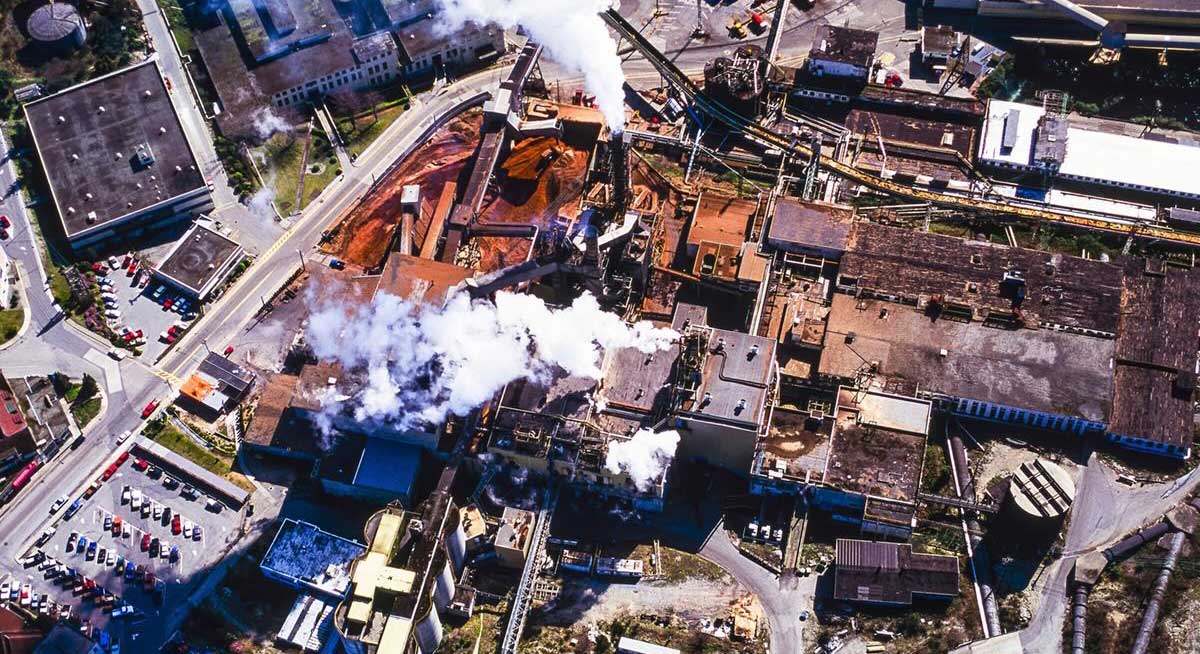
The “fireman” job in the bowels of the pulp mill is a far cry from that of the revered structural firefighters. Dante’s Inferno, I called it. In fact, it’s one of the worst jobs I have ever observed.
Don’t think typical hero. These are not the regularly lauded ones who rescue people out of burning buildings and use the jaws of life at motor vehicle accidents, a job I seriously considered for a while.
No, being a firefighter at a pulp mill consists of manually removing molten waste, known as klink, out of the bottom of a massive industrial furnace in the basement of a reeking pulp mill. What doesn’t burn is toxic and dangerous in the thermo-chemical process of pulping.
The chemical techniques are referred to as white and black liquor processes. Black liquor is a byproduct that emerges while “cooking” the fibre in the wood pulp in chemical compounds that break them down. The process produces a dark soup.
White liquor is used to remove lignin from wood, allowing it to be eventually turned into paper products. White liquor contains lime as part of the alkali solution that further breaks down the fibre. The lime also coats all the surfaces in the white liquor plant in white powder. The white liquor area is typically restricted because any water that comes into contact with the slaked lime can result in caustic lime that burns organic tissue due to chemical reactions.
I was grateful for viewing this area in winter because even sweat can cause these caustic burns on exposed skin. Wearing respirators is mandatory and I was grateful for mine along with my long-sleeved coveralls. The workers are necessarily vigilant because complacency kills in such an environment.
Removing klink from the massive furnace in the underbelly of the mill is akin to removing bone remnants from the cremation process — what is left at the end of it all and can’t be broken down.
In the case of pulp effluent and slag, it’s the stuff that can’t be flushed into the river. The firemen use a long-handled metal rake, open the furnace door and pull the waste product out before shovelling it into metal carts. I weigh the rake and the klink and calculate the internal load based on the weight and distance from the worker’s centre of gravity. It is very heavy. I measure the angle of the shoulder flexion, the wrist’s ulnar deviation and count the number of times a loaded shovel is lifted per minute.
The gusts of heat coming from the open furnace are enough to tire you out in minutes. The urge to remove one’s coveralls and shirt due to the heat rush is overwhelming, but sparks often fly and burn holes in materials so workers are prohibited from doing so.
The firemen go home exhausted after every shift. This is something out of a Dickens novel. My ancestors could have done these tasks in the bowels of the Industrial Revolution, hailing, as they did, from Manchester.
The firemen work four 12-hour shifts in a row, two days and two nights, then four days off, then start all over again, all year round. They do this for years before moving up into positions that are less physically demanding. Some never progress.
“What do you like about your job, Keith?” I can feel myself wince as I ask this of the tall, lanky, coverall-clad worker with the glowing red face that I am assigned to for the shift.
His soft-spoken answer is muffled by the yawping furnace and the clank of metal-on-metal: “Sorry, I can’t hear you.”
He signals to walk further away from the incinerator and I repeat myself.
“I like my co-workers and that it is an honest day’s work.”
“Easy for you to say, Padre,” his co-worker pipes in.
“What’s with your nickname?” I ask.
“Padre’s last shift. He’s leaving us to be a pastor. Gonna save us all from hell.” His co-worker winks at me.
“Minister. It’s called minister, not pastor, in the United Church,” says Padre.
“Wow, that is quite the change in jobs — hell to heaven,” I remark, wondering if faith got him through each shift.
His smile is wistful as he says, “Yeah, and less of a steady salary. I will be an itinerant minister, moving around whenever and wherever they need me.”
I imagined his years of shift work were paying penance for a perceived or actual sin. Perhaps it was just a way to pay for his master’s in divinity.
“Ah, a vocation instead of a job.”
He smiled at that. “Yeah, but this job paid well. I learned my body here. It has taught me how to survive in a toxic environment.”
“Have you done any other jobs in this mill?” I assumed not since this seemed the worst.
“Lots. I’ve been in the wood room turning wood into chips. I’ve been in the recovery boiler and the steam plant. I’ve tested pulp in the machine room. I’ve operated the crane, lifting wood from the boats.”
“Why are you here then? This is one of the most difficult environments I’ve ever been in. The heat exhaustion, the noise, the heavy physical demands.” I pondered if I should have said that out loud as a visitor there at the behest of the employer.
“They put me here because I have experience, so they didn’t need to train me and because another guy is injured.”
“Yeah, that’s why I’m here too, because of injuries on the job. How can this be changed to make it physically easier?” I find that workers often are experts on specific job improvements.
“Good to be asked. As a union steward, I’ve had some ideas about safety.”
“A union steward?”
“Yep.”
“For a padre, he’s good at it. Goes for the jugular in grievances. Wins most of the time,” says his co-worker.
“Oh yeah. Maybe you will win arguments with God too.” I laugh both nervous that this came out of my mouth on a job site visit and wondering what he might think.
“Ha, more like a conversation to convince members of community who don’t want to put social justice at the forefront, like I do.”
“Sounds like you will be doing good things in the world. Any other positions you’ve been in at the plant?”
“Yep, they also got me writing manuals for a while to shut me up.”
“I guess you were too good at grievances. Did manual writing go well?” By now I am not surprised at anything that comes out of his mouth, given the jobs he’s held and where he is going.
“I had to write task processes down for dozens of tasks. We got our ISO 9000 certification, so I guess it did, yeah.”
“Great, so you are qualified to tell me how this job can be changed then.”
“They could do job rotation between this and the other labourers, so workers aren’t stuck in this heat all shift,” he says.
“Why don’t they do this already? You must have heat exhaustion after each shift.”
“Yeah, we do, and we drink about eight litres of water per shift. They don’t rotate because once you climb the ladder up to the next job, you don’t want to look back at this one.”
“What are you looking forward to?”
“Not working shift work. Being less sore.”
“What about the actual job of minister?”
“I’m looking forward to learning more about community, relationships, love. All of us are loved by God.”
I try to conceal my wince. God, I think — who is God? My god is not your god, I am reasonably sure. Subsequently, I’ve come to hear the term “spiritual but not religious” thanks to Tapestry, the CBC’s spirituality program. Since then, I’ve heard about a United Church minister who did not believe in God and many who have difficulty with resurrection. I’ve learned that my own grandfather was a strict Baptist and a teetotaller. Fitting for a tea merchant.
“Thanks for your time and all the best in your new life.”
I pack up my force gauge and my weigh scale and walk to the nearest exit and into the air which is not exactly fresh, but a sweet relief after hell’s furnace. I have to stop myself from making a beeline to jump into the lake, the water from which is used to cool this pulp mill.
This job has since been engineered out, an outcome I was relieved to hear, despite the loss of well-paid union jobs. I was also delighted to know that this worker whose voice had so little influence would soon have the agency of the pulpit from which to be heard — from not being seen to standing in front of people and being highly regarded.
I watch people work. My ancestors would either roll over in their graves at that or tip their hats to me for escaping the repetitive, dirty and uncomfortable tasks they had to endure. My favourite part is getting to have conversations with engaged workers who surprise me with insights, dignifying their own lives through their reflections. For me, the objective facts are a kind of necessary sideshow. I always have to remind myself that these facts cause decision makers to consider changing the hazards in these jobs, that without my objective analysis, improvements to safety or reduced physical demands likely wouldn’t occur. Many corporations have learned to ignore anecdotes in favour of this objective analysis. But for me, it’s the stories that shine.
Excerpted from ‘Coming Home from the Candy Factory’ by Jane Byers. Copyright © 2025 Jane Byers. Published by Caitlin Press. Reproduced by arrangement with the publisher. All rights reserved. ![[Tyee]](/design-article.thetyee.ca/ui/img/yellowblob.png)
Read more: Books, Labour + Industry







Notice about commenting changes
The Tyee’s commenting system will be moving to a new platform on Nov. 12. If you’re already a Tyee commenter you must register with the new system on or after Nov. 12 with your preferred username.More information can be found here.