


 SHARE:
Rock and roll can never die, Neil Young once wrote.
Alas, the same is not true of rock’s mortal fans, so an aficionado known as Rockabilly Ed made provisions for the posthumous handling of his extensive record collection. Once he knew his time was limited, he told his family to have a trusted Nanaimo record dealer go through what amounted to a mountain of vinyl.
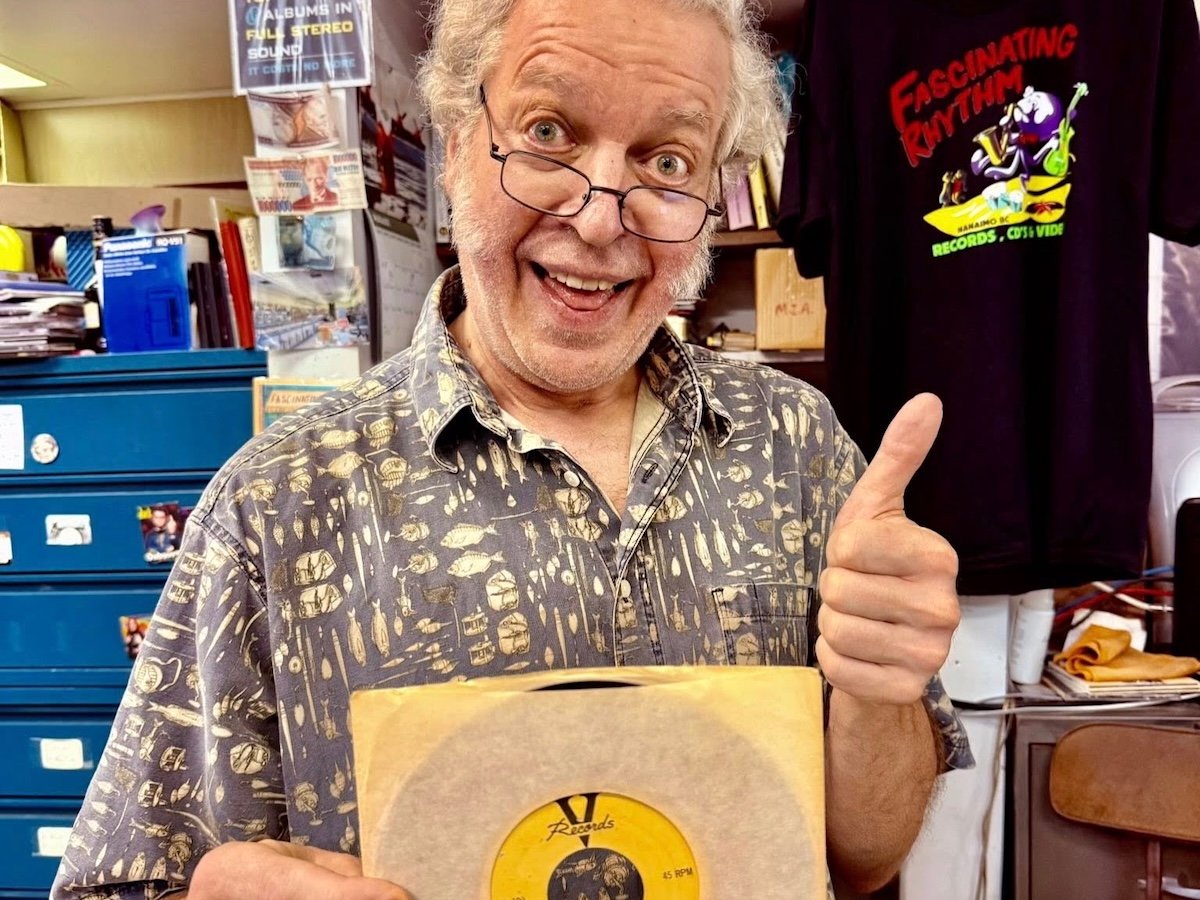
Earlier this year, Steve Lebitschnig of Nanaimo’s Fascinating Rhythm made several trips over the Malahat to weed through a collection in Victoria he estimates to be as many as 20,000 items. He was rifling through yet more boxes on his fourth visit to the collection when he paused.
In a plain brown sleeve, with a yellowish V Records label visible through the centre hole, he held in his hands a copy of one of the holy grails of Canadian record collecting.
“This is the one I’ve been looking for,” he thought to himself, “for 40 years.”
He was holding a seven-inch single by a band called the Squires.
The recording
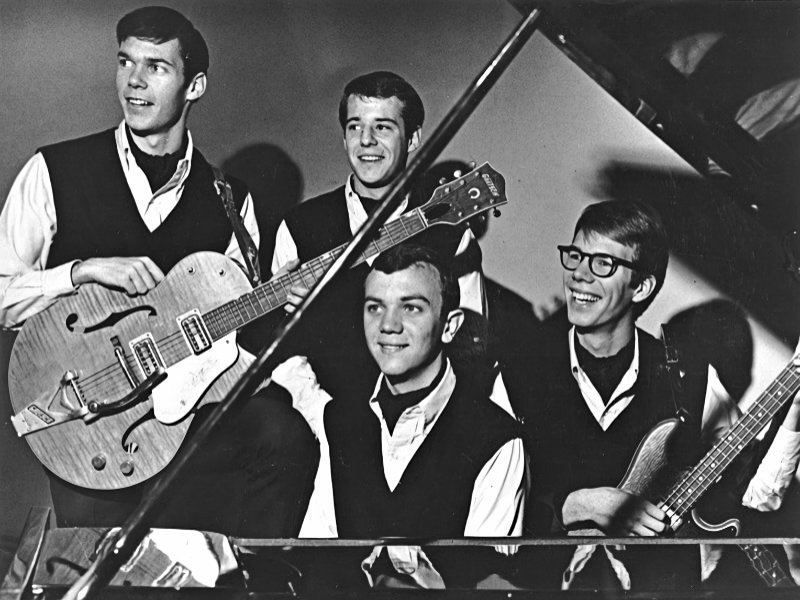
On a summer weekday in 1963, four Winnipeg teenagers brought their instruments to the recording studio of radio station CKRC. It was their third visit in recent days. They had auditioned and had a practice session. Now it was time to get down to business and record some instrumental tracks.
The quartet of high school students included guitarist Al Bates, drummer Ken Smyth, bass guitarist Ken Koblun and Neil Young, a lanky, guitar-playing 17-year-old with bad grades (a bright but indifferent student, he would be retaking Grade 10 in the fall) and a burning desire to make music.
The session had been arranged by DJ Bob Bradburn, who had seen the band at local dances. He would get producer credit for the recording, though most of that work was done by sound engineer Harry Taylor, in “Buddy Holly horn-rimmed glasses and a white shirt,” Young would later recall. The engineer took his assignment seriously, testing echoes and trying different microphones in the two-track studio.
The hot sound at the time included surf music and instrumentals by groups such as the Ventures and the Fireballs, who had a hit with “Bulldog,” which the Squires covered at dances. Koblun, a foster child who lived with a British family, got records from overseas. Young was especially influenced by Hank Marvin, the lead guitarist of Cliff Richard’s band the Shadows. (Young would later write an homage, “From Hank to Hendrix,” on 1992’s Harvest Moon.)
The band, the engineer and the DJ settled on two songs, both original instrumentals written by Young — “The Sultan” and “Image in Blue.”
Bradburn had two suggestions. He would bang a gong on the former, adding what they must have presumed to be the sound of Arabia, their only reference being Hollywood movies. And the title of the latter was to be changed to “Aurora,” a word Bradburn would speak at the end of the recording.
The studio was in the Winnipeg Free Press building. Young did not make the connection at the time, but his father had begun his own legendary writing career in the same building as a copy boy at about the same age.
The young Squires felt the recording session had been a success. They left the building “with our hearts soaring,” Young recalled.
The family
A marriage broke up. The father and his eldest son stayed in Ontario. The mother and her 14-year-old son Neil moved to her hometown of Winnipeg.
Scott Young was a noted sportswriter, broadcaster, newspaper columnist, short-story writer and genre novelist, notably including Scrubs on Skates, the first of a series of juvenile novels about boy hockey players. After the bitter breakup of his marriage, he soon remarried.
While he berated Neil from a distance for poor grades, the teen’s mother indulged his obsession with music.
Neil Young had been given a plastic ukulele as a boy, graduating to guitars in junior high. On his 17th birthday, his mother, Edna Blow (Rassy) Ragland Young, bought him a Gibson Les Paul Junior, his first electric guitar. By then, she was a celebrity of her own, appearing nationally on the 30-minute television quiz show Twenty Questions. Rassy was registered on the voters list as a “T.V. panellist.”
The Squires
The Squires were a hard-working band. On the Labour Day weekend following their recording session, they performed live during a radio broadcast atop a flatbed truck in the parking lot of a discount store across from Winnipeg’s Polo Park shopping centre. Bradburn served as MC for the three-hour, open-air dance party. Teenagers were offered free Coke, while 20 copies of Elvis Presley’s album It Happened at the World’s Fair were given as prizes. The drummer later told rock historian John Einarson that it got so cold after nightfall the bass player handled his instrument while wearing bulky gloves.
In the early 1960s, the city boasted as many as 200 bands.
“Like other big cities,” Einarson said, “Winnipeg had a big teenage population, and they wanted to hear their own music.”
The Squires, who formed in December 1962, played their first concert just two months later.
“They were paid $5,” Einarson said. “A buck for each of the guys and a buck for gas.”
When it comes to Neil Young’s musical apprenticeship, Einarson is regarded as the top expert not named Neil Young. He has interviewed all the many band members of the Squires and has chronicled their many shows, as well as writing more than a dozen books of rock history, including several about the Winnipeg scene and one about the Squires. He’s as detail oriented as a biblical scholar, only more so; those experts can’t track down and interview living witnesses.
The local guitarist most admired by others in Winnipeg was Lenny Breau, who started playing at eight and by 12, as Lone Pine Junior, was the star performer in his Acadian family’s country band before taking up jazz and rock. Both Young and Randy Bachman were admirers, the latter crediting Breau’s influence on the 1969 hit “Undun.”
Bachman played in what was regarded as the scene’s top band, Chad Allan and the Reflections (later the Expressions), who had a No. 1 hit in Canada (No. 22 in the United States) with a cover of “Shakin’ All Over.” As a publicity stunt, their record label released the anonymous single as being credited to “Guess Who?” — likely hoping kids might think it was from a British invasion band and not a group from the Canadian Prairies. With keyboardist and singer Burton Cummings of the Deverons joining the group, they eventually dropped the question mark.
Meanwhile, the Squires continued to work the city’s high school and community club circuit, now making $35 per gig while honing their skills and building an audience. The Squires once even provided the “special rock ’n’ roll intermission” on a wrestling card.
When Young returned to high school in September, a few weeks after the studio session, the student newspaper heralded the recording with a short article. “In our midst, we have a future recording star,” the Et Cetera newspaper reported. “This is an up-and-coming instrumental group with a bright future.”
The bouquet
Bachman remembers listening one morning with his mother to Red Alix’s Beefs and Bouquets show on radio station CJOB when a caller offered a bouquet to Neil Young and the Squires’ recent performance and predicted future stardom. Bachman was amazed until his mother said she recognized the voice. “That’s Rassy,” she said.
The label
The Squires’ record was released as a 45-rpm (revolutions per minute) single by V Records, a label launched the previous year by Alex Groshak, a sales representative for a record company.
Groshak noted the popularity of Ukrainian music at weddings and other social events, so he sought to fill a market need on the Prairies for recorded music, as the Cold War limited cultural exchanges between Ukrainian Canadians and the homeland.
Their bestselling act was Mickey (born Modest William Theodore Sklepowich) and Bunny (born Orissia Ewanchuk), a husband-and-wife team who sang such songs as “This Land Is Your Land” in English and Ukrainian. Their backup band, the D-Drifters-5, featuring the Roman (born Romanyshyn) brothers, also became big sellers, notably once releasing an album of Beatles covers recorded in Ukrainian. (One of the band members and his mother translated the lyrics.)
The label, which operated from a spare room in the family home, also released polkas.
Amid all the Ukrainian acts and music on the label’s roster, the Squires stand out as a rare rock ’n’ roll act. The company pressed about 300 copies of “The Sultan” with “Aurora” as the B-side. Bradburn slipped it into the rotation at CKRC, a station whose playlist was called the “Young at Heart Chart.” (Did the aspiring musician find encouragement in that title?)
“I will never forget the thrill of hearing it on the radio,” Young once wrote. “I was walking in the clouds!”
He took a box of records and drove west 200 kilometres to Brandon, leaving a copy with every radio station along the way. The band is also thought to have sold copies for 98 cents at shows.
“I’m sure Neil gave away more than they sold,” Einarson said.
The hearse
For two years, the Squires drove to gigs jammed into Young’s mother’s car, the same Ensign they had driven from Toronto to Winnipeg when the couple split.
In March 1965, an item appeared in the gossipy “Coffee Break” column carried by the Winnipeg Free Press. “Three young Winnipeg men have pooled resources and purchased a used hearse,” Gene Telpner wrote, before adding “it must have been quite a shock to their dates when they were first picked up in the vehicles.” Three days later, the columnist noted the vehicle had been purchased by Neil Young and Ken Koblun of the musical group the Squires.
The hearse was a custom-built 1948 Buick Roadmaster with a straight-eight engine and a three-speed manual transmission. Young dubbed it Mortimer Hearseburg. Not only did it have room enough to carry the group’s instruments, but the mechanism for loading and unloading caskets also made it easier to do so with instruments and equipment. As well, the vehicle had the bonus of having velvet curtains in blue and gold.
The Squires lineup changed frequently, as band members more interested in sports or scholarship were replaced. Young dropped out of high school, playing gigs in far-off Churchill, Manitoba, and holding weeklong residencies at the Flamingo Club and the Fourth Dimension coffee house in Fort William, Ontario, now part of Thunder Bay. On his 19th birthday, he wrote “Sugar Mountain” in his motel room. A low point might have been a gig at a pancake house.
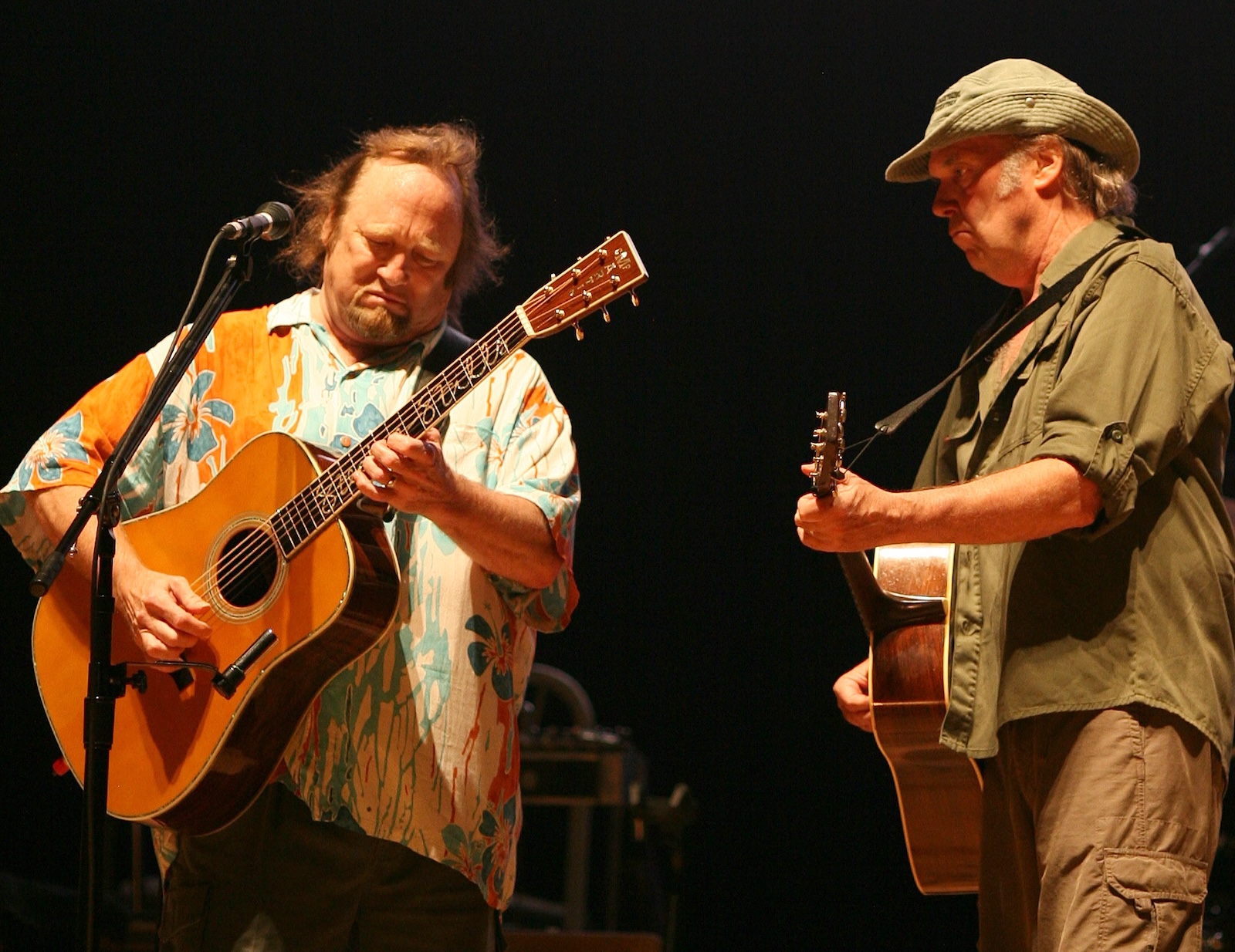
Young caught other acts on the circuit, including folky Don McLean and the bluesmen Sonny Terry and Brownie McGhee. In April 1965, the Squires opened at the 4D for the American folk band the Company. He and lead singer Stephen Stills became quick friends.
One day, the transmission failed, and the hearse stopped running outside Blind River, Ontario. Young stayed with the vehicle for two days, writing a mournful postcard to his mother asking her to cancel the insurance, as “Mort is dead.” He would later write a wistful ode to the hearse, “Long May You Run.”
The Hogtown interregnum
Mort was no more. The Squires were finished. Young telephoned his father.
“I am dirty and hungry,” Scott Young would quote him saying, “but if you can stake me the train fare I’d like to visit.”
Father met son at the train station.
“He’s six feet tall and weighs less than 140 — long legs in tight tan pants, a very dirty shirt under a good sweater, long hair hanging down at the back and brushed low on his forehead at the front, a big smile,” the father wrote. “He was carrying his toothbrush and toothpaste in a blue paper bag. He hadn’t shaved for several days.”
The musician checked out the Yorkville coffee house scene and liked it. He decided to make a go of it as a solo folk singer, playing the Second Stage in North Bay and other coffee houses. He got an unkind review, accusing him of being clichéd.
Back in Toronto, he hung out in Yorkville, spending time in the Cellar, a basement jazz and chess club on Avenue Road.
One of the people helping to run the club was Bev Davies, who would later become a well-known Vancouver concert photographer. She remembers him wearing a white shirt with homemade pink polka dots. They hung out at Webster, a 24-hour hamburger joint, where Young spent winter days and evenings shoving coins into the tabletop jukebox to hear “California Dreamin’.”
“He said he wanted to go to California to become a rock star,” she recalled.
His fortunes seemed to improve when bassist Bruce Palmer spotted Young walking down the street carrying a guitar case with an amp on his shoulder. He invited Young to join the Mynah Birds, a rhythm-and-blues outfit fronted by a dynamic lead singer. The group, originally formed as a promotional gimmick by the owner of a club of the same name, got a contract with Motown and had a recording session in Detroit with Smokey Robinson supervising, but it all fell apart in a dispute.
Their manager had used advance money to support a growing heroin habit. When the singer complained, he was ratted out as being absent without leave from the U.S. Navy Reserve. He did time, though Rick James would later have great success as a recording artist (“Super Freak”) and record producer.
With the Mynah Birds in abeyance, Young and Palmer cooked up a scheme at the Cellar, according to Einarson’s 1993 biography Neil Young: Don’t Be Denied: The Canadian Years.
“Let’s get the hell out of here,” Young said.
“What do you mean?” Palmer replied.
“Sell everything we can and get a car and go to L.A.”
They sold the band’s instruments even though they were owned by John Craig Eaton II, the department store scion who had sponsored the band.
Davies remembers Young heading off to buy a hearse. He returned with a 1953 Pontiac hearse, which he called Mort II. She greeted him excitedly, ready for the adventure of a road trip to California.
“Neil took me to the back door of the club and told me I couldn’t go because I didn’t have any money,” she recalled. The thought of needing money hadn’t occurred to her. (Hey, it was the ’60s.) Lesson 1. Lesson 2: “Neil doesn’t handle crying young women very well.”
Young, Palmer and four others headed off in the hearse. Among the baggage stuffed in the back was Davies’ sleeping bag, which had a cowboy-themed lining.
The legend
The cross-continental trek did not go well. The passengers squabbled, and at least three of them did not make it as far as California.
Once in Los Angeles, Young and Palmer spent the first week of April 1966 looking for Stills. They survived by charging 50 cents for rides in the hearse from club to club.
They decided to abandon the search and head north to check out the scene in San Francisco, only to get stuck in gridlocked traffic along Sunset Boulevard. A white van going in the opposite direction spotted the hearse with an Ontario licence plate. Stephen Stills was convinced it had to be the friend he had met in northern Ontario. The van swung around and waved the hearse over. Young and Stills embraced. Young felt like the cacophony of honking horns was a celebration of their reunion.
Buffalo Springfield
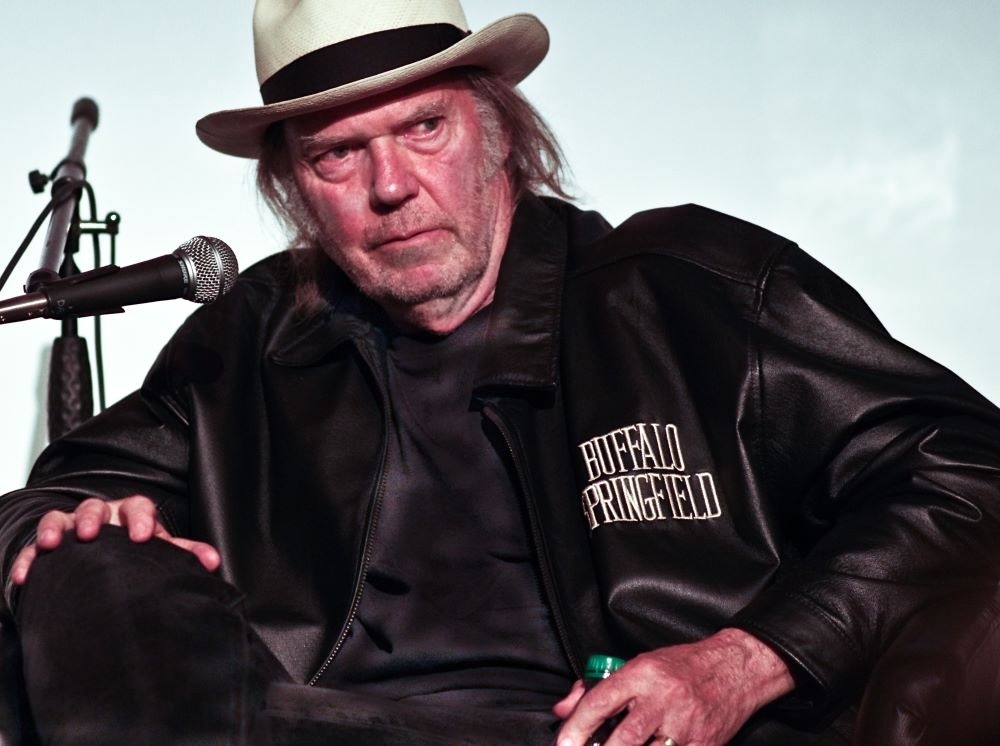
Young, Palmer, Stills, guitarist Richie Furay and Canadian drummer Dewey Martin formed a band. Roadwork was being done near their manager’s house, and they noted the nameplate on a steamroller. They called themselves Buffalo Springfield.
Days after their first show, they were opening for the Byrds. In July, they opened for the Rolling Stones at the Hollywood Bowl. The following month, the band released their debut single, “Nowadays Clancy Can’t Even Sing,” a song written by Young that became a regional hit. It was his first commercial release since the Squires single nearly three years earlier.
On Nov. 12, Young’s 21st birthday, youths protesting a nightly curfew battled with helmeted police outside the Pandora’s Box club on Sunset Boulevard.
In response to the riot, Stills wrote “For What It’s Worth (Stop, Hey What’s That Sound).” The band recorded it in December, and it climbed to No. 7 on the U.S. Hot 100 charts, earning the band several performances on national television. The song was such a smash it was added to second pressings of the band’s debut album. Its moody, haunting sound remains an instant throwback to ’60s days of protest.
In less than two years, Young had gone from playing a pancake house in exchange for meals on his way to becoming one of the best-known artists of his time.
Mythmaking
As Beatles fans have the Cavern Club and Liverpool haunts, Young’s success sparked interest in the Winnipeg scene.
Some of this was fuelled by his contemporaries.
Randy Bachman’s “Prairie Town” includes the lyrics:
On the other side of Winnipeg,
Neil and the Squires played the Zone.
But then he went to play
For a while in Thunder Bay.
He never looked back
And he’s never coming home.
The Twilight Zone was a restaurant by day and an all-ages nightclub with live bands in the evening in St. Vital, then a separate city, now a Winnipeg neighbourhood.
In 1994, the Vancouver band the Evaporators released “Winnipeg ’64,” a raucous ode to Young’s early days. Sample lyric from the surf-punk band led by Nardwuar the Human Serviette:
There once was a man, Neil, he used to be a Squire,
“Aurora” backed with “The Sultan” was such a great song
Vancouver novelist Kevin Chong embarked on a cross-country pilgrimage to visit all sites Neil Young, including the garage that served as the final resting spot for Mort, a journey engagingly retold in 2005’s Neil Young Nation.
Even as fans sought to revisit and recreate these musical sites with a passion and dedication usually reserved for religion, all but the wealthiest and most fortunate had to do without a copy of the original Squires single.
When Young himself was compiling his massive The Archives, Vol. 1: 1963-1972, released in 2009, he had to ask Alex Groshak’s son for use of master tapes. After giving away his record to all those radio stations so long ago, Young apparently did not have a copy himself.
The collectors
A copy of V-109 is listed on eBay by Ranch Records of Salem, Oregon, for US$2,900. It is described as being in mint condition.
It is rare enough to be worth whatever a collector is willing to pay. When a Winnipeg fan heard a copy had appeared in Nanaimo, he offered C$2,000 without hearing or seeing the record.
“They lose their minds,” said Einarson, the rock historian, “because it was Neil Young’s first recording. He obviously had a gift for melody.”
The twangy instrumentals of “The Sultan” and “Aurora” are clearly influenced by the Shadows.
“It’s distinctive from his canon of work,” Einarson acknowledges, though he thinks the songs more a reflection of their time than capturing any precocious genius on Young’s part.
Some years ago, Marc Coulavin was looking through 45s at Calgary’s Recordland. He asked proprietor Armand Cohen the price.
“Fifty cents for the ones with sleeves, 25 cents for the ones without sleeves,” he said.
Coulavin bought a bunch. Today, he can’t remember which ones.
“The Squires was one of the ones without a sleeve,” he wrote in an email. “I still have it.”
He is one of the lucky ones. Fewer than two dozen are known to exist.
That includes the latest find.
‘Big Crime’
Neil Young and the Chrome Hearts are playing Deer Lake Park in Burnaby on Saturday and Monday as part of his Love Earth Tour. Both shows are sold out.
Last week, Young and his band debuted a new song, “Big Crime,” which includes the refrain “There’s big crime in D.C. at the White House.” It is an angry polemic in the style of Crosby, Stills, Nash & Young’s “Ohio” (1970), in response to the killing of four students by national guardsmen at Kent State, and “Rockin’ in the Free World” (1989).
Young has been making music for more than six decades. He turns 80 in two months. Long may he run. ![[Tyee]](/design-article.thetyee.ca/ui/img/yellowblob.png)
Read more: Music








Tyee Commenting Guidelines
Please note that email notifications for replies are not currently working due to a software issue which may be resolved in a future update.
Comments that violate guidelines risk being deleted, and violations may result in a temporary or permanent user ban. Maintain the spirit of good conversation to stay in the discussion and be patient with moderators. Comments are reviewed regularly but not in real time.
Do:
Do not: