


 SHARE:
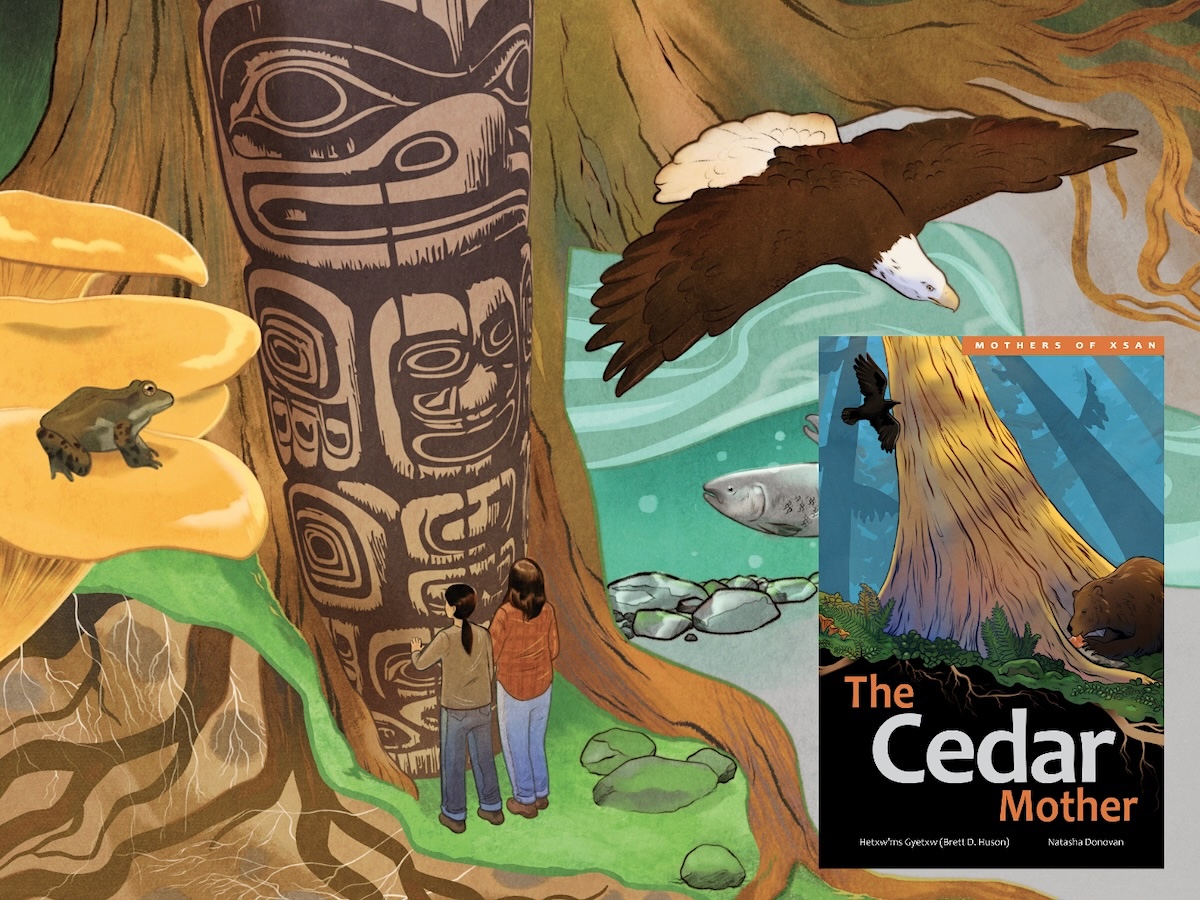
The Cedar Mother — the last instalment in the Mothers of Xsan series by Gitxsan author Hetxw'ms Gyetxw, also known as Brett D. Huson — is a beautifully illustrated non-fiction book that invites young readers aged 9 to 12 to explore the hidden mysteries of the cedar tree life cycle, offering lessons in interconnectedness and in wisdom passed down through generations.
Read on to hear the author reflect back on his celebrated children’s series.
What inspired the Mothers of Xsan series?
Brett Huson: When I was a kid, I never saw myself as a Gitxsan person reflected out in the world in any positive light. But I grew up in a Nation battling to protect our land through roadblocks, and I saw our people being pushed into Canada’s court systems through Delgamuukw. I spent a lot of my youth out on the land in those roadblocks, and I learned a lot, just like any other Gitxsan does when we are with our people on the land. I saw experts, practitioners and researchers at work, each of them carrying specific bits of knowledge.
I naturally gravitated toward ecology and tried to learn as much as I could about the natural cycles that were part of our governance, legal systems and structures. The Gitxsan formulated laws and histories that are directly tied to all the life cycles within our territories. To do so, we had to have a deep understanding of animal behaviour, the interconnectedness of species and how each contributed to our world.
When I was a child, I listened to our Elders talk about how the salmon fed the land. They explained that we held ceremonies for the returning salmon runs because we understood that respecting them and recognizing our dependence on them as law was integral to protecting our future. When I was in high school, I read The Sacred Balance by David Suzuki. It was the first time I read a book that used storytelling from the perspective of the species while also connecting the story to scientific understanding. I later discovered that David wrote this book because he was inspired by a Haida leader named Guujaaw.
That book gave me a model I could use to start telling our own stories from the perspective of keystone species within our territories. I wanted to share our knowledge, but more importantly, I wanted young people across the country to understand something that they don’t learn in school, something many Gitxsan learn at a very young age: we are nothing without the land.
The series, which has included frog, bee, raven, wolf, eagle, grizzly and salmon mothers, is coming to a close with the cedar, which seems to be a centrepiece of the ecosystem the series promotes. What other aspects of Mothers of Xsan do you hope people will notice?
There is no real centrepiece in our Nation. Our life cycles, governance systems, stories and laws are all determined by the bigger picture. I share the names of the moons in each book, as we follow a lunar calendar, but I hope this is more of a marker for our time. Our Nation will have to sit down together sooner or later to rename some of these moons because of our rapidly changing climate. Their names are more reflective of the cycles that existed when I was a kid. My hope is that this series inspires young people to learn about the land where they live, discover how it connects to their survival and find out how they can have a more positive impact on that land.
Let’s talk about the production of this series. What were some of the challenges or unexpected dialogues that came out of its creation? Do you have a favourite book in the collection?
I think my favourite book is still the first one, The Sockeye Mother. Not because its content is better than any of the others, but because it marks the moment when I began this journey of sharing. It started a discussion among many teachers, parents and other educators about how much we should share with young people.
During a Q&A session, a teacher asked me whether or not kids should read about death, as this is reflected in every book as the featured being’s life cycle comes to an end. I told her that death was a natural part of the Gitxsan way of being: we used to know it wasn’t an end, and that we were just returning to the land where we came from. It wasn’t until colonization and religion began to teach us to fear death that many of our people became removed from this concept. Her response was that she felt this concept might be too hard for young people to understand. I told her that I respected that, but regardless of how people feel, death still exists, and we can’t pretend that our human systems live outside of that while nature continues to happen all around us. No matter how she feels or what she believes, many kids will experience loss in their lives, and they also take life in the food they consume. Having a better understanding of that leads to a greater respect for all life and the lives we all depend on. She wasn’t happy with that answer, because she felt I was attacking her religion. After that session, she came over to let me know how she felt, and I told her that I hadn’t said her religion was bad; I was just sharing the truth as it relates to my people. She sat with that for a moment, and later, as I signed copies of my book, she came back and apologized.
It is dialogue like this that inspires me to continue my work. We have to know that, because of human nature, there is a pluriverse of perspectives out in the world, and when we don’t try to control everyone with a single way of knowing, we can begin to truly see humanity’s potential.
Those that live in this region seem to inherently understand the importance of the cedar, even if they are not as aware of what Indigenous knowledge has to share about it. What makes the cedar mother especially important, in your eyes?
As a Gitxsan, cedar represents truth. It also shows how caring for one another and all life can lead to longevity and wellness. Because cedar naturally resists rot, especially when cared for, it can last a very long time, even after harvesting. This trait suits the hostile environments of the Pacific Northwest well. We make clothing, tools, homes, storage and even ceremonial instruments, and medicine to treat ailments. All the while, we knew the truth: that it wouldn’t last forever and that it eventually returns to the land.
There is a misconception among some anthropologists that the Indigenous people of the Pacific used cedar only because it was easy to work with and readily available. While this is partially true, it was also because we saw cedar as a ceremonial gift. We could carve stone, and we had metals, but they weren’t always used because the toll they take on the ecosystems we depend on far outweighs the benefits. This is reflected in many of our stories, which also carry laws and teachings about overusing resources and the negative impact this has on our nations. We have to try to protect what cedar we have left.
How has writing this series influenced your future work? What have been some of the responses you have received over the years that impacted you personally?
This series has always been a part of a larger vision. The Mothers of Xsan children’s book series was just the first step, and it will become part of something greater. I’m now moving on to creating books for adult readers and researchers, and am also considering making some films (since I’ve spent 16 years working in film and television).
I have also started an Indigenous research institute called Aluu’taa (which means to deeply know or understand something). My focus is on evolving our ways of knowing into an institute of learning and sharing. We need to expand on who is creating the narratives in the world. I constantly hear the argument that only the best information and data make it to print and out into the world, but it is still humans deciding how to read that data, and what data is highlighted. And it is still a human who is deciding what they’ll allow themselves to see. I’m just trying to fight for our piece of the pie, as the western idiom goes.
Learn more about ‘The Cedar Mother’ here. ![[Tyee]](/design-article.thetyee.ca/ui/img/yellowblob.png)
Read more: Indigenous, Books
This article is part of a Tyee Presents initiative. Tyee Presents is the special sponsored content section within The Tyee where we highlight contests, events and other initiatives that are put on either by us or by our select partners. The Tyee does not and cannot vouch for or endorse products advertised on The Tyee. We choose our partners carefully and consciously, to fit with The Tyee’s reputation as B.C.’s Home for News, Culture and Solutions. Learn more about Tyee Presents.



Tyee Commenting Guidelines
Please note that email notifications for replies are not currently working due to a software issue which may be resolved in a future update.
Comments that violate guidelines risk being deleted, and violations may result in a temporary or permanent user ban. Maintain the spirit of good conversation to stay in the discussion and be patient with moderators. Comments are reviewed regularly but not in real time.
Do:
Do not: