 SHARE:

Harold Joe crosses the Cowichan River on a bridge used seasonally by Quw’utsun fishermen to reach their salmon spear fishery.
He unlocks a steel gate, drives his pickup truck a few hundred metres upstream along a dike, then parks and removes his spear from the box of the truck.
Joe prefers to fish alone, from the riverbank.
Individuals fishing on the bridge — one of two on Tzouhalem Road — sometimes lack experience in the old ways.
“There’s a process,” Joe says. “You have to wait and give the other spear fishermen a chance. If there’s eight spears and 10 fish, you each pick one. ‘Ready, now!’ And you all throw.”
Newer fishers, he says, can be too anxious.
Salmon migrating upstream to spawn also present a bigger target when viewed from the side rather than from above on the bridge, Joe says.
We walk a short distance in the crisp morning air, watching the autumn leaves drift down and listening to the melting frost drip off a forest of cottonwoods.
Joe likes to fish early in the morning and shortly before dark.
Fish are more likely to move when the tide is up; they enter the river downstream, from Cowichan Bay.
When it’s sunny, the fish tend to “sit tight” in pools. Cloudy and rainy days are best.
Soon, Joe is standing atop a three-metre-high bank on the south arm of the river, mist rising from the water. He readies his spear for action.
“I’m going to get you to stand on my right,” he says. “I throw left-handed.”
The Quw’utsun spear begins with a wooden shaft — a round, three-metre Douglas-fir pole. Today, Joe says, he buys these from Home Depot.
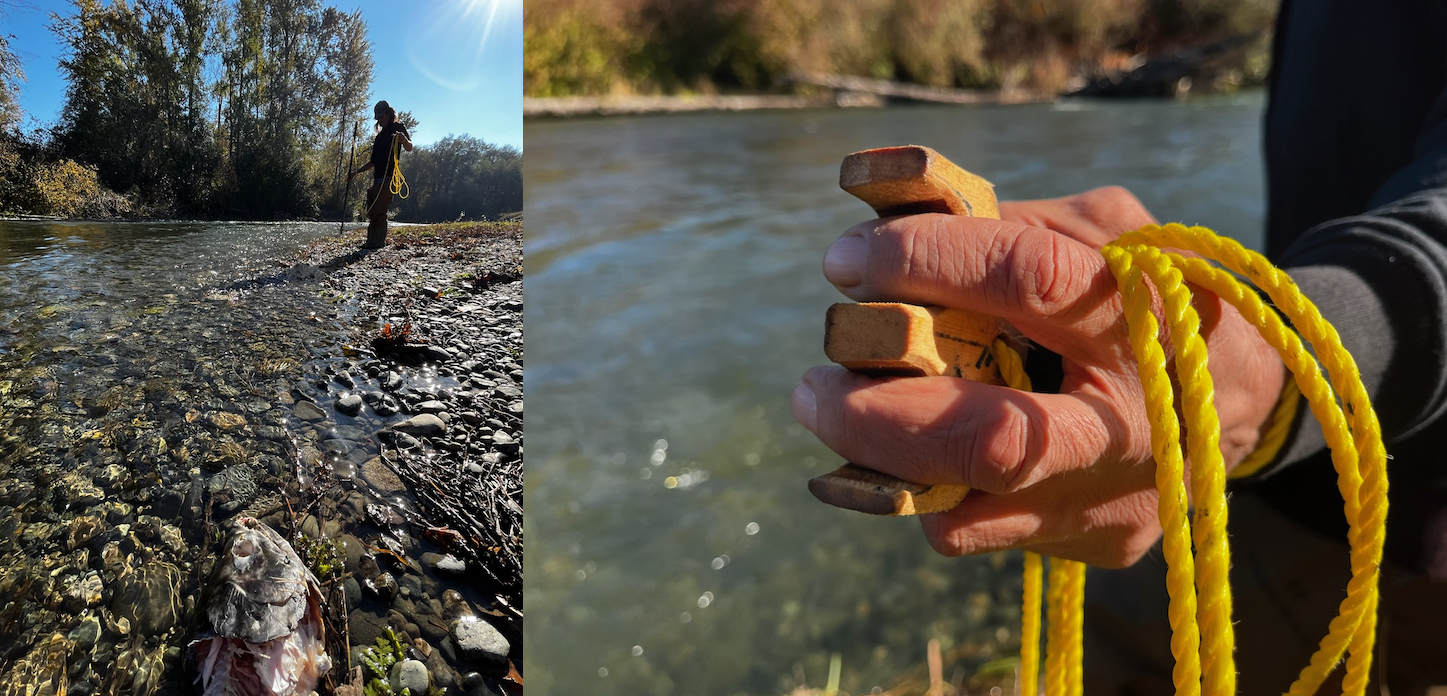
There is a nine-metre length of nylon rope attached to the top of the shaft, connecting it with Joe’s left wrist, so he can retrieve the spear from the river after a throw.
A wooden handle at the top of the shaft offers a good grip.
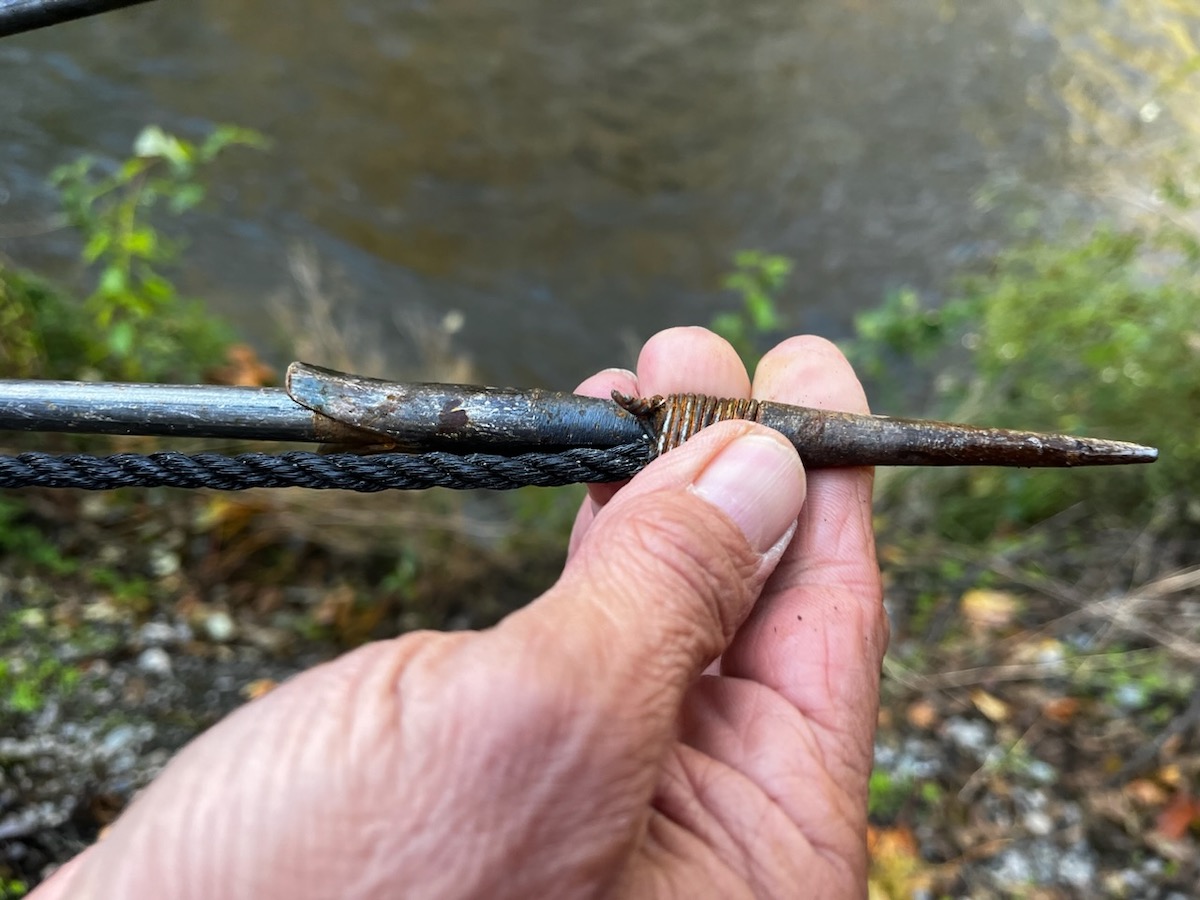
The bottom of the spear consists of two tempered-steel points, slightly flared, and tightly bound to the shaft with strong twine.
The tips of the points come off when the spear hits a salmon, sinking into the flesh to help prevent escape. But they remain attached to the spear with rebar wire, more nylon rope and flexible rubber from a bicycle inner tube.
“You could pull in a car with that thing,” he says.
Harbour seals and sea lions chasing fish upriver take their chances running the gauntlet of spear fishers.
“It is unique to us,” Joe says of the spear fishery. “We’ve been using this practice for thousands of years.”
In past decades, the points of the spear were fashioned from the sharp tines of elk antlers. “When colonization came, we turned everything bone into metal — blades, knives, axes,” Joe says.
The biggest salmon he’s caught in the river was a 34-pound Chinook. “I speared it right in the back. It pulled me in, pulled me down and shot up, and I finally got it in,” Joe says.
“I started spearing when I was nine. I’m 60 now. So pretty much all my life. Older cousins would train us by bouncing a bike tire by us — really fast — and we had to throw sticks to get it through the tire. If we got the tire, we got the fish.”
Concerned that so much history was being lost through the passing of Elders, Joe attended film school at Capilano College in North Vancouver in 2000 to “start preserving history, stories and legends,” and generally portraying his people's way of life.
Joe is now a producer with Orca Cove Media, which released the 2021 documentary Tzouhalem, about the controversial late Quw’utsun Chief.
“It’s not easy,” he says of the film business. “Hard to get funding. Brutal.”
Joe has three grown children — a daughter, and two sons who also enjoy fishing.
While men do the vast majority of spearfishing, that wasn’t always the case, Joe says.
“Women used to do it back in the day, in the 1800s. People used to talk about the ladies going out and harvesting because some of the men would be up in the mountains hunting elk or deer. The women would be down here. They learned how to harvest salmon. Nowadays you don’t really see it anymore. The odd young lady’s out there. That’s great,” he says.
For more than two hours, Joe roams one stretch of riverbank after another like a frustrated grizzly bear, plowing through the water in hip waders, spear poised for release.
But he doesn’t spot many fish. “It’s pretty slow because 90 per cent of the fish are up,” he says.
“If I had to survive this way, I’d be dead by now.”
Soon it’s time to pack up and drive to the main north arm of the Cowichan River.
A mature bald eagle sits on a branch watching our movements, while a red-tailed hawk carves lazy circles in a powder-blue sky. The bony remains of a salmon on the shoreline hint at potential.
“Do you have polarized glasses?” he asks. “It helps you see them.”
As the sun rises farther above the broad arched back of Mount Tzouhalem, it casts Joe’s shadow farther out into the river, making the salmon warier.
The vast majority of the Chinook have already migrated upstream. Fisheries and Oceans Canada reports that as of Oct. 18, a total of 12,642 Chinook had migrated past the counting fence on the Cowichan River, 150 metres below the Allenby Road bridge.
Coho and chum are still moving through the lower river. Coho is the preferred fish, although chum is good for smoking.
Coho also move upriver more quickly. “Look how fast the water is moving. And they’re moving fast. You need perfect timing,” Joe says.
Salmon are ideally speared about three to four metres from shore. The degree of difficulty only increases beyond that point.
Joe repeatedly throws the spear out into midstream, but the fish prove elusive. He hits a coho, but only one of the tips enters the fish. It gets away.
He takes off his jacket and sweater. “We’re getting serious now, Larry.”
Joe spots the flash of a spinner lure attached to a chum’s back, evidence it’s already eluded one fisherman — soon to be two.
The sun shimmering off the river also makes spotting the salmon more difficult.
“They’re getting smart,” Joe says of the fish, who have started to move to the other side of the river to avoid his spear.
After an hour, he says it’s time to “cheat.”
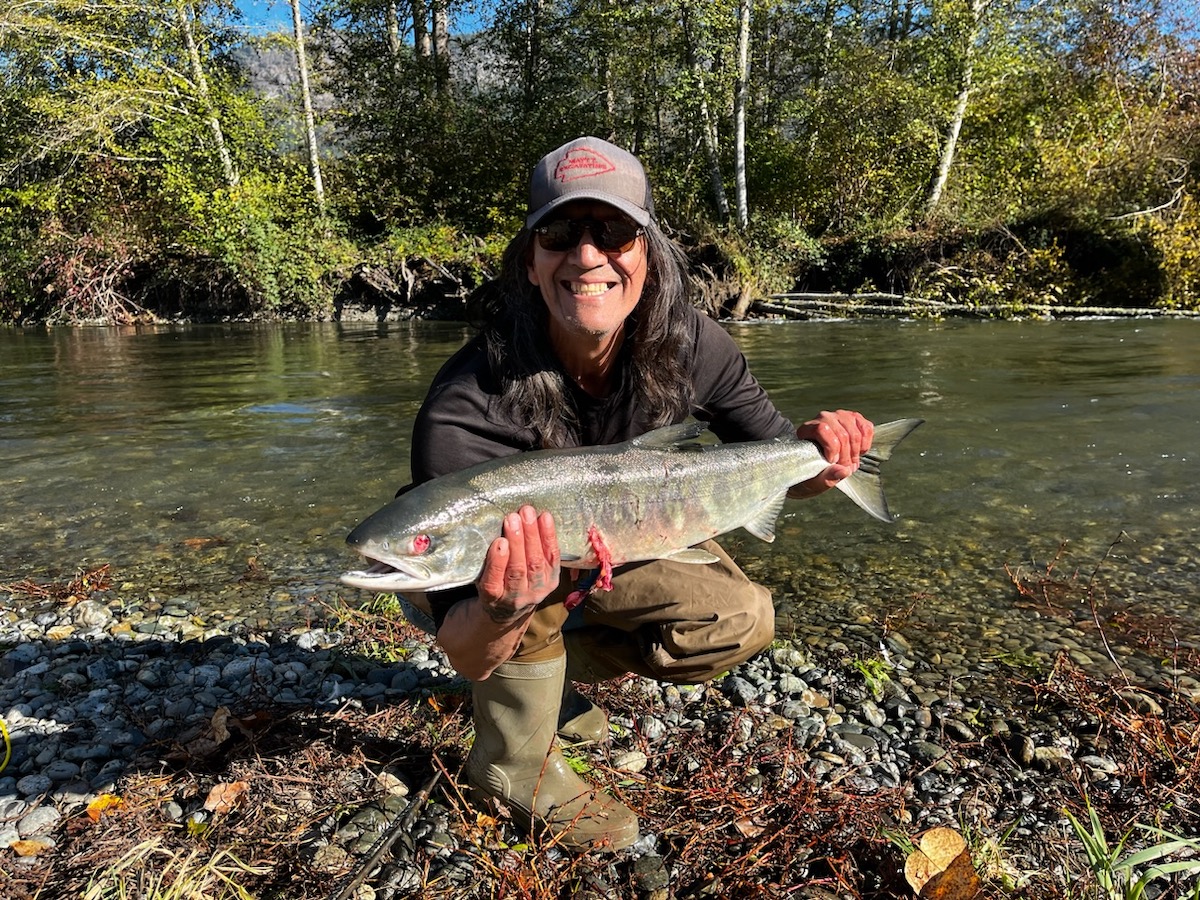
Joe backs his pickup down to the water’s edge, standing on the lowered tailgate to gain a better view of the fish. Several more throws and — finally — success. The points of his spear penetrate the belly of a chum and Joe hauls it ashore. “Done,” he says.
It’s unknown exactly how many fish are taken in the spear fishery on the river.
“One guy can maybe get five or six in a whole day,” Joe says.
“When I was younger, I saw some of the older relatives get 10 to 20 in a day. Chum were by the hundreds, thousands through here. The banks would be thick with dead, rotting carcasses. You don’t see that anymore. Never.”
Happy holidays, readers. Our comment threads will be closed until Jan. 2 to give our moderators a much-deserved break. See you in 2024!
![[Tyee]](/design-article.thetyee.ca/ui/img/yellowblob.png)
Read more: Indigenous, Food