

 SHARE:
In the late 1980s, the Western Canada Wilderness Committee operated out of a small, no-frills office with an entrance off an alley just west of Granville Street between Sixth and Seventh avenues.
The office also happened to be just steps from the Vancouver Press Club, a favoured watering hole and haunt of reporters and editors at the Vancouver Sun and Province newspapers working in the imposing Pacific Press building just steps away on Granville Street’s east side.
Paul George, co-founder of the Western Canada Wilderness Committee, could often be spotted at the club — his barrelhouse laugh told you he was there — where he regaled reporters with stories about the environmental battles brewing in old-growth forests on Vancouver Island, Haida Gwaii, the remote mainland coast and interior valleys like the Stein.
Back in those days, when cellphones weighed pounds and fax machines were as “real time” as it got, spreading the word about what made old-growth forests special had its challenges.
Courting relationships with individual reporters was something George did and did well. But it was his remarkable good fortune, and that of the then-small organization he headed, to hit on popularizing the fight to protect old growth with a poster.
The poster depicted a young woman gazing up the towering trunk of a massive, moss-covered Sitka spruce tree that shot from the fern-laden ground of the Carmanah Valley high into the sky. The poster’s tag line — “Big Trees Not Big Stumps” — was a model of economy. Five words that were like five wasp stings to the hide of MacMillan Bloedel, the company that wanted to cut that tree and every other one like it down.
Today we’d say it went viral. But not in the sense of a social media post that explodes with millions of views today only to be forgotten tomorrow. No, “Big Trees Not Big Stumps” would prove to have the lasting power of long COVID.
Joe Foy, who would later helm the same organization, says people often told him they saw the poster as a kid, and it compelled them to go to the Carmanah and fight for the trees as adults.
“That Carmanah poster rocketed the campaign across the country. It helped to make it a national campaign,” Foy says.
“In the early days, MacMillan Bloedel tried to take us to court for building trails into the valley, and they lost. That loss and that image going everywhere, I think nationally it stoked a sense of pride and fear: pride that we had such beautiful places in the country and fear that we were losing them, and sometimes the best of the last of them.”
The Walbran’s relationship to the Carmanah
The poster came to mind when I learned in late August that a small group of protesters had planted themselves on a logging road leading into stands of old-growth forest slated for logging in the upper Walbran Valley, which borders the Carmanah on Vancouver Island’s southwest coast.
Much has changed since the late 1980s and early 1990s. Coastal old-growth forest has been protected in places such as Clayoquot Sound and Haida Gwaii and on the central and north mainland coasts.
But, elsewhere, the last vestiges of irreplaceable old growth continue to be logged, a fact dramatically underscored in 2021 when a logging road blockade at Fairy Creek on Vancouver Island broke the record set at Clayoquot Sound for the most people arrested in a single sustained act of civil disobedience in Canada.
Two other notable things also changed in the ensuing decades.
First, a dramatic decline in logging and milling jobs — thanks in part to new parks, but mostly to the unrelenting logging of old-growth forests and ongoing raw log exports that translated into thousands of lost domestic milling jobs.
And second, mounting victories in the courts for First Nations that forced the logging industry and the provincial government into new relationships that elevated First Nations’ role both in forest conservation and in logging.
By the time the Carmanah was on the chopping block in the late 1980s, First Nations-led initiatives had already resulted in or were on track for conservation gains in places such as Haida Gwaii, Meares Island and the Stein Valley.
But in many cases, First Nations still remained on the periphery thanks to a long history of one provincial government after another granting logging companies exclusive rights — through tree farm licences, or TFLs, and other forest tenures — to cut down tracts of forest over very large areas with little or no regard for the First Nations who had occupied those lands for millennia.
The Carmanah formed part of MacMillan Bloedel’s Tree Farm Licence 44, which was one of the company’s exclusive fibre baskets for years.
Until, that is, George and a growing number of other environmental activists took up the fight to protect the valley. That fight reached a critical milestone in 1990, when the provincial government, under unceasing pressure, agreed to protect the lower half of the valley while telling MacMillan Bloedel that it could log the upper half.
Sawing the valley and its watershed in half made no ecological sense, but the government and the industry it regulated hoped their story of compromise — protecting iconic big trees on the one hand and a “working forest” on the other — would carry the day.
They were wrong. As the environmental campaign gained steam, government and industry were forced to confront the inconvenient truth that there were equally big trees in an equally threatened watershed just next door to Carmanah in the Walbran Valley.

In 1995, the government eventually acquiesced and announced a new protected area — Carmanah Walbran Provincial Park. All of the Carmanah Valley was now a new park. But once again the government went for a saw-off in the neighbouring Walbran, placing the lower Walbran inside the park and the upper Walbran outside its boundary and therefore open to logging.
MacMillan Bloedel, just like many a forested old-growth valley, is no more and has not been for some time. TFL 44 passed first to Weyerhaeuser and then to Western Forest Products, which was joined in holding and managing the licence a few years ago by Huu-ay-aht First Nations, a 35 per cent partner.
A new fight in the Walbran
That joint venture between Western Forest Products and Huu-ay-aht First Nations, operating under the name Tsawak-Qin Forestry Inc., is now squarely in the crosshairs, as protesters aim to prevent the logging of a number of blocks of old-growth forest in the upper Walbran.
Many of those protesters were also there for the historic fight at Fairy Creek.
But unlike that fight, which was against one corporate logging and milling entity — Teal-Jones — the current blockade pits protesters in opposition to a First Nation that is firmly embedded with a corporate partner in the disputed logging venture.
The blockade was first reported in the online publication Ricochet on Aug. 25. The article’s lead photograph showed a small group of people occupying a logging road leading into the upper Walbran.
A large wood sculpture of a cougar had been placed in the middle of the road; protesters stood or sat around it, their eyes turned toward Bill Jones, a member of the Pacheedaht First Nation who was also an inspiration to those involved at the protracted and historic Fairy Creek blockades.

In the early stages of the Tsawak-Qin Forestry partnership, Robert Dennis Sr., then the Huu-ay-aht’s chief councillor, said it would allow the nation to advance its forestry principles and to provide “real benefits” for Huu-ay-aht citizens, including economic and forestry management benefits. Forestry management, Dennis said, would align with the nation’s sacred principles.
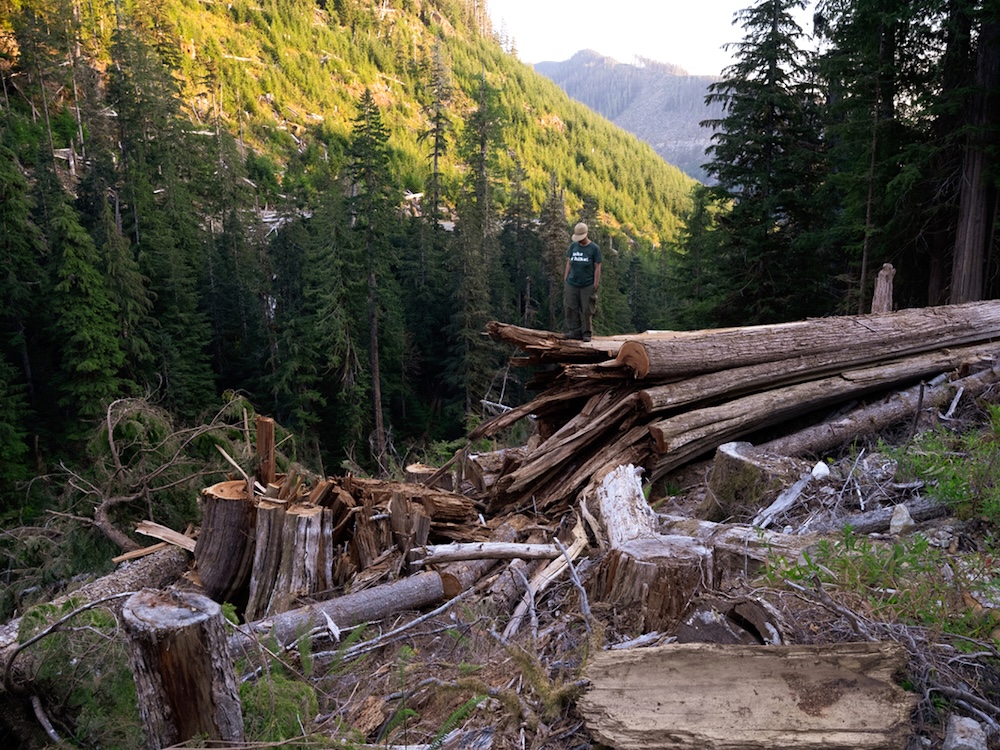
On the ground, however, it’s unclear how logging in TFL 44 has differed from industrial logging elsewhere in coastal old-growth forests. As crews come and go, every tree in the cutblock comes down in one clearcut after another. It’s been this way in coastal B.C. for over 150 years.
In 2024, according to a publicly available and searchable database maintained by the provincial Ministry of Forests, the Western/Huu-ay-aht business partnership logged nearly 200,000 cubic metres of trees in TFL 44. Slightly more than one in five of those trees were red cedar and cypress, two tree species of deep cultural significance to all coastal First Nations people because of the wide array of uses that their bark and wood were put to.
The same data shows that in the course of doing that logging, the equivalent of one in every five trees logged by Tsawak-Qin ended up as “avoidable waste” in the form of trees cut down but considered not desirable enough to haul away for processing at a mill.
Other commonly logged trees were Douglas fir, one of the most commercially prized of all trees logged on southern Vancouver Island, and hemlock. Small amounts of white pine were also logged — a tree that has suffered “severe population declines” in the last century due to an introduced blister rust and extensive logging.
“To be in an old-growth stand of white pine is a magnificent experience,” says forest ecologist Andy MacKinnon. “I can’t remember the last time I saw a big old one. While western white pine is not as endangered as the whitebark pine, the older stands are in danger and largely gone.”
MacKinnon went on to say that he is not surprised at the large amount of logged trees left behind on the cutblock at recent operations on TFL 44.
“It’s only ‘waste’ if you’re trying to produce timber,” he says. From an ecosystem perspective, it’s important habitat for many species. And it won’t be replicated in the managed, post-logging land base, he adds.
The Huu-ay-aht are far from alone in pursuing economic opportunities by logging remnant coastal old-growth forests. While the Pacheedaht’s Jones was there to inspire the small band of protesters when they commenced their blockade of the logging road leading into the Walbran, his own nation’s leadership actively supports and participates in its own logging and milling partnership in TFL 61, located close to TFL 44.
Provincial logging data shows that in 2024, the Pacheedaht were involved in logging just over 150,000 cubic metres of trees in forests on southwest Vancouver Island but that the trees they logged were of even more value than those logged in TFL 44. According to the data, Pacheedaht Anderson Timber Holdings Ltd. paid the provincial government nearly $6 million in stumpage fees on the trees it logged in 2024, while the corresponding stumpage payments by Tsawak-Qin was just shy of $2 million.
Neither the Huu-ay-aht nor the Pacheedaht responded to questions from The Tyee on the importance they placed on logging and their responses to the blockade. Western Forest Products similarly did not respond.
Overlapping territories
The portion of TFL 44 that is the target of the current blockade is in the traditional territory of the Pacheedaht First Nation.
Huu-ay-aht First Nations has said that in recognition of the fact that many First Nations have a portion of TFL 44 within their respective territories, Huu-ay-aht is committed to “respectful engagement” with other nations about its activities there.
According to the Ricochet report, the provincial Ministry of Forests says the contested logging in TFL 44 is supported by the Pacheedaht.
The Tyee asked the Ministry of Forests how it knew that this was the case, but the ministry declined to answer both that question and a second query about how the government navigates the tricky terrain of overlapping First Nations’ territories.
Instead, the ministry emailed a statement that referenced its “world-class harvesting activities” and silviculture guidebooks, guidance documents that it asserts help to maintain resilient forests, including old-growth management.
“The Ministry of Forests has taken unprecedented action to protect at-risk old growth, including safeguarding 1,489 hectares in the Walbran watershed,” the statement continued.
“It's an approach that considers both protection of old-growth forests and supports the forestry sector and its workers in British Columbia.”
Last Friday, a week and a half after the blockade in the upper Walbran commenced, Tsawak-Qin Forestry LP and Tsawak-Qin Forestry Inc. filed an application in B.C. Supreme Court seeking an interim injunction to end the occupation of the logging road.
The application calls for “anyone having knowledge of the Court’s order” to be restrained and prohibited from “impeding, physically obstructing or in any way interfering” with anyone wanting to use the road leading into the forests that the company wants to log.
If and when the injunction is granted, which could be as early as today, B.C. may once again be making headlines at home and abroad as protesters are arrested for trying to halt old-growth logging.
Today also marks the fifth anniversary of the B.C. government’s release of “A New Future for Old Forests,” a report that recommended a “paradigm shift” in the way the province manages and conserves old-growth forests.
Inaction on the report has resulted in five lost years, according to the Wilderness Committee, the organization that set the wheels in motion oh so many years ago to protect the Carmanah and Walbran valleys. ![[Tyee]](/design-article.thetyee.ca/ui/img/yellowblob.png)
Read more: Labour + Industry, Environment









Tyee Commenting Guidelines
Please note that email notifications for replies are not currently working due to a software issue which may be resolved in a future update.
Comments that violate guidelines risk being deleted, and violations may result in a temporary or permanent user ban. Maintain the spirit of good conversation to stay in the discussion and be patient with moderators. Comments are reviewed regularly but not in real time.
Do:
Do not: