


 SHARE:
Last week’s massive earthquake off Russia’s eastern coast was an 8.8 magnitude reminder that Vancouver is located in Canada’s most earthquake-prone region. The city has been aware of this significant seismic danger since the late 1980s, yet progress in reducing risks has been slow.
The latest assessment report, released in November 2024, adds weight to what many experts have long warned: the city’s greatest vulnerability in the face of a major earthquake lies in its thousands of privately owned buildings — many of which remain unretrofitted.
If a 7.2 magnitude earthquake were to hit tomorrow, the report predicts over 6,000 buildings would be damaged, about 300,000 residents displaced for three months or more, more than 1,350 lives lost, and an estimated $17 billion in direct damages.
Many of the commercial and residential buildings in Vancouver's densest neighbourhoods pose a serious safety risk in the event of an earthquake.
Thirty years after the city’s initial building risk inventory, the city’s timid approach has placed hundreds of thousands of lives in a precarious place.
So why has so little been done?
And if retrofits will be slow in coming, shouldn’t everyone who lives or works in older buildings in Vancouver at least be able to look up whether their lives are at risk in a serious tremor?
The ostrich syndrome
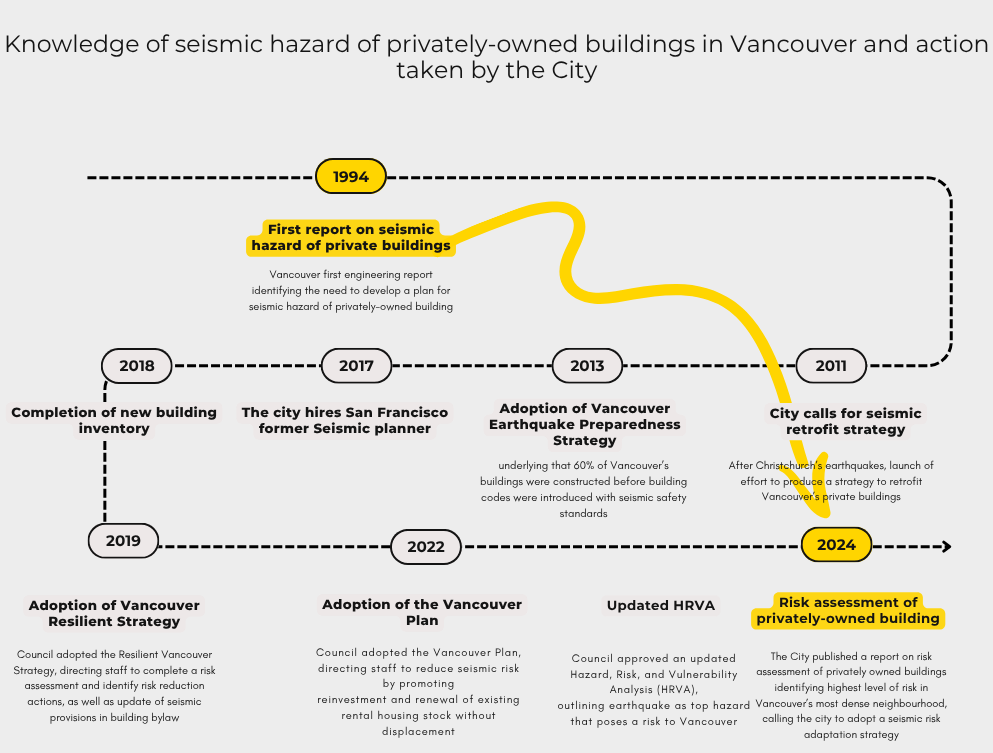
As far back as 1994, internal city assessments flagged the risk posed by unreinforced masonry and aging multi-unit residential buildings. But despite years of reports and lessons learned from international disasters, Vancouver has consistently chosen policies that sidestep mandatory retrofits.
Reporter Gordon Hoekstra, writing for the Province in 2016, revealed just how long the city had avoided confronting this ticking clock.
His investigation showed that the city had been aware of the seismic threat from privately owned buildings since 1994. However, it wasn’t until 2011, after the tragic earthquakes in Christchurch, New Zealand, that Vancouver formally acknowledged the need for a seismic retrofit strategy for its buildings and infrastructure. But even then, the city adopted a limited version in 2019, requiring retrofitting of private buildings only when property owners applied for major alterations or a change of use.
The rationale? Fear of displacing renters. In a city already overwhelmed by housing scarcity, officials have been reluctant to touch anything that might trigger “renovictions.” But this trade-off between short-term housing stability and long-term life safety may be a false choice.
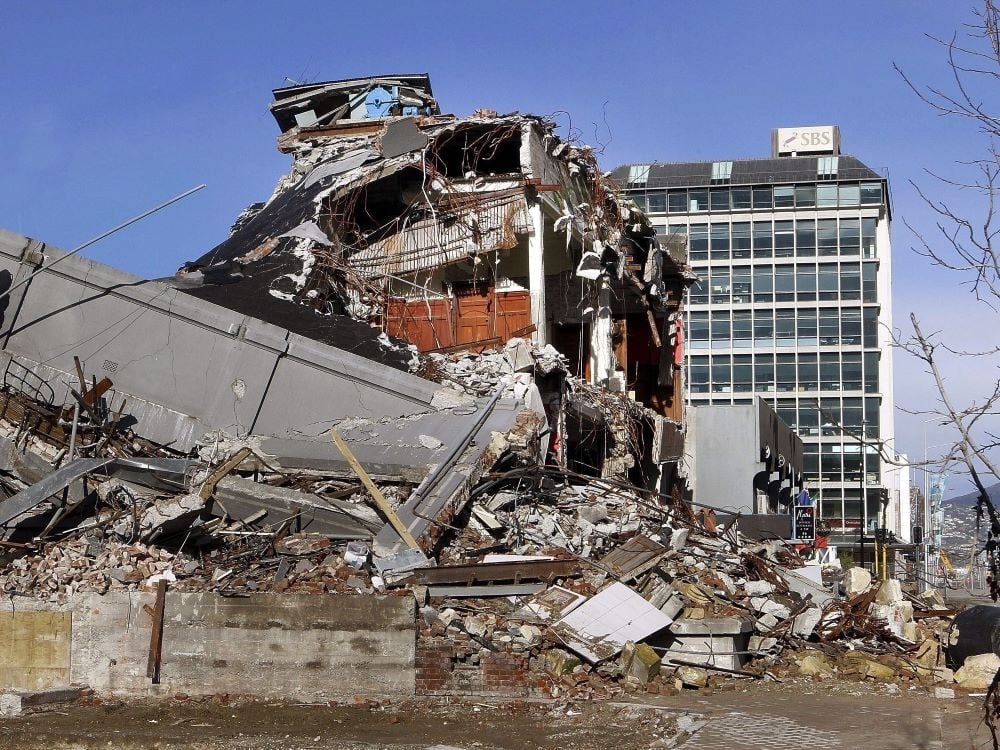
Christchurch offers a cautionary tale for Vancouver. When the 2010-11 earthquakes struck, 185 people died — most of whom were victims of building collapses. One building alone, the Canterbury Television building, accounted for 115 deaths.
Much like Vancouver today, Christchurch had a large number of unreinforced buildings, and a cultural reluctance to interfere with private property markets. Vancouver sent a delegation of municipal staff to Christchurch in the aftermath. Yet over a decade later, many of the same structural risks remain present at home.
Naming risk can spur action
Encouraging property owners to invest in seismic retrofitting is a major challenge and political risk faced by cities in earthquake-prone regions. While different economic and social factors play a role, research shows that mandatory retrofitting measures are the most effective in ensuring compliance. However, introducing such measures often sparks opposition from property owners, businesses at risk of closure and renters who fear eviction during renovations.
This is where transparency becomes crucial.
Cities like Seattle, Washington, have opted for a more open and accountable approach. In Seattle, residents can browse a public database that lists unreinforced masonry buildings in need of seismic retrofits, along with updates on city-led efforts to strengthen critical infrastructure. The message is clear: this is a shared risk, and the public has a right to know who is doing what about it.
Similarly, an experiment in Berkeley, California, in 2012, required participating building owners not just to evaluate seismic risks, but to disclose those findings to tenants — and physically post warnings on their properties.
Although the experiment was small, the results were telling. Landlords who had never considered their buildings unsafe began to understand the stakes. And with visibility came action: more owners initiated retrofits, not because they were forced to but because they felt responsible.
When risk is made visible, it’s harder to ignore. Transparency, it turns out, doesn’t just inform — it motivates.
Vancouver’s silence
In contrast, Vancouver’s approach to risk communication has remained muted. Thirty years after the city’s first seismic risk assessments, no publicly accessible inventory of at-risk buildings exists.
Even after the release of the sobering report in November 2024, no list of at-risk buildings was published. City officials merely pointed to the potential release of a risk inventory sometime within the year, alongside gradual, voluntary building upgrades as the proposed solution.
This lack of transparency erodes trust — and leaves renters, building managers and neighbourhoods uninformed and unprepared. It also shifts the burden of disaster preparedness away from systemic policy solutions and onto individuals, most of whom lack the means to take action on their own.
The protective power of open data
Since 2015, the United Nations’ Sendai Framework has emphasized the role of open data and transparency in disaster risk reduction. When citizens are given the tools to understand risk, they can advocate for safer neighbourhoods — and hold officials accountable for inaction.
Vancouver, with its high digital literacy and resources, could easily follow this path. A public database of seismic vulnerabilities, coupled with education campaigns and support for retrofitting, would allow the city to move from denial to mitigation. Transparency would also help balance the very real concerns about housing displacement — renovictions — with the need to save lives.
On Borrowed Time is the title of a 2021 book on west Canada’s earthquake risk — and it applies here too. The longer Vancouver delays stronger action, the more lives it places at risk. There are no perfect solutions, but there are better ones than pretending the danger isn’t there.
If the city truly wants to strike a balance between protecting renters and reducing seismic risk for its residents, it needs to start by telling the truth. Keeping people in the dark won’t make the threat go away. It only guarantees we’ll be unprepared when it hits.
A version of this article first appeared in Alice Kassam’s Substack. ![[Tyee]](/design-article.thetyee.ca/ui/img/yellowblob.png)
Read more: Municipal Politics, Urban Planning







Tyee Commenting Guidelines
Please note that email notifications for replies are not currently working due to a software issue which may be resolved in a future update.
Comments that violate guidelines risk being deleted, and violations may result in a temporary or permanent user ban. Maintain the spirit of good conversation to stay in the discussion and be patient with moderators. Comments are reviewed regularly but not in real time.
Do:
Do not: