


 SHARE:
Prolonged drought conditions are forcing British Columbia’s fire tacticians to rethink how they battle blazes in the province’s dry and hot Interior.
As huge, destructive blazes spread across the southern Interior, many are burning across land that has already experienced fire over the last decade. In years past, the BC Wildfire Service would expect previous burn scars to slow, or even stop, the progress of a new fire. But this fire season, a prolonged drought has upended that assumption. Firefighters’ experiences could have implications for what British Columbians can expect from fire seasons for years to come.
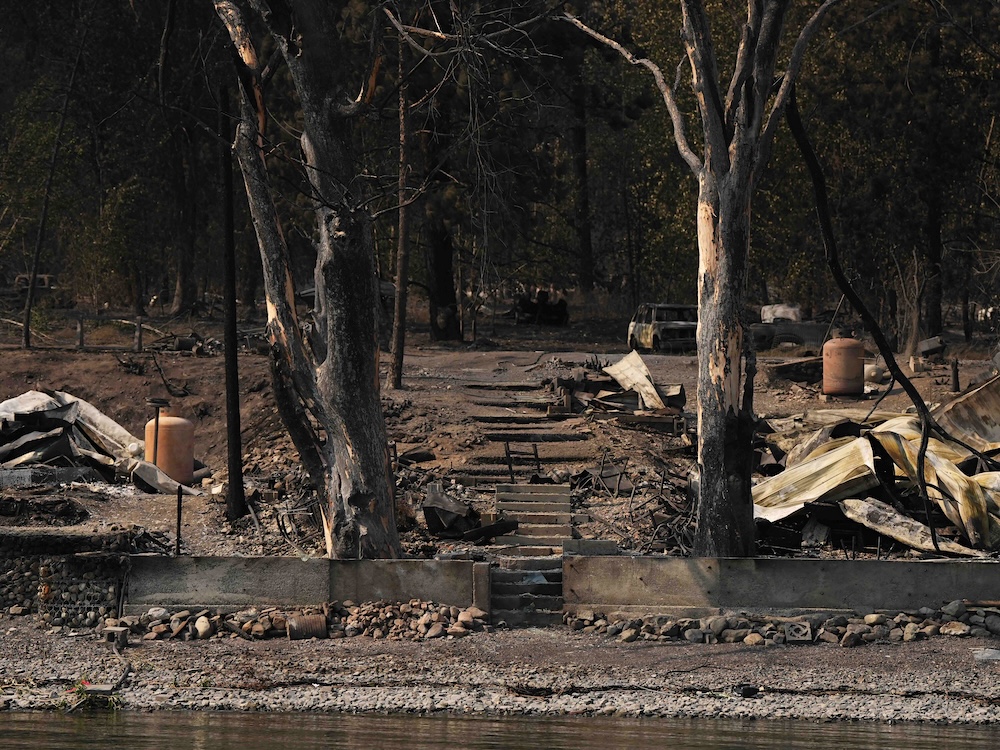
On Saturday, a grass and brush fire swept along the northwest edge of Okanagan Lake, through the Okanagan Indian Band community and several leasehold developments on the band’s land. Fanned by 85-kilometre-per-hour winds, the blaze burned more than 200 homes.
The area has seen many fires over the past decade, and some of the flames moved through areas that had previously burned, BC Wildfire director of operations Cliff Chapman said Monday.
The Quilpituk Creek fire just to the south, the Pear Lake fire near Clinton and the Brunswick Creek fire in the Fraser Canyon are also burning in areas that have seen major fires over the last decade.
But that history of fire isn’t helping crews to the extent that it once might have, Chapman said.
“We are not seeing the same sort of potential benefit of a fire running into a fire if [the burn scar] is more than five, seven, 10 years old,” he said.
Historically, crews would incorporate burn scars and control lines — a long man-made area with little or no fuel to burn. Although the most visible part of firefighting occurs in the air, from planes and helicopters dropping water or retardant on flames, some of the most important firefighting occurs through the creation of fire breaks dug by hand or heavy equipment.
Wildfire technicians frequently “tie in” such control lines to natural barriers such as creeks, rivers, lakes or man-made impediments like roads. The presence of burn scars could also influence long-term planning, as fire officials predicted the course of flames and plotted where to focus their efforts.
A burn scar “used to be something we could use as a control line,” Chapman said. Current conditions, though, make those scars untrustworthy. “The fire behaviour can be almost as extreme in some of those old burns, depending on their age and how severe the burn was.”
At a Tuesday press conference Chapman elaborated on the challenge in response to a question from The Tyee. He pointed to the Pear Lake fire, which is burning in territory that had been torched by one of B.C.’s largest fires on record: 2017’s massive Elephant Hill fire.
“When I started my career 20-plus years ago, burn scars would give us a 10-to-20-year buffer, especially if it was a high-intensity burn like Elephant Hill that we could then use as a control line,” he said. Today, drought and weather conditions stoked by climate change and warmer and longer summers make those old burned-over areas less reliable.
“Even a fire [in a scar] that’s only seven years old is now being able to display what I would say is significant extreme fire behaviour,” he said.
The conditions are requiring new approaches to fight, Chapman said.
“We’ve already adjusted our tactics on the fly, recognizing that when we need to put a control line in, that we will have to build it through an old burn scar, instead of using the old burn scar as a potential control line.”
More research is needed on the longer-term implications of this year’s fire season, Chapman said.
A question for science
University of British Columbia professor Lori Daniels, co-director of the Centre for Wildfire Coexistence, said the return of flames to recently burned landscapes reinforces the need to rethink how B.C. manages its forests.
Absent human intervention, fire is a regular feature of a natural forest that returns at periodic intervals, depending on the ecosystem, the climate and many other factors. But the interval between wildfires is shortening, Daniels said.
“We’re getting short-interval reburns, where places are reburning within five and 10 years, as opposed to waiting 20, 30 years before they’ve accumulated fuel again,” she told The Tyee.
Over the last decade, researchers and experts have pointed to historic wildfire suppression strategies as a major reason for the province’s increasingly fiery summers. In addition to hotter and drier summers resulting from human-caused climate change, experts pointed to the buildup of tinder in forests that had seen few fires over the past decade. Officials have focused on the need to reduce fuel loads in forests through “treatments” — the removal of timber and brush by hand, logging machines and sometimes prescribed and cultural burning.
Daniels said this year’s fires emphasize that managing fuel loads in forests will take repeated and ongoing work.
“One and done is not going to work,” she said.
Scientists, fire officials and forestry experts will also have to study the forests that have reburned and consider the influence of previous fires, she said. A section of forest that had sustained a low-intensity burn in the recent past might be more primed to ignite quicker. Previous fires can also kill trees that later tumble to the ground, creating a future ground-level fire hazard.
“The condition of the fuel and the abundance of the fuel has a huge implication of whether it can sustain a reburn,” she said.
The issue is complex. Some fire mitigation strategies, such as avoiding the creation of dense homogeneous forests, may run contrary to the preferences of industry. Others, such as the selected harvesting of trees, can find opposition among environmentalists.
The strategies also aren’t guaranteed to fully prevent a fire from spreading, Daniels acknowledged. Although extensive research has suggested that treatments reduced the impacts of previous fires on forests, they didn’t fully prevent those incidents. Nor did they stop this year’s fires, some of which have burned areas where Daniels and her team worked with communities on fuel reduction efforts.
The last month has demonstrated that British Columbia cannot rely on old burn scars to fight its fires or fuel treatments to fully prevent them. For Daniels, that suggests the need for another big change: a systematic rethinking of how the province and its forest industry manages and creates dense pine forests in British Columbia’s hot and dry Interior.
“We need to get away from that business-as-usual model as fast as we can,” she said. “Everybody says it’s too expensive, but what price have we just paid in B.C. in the last month?” ![[Tyee]](/design-article.thetyee.ca/ui/img/yellowblob.png)
Read more: Environment









Tyee Commenting Guidelines
Please note that email notifications for replies are not currently working due to a software issue which may be resolved in a future update.
Comments that violate guidelines risk being deleted, and violations may result in a temporary or permanent user ban. Maintain the spirit of good conversation to stay in the discussion and be patient with moderators. Comments are reviewed regularly but not in real time.
Do:
Do not: