


 SHARE:
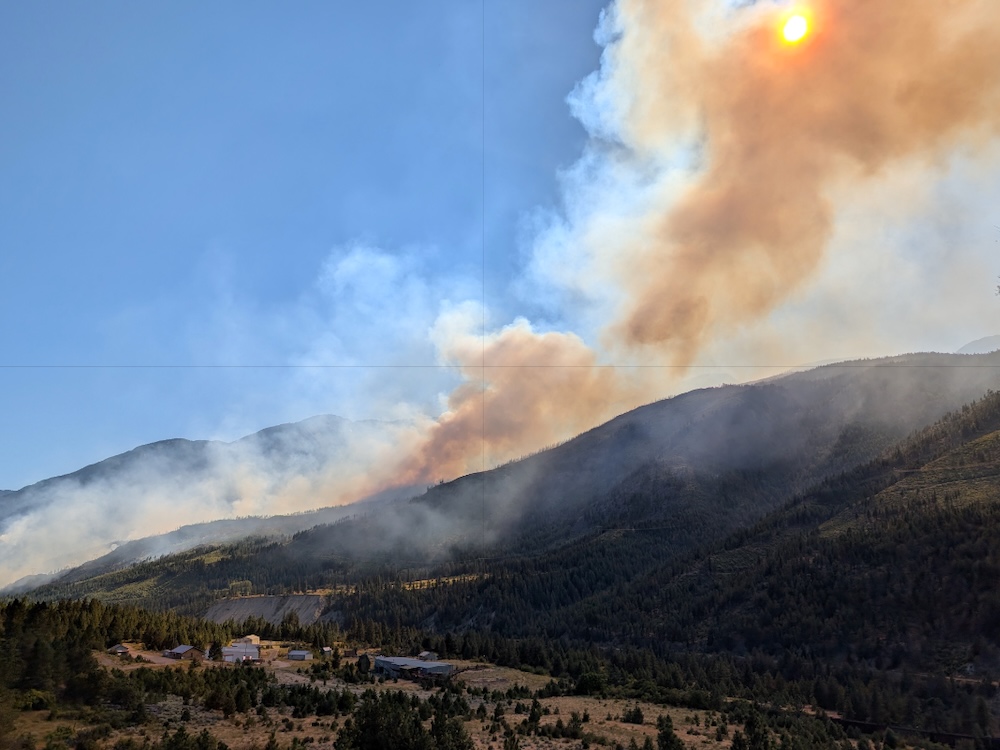
As crews look to hold the line on a new wildfire near Lytton, they are being aided by the legacy of a previous blaze, its scars still visible a decade later.
On Monday, the Cantilever Bar fire broke out 10 kilometres south of the village and quickly led to evacuation alerts for rural properties and First Nations reserves on the west side of the Fraser River. The fire heightened nerves among residents of Lytton, which sits on the opposite side of the river, and nearby First Nations.
With a heat wave bringing temperatures approaching 40 C to the area and the fire burning in steep terrain, conditions are difficult for wildfire crews, officials said Tuesday.
But one major factor is slowing the blaze’s spread to the north — the area’s own recent history with wildfires. And it demonstrates a key principle that provides some hope for residents in the province’s fire-struck Interior.
Good fire, bad fire
Fires are complex phenomena.
For millennia, fire has played a fundamental part in B.C. ecosystems. Regular low- and moderate-intensity fires open up habitat for animals and allow fresh vegetation to spring to life. They also clear out underbrush that, if allowed to accumulate, enables flames to jump from the ground to the crowns of forests, turning a smouldering blaze into an inferno.
Before the arrival of Europeans, lightning started most blazes. But not all. In summer, many Indigenous people would flee the sun-baked valley bottoms for cooler mountaintops. They would travel in the opposite direction in the fall, but just before they left the forested mountains, fire keepers would “put fire on the land.” Doing so would not only help rejuvenate the landscape, but also significantly reduce the chances of a dangerous and ecosystem-ravaging fire when the people returned in future years.
Irregular patchworks for burned land would create ecosystems with a “mosaic” of vegetation. Trees and shrubs dry out at different rates depending on species and age. So when a fire does start, a non-uniform forest will contain vegetation that isn’t primed to burn.
B.C. forestry policies are only slowly recognizing the role and importance of previous fires — both those set in controlled manners and those that occur naturally. But fire crews and tactics have long acknowledged that a piece of land that has burned recently can be a major asset when trying to contain a new blaze.
In other words, every fire that a community survives can help reduce the threat of future blazes.
That’s the scenario especially in Lytton.
Emotional and physical scars
The 2021 Lytton Creek blaze that burned the town started just yards from the townsite itself. It took only minutes for flames to tear through dried-out brush and grass and reach the village’s buildings. Its rapid spread made the blaze impossible to control before it ravaged 90 per cent of the village’s buildings.
That fire was not normal. Fed by unfathomable 50 C heat stoked by climate change, the fire was a human disaster. It killed two people and traumatized hundreds more. Logistical, bureaucratic and archeological factors have significantly delayed the rebuilding of the town. Four years later, residents are returning, while those who remained are seeing their community begin to re-emerge from its ashes and services return. (Although the village site burned, many homes on adjacent First Nations and rural properties did survive the 2021 blaze.)
The region has seen a half-dozen prominent fires since the 2021 blaze. Those fires have led some to question the community’s future in our new climate era. In response, authorities have focused on trying to fireproof the village as much as possible, providing grants to incentivize rebuilding homeowners to use fire-resistant materials while working to reduce the flammability and fuel in the surrounding forests.
But the Lytton area’s recent history with fire, although a sign of the vulnerability of the region, also can help mitigate the threat from future blazes.
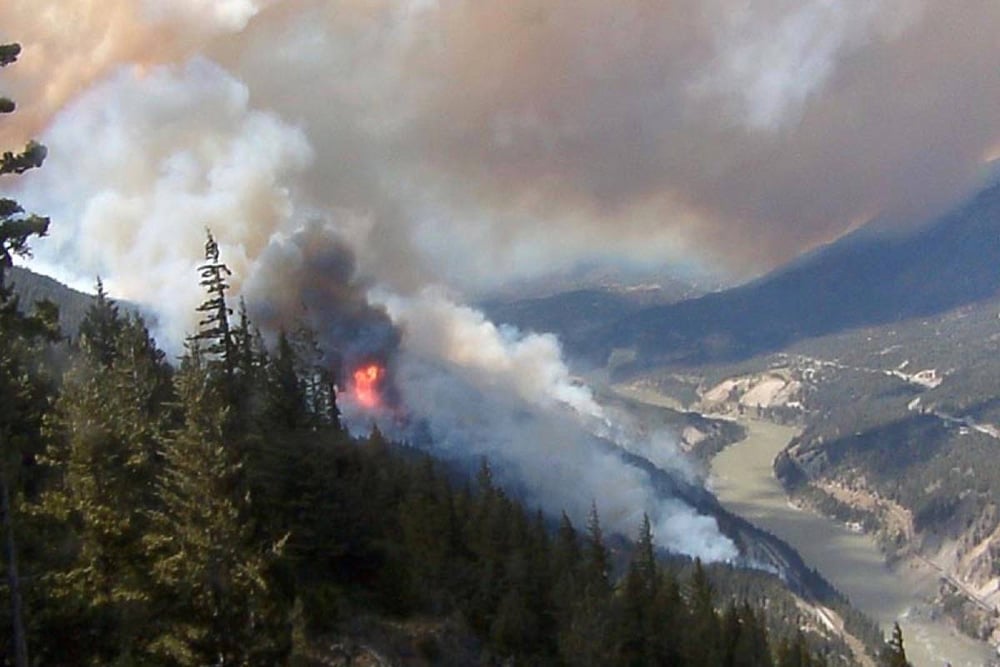
In 2015, a spark from workers cutting a rail line in hot, dry conditions triggered a massive blaze on the west side of the Fraser River, south of Lytton. The Cisco Road fire consumed thousands of hectares of forests, resulted in evacuation alerts for nearby First Nations reserves, set locals on edge in Lytton and cost the province millions to fight. The Canadian National Railway would eventually be ordered to pay more than $16 million to the province.
It took crews four months to extinguish the blaze, and a decade later, its massive scar looms over the canyon, a testament to the scale and frequency of fire in one of Canada’s hottest — and windiest — ecosystems.
Now, crews are fighting a new fire to the immediate south of that burn scar, much of which has since been logged.
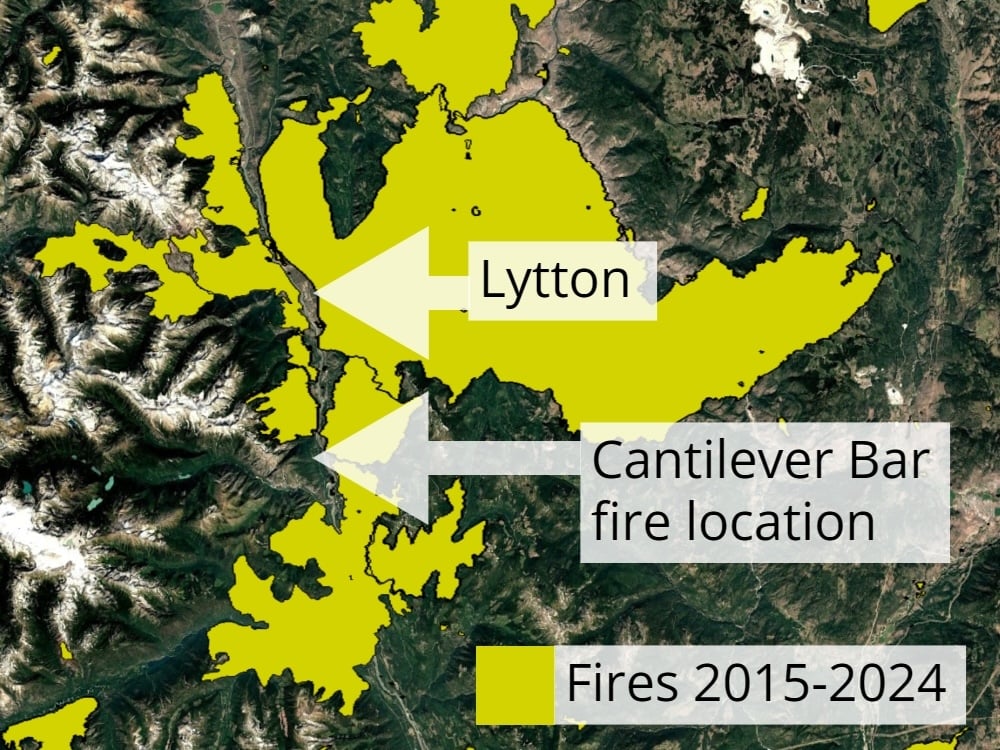
Firefighters battling the Cantilever Bar blaze are working in extremely mountainous terrain, in hot weather, in a canyon that sees wind gusts when conditions everywhere else in B.C. are relatively calm, Cliff Chapman, the director of provincial operations for BC Wildfire Service, told reporters at a press conference Tuesday morning.
They have a hard job in difficult conditions. And the weather isn’t helping, with temperatures forecast to reach 38 C on Wednesday and Thursday. But as wildfire officials and locals watch the progress of the blaze, the scar from the 2015 fire and another from 2023 are limiting the flames’ natural wind-aided tendency to move north, closer to Lytton.
“On a couple of its flanks, [the fire] is running into those old burns,” Chapman said Tuesday. “We are finding that, given the conditions right now, that with those two old fires in the area, that the fire is knocking itself down.”
In other words, the fire is finding it difficult to burn through terrain that it roared through a decade ago.
The behaviour aligns closely with what wildfire science says should occur in such scenarios — and the rationale behind a push for more prescribed and cultural burns in spring and fall, when fires can be used to reduce fuel loads in forests.
That does not mean a fire cannot burn through an old wildfire scar. The path of flames depends on a range of factors, including the weather and fuel. And with the climate changing, old burns are less trustworthy than ever before. Last year, Cabin Radio reported that in the Northwest Territories’ devastating 2023 fire season, flames burned across hundreds of thousands of hectares that had seen fires in recent years. So a burn scar won’t necessarily stop a fire in its tracks for a prolonged period of time.
But the scarcity of fuel can help calm a blaze where, previously, the forest could have fuelled a fire’s growth. That can give crews a chance to pour efforts on parts of a fire that aren’t abutting previous burn areas, or to stiffen defences before the weather shifts.
It can also provide a start for more comprehensive fuel mitigation work that officials can tackle ahead of time.
Part of the BC Wildfire Service’s fuel mitigation efforts, Chapman said, has been “to use things like old fires to make sure that they can’t re-burn, and make sure that the fuel that’s within those old fire scars is taken care of, so when a fire like the one that we’re experiencing right now runs into that old fire, we can actually use it as a control line.”
The push for more prescribed fires is echoed by policies that encourage officials to allow lightning-caused blazes to burn in areas where they aren’t deemed to pose a threat to humans or property.
The scars near Lytton aren’t the only ones that could help reduce the danger posed by future fires near communities that were previously struck by — or threatened by — flames.
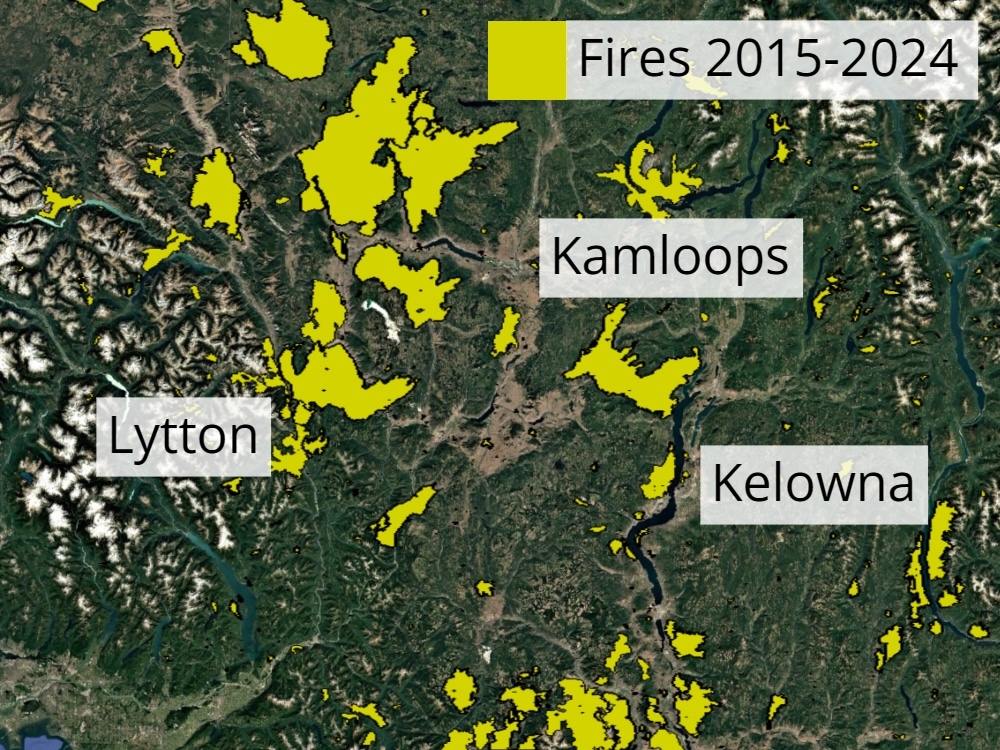
Over the last decade, hundreds of thousands of hectares of forests and grasslands have burned across the southern Interior. In the Shuswap, Okanagan and Cariboo regions, huge patches of blackened trees serve as a reminder of fires that once threatened communities and burned homes.
But they also provide lines of defence against future blazes. Mapping data collected by the province shows the extent of fire scars over the last decade, with blazes consuming a large chunk of the previously forested land between Osoyoos and Williams Lake. Even within the region, Lytton still stands out, with different fires having burned terrain on every side of the village.
As the climate warms, fires are becoming much more intense, commonly burning with energies that make them impossible to fight. But as those fires turn wood into smoke, and change the surrounding landscape, they are also affecting the future — and providing one reason to hope for residents worried that yearly fires are now a part of life.
And although fires in previous years have left residents understandably fearful that another blaze could force them to flee, right now, Lytton’s sad recent history with fire is working for crews on the ground.
“They have been fairly successful control lines for us so far, and we anticipate they will be again,” Chapman said. The fire “is not finding the same amount of fuel to burn” as it would otherwise have.
That doesn’t mean Lytton or the surrounding areas are definitely safe. Since it was detected Monday, the Cantilever Bar fire had grown to be 460 hectares as of Tuesday evening. Much hard work remains.
But fires that threatened the region in previous years are now ironically one of the biggest assets for crews fighting today’s blaze. ![[Tyee]](/design-article.thetyee.ca/ui/img/yellowblob.png)
Read more: Environment







Tyee Commenting Guidelines
Please note that email notifications for replies are not currently working due to a software issue which may be resolved in a future update.
Comments that violate guidelines risk being deleted, and violations may result in a temporary or permanent user ban. Maintain the spirit of good conversation to stay in the discussion and be patient with moderators. Comments are reviewed regularly but not in real time.
Do:
Do not: