


 SHARE:
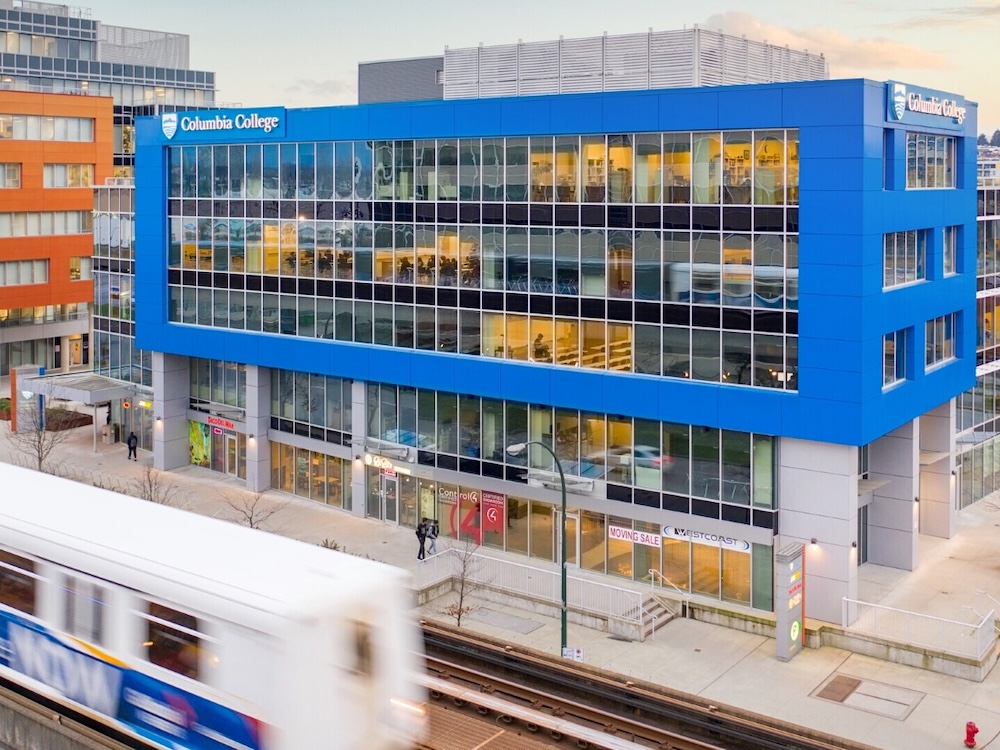
Grappling with diving enrolment, a yet-unresolved unionization effort and the recent layoffs of at least a third of its workforce, Columbia College is at a turning point.
The post-secondary school, located on Vancouver’s Terminal Avenue, relies heavily on tuition from international students. But the federal government has drastically cut the number of international students B.C. schools have been able to accept. By all accounts, this has put Columbia College in a dire financial situation.
It found a unique solution. In March, the college announced plans to merge with Quest University — a Squamish-based post-secondary school that went bankrupt in 2020 and shut down in 2023.
“There was a lot of talk at that point of trying to save as many jobs as possible,” said George, a recently terminated instructor who asked to be kept anonymous for fear of retribution.
“They were already talking about that there was going to have to be layoffs, but that they were going to try to keep them to a minimum as much as possible.”
But when George learned in June that a third of the college’s 200-person workforce would be out of a job come September, he and other staff started to get suspicious, he said.
“It was significantly more than we were expecting,” George said. “Layoffs are justifiable. What is not justifiable is the lack of transparency about the extent of them and the lack of communication.”
The Tyee spoke to two other employees of Columbia College. The Tyee has agreed to keep their identities confidential to protect them from retribution. All three will be out of a job by the end of the academic year.
Two said they were misled about the extent of the layoffs. All three said the layoffs violated several parts of their employment agreement, including requirements for management to conduct layoffs in order of seniority and offer employees the right to recall.
All three have said they’re concerned about their college’s merger with Quest University as critics call for more scrutiny of the school’s finances, real estate deals and involvement with an organization that had its charity status revoked in May.
And one has raised suspicion about the timing of the layoffs, which came while the BC Labour Relations Board was considering an application to unionize staff and faculty with the Professional Employees Association, or PEA.
The union is preparing an unfair labour practice complaint for the board. Any allegations have not yet been tested before a court or tribunal.
A Columbia College spokesperson said in an email the layoffs were due to a “dramatic decline” in enrolments, unrelated to the merger and conducted in accordance with labour laws.
“Like many post-secondary institutions across Canada, Columbia College has faced the direct consequences of federal policy changes affecting international student enrolment,” the spokesperson said.
“These are circumstances beyond our influence, and the recent staffing reductions reflect the college's responsibility to manage within that reality.”
Vancouver-based labour lawyer Adrienne Smith agrees with staff’s assessment that the layoffs are “problematic,” and said the changes at Columbia College are part of a larger trend of academic institutions undermining full-time tenured positions in favour of more temporary, precarious contract work.
“Precarity for academic workers has always been a problem, but it is worse now than ever,” Smith said. “There’s a great threat to the security that academic workers have enjoyed and are entitled to, and it’s really an attack on job security for academic workers.”
Plummeting enrolment
The college hasn’t always been at odds with its staff. Frank, one of the employees The Tyee agreed to keep anonymous, said he has taught at Columbia College for about two decades.
“Work was very good,” he said. “Columbia College used to be a very good place to work, because it's a society — it was run by the society members.”
Columbia College is an independent, not-for-profit post-secondary school. The college functions as a democratic society — a structure that offers workers a form of collective power. Full-time employees become society members. Members of the society discuss issues such as finances and enrolment and democratically vote on a direction for the college.
Still, some decisions are made by a board of directors, who are appointed through a hiring process and then ratified by the society. George estimated that by this year, the society had about 150 members.
“We have some democratic power and some say in our workplace,” he said. “At least, we did.”
According to its website, Columbia College offers two associate degrees, one in arts and one in science, designed to be equivalent to the first two years of a four-year bachelor’s degree program. It also operates a high school.
The college specializes in university transfers, which let students start their degrees at Columbia College before applying to finish them at a major university like the University of British Columbia or Simon Fraser University.
The students largely come from abroad. As of 2024, 95 per cent of the college’s population consisted of international students.
That meant the college took a big hit when the federal government reduced immigration targets. In an effort to reduce Canada’s temporary population to less than five per cent of its total population, the federal Liberal government started drastically cutting the number of international students it let into Canada.
In 2023, the federal government issued 60,864 study permits for British Columbia. With the new immigration targets, Immigration, Refugees and Citizenship Canada dropped that number by 47 per cent to 32,183 permits the following year.
Frank said the immigration targets concerned college administration. It was around this time the university’s board started pursuing a merger with Quest University. In 2020, the Squamish-based school filed for creditor protection as it faced growing debt. And in February 2023, Quest announced it would close its doors due to a lack of funding.
The university is still authorized to grant degrees. The B.C. University Act dictates which corporations have the power to grant degrees in their own name in this province: the University of British Columbia, the University of Victoria, Simon Fraser University and the University of Northern British Columbia.
But the 2002 Sea to Sky University Act, which established the school that would become Quest University, gave Quest the power to grant degrees and award certificates and diplomas despite the University Act.
It also set out a governance and corporate structure for the university — one that would not be a society.
Merging Columbia College with Quest would let the new institution offer a bachelor of arts and sciences degree and specialized programs in allied health, alongside Columbia’s existing associate degrees.
It would also mean the society would have to dissolve. Frank remembers the board presenting the merger at a society meeting in May 2025.
“They basically said we have no options,” Frank said. “The college will not survive. We cannot do much about it. The college will shrink, and the only way to maintain jobs and people working is to merge with Quest.”
On May 7, 2025, the approximately 150-member society voted 66 per cent in favour of allowing the board of governors to negotiate the terms of a merger, which would still be subject to final approval by the society.
An unresolved union drive
That summer, some society members started considering unionizing. George said a group of instructors approached the Professional Employees Association.
“We had to remove the society, and so people were worried,” George said. “The union became kind of a replacement. Not exactly the same thing, but essentially another way to have a bit of collective power in the workplace.”
According to Duncan Pike, an organizer with the Professional Employees Association, the majority of the approximately 125-employee bargaining unit signed union cards over the following year.
It was during this drive, George said, that the college’s situation suddenly became even more dire.
This year, the federal government announced the number of provincial attestation letters it planned to allocate per province. The letters — documents the federal government uses to ensure international student targets align with admissions — indicate how many new international students will be allowed to enrol in undergraduate post-secondary programs in each province each year.
Ottawa planned to allocate 24,786 letters for B.C. international students.
Columbia College did not share how many of those students it would be able to accept this year. But minutes from a Feb. 12, 2026, board of governors meeting provided to The Tyee suggest the college was allocated 52 letters — that’s 52 new international students the college might be able to enrol.
On March 4, the society made its last vote on the merger.
“This was this crisis moment,” George said. “It was presented as a do-or-die moment, like we needed to vote for this or would no longer be Columbia College.”
He added that the administration presented the merger as the way to protect the most jobs.
“There was a lot of talk at that point of trying to save as many jobs as possible,” George said.
The next day, Columbia College announced plans to merge with Quest University.
“The post-secondary sector is facing challenges across both public and private institutions, and the landscape is changing so quickly,” Arthur Coren, president of Quest University Canada, said in a press release. “This partnership represents a strategic step forward.”
On June 18, believing enough people had signed union cards for automatic certification, the Professional Employees Association went to the Labor Relations Board and filed to unionize the Columbia College instructors.
“A large majority of Columbia College workers signed PEA membership cards so that they could protect their collective voice and ensure fairness at work,” Pike said in an email.
Columbia College did not respond to questions about the certification.
Pike said the union is still resolving the issue at the Labour Relations Board. At the time of publication, the Labour Relations Board had not made a decision.
Staff allege terminations violate employment agreement
That same month, the terminations started. According to the PEA, on June 9, Columbia College started sending out termination notices. As of July 13, 17 staff had signed termination letters and 30 more faculty had received termination notices.
According to the three instructors, the layoffs also included several deans who were part of the society but not part of the union. While some of the staff feel misled about the extent of the layoffs, others say they saw them coming.
“I saw the writing on the wall,” said Selena, another instructor at Columbia College. “I felt sad, but I wasn’t surprised.”
What did surprise Selena was how the terminations were conducted. She said they were not conducted by seniority. She said staff were terminated without the right to return, should there be enough work to support their employment in the future. She said the deans’ council was not consulted in the terminations.
The other two staff members corroborated her claims.
A former employee sent The Tyee a copy of Columbia College’s employment agreement as of 2024. Section 9 of that agreement outlines the policy for staff reductions as a result of decreased enrolment.
It stipulates that staff reductions must be conducted in the order of reverse seniority, meaning newer employees are the first to go. It said if the board found employees can be increased in a specific area, the college will offer laid-off employees their jobs back in the reverse order of their layoffs.
“We are all feeling betrayed,” Selena said. “It's not just me; we're all feeling backstabbed.”
After examining the agreement, labour lawyer Smith said the whole situation deserves a closer look.
“The workers are saying that's problematic, and I can’t disagree with them,” Smith said, adding the employer has an obligation to honour its employment agreement.
Smith said the timing of the layoffs amid a certification effort was also suspicious. “I can’t tell you if it’s union-busting or not. But from the outside and at a distance, it sure smells like it.”
Smith added that without seeing all the evidence, they could not identify whether the college had done anything wrong.
Meanwhile, calls for a closer look into Quest University’s finances have been growing. In March, just months after the society approved a merger, Jeremy Valeriote, BC Green Party MLA for West Vancouver-Sea to Sky, called for an investigation into the financial history of Quest. As reported by the Investigative Journalism Foundation, alumni and faculty grew suspicious of how the university failed despite significant donations from diamond mining magnate Stewart Blusson.
A month later, critics called for a closer look into the university’s real estate dealings. And in June, a charity that lent the university $23 million had its charitable status revoked by the Canada Revenue Agency.
Frank said he’s calling for more scrutiny of Quest University’s finances before the merger can be completed.
“We're hoping that even if we cannot keep our jobs, at least the money will not go to Quest,” he said. He said he’s joining the call for an investigation into Quest University and hopes it reverses its plans to merge with Columbia College.
“There is now very strong consensus that the merger should not — hopefully will not — happen,” he said. “Somebody should question it.” ![[Tyee]](/design-article.thetyee.ca/ui/img/yellowblob.png)
Read more: Education, Labour + Industry









Tyee Commenting Guidelines
Please note that email notifications for replies are not currently working due to a software issue which may be resolved in a future update.
Comments that violate guidelines risk being deleted, and violations may result in a temporary or permanent user ban. Maintain the spirit of good conversation to stay in the discussion and be patient with moderators. Comments are reviewed regularly but not in real time.
Do:
Do not: