


 SHARE:

In 1938, the principal of Sturgeon Lake Residential School attempted to project what enrolment would look like in seven years.
Principal Fournier warned the local Indian agent that before the 1945 school year began, some child deaths must be expected, according to a French-language letter in the Investigative Journalism Foundation’s Residential Schools database.
And his prediction came true.
At least 14 deaths were recorded at the northern Alberta school in the intervening years, from causes including measles, pneumonia and poor heating during the winter, according to a narrative for the institution.
Sturgeon Lake Cree Nation announced in May that it had identified 62 potential unmarked graves connected to the former residential school.
Located about 300 kilometres northwest of Edmonton, the Cree Nation has been working with the University of Alberta’s Institute of Prairie and Indigenous Archaeology to investigate potential burials using ground-penetrating radar.
The work is part of the Cree Nation’s ongoing effort to better understand what happened to the 202 children believed to have died or gone missing between 1907 and 1968 while attending Sturgeon Lake, also known as St. Francis Xavier Boarding School.
Now, archival records analyzed by reporters at the Investigative Journalism Foundation are helping identify children who died at the institution while offering new insight into the conditions they lived in, the illnesses that spread through the school and what government and church officials documented over several decades.
The records come from the IJF’s Residential Schools database, a collection of school narratives prepared for the Independent Assessment Process to resolve claims of abuse.
Chronological timeline of health issues
A chronology of health issues at the school records at least four student deaths in December 1942 alone. The same chronology references two student deaths in 1933, two more in the span of three months in 1940, one in 1941, five deaths throughout 1943 and more in the mid-1940s.
It also documents repeated outbreaks of infectious disease and growing concerns about the condition of the school itself.
While some children can be identified through records, connecting those records to surviving families and burial locations remains an ongoing challenge for researchers and communities.
Those questions are becoming increasingly important as Sturgeon Lake Cree Nation continues its investigation.
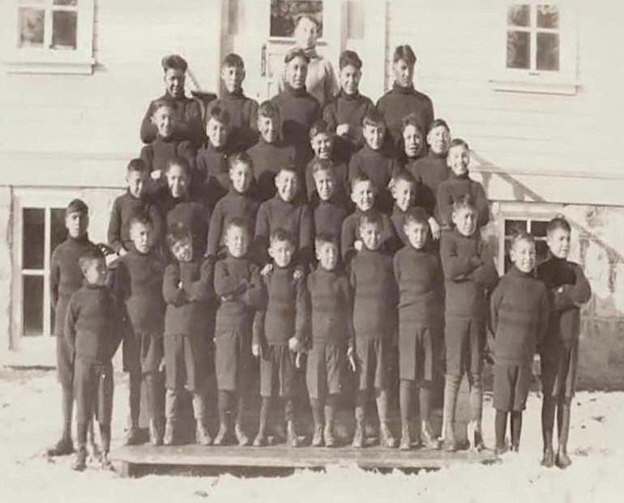
One child’s story
One of the clearest examples found in the records concerns a student named Mabel Kiyawasew.
A Department of Indian Affairs death inquiry states that Kiyawasew died on Dec. 8, 1941, while attending Sturgeon Lake Residential School.
According to the records, Kiyawasew contracted measles before developing bronchopneumonia. A statement submitted by the school’s principal describes efforts to treat her illness and arrange hospitalization before her death.
She was far from alone in her illness, according to a note from an Indian agent included in the inquiry report. “Most of the children at the school caught measles in October. On my visit on Nov. 12, 1941, there were a number of other pupils all with bronchopneumonia which they developed following measles,” he wrote.
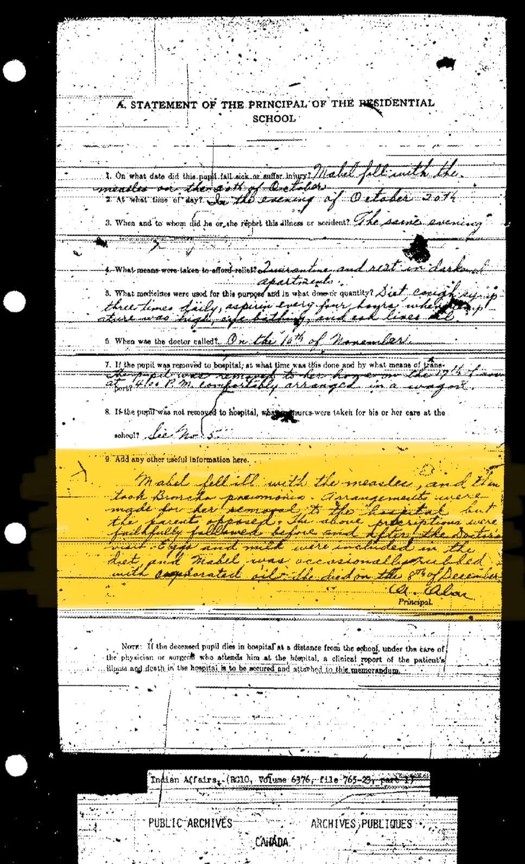
Repeated outbreaks of infectious disease are recorded in the documents, including measles and pneumonia.
A monthly report from 1940 notes influenza cases within residential schools in the region.
The records later document an influenza quarantine in 1952 and a measles outbreak in 1956.
The records do not establish the circumstances surrounding every documented death. For example, a 1933 admission and discharge report mentions the deaths of two students, Narcisse Tchowis and Emma Nuane. No cause of death is given.
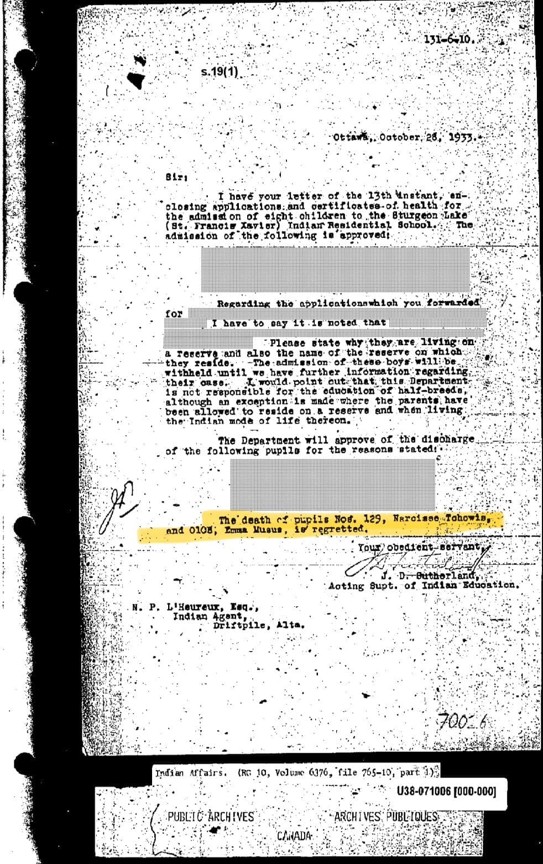
Comparing those records with the National Centre for Truth and Reconciliation’s online memorial register reveals both similarities and differences.
The memorial register contains entries for Mabel Kiyawasew and Narcisse Tchowis that match the dates of death in the documents. The register also includes a child named Emma Musus who died in 1933, but there is no entry under the name Emma Nuane.
Officials warned about conditions for decades
The archival records reveal that government and church officials repeatedly documented concerns about deteriorating buildings, inadequate heating and children’s safety while student deaths continued at the school.
A 1940 memorandum described parts of the school as “dilapidated” — particularly the girls’ wing.
“This building is heated by stoves and has been for a number of years an acute fire hazard,” the memo reads.
Another document from August 1943 states that the aging school building posed “a danger for the health of Indian children” and staff, adding that church officials had been requesting replacement facilities for years as the building was a fire hazard.
Calls for replacement
The documents suggest concerns about the school’s condition persisted for years.
A 1941 letter discussing construction of a replacement school acknowledged requests for new facilities but noted that wartime spending had delayed construction projects.
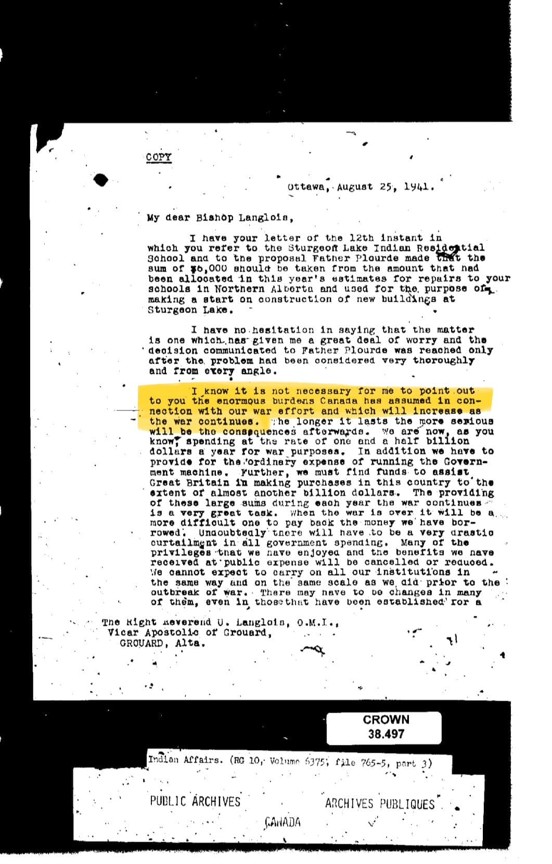
Two decades later, an educational survey completed in 1960 described the dormitory building as being in “extremely poor condition” and recommended closing the residential school altogether and replacing it with a day school.
Sturgeon Lake closed as a Catholic-run residential school in June 1961, but operated as Namew Indian Day School until 1962. The school land and buildings were sold to the Sturgeon Lake Band in 1967. ![[Tyee]](/design-article.thetyee.ca/ui/img/yellowblob.png)
Read more: Indigenous, Rights + Justice, Alberta












Tyee Commenting Guidelines
Please note that email notifications for replies are not currently working due to a software issue which may be resolved in a future update.
Comments that violate guidelines risk being deleted, and violations may result in a temporary or permanent user ban. Maintain the spirit of good conversation to stay in the discussion and be patient with moderators. Comments are reviewed regularly but not in real time.
Do:
Do not: