


 SHARE:
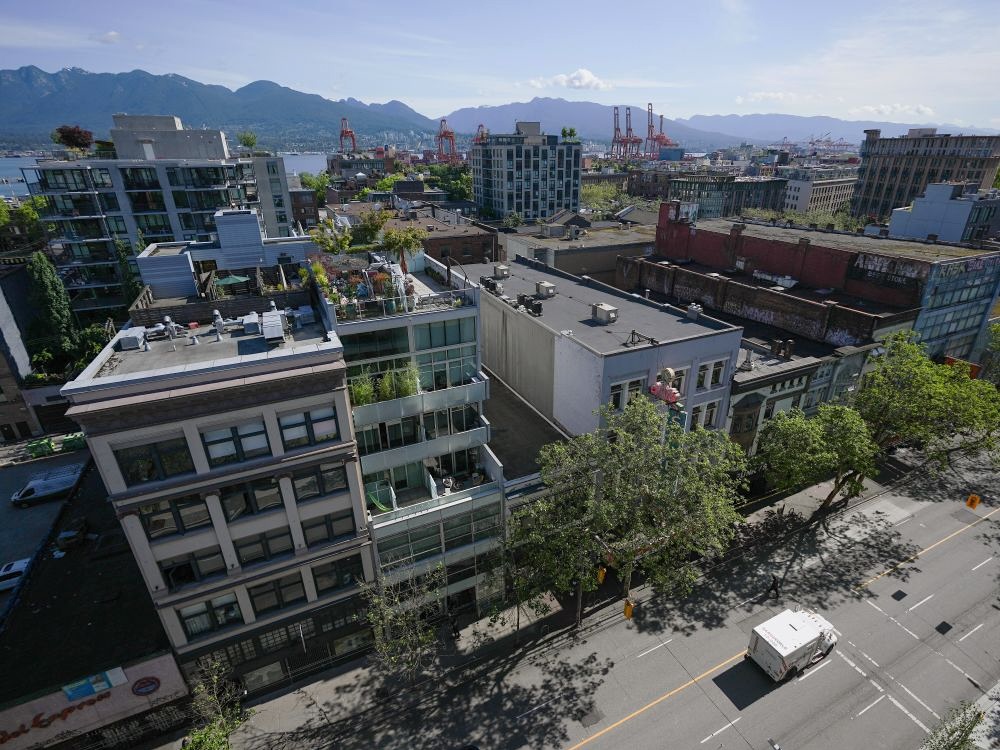
Before the first ball is drop-kicked in the 2026 FIFA World Cup’s Vancouver matches next spring, seven city bylaws will undergo temporary changes in enforcement, relaxation or bylaw officer access to private property.
City staff told councillors last month that the bylaw changes, which are required by the international soccer body for all its host cities, will be captured under one temporary FIFA World Cup 2026 Bylaw and are required to ensure public safety, brand protection for the event’s corporate sponsors and smooth city logistics and operations.
The bylaws covered are Ticket Offences Bylaw No. 9360, Street Vending Bylaw No. 10868, Street and Traffic Bylaw No. 2849, Sign Bylaw No. 11879, Noise Control Bylaw No. 6555, Graffiti Bylaw No. 7343 and Building Bylaw No. 14343.
Amendments to relax the Zoning and Development Bylaw will be presented to council at a later date.
The changes will be in effect only from May 13 to July 20, 2026 — except changes to the Building Bylaw, which will take effect Jan. 1, 2026, to allow for the construction of temporary event structures — in two zones: the 100-metre radius around the Pacific National Exhibition in East Vancouver, and a two-kilometre radius around BC Place stadium downtown.
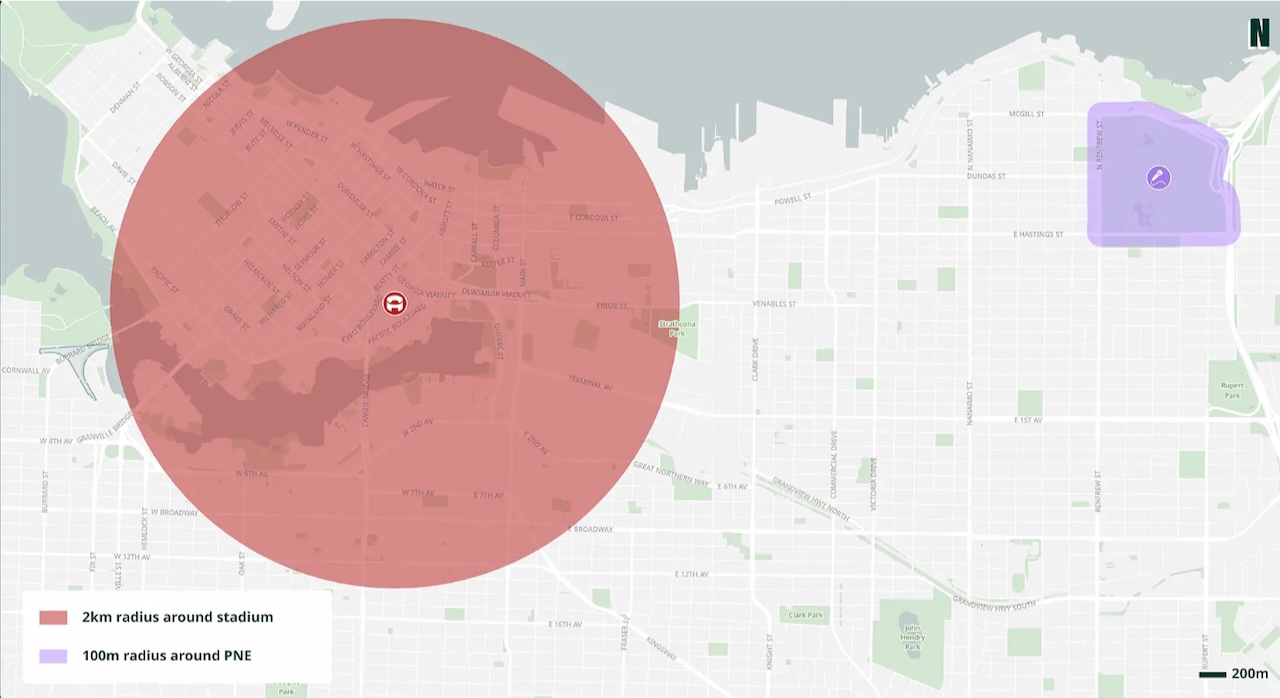
The city is expecting about 350,000 fans to attend the seven matches at BC Place.
With the BC Place radius capturing both wealthy and low-income Vancouver neighbourhoods including Yaletown, Gastown, Chinatown and the Downtown Eastside, concerns and confusion abound over how FIFA’s infamously strict brand protection will affect people living and working there.
Councillors’ questions to city staff about the changes during their Nov. 26 council meeting offered some clarification.
But the grey areas — what’s not captured in the bylaw wording, the potential for broad application and the reliance on individual city bylaw officers’ discretion over what is and is not an infraction — create uncertainty over the bylaw changes’ impact, said Laura Macintyre, staff lawyer with Pivot Legal Society.
“I just find it very concerning that we’re basically being asked to rely on good will of enforcement officers to ensure that the law is not abused,” she said.
“It’s a very basic principle of Canadian law that when a piece of law is intended to cause a particular consequence or allow a certain activity, it’s no answer for the state to just say that the realization of that consequence is uncertain, or it depends upon the exercise of discretion.”
Signs, food carts and street vending
Temporary changes to Ticket Offences Bylaw No. 9360 allow city bylaw officers to issue fines for infractions that range from $250 to $1,000.
Changes to Sign Bylaw No. 11879 require businesses to remove, cover or alter unauthorized signage that violates FIFA’s intellectual property, as covered under the FIFA brand protection program, within 24 hours of notice from the city.
This includes images of the FIFA World Cup trophy, official FIFA 2026 World Cup emblems and even the 2022 and 2023 World Cup emblems.
If businesses fail to act, and the city has provided proper notice, the bylaw authorizes city staff to enter private property and cover the offending signage themselves.
Private residential properties will require the owner’s consent, a warrant or “significant risk” to health and safety before the city is allowed to enter to remove offending signage.
FIFA’s intellectual property is also behind changes to Street and Traffic Bylaw No. 2849 to allow city staff to remove any commercial signage including unauthorized use of FIFA’s emblems and trophy. The same applies for signage that creates significant litter or blocks the flow of pedestrian traffic, and any “ambush marketing.”
During the policy and strategic priorities committee meeting last month, Coun. Pete Fry asked if posters for club nights and rock shows, including anti-FIFA-themed events, would also be removed under this bylaw.
“I’m worried that kids are putting up posters on a legitimate street pole for a show at the Red Gate and they’re going to get dinged $1,000 a pop,” he said.
But Jessie Adcock, lead on the city’s FIFA World Cup 26 Vancouver host committee, said that is not the intent of the bylaw.
“We will not be actively looking to bureaucratize the removal of all of these posters,” she said. “At the end of the day, what we’re trying to do is if something blatantly egregious that puts us in violation of our FIFA agreement or is, I would say, very offensive, it is a preparation for that eventuality.”
That isn’t spelled out in the bylaw changes, Fry noted, and Adcock responded that his concerns fell under a “grey” area the bylaw changes do not cover.
“We will be very busy, and it’s not meant to go after people in a proactive manner,” Adcock said. “That is just unrealistic in terms of the resources we have.”
Fry, who abstained from voting on the bylaw changes, said he was “struggling” with the fact the bylaw did not spell out what signage wouldn’t be affected.
Changes to Street Vending Bylaw No. 10868 restrict mobile street-level food vendors from operating within the two-kilometre zone, “unless they have received written permission from the General Manager of Engineering Services.”
But Pivot’s Macintyre suspects bylaw officers may use the bylaw to limit any kind of street-level vending, including in the Downtown Eastside, where residents often sell clothing, electronics and goods on the sidewalks.
“We know already that bylaws are enforced in a discriminatory way, especially in the Downtown Eastside,” she said.
Busking and street performances, normally allowed in many locations without a permit, will also be restricted under changes to Street and Traffic Bylaw No. 2849, including on sidewalks next to Library Square, Science World, the Vancouver Art Gallery, Queen Elizabeth Theatre, Terry Fox Plaza and SkyTrain stations within the two-kilometre zone. Granville Island also falls within the zone.
Street sweeps are already here
At the committee meeting Coun. Mike Klassen asked if the city would be conducting “street sweeps” of people sheltering outside, particularly in the Downtown Eastside neighbourhood within the two-kilometre zone.
City staff said no, but Coun. Sean Orr expressed skepticism.
“I, too, have heard concerns around increased sort of street sweeps, but I guess we’re not calling it that,” he said.
Macintyre is also skeptical, noting Klassen claimed there were no street sweeps during the 2010 Winter Olympics, contrary to documentation about the treatment of people living on Vancouver's streets at the time.
“We know that street sweeps happened in the 2010 Olympics; it was very well documented. Street sweeps happen daily in the Downtown Eastside — I’m confident there’s one happening now,” Macintyre said, adding that “street sweeps” are any displacement of people from a public space by city workers or police.
“Often in the course of doing so they also issue impoundment notices under the Street and Traffic Bylaw... and then they use that to confiscate people’s belongings. Often the belongings they’re relying on to protect themselves from the elements.”
As well, Macintyre noted a single-room occupancy hotel on Granville Street is set to close next June, during the temporary bylaw change period. BC Housing is working to find current tenants — many of whom struggle with poverty, addiction and mental health issues — alternative accommodations.
Orr asked city staff if there would be increased policing of people sheltering in parks, which is legal overnight but not during the day.
“There would be no increase to enforcement on sidewalks and in parks,” said Gurv Brar, director of departmental corporate services and program management at the city.
When Orr asked about the impact on homeless shelters within the two-kilometre zone, Brar said they will operate as normal.
“If there’s a safety issue of major obstructions, I believe our engineering department does followup on that. But nothing new would be done as a part of the games,” Brar said.
Klassen also asked about safeguard measures for vulnerable people within the FIFA zone. City staff said that would be covered by a FIFA human rights action plan, co-ordinated across the 16 host cities, that will be presented to council in the new year.
“It’s one of our obligations as the host city, and it addresses this topic, among many others,” Karen Levitt, deputy city manager, said, adding the release of the action plan is up to FIFA, not the city.
“I think there’s about 30 different categories that FIFA has had us dig into and make sure we can mitigate risks and harms in each of these categories. We have done outreach; we’re doing outreach in the Downtown Eastside right now.”
But Macintyre said that if outreach is happening in the neighbourhood, that’s news to her and many of the non-profit and community organizations operating there.
“We have zero information and clarity on what that outreach entails, and who they’re speaking to about what,” she said, adding human rights violations connected to mega-events like the Olympics and World Cup have been well documented.
With hundreds of thousands of visitors expected during the games, the city has a “vested interest” in removing visible indicators of the housing, drug and mental health crises on our streets, Macintyre said.
She would rather the city acknowledge the real impact mega-events have on vulnerable populations, she told The Tyee, and conduct an “open, transparent” consultation process around the human rights plan with affected communities, instead of offering vague assurances.
“I think these bylaw changes give the city a lot of leeway to do so in the name of protecting branding, making sure that there’s not too much foot traffic, and reducing density,” she said.
“It gives them discretion to get rid of a lot of the markers that they see as potentially problematic for them.”
24 hours to remove graffiti
Temporary changes to Building Bylaw No. 14343 will be in place the longest, starting Jan. 1, in order to accommodate the construction of temporary event-related structures, primarily tents, “air-supported structures,” modular buildings and shipping containers.
These include relaxation of some fire safety, ventilation, egress, lighting and structural design standards. Any temporary structures must be removed within 60 days of the end of the games on July 19, 2026.
Under the temporary changes to Graffiti Bylaw No. 7343, businesses that fail to remove graffiti within 24 hours’ notice from the city will face a $1,000 fine.
That’s not enough notice, Fry told city staff, calling it “onerous” for small-business owners.
“Even when we had the problems with graffiti in Chinatown, we were more supportive of independent businesses,” he said.
“And I worry that in the context of FIFA, fans, what have you, we might see more graffiti unfairly burden small businesses.”
Levitt responded that city bylaw officers will be more concerned with pop-up or “ambush” marketing that violates FIFA’s advertising rules, as well as hate-speech graffiti.
“We need these rules in place to make sure we don’t have that graffiti on the worldwide stage with billions of people literally watching Vancouver,” she said.
Businesses would be working to remove graffiti anyway, Levitt added; the bylaw change just speeds up their timeline.
Jordan Eng from the Vancouver Chinatown Business Improvement Area Society agreed with Fry that 24 hours isn’t enough time for businesses to remove any graffiti.
Even with their long-term removal contractor, Mission Possible, and funding from the city’s Uplifting Chinatown program, removal currently happens within a couple of weeks, he told The Tyee.
“The timing, on a literal basis, on the bylaw would make it difficult for us to keep up,” Eng said, adding removing “racial” or “offensive” graffiti takes priority.
But the business association has been in contact with the city about the bylaw changes, and Eng added the roughly two-month period the changes will be in effect will “go by in a heartbeat.”
“From what we understand [the bylaw change] is really a tool for if it becomes a problem,” he said.
Another change to Street and Traffic Bylaw No. 2849 removes restrictions against trucks on downtown streets within the game zone, specifically between the hours of 10 a.m. and 3 p.m.
Noise Control Bylaw No. 6555 will also be relaxed during game time, allowing noise 24 hours a day at FIFA and city sites if associated with waste removal; the maintenance, repair and operation of structures and transportation; TV and radio broadcast production; and portable toilet cleaning.
Music and entertainment, as well as public announcements at FIFA and city sites, will be exempt from noise restrictions from 8 a.m. to midnight.
A designated area around Science World — from Ontario Street to Station Street and 1st Avenue to National Avenue — will also extend solid waste removal noise allowance from 6 a.m. to 8 p.m. on weekdays and 8 a.m. to 8 p.m. on holidays and weekends.
When Klassen inquired about quality of life for people living within the two-kilometre zone, Levitt said the relaxation period will be short and affect areas that are already noisy.
“A lot of the places where that will be happening are already kind of places that are used to elevated noise around entertainment districts, and so on,” she said.
“It will be an active period for the city, especially around the PNE and the stadium and Killarney.”
The city will soon release an updated version of its host city community activation guidelines, Levitt added, which will include information about support for local businesses affected by the games, for example by reduced public access through street closures.
When Orr asked Levitt how businesses were being made aware of the changes to the graffiti bylaw in particular, she said the city was in regular communication with business improvement associations and businesses themselves.
But Macintyre thinks the city should be engaging residents in a “robust public education program” about all the bylaw changes, as well as their rights.
“And what that means for their lives and their ability to post signs, vend on the streets and that sort of thing,” she said. ![[Tyee]](/design-article.thetyee.ca/ui/img/yellowblob.png)
Read more: Rights + Justice, Municipal Politics, Sports, Urban Planning






Tyee Commenting Guidelines
Please note that email notifications for replies are not currently working due to a software issue which may be resolved in a future update.
Comments that violate guidelines risk being deleted, and violations may result in a temporary or permanent user ban. Maintain the spirit of good conversation to stay in the discussion and be patient with moderators. Comments are reviewed regularly but not in real time.
Do:
Do not: