


 SHARE:
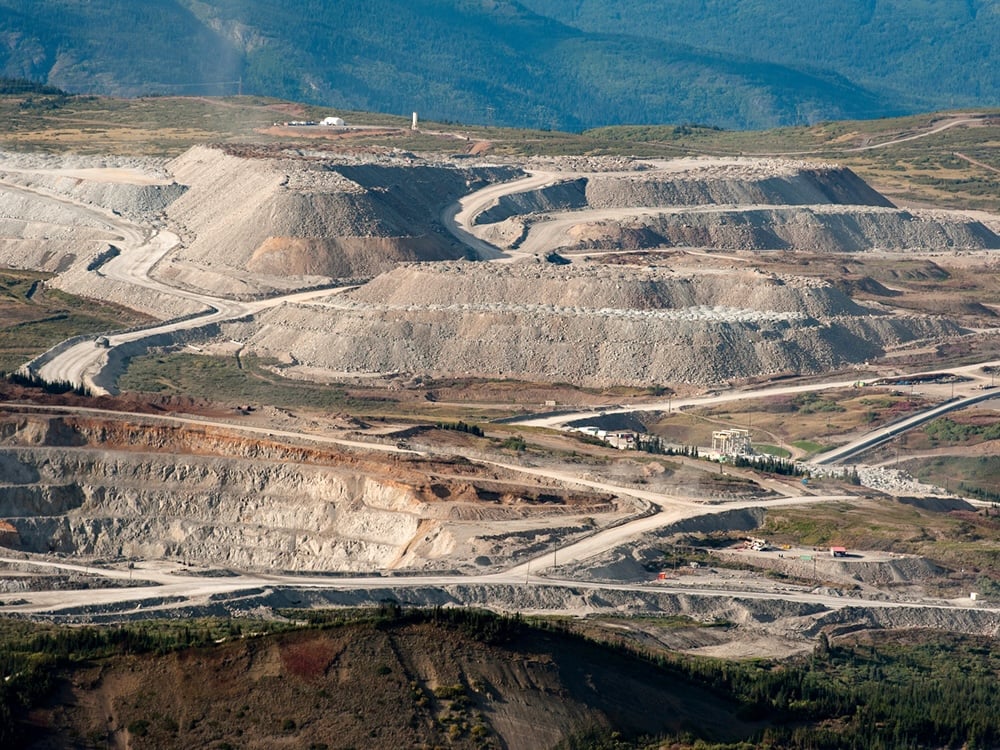
Relief finally arrived last week for three workers trapped deep underground behind a wall of caved-in rock for more than 60 hours at the Red Chris mine in northern B.C.
The morning after the rescue, Bernard Wessels, global group head of health, safety and security for Newmont, which has a 70 per cent stake in the mine, donned a hi-vis jacket to deliver the good news.
“This one caught us by surprise,” Wessels said. “We need to go and understand that.”
As the Red Chris mine embarks on a new, riskier form of mining, it might not be the last time owners or workers are caught unprepared.
Red Chris has been operating as an open-pit mine since 2015. But Newmont has applied to switch to block cave mining — an underground method that comes with added stability concerns. If approved, it will be Canada’s second block caving mine, and its largest.
The province added Red Chris’s block cave proposal to its list of fast-track decisions earlier this year. It has yet to make a decision. Putting the proposal on the fast-tracking list received pushback from the Tahltan Nation, which wasn’t engaged about the decision despite having signed a consent-based decision-making agreement on the mine with the province.
Via email, a spokesperson for Newmont told The Tyee that the Red Chris mine employs around 220 members of the Tahltan Nation, procures over $100 million of business annually with Tahltan Nation Development Corp. and shares revenue with the nation through their Impact, Benefit and Co-Management Agreement. The company said that, if approved, its block caving proposal would allow for continued economic growth and prosperity for the nation and the workers at the mine.
The mine began its preparatory work underground four years ago to build the network of tunnels required for block cave mining if its plan goes ahead.
That’s where the problems began last week, when two “fall of ground” incidents occurred in the same section of tunnel. The first fall was less substantial and left the mine’s communication system intact, allowing the company to tell the three trapped workers to retreat to a metal refuge chamber the size of a small camper. The second fall was larger, blocking the entire tunnel with a pile of rock 20 to 30 metres long and seven to eight metres high. After the second fall, the company lost communication with the workers until their rescue last Thursday.
Work on the above-ground section of the mine has continued, but work underground has paused. The company and province have since launched investigations into the cause of the fall.
Those findings will be important, said David Chambers, a geophysicist and president of the Center for Science in Public Participation, because the mine’s block caving plan will bring new risks.
By extending the mine’s lifespan, block caving at the mine also could exacerbate growing watershed contamination the company failed to predict when it first began its open-pit operations.
Going underground in search of more ore
The Red Chris mine site sits at the headwaters of the Stikine River, a key fish-bearing watershed in Tahltan territory in northwestern B.C. Since it began operating, it has dug an Empire State Building-sized hole in the earth and constructed a tailings pond larger than Stanley Park.
The mine is currently owned by Newmont Corp., one of the world’s largest mining companies, and Imperial Metals Corp., its former sole owner.
Open-pit mining is common in B.C.; it’s relatively low-cost for the company and safer than mining underground. But it also takes a heavy environmental toll, and it works only when ore deposits are shallow.
“We mine the easy stuff on surface, but at some point you go as deep as you can, and there's still more to mine,” said Erik Eberhardt, head of the geological engineering program at the University of British Columbia.
That’s where Red Chris’s block caving application comes in. Block caving works like open-pit mining in reverse: instead of mining down from above, block cave mines tunnel underneath their desired ore. Rocks are then pulled down into the tunnel through funnel-like dispensers — sort of like a giant gum-ball machine. As the rocks are pulled out from below, the rock above caves in under its weight, creating a sinkhole above ground.
The vast network of tunnels establishes different dispensers at various points to target hot spots for ore — in the case of Red Chris, copper and gold.
While B.C. hasn’t granted Red Chris approval to begin block caving, it did allow the company to create a network of underground tunnels in preparation for the caving to begin.
To keep stresses on the rock under control while creating the tunnels for block caving, engineers will reinforce tunnels with things like bolts and steel arches. They will also recommend inserting strategic fractures, using the same technology companies use to frack oil and gas, to balance out strains. By email, a spokesperson for Newmont said the company’s preconditioning activities would require fewer additives than fracking for oil and gas, are spatially limited to the mine, and do not require cracks in the rock to be left open, allowing for more water recovery.
“Our modelling shows that preconditioning activities will not be heard outside of the mine site and are not anticipated to cause an earthquake,” the spokesperson said.
In the case of the Red Chris mine, the company’s reinforcements failed, allowing a wall of rock to cave into a tunnel and block off access to the outside world.
For now, the cause of that miscalculation remains a mystery.
“Any underground construction has this risk,” said Eberhardt. “Whether you're developing a mine, whether you're developing a tunnel for a highway or a rail line, there's always the potential for collapse.”
There might have been little Red Chris could have done to prevent the accident, said Eberhardt, particularly if a portion of weak rock was lying parallel to the tunnel and therefore hidden from those doing the blasting.
But it could also have stemmed from the company’s failure to monitor or reinforce the rock appropriately.
In an email to The Tyee, the Ministry of Mining and Critical Minerals said it “anticipates that the outcome of Newmont’s investigation and report to the chief inspector will inform adjustments to the technical review.”
It added that its review processes underway “include a comprehensive review of the geotechnical design of the proposed underground mine to ensure it adheres to mining code requirements and professional best practices.”
Understanding the origins of a tunnel failure is important going forward, René Gómez, an expert on block cave mining at the Universidad de Concepción in Chile, told The Tyee. But he added that issues in the tunnel, which can be far away from the actual mine, don’t necessarily mean the block caving mine will face the same challenges, particularly because companies tend to invest more in testing the rock inside the block caving mine itself.
Concerns about stability at Red Chris
Interveners and governments have raised concerns about stability issues during Red Chris’s environmental assessment process for its block caving application, with some pointing to gaps in the company’s transparency around its geotechnical modelling.
Known stability risks include a nearby landslide complex south of the mine site. Newmont has acknowledged that mining-induced landslides are an unlikely but possible outcome.
As mines across B.C. exhaust their supplies of shallow, easy-to-access ore, switching to block caving is a likely next step for many mines in the province, and around the world, said Eberhardt.
“It's where the next generation of large mines is going,” Eberhardt added. This new era of mining will be needed to access the stores of copper needed for the energy transition, he said. Over time, Eberhardt expects underground mines to get deeper as companies run out of ore that’s easy to access.
But those deep mines bring higher temperatures and pressures, which exacerbate their structural risks, said Gómez. “When we are working in deeper zones, we have harder rocks and higher stresses,” said Gómez. “It makes a lot of problems.”
Early block cave mines from the 1970s and onward were relatively shallow at around 200 metres below ground, but today at least four operational and proposed block cave mines are 1,000 metres deep. Red Chris is one of them.
Eberhardt told The Tyee that mining companies are active funders and participants in research to better understand these risks. That includes Red Chris’s owner, Newmont, which funds studies at the University of British Columbia.
“The companies are always looking to invest in research to do things better, and to understand things better,” he said.
Last week’s incident at Red Chris, he added, will likely inform future prevention efforts across the industry.
A Newmont spokesperson told The Tyee by email that block caving is a “safe underground mining method that is used in about 17 mines around the world.”
The proposed Red Chris block cave project will be subject to evaluation and approval by geotechnical experts and environmental experts with the B.C. government and the Tahltan First Nation, the spokesperson added.
Canada’s only other block caving operation so far is the New Afton mine, located near Kamloops, B.C., which began its underground work in 2012. The mine has experienced stability issues related to its block cave operations, including a rush of mud into a tunnel that killed one worker and injured two in 2021. In 2023, the mine paused operations because of concerns that block cave activity was threatening the stability of its tailings dam. The mine has since undergone a project to stabilize its tailings dam.
“There needs to be a precautionary approach,” said Nikki Skuce, director for the environmental advocacy organization Northern Confluence. “What are some lessons learned at New Afton to apply to this potential site?”
Surprise pollution
Questions also remain about the long-term environmental impacts of the mine.
In its application for its earlier, open-pit operations, Red Chris failed to anticipate the scale of contamination it would cause, according to a recent report by the environmental non-profit SkeenaWild Conservation Trust, which found elevated levels of pollutants such as selenium, sulphate and nitrate in nearby creeks and lakes, often at levels high enough to harm aquatic plants and animals. Elevated levels of selenium, which can lead to fish deformity and death, were particularly high in the two lakes closest to the mine.
Adrienne Berchtold is an author of the study and an ecologist at SkeenaWild. Her research found that those issues were, in part, due to the company’s failure to understand its site conditions. In some areas, the company had no site-specific baseline studies to compare its impacts with.
“The proponent wasn't required to really understand the site all that well before they designed the mine and were given permits to build it,” Berchtold told The Tyee.
During the period Berchtold was studying the pollution, the company and the province did little to address the issue, allowing the mine’s operations to continue and leading to what Berchtold called a “wait-and-see approach” to mining pollution.
“The province is really complicit in that,” she said.
By email, a Newmont spokesperson noted SkeenaWild’s research looked at the period before the company acquired Red Chris from Newcrest Corp. in 2023.
“Newmont has been working in close partnership with Tahltan Nation to co-manage the mine and invest in environmental protections that reflect our industry-leading sustainability standards,” the spokesperson said, adding the company has since taken steps to address pollution, including installing new seepage interception systems and investing in monitoring systems. The spokesperson also noted that block caving would extract less acid-generating waste rock than its existing open-pit approach, decreasing the intensity of pollutants relative to each unit of ore they mine.
B.C.’s Ministry of Mining and Critical Minerals added by email that “many of the issues mentioned in the report have been addressed by Newmont to the satisfaction of inspectors.”
While Berchtold acknowledged Newmont had made improvements since it took over the mine, she said she has outstanding concerns. For example, while the company acknowledges that selenium levels in nearby fish tissues are rising, it hasn’t investigated to determine how and why the contamination is happening.
“We need to know what is causing those issues to address them,” said Berchtold, adding that the mine’s seepage interception systems remain limited.
Chambers of the Center for Science in Public Participation told The Tyee that the recent rockfall incident compounds the need to take a closer look at the mine’s expansion proposal.
“My main takeaway is, well, here's another unanticipated problem,” he said. ![[Tyee]](/design-article.thetyee.ca/ui/img/yellowblob.png)
Read more: Energy, Labour + Industry








Tyee Commenting Guidelines
Please note that email notifications for replies are not currently working due to a software issue which may be resolved in a future update.
Comments that violate guidelines risk being deleted, and violations may result in a temporary or permanent user ban. Maintain the spirit of good conversation to stay in the discussion and be patient with moderators. Comments are reviewed regularly but not in real time.
Do:
Do not: