


 SHARE:

- All Things Move: Learning to Look in the Sistine Chapel
- Biblioasis (2023)
On the surface, Jeannie Marshall’s book All Things Move: Learning to Look in the Sistine Chapel is about the author’s immersion with Michelangelo’s masterwork. But, of course, there is much more than that.
Part memoir, part art theory, and all manner of exploration: All Things is an essay in the greatest sense of the word, a meaningful attempt to get to the very heart of why art matters.
So, why does it matter?
To be frank, I am sometimes nonplussed by the towering edifices (literal and metaphoric) that are constructed around something so fundamental — and in one sense simple — as making art. And by simple, I don’t mean easy or facile, but something deeper than that. Elemental, let’s call it. Ever since humans have been around, we’ve been drawing, painting and carving. The act of making art is so embedded in our genetic code that extricating it from what it means to be human is impossible and also why would you want to do that?
A number of years ago, when I was working as the director of programming for the DOXA Documentary Film Festival, our closing night film was Werner Herzog’s Cave of Forgotten Dreams. In 3D no less.
I will spare you the agonies and the ecstasies of organizing the screening. Suffice to say it probably shaved a few years off my life from stress alone. But sitting in the theatre, watching the film with a sold-out audience, I was astounded by the nature of the place. The paintings of creatures that grace the walls of the cave undulate where the rock bulges or recedes. The bumps, knots, whorls of stone are incorporated into the art itself to create not only vivid and febrile versions of the animals, but a totality of experience. The cave itself becomes a holistic integrated marvel of image and space: the two things wedded inextricably together to create a sacred place.
Michelangelo’s famous ceiling does something similar, incorporating the aspects of the physical structure of the chapel in the frescoes themselves. Separated by time and distance, these two sites are both attempts to understand the world through art. But before we get to that arty part, let’s go back a bit to how Jeannie Marshall came to the Sistine Chapel.
After living in Rome for a number of years, Marshall still wasn’t all that comfortable visiting the famed site. In part, this reluctance had something to do with the throngs of hot, sweaty tourists craning their necks to take in the frescoes. But also, Marshall’s unease with the artwork was prompted by something altogether deeper and thornier. Namely: what does this densely obscure, wildly over-exposed artwork mean in our current age?
As a personal investigation, All Things Move branches out like an enormous tree, taking in a broad array of subjects: religion, history, family — and that’s only in the first few chapters. Structure is where everything begins, in the building blocks of cells, in the preparation and composition of a painting and in the case of a book, the chapters and their subheadings, breaking a massive project into its constituent parts aligned with the component panels of the famed ceiling. There are the massive Sibyls, prophets of the ancient world, the corner pendentive paintings, the architectural supports of the chapel itself and finally, the grand slam of The Last Judgement, what Marshall calls The End of Things.
While All Things Move takes as its informing idea the construction of the Sistine Chapel, its different sections and the figures and stories therein, there is also an element of deeply personal inquiry, beginning with the author’s own childhood and adolescence.
Marshall begins her story in the height of the global pandemic, when the streets of Rome had gone eerily still and silent. Michelangelo own’s experience encompassed earlier plagues, when the Black Death would pop up and take a whack of folks out. Reading the book, one of the things that kept circulating was the patterns and echoes of history, both micro and macro.
The painter started work on the ceiling in 1508 and finished in 1536 with The Last Judgement. The creation period was one of dizzying social and political upheaval that rivals our own in present day. Religious clashes, the Sack of Rome, war and people just generally being crazy. Over this period of time, Michelangelo changed from a young man brimming with confidence, ego and a wee bit of hubris to an older, more chastened individual, as witnessed by the evolution in the frescoes themselves. By the time of the project’s completion, he was arguably a different man. Life will do that to you.
During her time in Rome, Marshall avoided the chapel for a number of years. When friends came to visit and expressed an interest in seeing it, she bluntly told them they were on their own. But a few weeks after the death of her mother, Marshall finally saw it. This first viewing was not a great experience: the heat, the crowds, the confusion of the thing itself. How to make sense of this damn overwhelming creation, teeming with larger-than-life characters and stories as well as colour, form, flayed skin, angels, devils, biblical-scale events — and, of course, God, wafting about on a cloud.
The experience proved so unsatisfying that Marshall was forced to return, if only to try and gain a better grip on this monumental artwork. As she writes: “The images in the Sistine Chapel are not simply biblical illustrations; they are also the products of an intellectual culture, of the ideas of one of the most influential artists of the Renaissance, and of the consequences of historical events. Out of a sense that seeing this work could yield some insight into the past and the present, that it could lead me to see something of the world of now that we all inhabit and that world in relation to my own life, I decided to persevere. I was finally ready to be situated.”
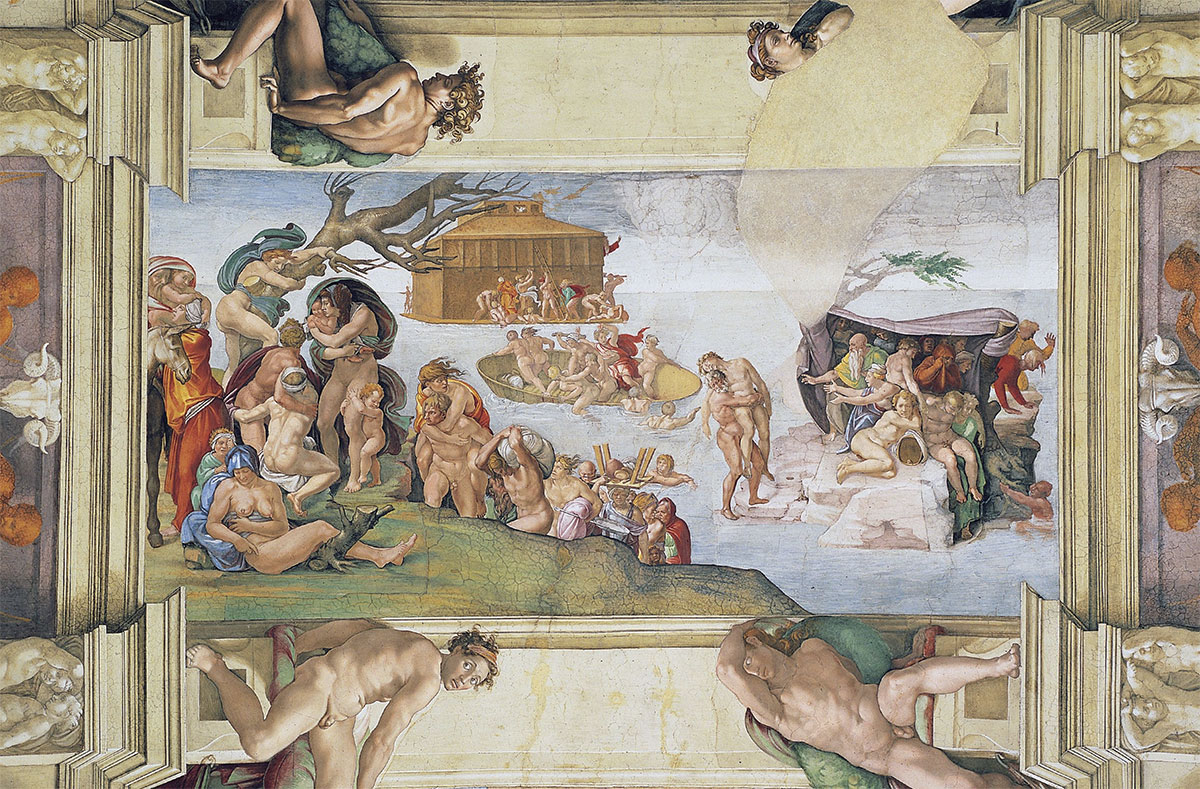
The Deluge is where she starts, a particularly apt and perhaps painful place to begin given where we current humans are at, standing on the precipice of climate catastrophe and the looming threat of rising waters. While compelling, it isn’t the figures of doomed humans straggling out of the biblical flood, juggling possessions and young children, but it’s the void between ocean and sky that snags the author’s attention. Michelangelo painted it a deadened grey-blue, an elemental emptiness that brings on something of an existential crisis in Marshall.
Of this particular section of the work, and maybe also about this period in time, she writes: “We still don’t know who we are, where we come from, or where we’re going.”
Emotional encounters with great works of art can mess with people in profound ways. From Stendhal Syndrome to acts of outright violence. Michelangelo’s sculpture Pieta was attacked with a hammer, Barnett Newman’s painting slashed by an angry viewer, and the list goes on.
Why people feel compelled to physically assault art is a curiosity, but it continues, with activists throwing foodstuffs at the Mona Lisa or Van Gogh’s Sunflowers to make a point about the climate crisis.
Art as conduit to the divine makes people a little uneasy. This is especially true of the voluptuous creations of the high Renaissance, testimonials to the power and wealth of the Catholic Church. But all this beauty, heralding the majesty of God, as well as the largesse of a few different popes, cost a considerable amount of filthy lucre. Marshall dedicates a good chunk of her book to detailing what happened when the sale of indulgences (pay money, get out of Hell) attracted the attention of religious reformers. One Martin Luther proved sufficiently vexed to nail his infamous 95 Theses to a church door and hello, here comes the Reformation!
The reminders of the 1527 Sack of Rome are still carved into the walls of the city, lingering rage-filled residue that speaks of the conflagration that halved the population of Rome. Famine, plague and refugees fleeing the violence also contributed to the decimation. But as Marshall indicates, this eruption had an unexpected effect.
She quotes Brad S. Gregory’s book Rebel in the Ranks: “The Protestant reformers also did not intend another consequence of the Reformation that remains deeply influential today: people’s ability to answer questions of meaning and morality in an open-ended variety of ways both religious and secular.”
As Marshall points out, art can encompass time, both backwards and forwards. Which is perhaps why we humans perpetually return to it, seeking something to indicate why any of this stuff is happening. Even as Marshall herself repeatedly returns to the Sistine Chapel courting hope and frustration, uncertain about where this immersion will ultimately lead, larger questions linger. “But I can’t stop. I keep coming back, I keep going over it again and again as though civilization depended on it. And it feels that way, it feels as if civilization really does depend on it.”
Sometimes it is the smallest details of frescoes that speak the loudest, whether it’s splayed toes of Libyan Sibyl or the figure of Isaiah, sticking one finger between the pages of a book to mark his place. Reminders that above all, this is a deeply humanist work that situates the grandest epic in a resolutely humble and human experience.
Join The Tyee’s culture editor Dorothy Woodend for an evening with Jeannie Marshall on Thursday, May 4, 2023, at 7 p.m. at Upstart & Crow, 1387 Railspur Alley, Granville Island, Vancouver. ![[Tyee]](/design-article.thetyee.ca/ui/img/yellowblob.png)






Tyee Commenting Guidelines
Comments that violate guidelines risk being deleted, and violations may result in a temporary or permanent user ban. Maintain the spirit of good conversation to stay in the discussion and be patient with moderators. Comments are reviewed regularly but not in real time.
Do:
Do not: