


 SHARE:
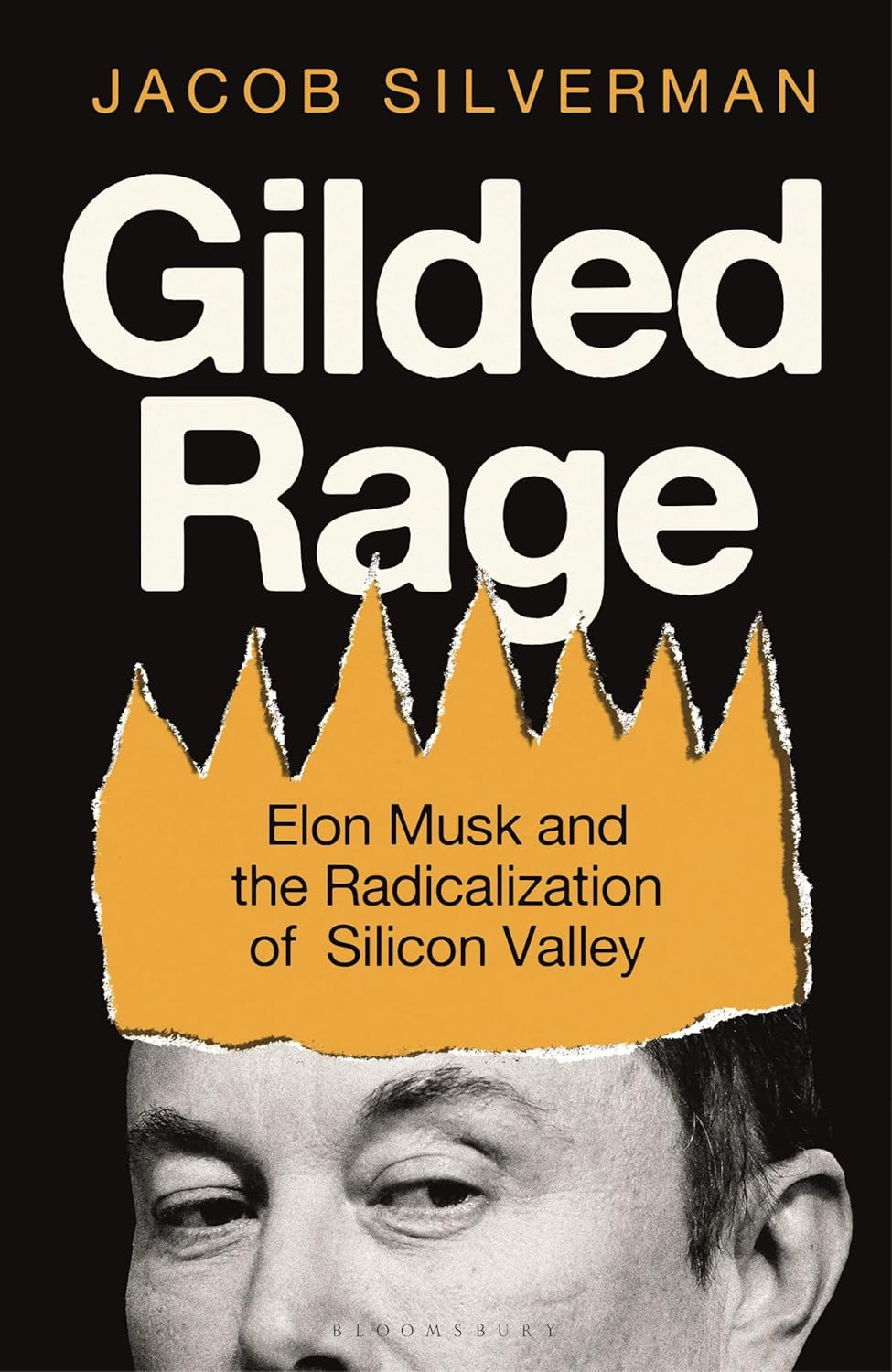
Gilded Rage: Elon Musk and the Radicalization of Silicon Valley
Jacob Silverman
Bloomsbury Publishing (2025)
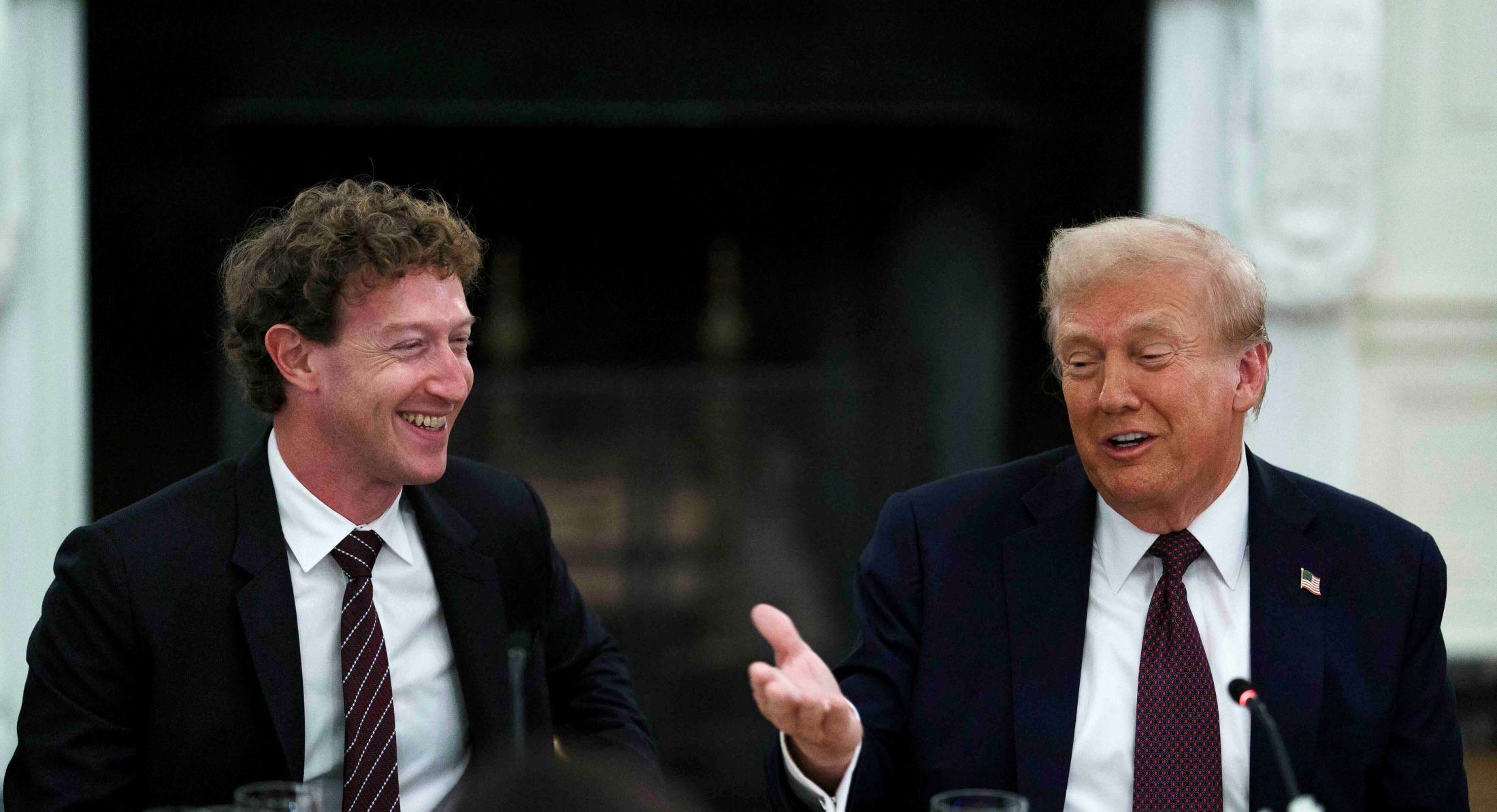
A coterie of tech industry leaders gathered around a long dining table in the White House on the evening of Sept. 4, each draped in dark suits, smiles pulled back wide. There was Mark Zuckerberg of Meta, Tim Cook of Apple, Sundar Pichai of Alphabet and Google, Satya Nadella of Microsoft and Sam Altman of OpenAI, to name a few. These were the tech industry’s elite, some of the wealthiest and most powerful men in the world.
At the centre of the group, with Zuckerberg to his right and Microsoft co-founder Bill Gates to the left of his wife, Melania, was U.S. president Donald Trump, the man they had all come to dote on. He sat under a portrait of Abraham Lincoln, artificially bronzed in a room full of gaudy gold fixtures.
It was a scene that would have seemed farcical if it weren’t for the already farcical nature of our present-day reality. Several of the men at the table, such as Cook, had recently been browbeat by the Trump administration with regulatory threats.
That night, Cook thanked the president profusely for his “leadership” and promised to invest $600 billion in domestic manufacturing.
Zuckerberg, who Trump once warned would “spend the rest of his life in prison,” was caught on a hot mic at the dinner telling the president that the “at least $600 billion” he claimed Meta would invest in the U.S. through 2028 was a figure seemingly made up on the fly.
"I’m sorry, I wasn’t ready,” Zuckerberg told Trump in an unscripted moment. “I wasn’t sure what number you wanted to go with!"
The obsequious public fawning was jarring. It wasn’t long ago that some of these tech leaders had vigorously denounced the president.
Following the insurrection on the U.S. Capitol on Jan. 6, 2021, which Trump had fomented, was impeached for and would later retcon as patriotism, Zuckerberg told a March 2021 House committee, "I believe that the former president should be responsible for his words and that the people who broke the law should be responsible for their actions.” He called it a “disgraceful moment in our history.”
Shortly after the Capitol riots in January 2021, Cook told CBS This Morning, “I think no one is above the law… that’s the great thing about our country, we’re a rule of law country. I think everyone that had a part in it needs to be held accountable. I don’t think we should let it go.”
Pichai called the events of Jan. 6 “the antithesis of democracy” in a memo to Google employees. In 2018, Nadella said the first Trump administration’s policy of separating immigrant families and children at the Mexico border was “abhorrent,” “cruel and abusive.”
In the lead-up to the 2016 election, OpenAI’s Altman called Trump “unfit to be president” and “a threat to national security.”
Yet there they all were at the White House last month, gassing up an ascendant autocrat. As these titans of Silicon Valley kissed the ring, one familiar face was missing.
Businessman, former Trump advisor, and frequently the richest person in the world, Elon Musk had spent nearly $300 million and leveraged his vast influence to help secure Trump’s second presidential victory, receiving in kind the opportunity to gut the administrative state with his Department of Government Efficiency project before falling out with the president in June of this year.
The scene at the September dinner, including Musk’s absence, was an intuitive, if dystopian, coda to American journalist and author Jacob Silverman's latest book, out this month through Bloomsbury Publishing.
Gilded Rage: Elon Musk and the Radicalization of Silicon Valley looks to take stock and make sense of the teetering moment in which we find ourselves.
Curdled futurism
Silverman started working on Gilded Rage in early 2023 as a “hunch,” writing that, “It seemed to me that some of America’s most famous tech executives and venture capitalists were moving — often quite vocally — to the political right.”
That hunch proved correct, with Gilded Rage tracing how those tech elites’ vision of the future turned dark, and how the people who run the companies that touch most of our lives have come to see the world not as something to improve, but as something to overcome.
Silverman shows that for many of these oligarchs, simple regulation and the rule of law are no longer the sole enemies of progress, but also democracy and our shared sense of humanity.
While Musk plays an outsized role in this story, he is only part of it.
There are the hordes of cryptocurrency grifters who have bought their way into political influence, including Sam Bankman-Fried, the wünderkind founder of the cryptocurrency exchange FTX.
Silverman first met Bankman-Fried at a media event during his meteoric rise. A year later, in summer 2023, Silverman would bump into him in the courthouse ahead of one of his pre-trial hearings after being caught stealing $8 billion in FTX customer funds.
We get a look at petty billionaires like David Sacks, who led and funded a campaign to oust progressive District Attorney Chesa Boudin in San Francisco.
Silverman also writes about venture capitalists such as Marc Andreessen, who have invested in “Network State” projects like California Forever, an investor-backed utopian city that tech journalist Gil Duran described as part of “a movement which seeks to build new sovereign territories ruled by tech plutocrats.”
These people and their projects all ladder back to the curdled futurism promoted by those like Musk: one of isolationism, accumulation and consolidation, where modern society’s failures under the weight of capitalism can only be fixed by more extreme expressions of it.

A salvo to the ‘woke mind virus’
A number of stories in Gilded Rage have only accelerated since they were first reported. It can be difficult to keep up with these seemingly disparate headlines flashing across our various social feeds.
Many of the figures in the book have themselves become addled by the technology of our digital age. Twitter did such psychic damage to Musk that he decided to buy it, gut it, rename it X and reshape it into a rickety propaganda arm and gooning companion.
Gilded Rage’s author, Silverman, with the help of the Reporters Committee for Freedom of the Press, successfully sued X in August 2024 to reveal the investors who helped Musk purchase the company for $44 billion in 2022.
Some names include Twitter founder Jack Dorsey, Saudi Arabian billionaire and Prince Al Waleed bin Talal al Saud, and Sean “Diddy” Combs. Oracle co-founder and longtime Trump supporter Larry Ellison is among them.
Ellison and his son, David, are poised to become a dominating force never before seen in American media, with David’s company Skydance recently merging with Paramount, and that conglomerate reportedly preparing a bid to take over Warner Bros. Discovery.
Ellison is also part of a bid to control the American version of the social media platform TikTok, that sale part of a pressure campaign by the Trump administration.
All of these companies would be owned by Ellison, a man who once joined a call with officials who conspired to overturn the 2020 presidential election results, according to the Washington Post.
Fortune recently described Ellison as “[seeing] a growing opportunity for his company to help authorities analyze real-time data from millions of surveillance cameras.”
The purchase of X was a salvo in, as Musk has proclaimed many times over the years, his war against the “woke mind virus.”
Here in Canada, ripple effects
Musk’s increasingly extreme ideological bent is not unique, but it does appear to have spread, or at least emboldened fellow tech leaders to step rightward, even in Canada.
In the last two years, Shopify CEO Tobi Lütke has continuously promoted far-right ideas on social media.
Reporting for the Breach in December 2024, Paris Marx wrote that Lütke has “praised Trump’s threat to enact 25-per-cent tariffs on Canada, stating that the U.S. is ‘within its rights’ to do so. He has retweeted posts calling for social support programs to be cut because ‘Canada spends billions on illegals, asylum and refugees.’ And he’s generally spread right-wing misinformation about the state of Canada and the world.”
Kaz Nejatian, the former chief operating officer of Shopify who left the company last month, was even more open in his beliefs, Marx notes.
“Nejatian’s right-wing associations became even clearer in 2017, when he and his partner Candice Malcolm, a former columnist at the Toronto Sun, took over a charity called True North and turned it into a right-wing media organization,” Marx wrote.
True North once published an interview with Gavin McInnes, the founder of the Proud Boys, a far-right group designated as a terrorist entity in Canada.
These are, and were, the leaders of one of Canada’s largest companies.
One that has refused to do anything about sellers who use their e-commerce platform to fund hateful organizations, with Lütke once stating, “products are speech and we are pro-free speech.”
Shopify only took action on musician Kanye West for selling a T-shirt emblazoned with a swastika because it was “not a good faith attempt to make money,” journalist Rachel Gilmore reported at the time.
These hollow ideological arguments are this ilk’s bread and butter. The chest-thumping calls for protection of “freedom” and “free speech,” consistently a culture-war cudgel for the right, have become an insultingly low-effort straw man for tech.
We see that borne out to extreme degrees as Silverman guides us through the libertarian nihilism of Peter Thiel, a man who once wrote that freedom and democracy are incompatible, and whose influence and acolytes stretch to funding the senatorial campaign of current U.S. Vice-President JD Vance.
In the last year or so, Thiel has been pushing the idea that anyone standing in the way of the advancement of AI — critics, regulators, Greta Thunberg — are working in service of the Antichrist, literally referring to the Biblical figures whose deceit is prophesied to usher in the Last Judgement and Second Coming of Jesus Christ. In September, he gave a series of closed-door lectures on the topic.
As Silverman lays out, Thiel and others are helping facilitate hell on earth for untold numbers of people around the world, as tech becomes increasingly entwined with the security state.
Thiel’s company, Palantir, has been contracted to create tracking tools for Immigration and Customs Enforcement. The government agency will use those tools to locate, surveil and deport undocumented migrants.
The Miami Herald reported on Sept. 16 that “the whereabouts of two-thirds of more than 1,800 men detained at Alligator Alcatraz during the month of July could not be determined.”
Palantir, in an ongoing effort to streamline these horrors, was due to deliver a prototype of a new AI system called ImmigrationOS on Sept. 25.
Palantir also supplies its Artificial Intelligence Platform to the Israel Defence Forces, who, as Bloomberg reported, use the technology to identify potential targets and propose air strikes and battle plans in Israel’s ruthless siege on Gaza, which a UN Commission officially called a genocide in September.
That’s the sharp, violent end of Silicon Valley’s radicalization.
A gilded age?
On Sept. 17, a group of crypto investors installed a 12-foot golden statue of Donald Trump holding a Bitcoin outside the U.S. Capitol. It was meant to pay “tribute to Trump’s outspoken support for cryptocurrency,” per ABC’s Washington affiliate.
On Sept. 4, Google, which was found to hold an illegal monopoly in the internet search market last year, avoided getting broken up in a landmark antitrust case.
“Google had a very good day yesterday. Do you want to talk about that big day you had yesterday?” Trump asked Pichai while the tech elites dined at the White House on Sept. 4.
“I’m glad it’s over,” Pichai said as the other CEOs laughed.
That’s the endlessly stupid, gutless end of Silicon Valley’s radicalization — and these are the people guiding our future. Gilded Rage excels at illustrating just that.
The writer Kaleb Horton, who died last month, once wrote that “the 20th century was a long time ago and it’s a ghost now. A ghost you see in places you wouldn’t expect.”
Horton was ostensibly talking about the decline of retail and how the world has changed so much, so fast, in such a short amount of time. The recent past is almost unrecognizable.
That things have been rushed in this direction should be enraging. Radicalizing.
It’s also a reminder that they can still change. ![[Tyee]](/design-article.thetyee.ca/ui/img/yellowblob.png)
Read more: Books, Politics, Science + Tech










Tyee Commenting Guidelines
Please note that email notifications for replies are not currently working due to a software issue which may be resolved in a future update.
Comments that violate guidelines risk being deleted, and violations may result in a temporary or permanent user ban. Maintain the spirit of good conversation to stay in the discussion and be patient with moderators. Comments are reviewed regularly but not in real time.
Do:
Do not: