


 SHARE:
Challenging Borders: Contingencies and Consequences
Edited by Paul McKenzie-Jones, Sheila McManus and Julie Young
Athabasca University Press (2025)
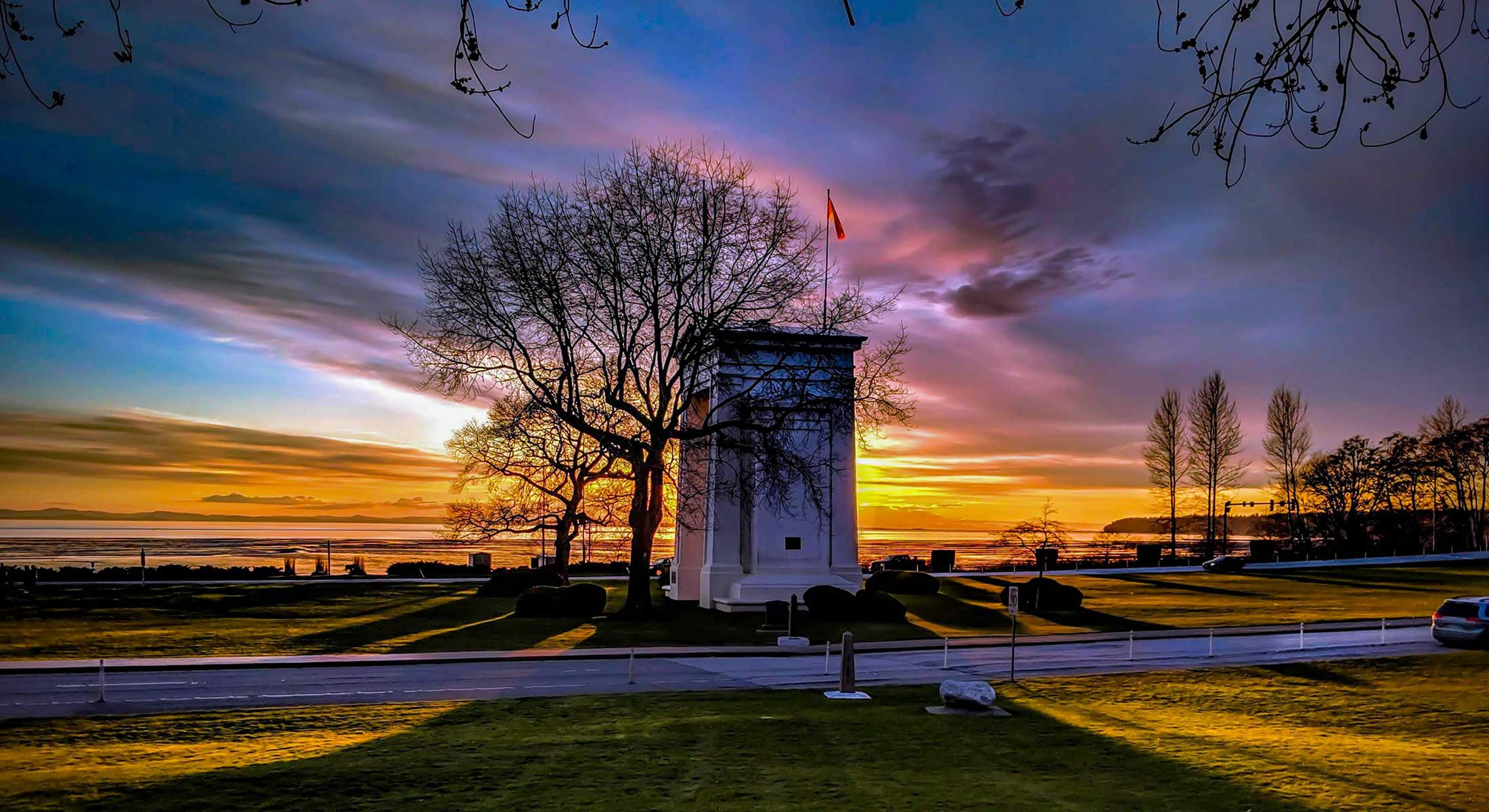
A few weeks ago, a sizeable group of people comprising both Canadians and Americans gathered in Peace Arch Park to protest against Donald Trump’s preposterous idea of annexing Canada into the United States — an apparent threat to Canada’s sovereignty.
Tucked between two ports of entry, one in Washington State in the U.S. and one in B.C., Peace Arch Park celebrates the neighbourly friendship between the two countries. In the middle of a lawned field, the monumental structure of the Peace Arch marks the 49th parallel, the invisible boundary separating western Canada from the U.S.
Each year, hundreds of thousands of people amble through the arch’s whitewashed portal inscribed with hopeful declarations. “May these gates never close,” reads one of the etchings that adorn the structure. “Children of a common mother,” reads another.
For many, Peace Arch Park presents a rare opportunity to experience a tranquil crossing into the United States. Even though this serenity is merely symbolic, it allows us to imagine what it would feel like to skip the invasive inquiries of border agents, or the latent anxiety of unlawful detention, when crossing an imaginary line that divides countries and peoples.
Up until recently, one could wander freely into the park. Kids could playfully lay one foot on Canada, and another on the United States, bouncing back and forth from one country to the other. Visitors were simply asked to leave through the same country they entered.
But in the face of rising fears of illegal crossings into the United States, Canadians are now asked to use the official port of entry into the U.S. to access the Peace Arch. Although this move has not gone unacknowledged by critics, it’s largely remained under the radar.
As the border between Canada and the U.S. becomes less amicable, its violent reality is coming into focus.
In Challenging Borders: Contingencies and Consequences, a new book published by Athabasca University Press, editors Paul McKenzie-Jones, Sheila McManus and Julie Young, a group of scholars of the University of Lethbridge, bring together a variety of perspectives — from artists and Indigenous elders, to historians and political scientists — to examine the complexity of borders, which both unite us and divide us.
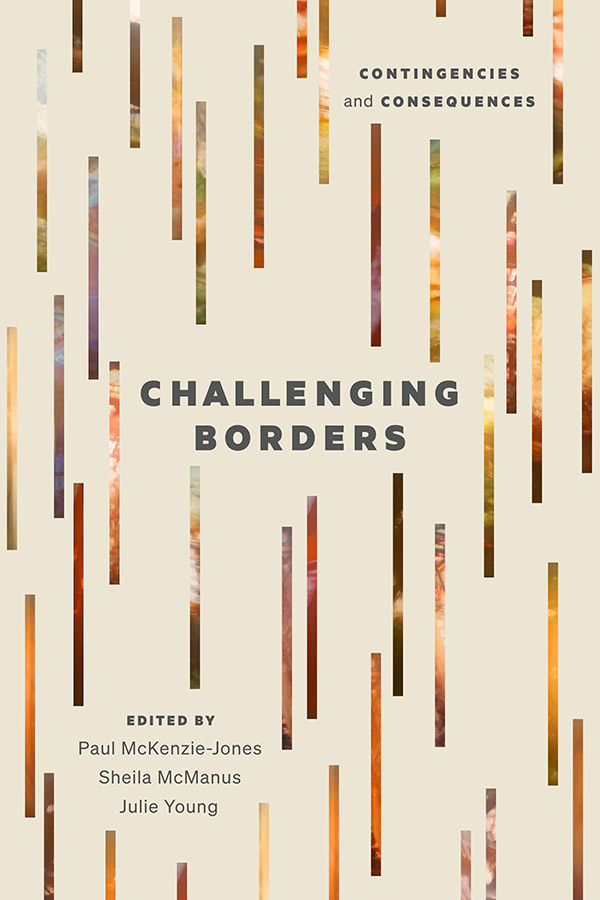
The book offers a detailed account of the role political boundaries play in protecting our sovereignty and in shaping our identities at a time when both seem to be in flux. Donald Trump’s threats to annex Canada awoke fears that laid dormant for at least a century, and made Canadians adopt a strain of nationalism rarely observed north of the border. Challenging Borders invites readers to take a deep dive into the forces, old and new, that continue to shape us.
Plainly understood as the boundaries enclosing a geographical area, borders “are also abstract concepts constantly reproduced and invested with emotional significance by individual actors,” explains researcher Chloe Wells, whose book chapter sheds a light on the immaterial impact of Finland’s changing boundaries after the Second World War.
Beyond the rallies at Peace Arch Park, the threat of annexation has brought Canadians together in a nationalistic pull to protect our identity and our sovereignty from the whims of an authoritarian ruler across the border.
But we can’t talk about Canada’s sovereignty without recognizing its brutality.
Ensuring a state’s ‘innocence’
A colonial construct, the borders that contain Canada’s sovereignty are little more than an imposition from settlers.
“Contested claims of sovereignty [are] replete with contradictions and compromises of multiple peoples claiming the same spaces as their own,” the book’s editors write in the introduction. “The inherent disjunction of borders [is] both a source of hope for those seeking sanctuary and a method of protection against those same people.”
The creation of treaties to define Canada’s political boundaries obliterated the rights of Indigenous Peoples to the land they’ve inhabited for millennia, as the new border limited the ability of Indigenous Peoples such as the Sinixt to roam freely across təmxwúlaʔxw, their traditional territory.
For the Sinixt peoples, or the Arrow Lakes Band as Canadian settlers called them, the establishment of the Canada-U.S. border caused them to lose their land rights in Canada. Banished to a reserve in an area so remote that made year-round habitation difficult, the Sinixt migrated to other communities within təmxwúlaʔxw, which spans a sizeable share of the West Kootenay region, and part of Washington State.
Without qualified members living at the Arrow Lakes reserve, the band was deemed “extinct” and Indigenous land rights reverted to the government. As a result, there’s little the Sinixt can do to protect təmxwúlaʔxw from the logging operations destroying wildlife habitats and watersheds in the region.
“Land claims and the drawing of borders are part of the ongoing process of settler colonialism,” write Challenging Borders contributors Lori Barkley, Marilyn James and Lou Stone. “[They are] explicitly designed to ensure the state’s ‘innocence’ in ongoing control over Indigenous Peoples and their resources.”
Not only did the treaties deployed by settlers help legitimize dispossession in Canada, they also served to assert dominance over the land and appease Americans, explains historian Ryan Hall.
The signing of Treaty 7 in Southern Alberta was hastened to control the inflow of so-called Indigenous refugees moving north of the Canada-U.S. border.
“The presence of refugees raised fears about Canadians’ ability to guard the region against U.S. incursions,” Hall writes. “Even if formal annexation was unlikely, U.S. officials could conceivably use perceived Canadian weakness as an excuse to send soldiers across the border.”
Those fears were not unwarranted.
A 1,000-kilometre wall. For what?
A few years earlier, the United States had used Indigenous unrest and a sparse population in northern Mexico as an excuse to invade the country. This led to the eventual annexation of close to a third of Mexico’s territory into the United States, and the displacement of 200,000 Indigenous people.
The Mexico-U.S. border has since become a blatant display of colonial authority, whose brute force is expressed in the continued expansion of a border wall more than 1,000 kilometres long, or roughly the distance between Vancouver, B.C. and the oil sands in northern Alberta.
For filmmakers Ramón and Rosalva Resendiz, the role of the border wall has always been more symbolic than functional. “The metrics for [the wall’s] success [are] vastly psychological,” they write. “With little data demonstrating it [meets] its intended purpose of slowing down illegal immigration, drug trafficking or organized crime.”
Turning an imaginary boundary into a 30-foot tall barrier, the wall has been instrumental to reframing the Mexico-U.S. border as a militarized no-man’s land, bolstering the “colonial erasures necessary for the creation of modern settler-colonial imaginaries.”
Today, a section of the wall bisects Friendship Park, on the Tijuana-San Diego border.
Visitors to this park were once allowed to roam freely. Families estranged by border controls had an opportunity to go for a stroll or a picnic with their loved ones, no questions asked — just like at Peace Arch Park on the Canada-U.S. border.
“National borders are in flux,” write Challenging Borders contributors Evan Light, Sarah Naumes and Aliya Amarshi, who characterize border control “as an intervention magnifying the scale of all that passes before it.”
In Canada, stronger borders, but no safe neighbour
When it comes to controlling our country’s border, Canada has had little choice but to acquiesce to the pressures of a domineering neighbour, often reproducing the same violence against migrants as the U.S. exerts on its boundary with Mexico.
“The border operates in a permanent state of exception,” Light, Naumes and Amarshi write, adding that whenever we cross the Canada-U.S. border “we surrender ourselves to border authorities who have control over our bodies and belongings. Canadian border authorities have immense power, yet they lack public oversight.”
Confronted with tariff threats late last year, Canada was quick to strengthen the security of its borders. Among other measures, Canada’s Border Plan expands surveillance between ports of entry and clamps down on asylum applications at the Canada-U.S. border, using the Safe Third Country Agreement to justify a breach on human rights.
But the United States is hardly safe.
A rising number of unlawful deportations prompted Amnesty International to suggest Canada withdraw from the Safe Third Country Agreement with the United States. This issue has been on our country’s radar for a few years, to no avail.
“As much as borders morph in form, they also stay stuck on enduring cuts of difference hiding in plain sight,” Anne McNevin reflects in the book’s afterword.
“The global and local configurations of those cuts and their attachments to specific combinations of nationalism, authoritarianism, neoliberalism, colonialism, patriarchy and capitalism are the borders we face today.”
With reality laid bare, Canada has a chance to break from the United States and set out in a new direction that tears down the structures of oppression and nourishes reconciliation within and without our country’s borders. ![[Tyee]](/design-article.thetyee.ca/ui/img/yellowblob.png)
Read more: Indigenous, Books, Politics, Alberta


Tyee Commenting Guidelines
Comments that violate guidelines risk being deleted, and violations may result in a temporary or permanent user ban. Maintain the spirit of good conversation to stay in the discussion and be patient with moderators. Comments are reviewed regularly but not in real time.
Do:
Do not: