

 SHARE:
On the last day of October 1898, the Vancouver Daily World tried to explain how to celebrate something called “Hallowe’en.” Its reporting from the day before and after the occasion marked the first instance of anything resembling trick-or-treating on the public record.
This harvest-time holiday, described as “the night set apart for a universal walking about of spirits,” came to Vancouver from Europe along with the city’s first settlers.
Its customs, however, were due for an update. You could wade into the sea with a bottle of malt and ask Shony, the sea god, to bless you. You could eat an apple, stand before the mirror, comb your hair and let the looking glass reveal your future spouse. Or maybe a third thing.
“Halloween is celebrated just because it is Halloween, and something must be done,” the newspaper said, making clear that the holiday mattered and should be observed, even if its social mores were not yet set in stone.
By the morning, however, they were. Two days later, on Nov. 2, 1898, the Vancouver Daily World printed the first recorded instance of trick-or-treating in North America.
“The young people of Vancouver have inaugurated an innovation in the manner of celebrating Hallowe’en night. It is that of paying friendly visits to the residences while disguised. The habit, if properly followed out and observed, is a harmless one.”
Did Vancouver invent trick-or-treating? I wouldn’t go that far. The practice of door-to-door begging predates the newspaper and, probably, the door.
But even if we didn’t do it first, we do it best, in my opinion.
Halloween in Vancouver is special.
In Vancouver, Satan rules
You should know that I’m hopelessly biased. You never forget your first time, and the first time I went trick-or-treating was five years ago in East Van with my partner and one-year-old daughter.

The custom wasn’t new to me, of course. I didn’t grow up in a bunker — just the Bible Belt, where Halloween was seen as a Satanic holiday.
In Abbotsford, when I was growing up, Halloween night was for staying inside, waging spiritual warfare against the principalities of darkness. There was candy, of course. We would fill up a bucket to hand out to children who came to the door. But when nobody did, as my family was weird and our house was a long walk uphill, we ate all of the candy ourselves.
Some years, in lieu of trick-or-treating, we attended the church harvest party, a righteous alternative where kids were encouraged to dress in non-demonic costumes — farmers, cowboys, angels — and play festival games that brought glory to God.
With all that in mind, I’d never experienced anything like what goes on around here in October when I moved to East Van with my partner and one-year-old daughter in 2019. There’s the Parade of Lost Souls, a modern, family-friendly Danse Macabre on the Drive. And on every block, the neighbourhood transforms from something picturesque to something horror-picturesque before your very eyes.
As a child, I was warned: Satan rules in Vancouver. He totally does.
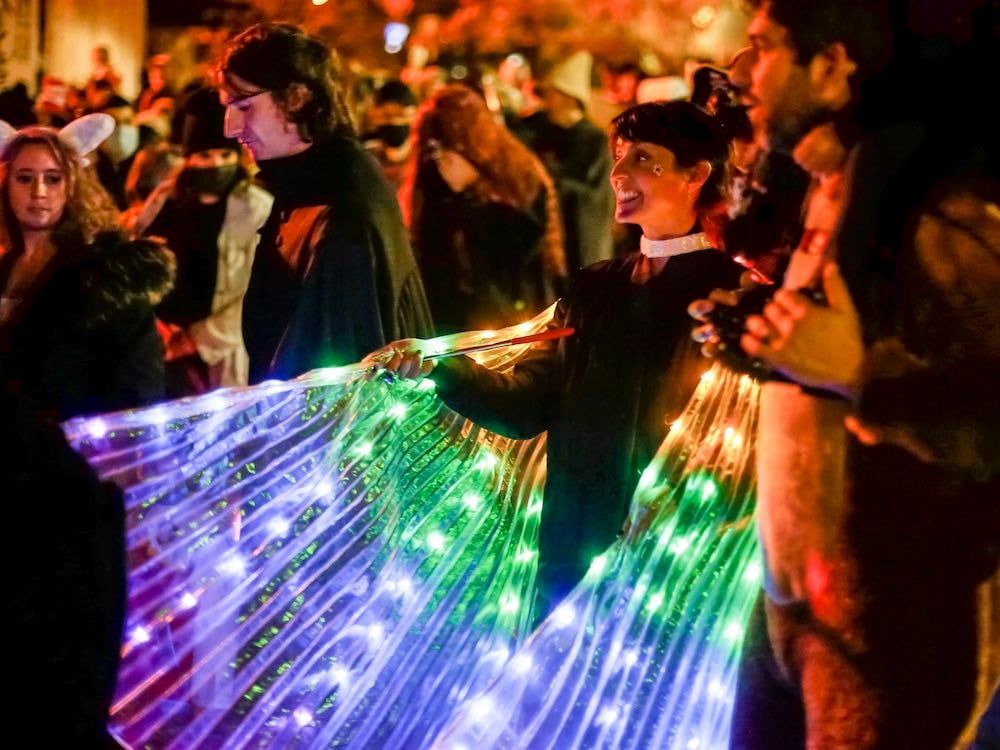
It’s amazing. Halloween mega-displays pop up seemingly everywhere: zombies emerging from underground, ghosts in the maple trees, cobwebs on every hedge, witches in every front window, haunted houses, skeletons taller than houses, and fake lemonade stands that sell severed hands, pickled heads and all manner of internal organs.
Amid these macabre, uninviting scenes, a thoroughly inviting atmosphere brings everything — and everyone — together. Vancouver’s east side is incredibly diverse, from ethnicity to household income. Renters and homeowners peacefully coexist, for the most part, but on Halloween night, class divisions dissolve. Everyone’s out and about, and it’s hard to tell who’s rich and who’s not amid the delight and disguises. The streets are a-rocking. All doors are for knocking.
Anecdotally, after five years, I’m convinced that Halloween’s bigger than Christmas in East Van, at least in terms of holiday decor.
Hard data in support of this hypothesis is hard to find. The Vancouver Sun’s annual Halloween count consistently finds what it calls East Vancouver’s “creative crescent” — Hastings-Sunrise, Grandview-Woodland — the busiest hot spots for trick-or-treating, with some houses seeing as many as 1,000 children.
A recent BC Hydro survey backs me up too, at least in part. Last year, the utility announced that more British Columbians went big on Halloween displays than for the winter holidays.
The survey reported a notable, seasonal shift in our energy usage.
The survey conducted on behalf of BC Hydro finds half of British Columbians decorated their home for Halloween this year, and of those 13 per cent considered their outdoor decor to be a “mega display,” of 10 or more strings of lights, and at least one plug-in inflatable decoration.In comparison, while just over half of British Columbians are also planning to decorate for the winter holidays, 10 per cent are planning a mega display for the exterior of their home.
“Elaborate holiday displays account for about three per cent of the provincial electricity load during the winter holiday season, and Halloween displays are starting to keep pace with what was once unique to the December to January period,” said Susie Rieder, BC Hydro spokesperson.
“While winter holiday season decorating is still more popular, those who go all out with mega displays are favouring Halloween for the first time ever.”
It’s hard to put much stock in an informal study mostly released to promote energy-efficient LED lighting, but a statistic like this would have shocked my old religious community. We’d have gotten a whole Sunday service about it.
The preacher would say that it was proof that the enemy reigns in B.C.
And he wouldn’t be entirely off base.
The rise of the ‘nones’
Halloween seems to have overtaken Christmas as the holiday of the year, at least by one dodgy metric, whereby census data found that B.C. has become Canada’s first majority non-religious province.
According to the 2021 population census, while 34.6 per cent of people coast to coast claim no religious affiliation, the number of “nones” in B.C. (those with no religious affiliation) has jumped to a staggering 52.4 per cent.
The pandemic played a role in this, with many religious institutions seeing enormous declines in attendance after the first years of the COVID-19 pandemic.
But these numbers are part of a decades-long pattern.
“The fastest-growing religious group in North America is the nones,” said Sabina Magliocco, a University of British Columbia professor of anthropology, who made sure to spell out the word so I wouldn’t confuse it with “nuns.”
The rapid secularization of British Columbia in particular, Magliocco explained, is “part of a regional pattern where, generally, communities along the West Coast see more unaffiliated people than communities in the rest of the country.”
Many people migrate to Vancouver from back east, and as they do, Magliocco said, “they may lose connections that they had with their previous religious communities.... They find they don't miss it that much. They find that there are other things that take up their time, and so they don't reconnect with that community.”
Others, like me, make their way to Vancouver to lose those connections on purpose.
For many, this part of the world is a place to start over, a trend reflected everywhere you look, including in that Vancouver Daily World clipping, which sought to retain Halloween as a concept while showing contempt for its Old World traditions.
That’s typical, local behaviour.

An explosive tradition
Even now, as Halloween is celebrated coast to coast, Vancouver, as ever, does it differently.
Nowhere else in Canada associates the holiday with fireworks and firecrackers, a practice that’s been banned in Vancouver, but carries on nevertheless.
In East Van, it’s not Halloween unless something explodes in the distance, again and again.
“I remember going around on Halloween with a K-Way jacket,” Vancouver author, poet and historian Wayde Compton told The Tyee.
“The pouch in the front, I would fill it with thunder bombs, and we would just go off, lighting them and throwing them into sewers so they would explode before they hit the water. Huge explosions. At the end of the night, the bottom of my K-Way pouch would be just full of gunpowder.”
Some folks suggest this tradition began with Guy Fawkes Day, a British occasion for fireworks and bonfires that falls on the 5th of November, and that may be part of it.
But if that were all, Compton argued, then Halloween and fireworks would go hand in hand throughout the Commonwealth.
Instead, it’s only here, where Vancouver’s Chinese population first introduced firecrackers to everyone else with their explosive Lunar New Year celebrations.
What we have in Vancouver, Compton suggests, is a form of “dialectical multiculturalism — an aspect of Chinese culture crossed over into a European tradition in a region that is a contact zone between the two.”
“I think it has to do with Chinatown,” he said, of the unique ubiquity of Halloween fireworks in Vancouver.
“I think it has to do with the fact that fireworks were easier to get here because we had the biggest Chinatown in the country.”
I think it has to do, as well, with what this city is: a place where traditions arise not from where people come from, but from where we are now.
In Vancouver, Halloween is by the people, for the people. It’s been that way since the beginning, and I, for one, can’t believe it took me just shy of four decades to see what the fuss was about. Now I’m hooked.
This Halloween, you can find me on Lily Street, lined up for the haunted pirate ship in my adult-sized Charmander onesie, with a mouthful of candy I swiped from my kids and a heart full of holiday cheer.
And if my newfound obsession with this holiday lands me in hell, that’s OK. I’ll bet Satan goes all out for Halloween, too. ![[Tyee]](/design-article.thetyee.ca/ui/img/yellowblob.png)
Read more: Media





Tyee Commenting Guidelines
Comments that violate guidelines risk being deleted, and violations may result in a temporary or permanent user ban. Maintain the spirit of good conversation to stay in the discussion and be patient with moderators. Comments are reviewed regularly but not in real time.
Do:
Do not: